
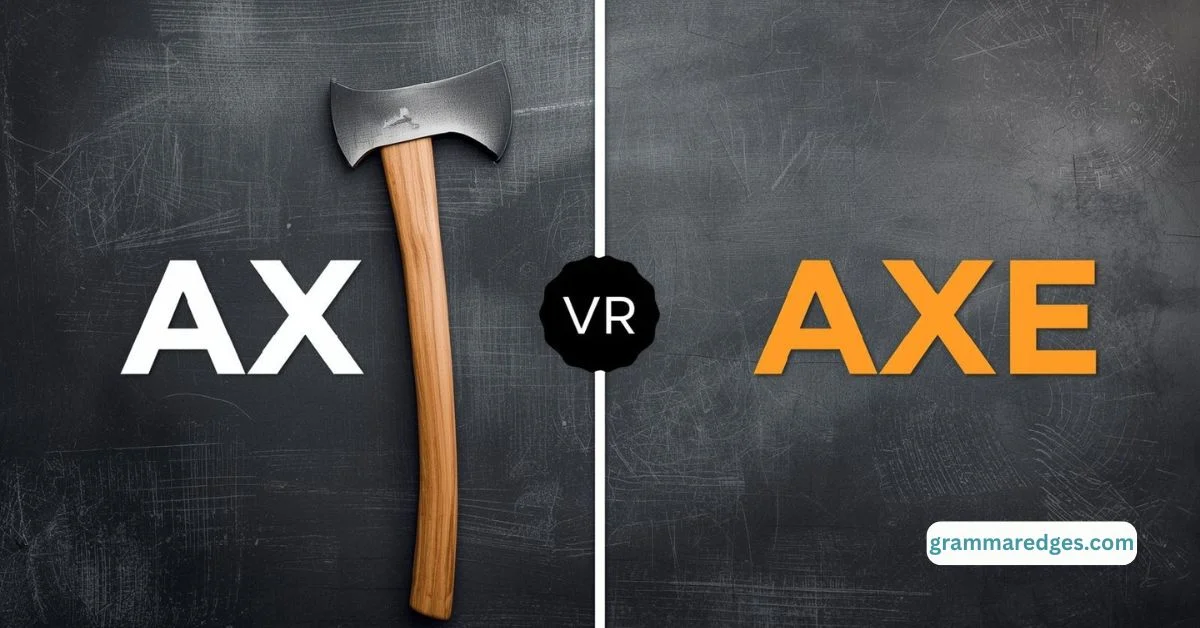
When it comes to the words “ax” or “axe,” many people get confused. Both words refer to the same tool used for chopping wood, but the difference lies in spelling.
If you’ve ever wondered why you see two versions of the same word, you are not alone. People often search for “ax or axe” to understand which spelling is correct, especially in writing, emails, and school or professional work.
Knowing the difference helps avoid embarrassing mistakes in essays, articles, and online posts. Some may even think one spelling is wrong, but that’s not the case. The confusion mainly comes from the difference between British and American English.
In this article, we will give you a clear answer, explain the history of the word, show how to use it correctly in daily writing, and provide advice based on your audience. By the end, you’ll confidently know whether to use ax or axe in any context.
Ax or Axe – Quick Answer
Answer: Both ax and axe are correct spellings of the same word.
- Ax – Preferred in American English. Example: He used an ax to chop firewood.
- Axe – Preferred in British English and most Commonwealth countries. Example: The lumberjack swung his axe skillfully.
✅ Use whichever spelling matches your audience’s English style.
The Origin of Ax or Axe
The word comes from Old English “æx” and Old Saxon “acs”, dating back over a thousand years. Over time, spelling evolved differently in different regions.
- In British English, the spelling “axe” became standard.
- In American English, simplified spelling rules led to “ax.”
Both versions have been correct historically, and dictionaries recognize them.
British English vs American English Spelling
The main difference is regional. Here’s a quick comparison:
| Feature | British English | American English |
|---|---|---|
| Spelling | axe | ax |
| Example Sentence | He swung his axe carefully. | He swung his ax carefully. |
| Common in | UK, Canada, Australia | USA |
British English often keeps traditional spellings, while American English favors simplicity.
Which Spelling Should You Use?
- US audience: Use ax.
- UK/Commonwealth audience: Use axe.
- Global audience: Choose the version most familiar to your readers or stay consistent throughout your content.
Consistency is more important than which version you pick.
Common Mistakes with Ax or Axe
- Mixing styles in one text: He swung an ax with his axe. ❌
- Using ax in formal UK writing: The knight held his ax. ❌
- Forgetting to capitalize properly at the start of a sentence: axe chopping is fun. ❌
✅ Always pick one spelling style and stick to it.
Ax or Axe in Everyday Examples
Emails: Please bring an ax to the camping trip.
News articles: Firefighters used axes to break through the door.
Social media: Just bought a new axe for my garden! #woodworking
Formal writing: The lumberjack skillfully used his axe throughout the forest.
Ax or Axe – Google Trends & Usage Data
According to Google Trends:
- “Axe” is more searched in the UK, Canada, and Australia.
- “Ax” dominates in the United States.
- Searches peak during camping season and around discussions of tools and woodworking.
Comparison Table: Ax vs Axe
| Aspect | Ax | Axe |
|---|---|---|
| Region | US | UK/Commonwealth |
| Usage Frequency | High in the US | High in UK/Canada |
| Formal Writing | Acceptable | Preferred in UK |
| Informal Writing | Acceptable | Acceptable |
FAQs
1. Is ax a correct spelling?
Yes, ax is correct in American English.
2. Is axe British or American?
Axe is British English, used widely in the UK, Canada, and Australia.
3. Can I use ax in formal writing?
Yes, if your audience is American. Otherwise, use axe.
4. Why are there two spellings?
Historical spelling differences and regional language evolution caused the split.
5. Which spelling is more popular online?
Axe is more common globally, but ax is dominant in the US.
6. Should I switch spelling in different documents?
No. Stick to one style for consistency.
7. Can I use axe in American English?
Yes, it’s understood, but ax is the standard in the US.
Conclusion
In short, both ax and axe are correct. The difference is mainly regional. Use ax in American English contexts and axe for British or Commonwealth readers. Consistency matters more than which version you choose.
Whether you’re writing an article, email, or social media post, selecting the right spelling shows professionalism and avoids confusion. By following these guidelines, you’ll confidently use ax or axe correctly in every situation.
Remember, both refer to the same sharp, chopping tool, so your readers will understand you no matter which spelling you choose—just keep it consistent.