
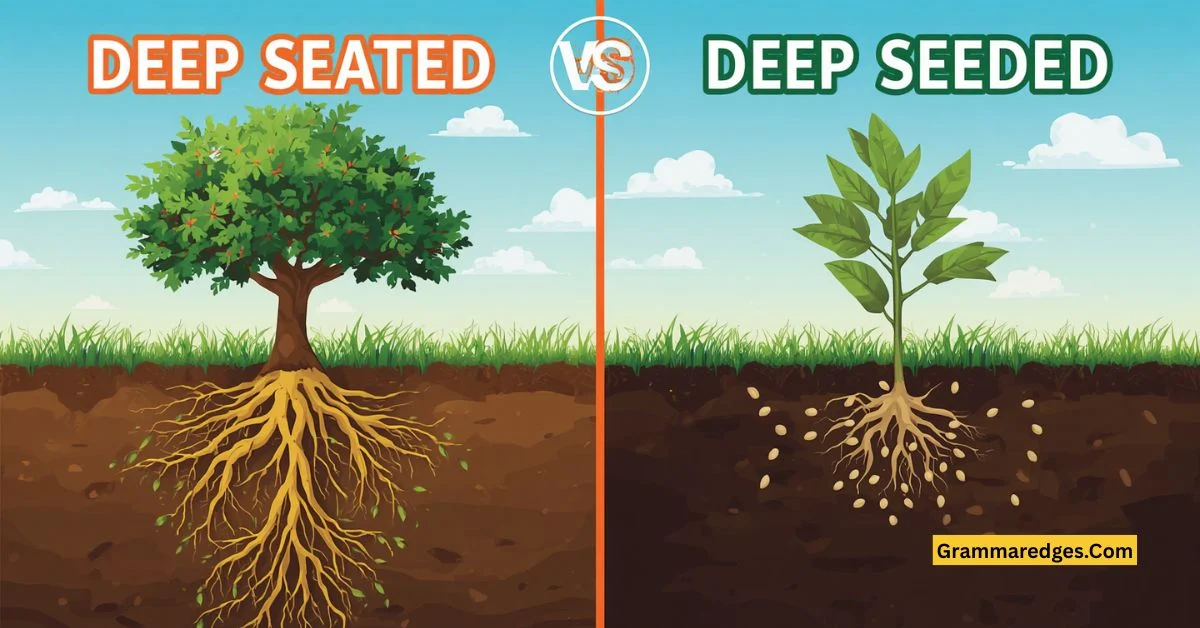
Have you ever stopped while writing and wondered whether it should be deep seated or deep seeded? You’re not alone. This is one of the most common English spelling and phrase mistakes because both versions sound exactly the same when spoken.
People search for “deep seated or deep seeded” because they want to know which phrase is correct for emails, essays, business writing, blogs, social media, and everyday conversations. Many writers assume the phrase has something to do with seeds growing deep in the ground. That idea seems logical, but it isn’t where the expression comes from.
The truth is simple: deep-seated is the correct form in standard English. The phrase refers to something that is firmly fixed, strongly established, or difficult to change. Meanwhile, deep seeded is generally considered a misspelling or a mistaken version created because of similar pronunciation.
This guide explains the correct spelling, its history, differences between British and American English, common mistakes, examples, and practical advice so you’ll know exactly which version to use.
Deep Seated or Deep Seeded – Quick Answer
The correct phrase is deep-seated.
It describes beliefs, emotions, fears, habits, or problems that are firmly established and difficult to change.
Correct examples
- She has a deep-seated fear of heights.
- The company has deep-seated financial problems.
- Their disagreement comes from deep-seated political differences.
Incorrect examples
- ❌ She has a deep seeded fear of heights.
- ❌ The issue is deep seeded.
Although many people write deep seeded, dictionaries and style guides recognize deep-seated as the standard expression.
The Origin of Deep Seated or Deep Seeded
The confusion begins because both phrases sound alike.
The original expression is deep-seated.
The word seated comes from the verb seat, meaning to place or settle firmly. Over time, deep-seated came to describe ideas, emotions, beliefs, or problems that are firmly fixed in someone’s mind or within a system.
For example:
- A deep-seated prejudice is firmly established.
- A deep-seated habit is difficult to break.
So where did deep seeded come from?
It developed as an eggcorn. An eggcorn is a word or phrase that people replace with another because it sounds similar and seems to make sense.
Many people imagine ideas growing like seeds planted deep in the ground. While this image is understandable, it is not the historical origin of the expression.
Today, major dictionaries list deep-seated as the correct spelling.
British English vs American English Spelling
Unlike many English words, this phrase does not change between British and American English.
Both forms of English use deep-seated.
| Feature | British English | American English |
|---|---|---|
| Correct phrase | Deep-seated | Deep-seated |
| Accepted in formal writing | Yes | Yes |
| Used in newspapers | Yes | Yes |
| Academic writing | Yes | Yes |
| “Deep seeded” accepted? | No | No |
British example
The country faces deep-seated economic challenges.
American example
The community has deep-seated concerns about safety.
Both versions use exactly the same spelling.
Which Spelling Should You Use?
Your audience determines many spelling choices in English, but not this one.
If your audience is American
Use deep-seated.
Example:
The report found deep-seated problems in management.
If your audience is British
Use deep-seated.
Example:
There are deep-seated concerns about healthcare.
If your audience is Australian, Canadian, or other Commonwealth countries
Use deep-seated.
If your audience is global
Use deep-seated because it is universally accepted and understood.
Quick recommendation
| Audience | Best Choice |
|---|---|
| United States | Deep-seated |
| United Kingdom | Deep-seated |
| Canada | Deep-seated |
| Australia | Deep-seated |
| International readers | Deep-seated |
Common Mistakes with Deep Seated or Deep Seeded
Many writers accidentally use the wrong version because the pronunciation is identical.
Mistake 1
❌ Deep seeded fear
✅ Deep-seated fear
Mistake 2
❌ Deep seeded issue
✅ Deep-seated issue
Mistake 3
❌ Deep seeded beliefs
✅ Deep-seated beliefs
Mistake 4
Thinking both versions are correct.
Only deep-seated is considered standard English.
Mistake 5
Using deep seeded in professional writing.
Avoid it in:
- Academic papers
- Business emails
- News articles
- Books
- Legal documents
- Professional websites
Deep Seated or Deep Seeded in Everyday Examples
Here are examples showing how the correct phrase appears in everyday writing.
Our team identified several deep-seated issues that require long-term solutions.
News
Experts say the country faces deep-seated economic problems.
Social Media
Changing deep-seated habits takes time and patience.
Business Report
The audit uncovered deep-seated operational weaknesses.
School Essay
The novel explores deep-seated family conflicts.
Conversation
His fear isn’t new. It’s deep-seated.
Deep Seated or Deep Seeded – Google Trends & Usage Data
Search interest for deep seated or deep seeded remains steady because people frequently hear the phrase before they write it.
Many users search the incorrect version to check whether it is acceptable.
General usage trends
| Phrase | Popularity | Correct? |
|---|---|---|
| Deep-seated | Very High | ✅ Yes |
| Deep seated | High (without hyphen in searches) | ✅ Usually acceptable in searches, hyphen preferred in writing |
| Deep seeded | Moderate | ❌ No |
| Deep seeded meaning | Moderate | ❌ Searches for correction |
Countries where the question is common
- United States
- United Kingdom
- Canada
- Australia
- India
Most searches come from people checking grammar before publishing documents, emails, articles, or assignments.
Comparison Table: Deep Seated or Deep Seeded
| Variation | Correct? | Meaning | Recommended |
|---|---|---|---|
| Deep-seated | ✅ Yes | Firmly established | Yes |
| Deep seated | ✅ Acceptable in search queries; hyphen preferred in writing | Same meaning | Use hyphen in formal writing |
| Deep seeded | ❌ No | Misspelling | No |
| Deep seeded beliefs | ❌ No | Incorrect phrase | No |
| Deep-seated beliefs | ✅ Yes | Strongly held beliefs | Yes |
FAQs
Is deep seated or deep seeded correct?
Deep-seated is the correct expression. Deep seeded is a common mistake.
Why do people write deep seeded?
Because it sounds identical to deep-seated and seems logical, many people mistakenly connect the phrase with seeds growing in the ground.
Is deep seeded ever correct?
In almost all situations, no. Standard dictionaries and style guides recommend deep-seated.
Does British English use deep seated?
Yes. British English uses deep-seated, just like American English.
Should I use a hyphen?
Yes. Write deep-seated when it appears before a noun.
Example:
- A deep-seated fear.
The hyphen is also commonly retained elsewhere.
What does deep-seated mean?
It means something is firmly established, deeply rooted, and difficult to change.
Is deep seeded acceptable in casual writing?
Some people may understand it, but it is still considered incorrect. Use deep-seated for both casual and professional writing.
Conclusion
Understanding the difference between deep seated or deep seeded is easier once you know the phrase’s history. Although deep seeded sounds reasonable because ideas can seem to grow like seeds, that is not where the expression comes from. The correct phrase is deep-seated, meaning firmly established, deeply rooted, or difficult to change.
This spelling is accepted in British English, American English, Canadian English, Australian English, and other forms of standard English. Whether you’re writing an email, preparing a business report, publishing a blog, or completing schoolwork, deep-seated is the version you should choose. Using the correct phrase improves clarity, professionalism, and credibility.
If you ever hesitate between deep seated or deep seeded, remember this simple rule: the expression comes from “seated,” not “seeded.” Keeping that in mind will help you avoid a common writing mistake and communicate with confidence.