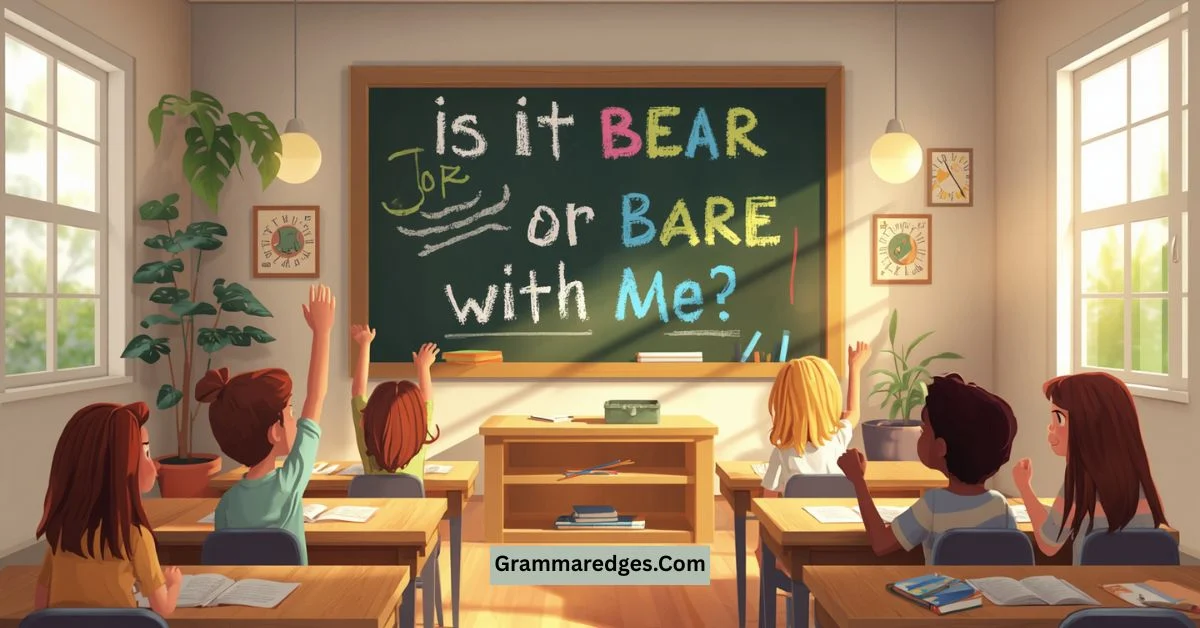
Have you ever typed “bare with me” in an email or social media post and wondered if it was correct? You are not alone. Thousands of people search for is it bear or bare with me because the two words sound exactly the same. Since they are pronounced alike, many writers mix them up.
This confusion appears in emails, text messages, business communication, and even published articles. While both bear and bare are real English words, only one is correct in the common phrase “___ with me.”
Understanding the difference helps you avoid embarrassing mistakes and communicate more clearly. Whether you are writing a professional email, posting on social media, or speaking with colleagues, knowing the correct phrase can improve your writing instantly.
In this guide, you will learn the correct answer, the history behind the phrase, differences between British and American English, common mistakes, real-world examples, and practical advice on when and how to use it correctly.
Is It Bear or Bare With Me? – Quick Answer
The correct phrase is:
✅ Bear with me
The phrase means:
“Please be patient with me” or “Please wait for me.”
Examples
- Please bear with me while I check the information.
- Bear with me for a moment.
- Thank you for bearing with me during the delay.
Incorrect Examples
- ❌ Bare with me while I find the file.
- ❌ Please bare with me for a minute.
The confusion happens because bear and bare sound the same, but they have completely different meanings.
| Word | Meaning |
|---|---|
| Bear | To tolerate, endure, or carry |
| Bare | Uncovered, exposed, or naked |
Because the phrase means “be patient” or “tolerate the delay,” bear with me is always the correct choice.
The Origin of Is It Bear or Bare With Me?
To understand why the phrase uses bear, it helps to look at the word’s history.
The word bear comes from Old English and originally meant:
- To carry
- To support
- To endure
- To tolerate
Over time, English speakers began using phrases such as:
- Bear the burden
- Bear the pain
- Bear responsibility
Eventually, bear with me developed to mean:
“Continue supporting me patiently while I finish something.”
The word bare, however, has a completely different origin. It comes from an Old English word meaning:
- Exposed
- Uncovered
- Naked
Examples include:
- Bare feet
- Bare walls
- Bare hands
Because the two words evolved from different roots but sound identical, spelling confusion became common.
British English vs American English Spelling
One interesting fact is that there is no spelling difference between British English and American English for this phrase.
Both versions of English use:
✅ Bear with me
Never:
❌ Bare with me
Comparison Table
| Phrase | British English | American English | Correct? |
| Bear with me | Yes | Yes | ✅ |
| Bare with me | No | No | ❌ |
| Please bear with me | Yes | Yes | ✅ |
| Thank you for bearing with me | Yes | Yes | ✅ |
Unlike words such as:
| British English | American English |
| Colour | Color |
| Favourite | Favorite |
| Organise | Organize |
The phrase bear with me remains identical across both language varieties.
Which Spelling Should You Use?
You should always use:
✅ Bear with me
This applies to:
- American audiences
- British audiences
- Canadian audiences
- Australian audiences
- New Zealand audiences
- International readers
Audience-Based Advice
| Audience | Recommended Spelling |
| United States | Bear with me |
| United Kingdom | Bear with me |
| Canada | Bear with me |
| Australia | Bear with me |
| Global Audience | Bear with me |
Since the phrase has only one accepted spelling, you do not need to change it for different English-speaking regions.
Common Mistakes with Is It Bear or Bare With Me?
Many people make the same mistakes repeatedly.
Mistake #1: Using Bare Instead of Bear
❌ Bare with me
✅ Bear with me
Remember:
- Bear = tolerate
- Bare = uncovered
Mistake #2: Thinking Bare Means Wait
Some writers assume bare means “wait.”
It does not.
The word has no connection to patience or waiting.
Mistake #3: Autocorrect Errors
Many devices fail to flag:
- bare with me
Because “bare” is a legitimate English word.
Always proofread before sending professional messages.
Mistake #4: Confusing Homophones
Bear and bare are homophones.
Homophones sound alike but have different meanings and spellings.
Examples:
| Correct Word Pair |
| Bear / Bare |
| Their / There |
| Brake / Break |
| Peace / Piece |
Is It Bear or Bare With Me in Everyday Examples
Here are common situations where the phrase appears.
Email Example
Please bear with me while I gather the required documents.
Customer Service Example
Bear with me for a moment while I check your account details.
Social Media Example
Bear with me, the video upload is taking longer than expected.
News Example
Officials asked residents to bear with them during road repairs.
Formal Writing Example
We appreciate your patience and ask that you bear with us during the transition period.
Workplace Example
Please bear with me as I complete the final report.
In every case, bear with me means asking someone to remain patient.
Is It Bear or Bare With Me? – Google Trends & Usage Data
Search behavior shows that many users are unsure about the phrase.
People commonly search:
- is it bear or bare with me
- bear with me meaning
- bare with me meaning
- bear with me correct spelling
- bear vs bare
Countries Where the Search Is Common
The question appears frequently in:
- United States
- United Kingdom
- Canada
- Australia
- India
The reason is simple: bear and bare sound identical in spoken English.
Contexts Where the Phrase Appears Most
| Context | Frequency |
| Emails | Very High |
| Customer Support | Very High |
| Business Communication | High |
| Social Media | High |
| Academic Writing | Moderate |
| News Writing | Moderate |
Most searches come from people checking spelling before sending professional messages.
Comparison Table: Bear vs Bare
| Feature | Bear | Bare |
| Part of Speech | Verb/Noun | Adjective/Verb |
| Meaning | Endure or tolerate | Uncovered or exposed |
| Used in “Bear with me” | Yes | No |
| Refers to Patience | Yes | No |
| Formal Usage | Common | Different meaning |
| Correct Phrase | Bear with me | Incorrect |
Quick Memory Trick
Ask yourself:
Does the sentence mean “please be patient”?
If yes, use:
✅ Bear with me
If it refers to something uncovered:
✅ Bare
Example:
- Bear with me while I explain.
- She walked with bare feet.
FAQs
1. Is it bear with me or bare with me?
The correct phrase is bear with me because bear means to tolerate or be patient.
2. Why do people write bare with me?
People confuse the words because they sound identical when spoken.
3. What does bear with me mean?
It means “please be patient with me” or “please wait while I finish something.”
4. Is bare with me ever correct?
No. In standard English, bare with me is considered a spelling mistake.
5. Is bear with me formal or informal?
It can be used in both formal and informal communication.
6. Can I use bear with me in business emails?
Yes. It is commonly used in professional emails and customer service messages.
7. What is an easy way to remember the correct spelling?
Remember that bear means endure or tolerate. Since you are asking for patience, bear with me is correct.
Conclusion
The answer to is it bear or bare with me is simple: bear with me is always correct. The phrase means “please be patient with me” or “please wait for me,” making the word bear the proper choice because it relates to enduring, tolerating, or supporting something. Although bare is a real English word, it refers to something uncovered or exposed and does not fit the meaning of the expression.
Both British English and American English use exactly the same spelling, so there is no regional variation to remember. Whether you are writing an email, responding to customers, posting on social media, or communicating at work, using bear with me will ensure your message is accurate and professional.
A simple memory trick can help: if you are asking someone for patience, use bear. If you are talking about something uncovered, use bare. Keeping this distinction in mind will help you avoid one of the most common spelling mistakes in English.