Both flyer and flier are correct spellings in American English. They can refer to a printed advertisement, a promotional handout, or a person who flies. However, flyer is a common choice for advertising materials and air travel, while flier also appears in expressions such as “take a flier,” meaning to take a risk. When in doubt, follow your style guide and use one spelling consistently.
Key Takeaways
- Flyer is a common spelling for promotional handouts, event advertisements, and business marketing materials.
- Flier is an accepted spelling, not a spelling mistake.
- Both spellings can describe someone who travels by air or something that flies.
- The expression “take a flier” means to take a chance or risk.
- For American English, choose the spelling that fits your context and follow your preferred style guide.
What Is the Difference Between Flyer and Flier?
The main difference between flyer and flier is spelling preference, not a strict difference in meaning. Both words are established English nouns, and their meanings overlap.
A flyer usually refers to a printed sheet that advertises an event, product, service, or business. For example, a restaurant might distribute flyers to announce a grand opening.
Flier can describe the same kind of printed material. It can also refer to a person or animal that flies. Some writers prefer this spelling for flying-related meanings, although flyer is also widely accepted in that context.
Here is a quick comparison:
| Word | Common usage | Example |
|---|---|---|
| Flyer | Promotional handout | She designed a flyer for the concert. |
| Flier | Alternative spelling for a handout | The volunteers distributed fliers. |
| Flyer | Person who travels by air | He is a frequent flyer. |
| Flier | Person or thing that flies | The experienced flier boarded the aircraft. |
| Flier | Risk-taking expression | She decided to take a flier on the investment. |
The last example uses a familiar expression meaning to take a risk. Although “take a flyer” also appears in writing, “take a flier” is a well-established form.
The important point is that neither spelling is automatically wrong. Your choice should reflect the meaning, audience, and writing style.
What Does Flyer Mean?
Flyer is a noun with several uses. In everyday American English, it is especially familiar in advertising, marketing, and travel-related writing.
1. A Printed Advertisement
A flyer is a single sheet of paper used to share information or promote something. It often includes a headline, short description, contact details, and a call to action.
Businesses, schools, nonprofits, and event organizers use flyers to reach a local audience.
Examples include:
- A restaurant flyer advertising a new menu.
- A school flyer announcing a parent meeting.
- A business flyer promoting a seasonal discount.
- A concert flyer displaying the date, venue, and ticket information.
- A community flyer inviting residents to a charity event.
Example sentence: The bakery created a colorful flyer to promote its weekend sale.
In this context, flyer is a practical, familiar spelling for American readers.
2. A Person Who Travels by Air
Flyer can also describe someone who travels on an airplane. This meaning appears in everyday conversation and travel writing.
Examples:
- She is a frequent flyer who travels for work.
- He is a nervous flyer and prefers short flights.
- The airline offers rewards to eligible frequent flyers.
Example sentence: As a frequent flyer, Marcus knows how to prepare for a long international trip.
Therefore, flyer does not refer only to a piece of advertising paper.
3. Something or Someone That Flies
The word can also describe a person, animal, or other thing that flies.
For example:
- The young bird is a strong flyer.
- She became a confident flyer after several lessons.
- The pilot is an experienced flyer.
The precise meaning depends on the sentence. Context makes it clear whether the writer means a traveler, a bird, or a promotional handout.
What Does Flier Mean?
Flier is another accepted spelling with several overlapping meanings. It is sometimes preferred when describing a person or thing that flies, but it can also refer to printed advertising material.
1. A Person or Thing That Flies
Some writers use flier when referring to someone who flies in an aircraft or an animal that can fly.
Examples:
- The experienced flier remained calm during turbulence.
- The bird is an agile flier.
- Several nervous fliers waited near the departure gate.
These sentences are understandable and use a recognized spelling. However, flyer is also correct for these meanings.
2. A Printed Handout
Flier can also mean a sheet of paper used to advertise an event, service, or product.
Examples:
- The volunteers handed out fliers at the community center.
- I received a flier about the upcoming school fundraiser.
- The store placed fliers near the entrance.
Although this spelling is acceptable, flyer is a straightforward choice for general marketing and business writing.
3. The Expression “Take a Flier”
One especially useful expression is “take a flier,” which means to try something despite uncertainty or risk.
Examples:
- The investor decided to take a flier on a new company.
- We took a flier on the unfamiliar restaurant and enjoyed the meal.
- She took a flier on a new business idea.
The expression often appears in casual conversation, business discussions, and financial writing.
You may also encounter “take a flyer.” If you are following a specific editorial style, check its preferred form.
Flyer or Flier in American English
For American English, both spellings are recognized, but their use depends on context and editorial preference.
The Associated Press Stylebook adopted flyer as its preferred spelling for a person flying in an aircraft and for printed handbills, while retaining flier in the expression “take a flier.” Other dictionaries and editorial references may describe the general usage differently. Scribbr’s spelling guide and ThoughtCo’s comparison discuss these overlapping meanings and differing preferences.
For everyday writing in the United States, these guidelines are useful:
- Marketing: Use flyer for a promotional handout.
- Travel: Frequent flyer is a familiar form.
- Aviation: Flyer and flier can both refer to someone who flies.
- Risk-taking: Take a flier is an established expression.
- Professional writing: Follow the relevant publication or organization’s style guide.
There is no need to correct every instance of flier to flyer. First determine whether the existing spelling is acceptable in its context.
Frequent Flyer or Frequent Flier?

Both frequent flyer and frequent flier appear in English. Each describes someone who travels by airplane regularly.
However, frequent flyer is a widely recognized expression in American travel writing, especially when discussing airline rewards, travel habits, or accumulated miles.
Consider these examples:
- She earned enough miles through her frequent flyer program to book a reward flight.
- Frequent flyers often learn how to make airport connections more efficiently.
- He became a frequent flier after accepting a job that required regular travel.
All three sentences communicate the intended meaning.
If you are writing an article about airline rewards, a travel website, or a business trip, frequent flyer is a sensible default for a broad American audience.
If an airline, publication, or organization uses frequent flier in its official wording, preserve that form when referring to its name or following its style.
Flyer vs. Flier Examples in Sentences
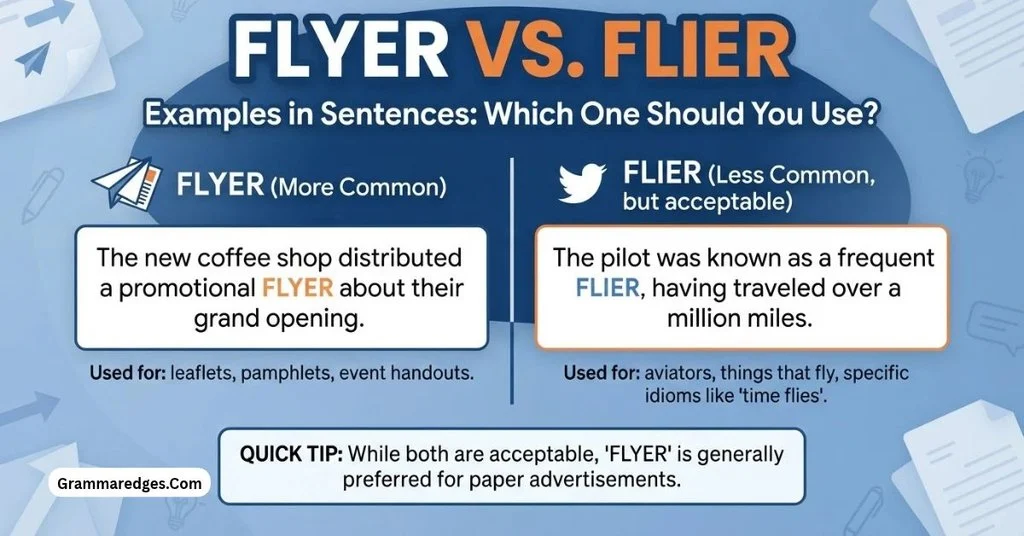
Seeing both spellings in context makes the difference easier to understand.
| Context | Example sentence | Recommended choice |
|---|---|---|
| Business advertising | We created a flyer for our new service. | Flyer |
| School announcement | The teacher sent home a flyer about the trip. | Flyer |
| Local event | Volunteers distributed flyers before the festival. | Flyer |
| Air travel | My brother is a frequent flyer. | Flyer is a familiar choice |
| Aviation | The experienced flier checked the weather. | Either spelling |
| Taking a risk | The company took a flier on the new idea. | Flier in this expression |
| Community notice | The group printed fliers for the fundraiser. | Either spelling |
More Examples With Flyer
- Please email me the flyer before the meeting.
- The gym designed a flyer to advertise its membership offers.
- We posted digital flyers on our social media accounts.
- The airline rewards frequent flyers through its loyalty program.
More Examples With Flier
- The nervous flier asked the flight attendant for reassurance.
- Volunteers distributed fliers throughout the neighborhood.
- The entrepreneur took a flier on an untested business plan.
These examples show why context matters more than memorizing a rigid rule. Both spellings are legitimate, but one may be more natural for a particular audience or phrase.
Common Mistakes to Avoid
Even though flyer and flier are both correct, writers can still make mistakes when choosing between them.
Mistake 1: Assuming Flier Is Always Wrong
Flier is an accepted English spelling. It can describe a flying person, a printed handout, or the action expressed in “take a flier.”
Better approach: Check the context before changing the spelling.
Mistake 2: Assuming Flyer Only Means an Advertisement
Flyer can refer to a person who flies or travels by airplane, too.
Better approach: Use the full sentence to identify the intended meaning.
Mistake 3: Switching Spellings Without a Reason
Using flyer in one paragraph and flier in the next may make a document look inconsistent if both words have the same meaning.
Better approach: Choose a preferred spelling and apply it throughout the document unless a particular expression or official name calls for another form.
Mistake 4: Ignoring a Required Style Guide
Schools, publishers, newspapers, and businesses may have specific spelling preferences.
Better approach: Follow the style guide required for the project. If there is no rule, choose a familiar form that suits your readers.
How to Choose the Right Spelling
If you still feel unsure about flyer or flier, use this simple process.
Step 1: Identify the meaning. Are you talking about an advertisement, an air traveler, or a risky decision?
Step 2: Check the context. Flyer is a familiar choice for advertising materials and frequent flyer references. Flier is common in the expression “take a flier.”
Step 3: Consider your audience. For general American readers, flyer is often the easiest default.
Step 4: Check your style guide. If your employer, teacher, or publisher has a preferred spelling, follow it.
Step 5: Stay consistent. Do not alternate between the two forms without a clear reason.
For example, if you are creating a promotional handout for a local business, write “Download our new flyer.” If you are describing a risky investment, “We decided to take a flier” is a suitable choice.
This approach keeps your writing clear without treating a valid spelling variation as an error.
Frequently Asked Questions
1. Is it flyer or flier in American English?
Both spellings are correct in American English. Flyer is a common choice for printed advertisements and is widely used in travel-related expressions. Flier is also accepted and appears in expressions such as “take a flier.” Follow your preferred style guide when writing professionally.
2. Is flier a real word?
Yes. Flier is a recognized English word, not a misspelling. It can refer to someone or something that flies, a printed handout, or a person taking a chance in the expression “take a flier.”
3. Is it a flyer or a flier for an advertisement?
Both spellings can refer to an advertising handout, but flyer is the straightforward choice for most American marketing materials. Use it for event promotions, business advertisements, sale announcements, and community notices unless a specific style guide requires another form.
4. Which is correct: frequent flyer or frequent flier?
Both forms are used to describe someone who travels by air regularly. Frequent flyer is a widely recognized expression in American English. Frequent flier is also established. For general travel content, frequent flyer is a sensible default.
5. Do flyer and flier have different pronunciations?
No. Flyer and flier are normally pronounced the same way. The difference is in their written forms and usage preferences, not their standard pronunciation.
6. What does “take a flier” mean?
“Take a flier” means to take a chance on something uncertain or risky. For example, “They took a flier on the new product” means they decided to try it despite not knowing whether it would succeed.
Conclusion
When comparing flyer or flier, remember that both spellings are correct. Flyer is a practical choice for advertising handouts, event promotions, and familiar travel expressions such as frequent flyer. Flier remains an accepted alternative and is especially recognizable in the phrase “take a flier,” meaning to take a risk.
The best choice depends on your meaning, audience, and preferred writing style. For most general American English content, flyer is a useful default, but there is no need to label flier incorrect.
Follow your organization’s style guide when one applies, and keep your spelling consistent throughout your writing. For more helpful spelling comparisons, explore Grammaredges and its guides to commonly confused English words.