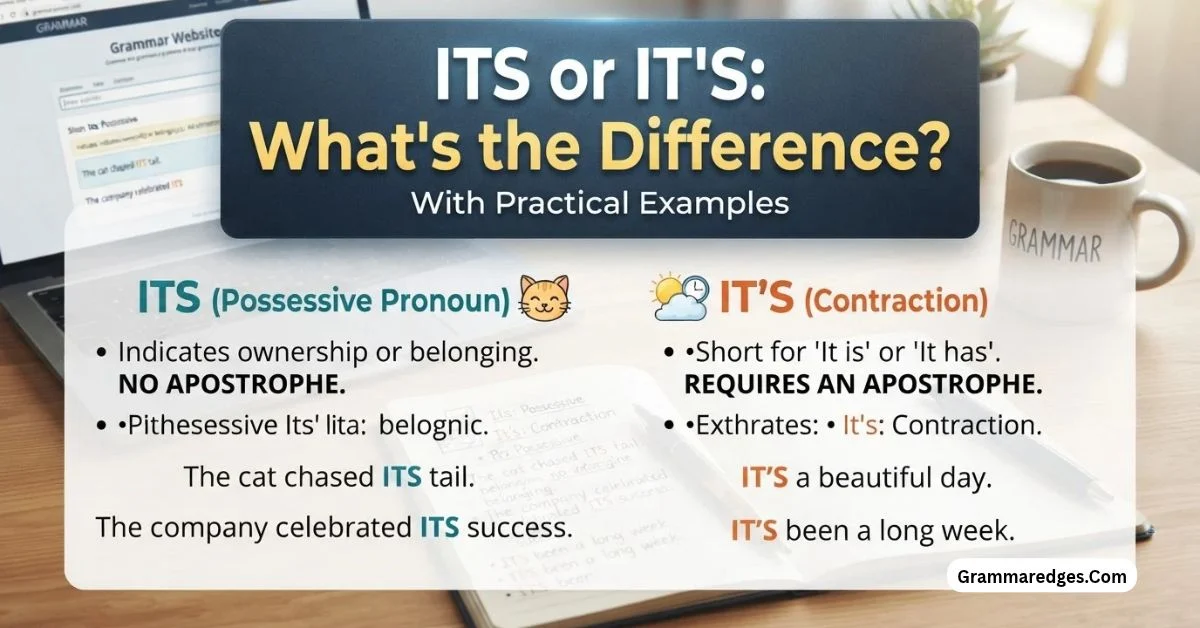
Its and it’s have different meanings. Its shows possession, such as “The cat licked its paw.” It’s is a contraction of it is or it has, as in “It’s cold outside” or “It’s been a long day.” Remember that its has no apostrophe when showing possession, while it’s always has an apostrophe.
Key Takeaways
- Its shows that something belongs to or is associated with something else.
- It’s means it is or it has.
- Replace it’s with it is or it has to check whether it fits the sentence.
- Use its in phrases such as “its color,” “its purpose,” and “its own.”
- Both forms are correct, but they cannot be used interchangeably.
What Is the Difference Between Its and It’s?
The difference between its or it’s comes down to possession versus contraction. Although the two words look almost identical, they serve different grammatical purposes.
Its is a possessive form used to show ownership, connection, or association. For example, “The company changed its policy” means the policy belongs to or is associated with the company.
It’s is a contraction that combines it with is or has. For example, “It’s a beautiful day” means “It is a beautiful day.”
The apostrophe is the key visual difference, but the meaning of the sentence determines which spelling is correct.
What Does Its Mean?
Its is a possessive determiner. It comes before a noun to show that something belongs to, relates to, or is part of an animal, object, organization, or other thing.
Examples include:
- The dog wagged its tail.
- The phone lost its connection.
- The restaurant updated its menu.
- The tree dropped its leaves.
- The website changed its design.
In each sentence, its connects the noun that follows it with something already mentioned.
For example, in “The website changed its design,” the word its tells readers that the design belongs to or is associated with the website.
Unlike many possessive nouns, its does not need an apostrophe. You write “the machine and its parts,” not “the machine and it’s parts.”
What Does It’s Mean?
It’s is a contraction of two words: it is or it has. The apostrophe marks the letters omitted when the words are shortened.
Examples of it is:
- It’s raining outside. (It is raining outside.)
- It’s a difficult question. (It is a difficult question.)
- It’s important to practice. (It is important to practice.)
- It’s too late to call. (It is too late to call.)
Examples of it has:
- It’s been a busy week. (It has been a busy week.)
- It’s already started. (It has already started.)
- It’s taken longer than expected. (It has taken longer than expected.)
Notice that it’s does not automatically mean it is. It can also mean it has, depending on the sentence.
When to Use Its or It’s
Choosing the right word becomes easier when you identify what the sentence is trying to express.
Use Its to Show Possession
Use its when you want to indicate ownership, a relationship, or an attribute. It normally appears before a noun.
Examples:
- The bird built its nest in the tree.
- The school announced its new schedule.
- The car needs its tires replaced.
- The book has lost its cover.
- The business improved its customer service.
Quick rule: If the sentence answers “Whose?” or “What belongs to it?”, its may be the correct choice.
For example:
“The company announced its decision.”
Whose decision? The company’s decision. Therefore, its is correct.
Use It’s for It Is or It Has
Use it’s when you can replace it with it is or it has without changing the sentence’s intended meaning.
Examples:
- It’s my favorite movie. (It is my favorite movie.)
- It’s getting dark. (It is getting dark.)
- It’s been three days. (It has been three days.)
- It’s already finished. (It has already finished.)
Quick rule: Expand the contraction. If the full phrase makes sense, it’s is likely correct.
Consider this example:
“It’s a great opportunity.”
Replace it’s with it is: “It is a great opportunity.” The sentence still makes sense, so the apostrophe belongs there.
However, this test does not work for every sentence if you choose the wrong expansion. Check whether it is or it has fits the surrounding grammar and meaning.
Its vs. It’s Examples in Sentences
The following table compares both forms side by side.
| Sentence with Its | Sentence with It’s |
|---|---|
| The dog ate its food. | It’s time to eat. |
| The company changed its name. | It’s changing its name. |
| The house lost its roof. | It’s an old house. |
| The computer needs its charger. | It’s running slowly. |
| The bird spread its wings. | It’s been flying all morning. |
| The phone lost its signal. | It’s not working. |
| The restaurant updated its menu. | It’s open today. |
| The plant needs its water. | It’s growing quickly. |
The two forms can even appear in the same sentence:
“It’s important to protect the planet and its natural resources.”
Here, it’s means it is, while its indicates possession or association.
Another example is:
“It’s easy to see that the company values its employees.”
The first word is a contraction; the second shows the relationship between the company and its employees.
How to Remember Its vs. It’s
If you regularly confuse these words, use the following simple methods.
1. Try the Replacement Test
Replace it’s with it is or it has.
- Original: It’s a sunny day.
- Test: It is a sunny day.
- Result: The sentence works, so it’s is correct.
Now try a possessive example:
- Original: The cat cleaned it’s paws.
- Test: The cat cleaned it is paws.
- Result: The sentence does not work, so use its.
Correct version: “The cat cleaned its paws.”
2. Look for a Noun After the Word
When the word appears before a noun and indicates possession, use its.
Examples:
- Its color
- Its purpose
- Its location
- Its owner
- Its future
These phrases describe a relationship between something and a noun. They do not mean it is color or it has purpose.
3. Remember That Apostrophes Mark Contractions Here
In it’s, the apostrophe replaces missing letters in it is or it has.
The word its, however, already serves as the possessive form. English uses different patterns for possessives, so the usual apostrophe rule for nouns does not apply here.
Compare:
- The girl’s backpack (possessive noun)
- The backpack lost its strap (possessive determiner)
- It’s a heavy backpack (contraction)
Remembering these patterns helps prevent common writing mistakes.
Common Mistakes to Avoid
Even experienced writers sometimes mix up its and it’s, particularly when typing quickly.
Mistake 1: Writing “It’s Own”
Incorrect: The company created it’s own website.
Correct: The company created its own website.
Why? Own emphasizes possession. The phrase does not mean “it is own website,” so the possessive form its is required.
Mistake 2: Writing “Its Been”
Incorrect: Its been a long day.
Correct: It’s been a long day.
Why? The intended meaning is “It has been a long day.” Because it’s represents it has, the apostrophe is necessary.
Mistake 3: Using “It’s” Before a Possessed Noun
Incorrect: The bird returned to it’s nest.
Correct: The bird returned to its nest.
Why? The nest belongs to or is associated with the bird. Use its without an apostrophe.
Mistake 4: Assuming Every Apostrophe Shows Ownership
Incorrect: The app updated it’s settings.
Correct: The app updated its settings.
Why? In this sentence, its identifies the settings associated with the app. The apostrophe would incorrectly turn the word into a contraction.
Mistake 5: Forgetting That It’s Can Mean It Has
Incorrect: Its already started.
Correct: It’s already started.
Why? The sentence means “It has already started.” Recognizing both meanings of it’s helps you identify the correct form.
Its or It’s in American English and Professional Writing
In American English, the distinction between its and it’s is the same in casual conversation, schoolwork, business communication, and formal writing.
The right choice depends on meaning, not formality.
In emails:
- Correct: Please review the document and its final section.
- Correct: It’s ready for your review.
In academic writing:
- Correct: The study explains its findings.
- Correct: It’s important to consider the available evidence.
On websites and social media:
- Correct: The app has updated its features.
- Correct: It’s finally here!
In business writing:
- Correct: The organization revised its policies.
- Correct: It’s been approved by the management team.
For professional documents, proofreading tools can flag possible errors, but they may not understand the intended meaning of every sentence. A quick manual check is often enough: determine whether you mean possession, it is, or it has.
Also, do not assume that its is always more formal or that it’s is always informal. Both are standard English forms. The sentence’s meaning determines the correct choice.
Frequently Asked Questions
1. What is the difference between its and it’s?
Its shows possession or association, as in “The dog found its toy.” It’s is a contraction of it is or it has, as in “It’s a new toy” or “It’s been repaired.” The apostrophe changes the word’s grammatical function, so choosing the correct form depends on what you want to say.
2. Is it’s ever possessive?
No. In standard modern English, it’s is not the possessive form of it. It means it is or it has. Use its to show possession, as in “The company changed its logo.” This differs from possessive nouns such as “the company’s logo,” which use an apostrophe.
3. Is it “its own” or “it’s own”?
The correct phrase is “its own.” For example, write “The business has its own office.” The word its indicates possession, while it’s own would expand to “it is own,” which is grammatically incorrect in this context.
4. Can it’s mean it has?
Yes. It’s can mean it has when has functions as an auxiliary verb, usually before a past participle. For example, “It’s finished” can mean “It has finished” in an appropriate context, and “It’s been a long day” means “It has been a long day.” The surrounding words help determine the intended meaning.
5. Why does its have no apostrophe?
Its is already the possessive form of it. English does not form every possessive in the same way. While nouns often use apostrophe-based forms, possessive determiners such as his, hers, ours, and its do not take apostrophes.
6. How can I check whether I used its or it’s correctly?
Read the sentence and replace it’s with it is or it has. If the replacement preserves the intended meaning and grammar, it’s is appropriate. If you are showing that something belongs to or is associated with something else, use its. For example, “The dog wagged its tail” is correct.
Conclusion
Understanding its or it’s is easier once you remember one simple difference: its shows possession, while it’s means it is or it has. Use “The cat licked its paw” to describe possession and “It’s getting late” to express a contraction.
When you’re unsure, expand it’s into its full form and check whether the sentence still makes sense. If it doesn’t, consider whether you need its instead.
With a little practice, you can avoid this common grammar mistake and write more clearly in emails, school assignments, website content, and everyday conversations.