
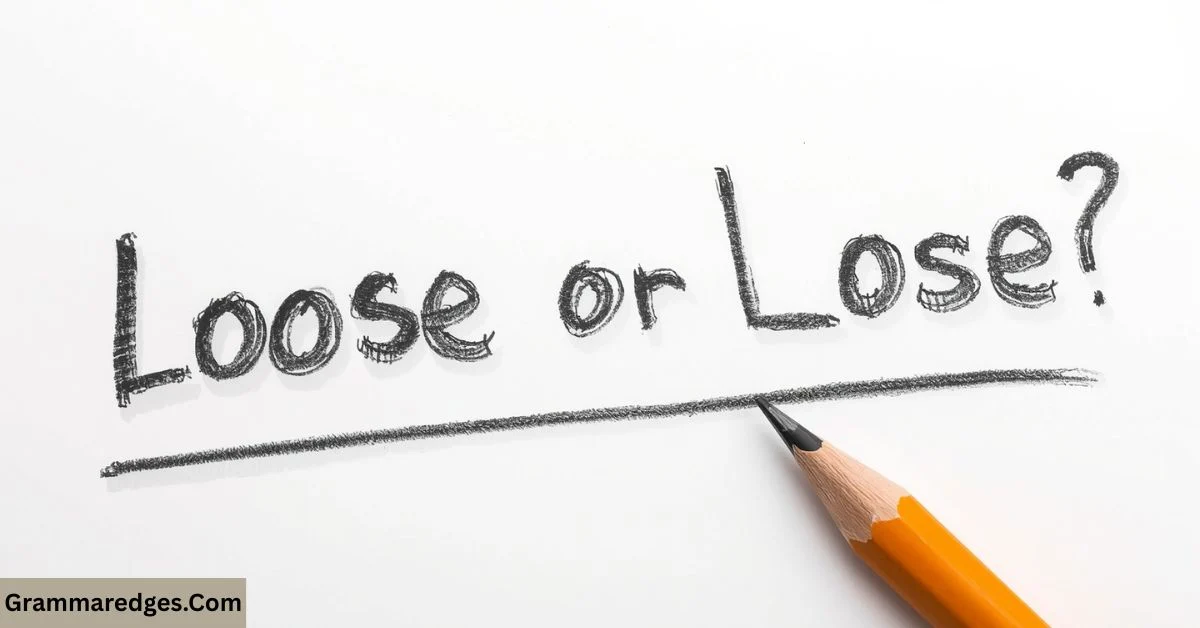
Many people confuse loose and lose because the words look similar and sound close in fast speech. A single extra “o” changes the meaning completely. This mistake appears in emails, school writing, business messages, and social media posts every day.
If you write “I don’t want to loose my keys,” readers may notice the spelling error immediately. That is why people often search for loose or lose online. They want a quick answer, easy examples, and simple grammar help.
The good news is that the difference is very easy once you learn one rule. Lose is usually a verb about missing something or failing to keep it. Loose is usually an adjective that means not tight.
This guide explains the meaning, origin, spelling rules, common mistakes, real-life examples, and usage trends for loose or lose. You will also see comparison tables and FAQs to help you remember the correct spelling every time.
Loose or Lose – Quick Answer
The difference is simple:
| Word | Meaning | Part of Speech | Example |
|---|---|---|---|
| Loose | Not tight | Adjective | My shirt is loose. |
| Lose | To misplace or fail to keep | Verb | I do not want to lose my phone. |
Easy Trick to Remember
- Lose has one “o” because you lose one thing.
- Loose has two “o” letters, like something wide or open.
Quick Examples
- Correct: Please do not lose the tickets.
- Correct: The screw is loose.
- Wrong: I might loose my wallet.
- Wrong: These pants are too lose.
The Origin of Loose or Lose
The words loose and lose come from Old English, but they developed different meanings over time.
Origin of “Loose”
The word loose came from Old Norse and Old English roots meaning “free,” “untied,” or “not fixed.” For centuries, it described things that were open, relaxed, or not firmly attached.
Example:
- A loose rope
- Loose clothing
Origin of “Lose”
The word lose came from Old English losian, meaning “to perish,” “to fail,” or “to be unable to keep.”
Example:
- Lose a game
- Lose money
- Lose control
Why the Spelling Difference Exists
English spelling changed slowly over hundreds of years. Even though the words sound similar today, they kept different spellings because they have different meanings and histories.
That is why:
- Loose = open or not tight
- Lose = fail to keep something
British English vs American English Spelling
The good news is that loose and lose are spelled the same in both British and American English.
Unlike words such as:
- Colour vs color
- Organise vs organize
There is no spelling change for these two words across regions.
Comparison Table
| Meaning | British English | American English |
|---|---|---|
| Not tight | Loose | Loose |
| Fail to keep | Lose | Lose |
Examples in British English
- Your shoelaces are loose.
- Do not lose your passport.
Examples in American English
- This bolt feels loose.
- I do not want to lose my job.
The meanings and spellings stay the same worldwide.
Which Spelling Should You Use?
The correct spelling depends on the meaning, not the country.
Use “Loose” When:
You talk about something:
- Not tight
- Free
- Relaxed
Examples:
- Loose jeans
- Loose wire
- Loose tooth
Use “Lose” When:
You talk about:
- Misplacing something
- Failing
- No longer having something
Examples:
- Lose weight
- Lose a match
- Lose your keys
Audience-Based Advice
| Audience | Recommended Usage |
|---|---|
| US readers | Use loose and lose normally |
| UK readers | Use loose and lose normally |
| Global audience | Follow the meaning carefully |
Because both spellings are universal, you only need to remember the meaning difference.
Common Mistakes with Loose or Lose
This is one of the most common English spelling mistakes online.
Mistake 1: Using “Loose” Instead of “Lose”
❌ I do not want to loose my phone.
✅ I do not want to lose my phone.
Mistake 2: Using “Lose” Instead of “Loose”
❌ My jacket is too lose.
✅ My jacket is too loose.
Mistake 3: Social Media Errors
People often type quickly online and confuse the words.
❌ You will loose followers.
✅ You will lose followers.
Mistake 4: Business Writing Errors
❌ We cannot afford to loose customers.
✅ We cannot afford to lose customers.
Easy Memory Rule
- Loose = extra space
- Lose = missing something
Loose or Lose in Everyday Examples
Here are simple real-world examples.
In Emails
- Please do not lose the contract.
- The cable connection feels loose.
In News Writing
- The team could lose the championship.
- Officials reported a loose animal near the highway.
On Social Media
- I always lose my charger.
- These shoes are too loose.
In Formal Writing
- Companies may lose revenue during economic decline.
- A loose connection caused the system failure.
In School Writing
- Students should not lose focus during exams.
- Wear loose clothing in hot weather.
Loose or Lose – Google Trends & Usage Data
Search data shows that many people confuse these words every month. The phrase “loose or lose” is popular in:
- The United States
- The United Kingdom
- Canada
- Australia
- India
Why People Search It
Most users search because:
- The pronunciation sounds similar
- Auto-correct does not always catch the error
- Social media spreads spelling mistakes quickly
Usage Contexts
| Word | Most Common Context |
|---|---|
| Loose | Clothing, screws, wires, teeth |
| Lose | Games, money, weight, items |
Online Writing Trends
Grammar experts report that:
- “Loose” is often incorrectly used instead of “lose” online.
- “Lose” mistakes are more common in fast typing and casual writing.
Loose or Lose Comparison Table
| Feature | Loose | Lose |
|---|---|---|
| Meaning | Not tight | Fail to keep |
| Word Type | Adjective | Verb |
| Number of “O” Letters | Two | One |
| Example | Loose pants | Lose money |
| Common Topic | Clothing, objects | Failure, missing items |
| Correct Sentence | The bolt is loose. | I might lose my wallet. |
FAQs :
1. Is it “lose weight” or “loose weight”?
The correct phrase is lose weight.
✅ I want to lose weight.
❌ I want to loose weight.
2. What does “loose” mean?
“Loose” means not tight or not firmly fixed.
Example:
- The button is loose.
3. Why do people confuse loose and lose?
The words look similar and sound close in pronunciation, especially in fast speech.
4. Is “lose” a verb?
Yes. “Lose” is usually a verb.
Examples:
- Lose a game
- Lose money
- Lose control
5. Is “loose” an adjective?
Yes. “Loose” is usually an adjective.
Examples:
- Loose shirt
- Loose screw
6. Do British and American English use different spellings?
No. Both use:
- Loose
- Lose
The spellings are identical worldwide.
7. How can I remember the difference quickly?
Remember:
- Loose has extra “o” space
- Lose means losing one thing
Conclusion :
The difference between loose or lose is simple once you understand the meanings. Loose describes something that is not tight, while lose means failing to keep something or no longer having it. Even though the words look similar, they serve very different purposes in English writing.
This mistake is common in emails, social media, school assignments, and business communication. Using the wrong spelling can make writing appear careless or confusing. The easiest way to remember the difference is this: loose has extra letters, just like something wide or relaxed, while lose means something is missing.
Another helpful point is that British English and American English use the same spellings, so there is no regional confusion. You only need to focus on meaning and context.
If you practice with everyday examples and remember the simple memory tricks, you will stop mixing up loose and lose in your writing.