If you have heard the term trunk or treat and wondered what it means, you are not alone. Many parents, teachers, church groups, and community organizers search for this phrase every year, especially around Halloween. Some people think it is the same as traditional trick-or-treating, while others are unsure how it works or where it came from.
The growing popularity of trunk or treat events has created interest across schools, churches, neighborhoods, and community centers. People often search for the keyword because they want a safer, more organized alternative to door-to-door Halloween activities. Others want ideas for hosting an event or understanding the difference between trunk or treat and trick-or-treating.
This guide explains everything you need to know about trunk or treat. You will learn its meaning, history, common usage, popularity, and how it compares to traditional Halloween activities. Whether you are planning an event or simply curious about the term, this article provides a quick answer and a complete explanation.
Trunk or Treat – Quick Answer
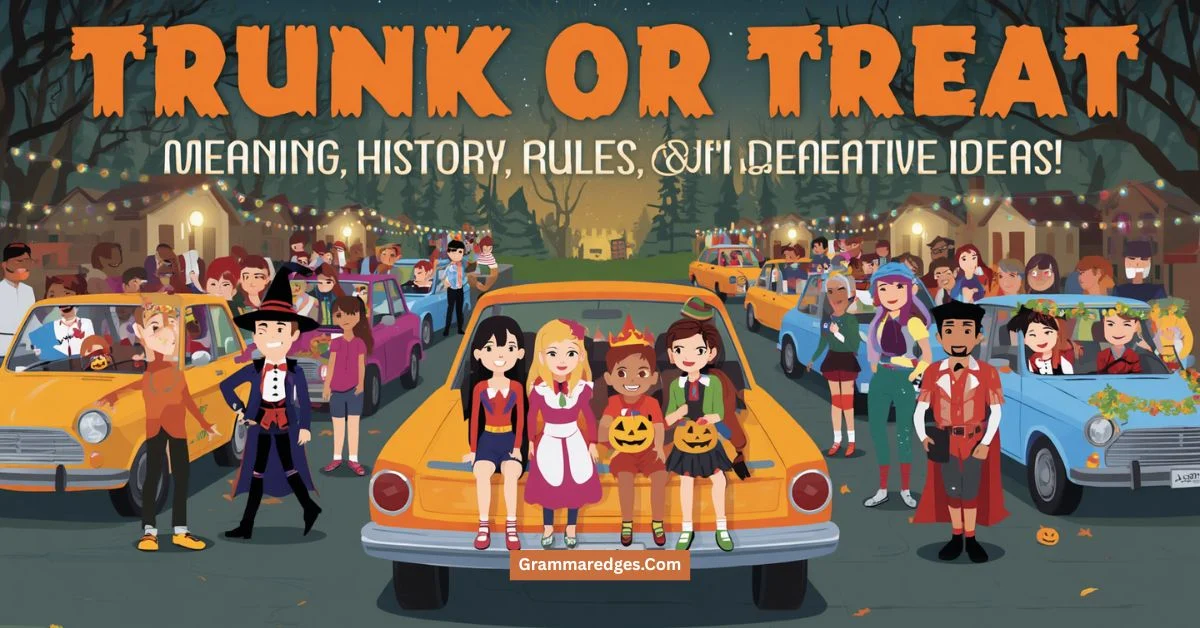
Trunk or treat is a Halloween event where people decorate the trunks of their vehicles and hand out candy to children in a parking lot or designated gathering area.
Instead of children walking from house to house, families visit decorated cars and collect treats from each vehicle.
Examples of Trunk or Treat
- A church hosts a trunk or treat event in its parking lot.
- Parents decorate their car trunks with Halloween themes.
- Children walk from vehicle to vehicle collecting candy.
- Schools organize trunk or treat celebrations for students and families.
The main goal is to create a fun, safe, and community-focused Halloween experience.
The Origin of Trunk or Treat
The term trunk or treat combines two ideas:
- Trunk = the storage area at the back of a car.
- Treat = candy or small gifts given during Halloween.
The phrase emerged in the United States during the late 20th century. Community groups, churches, and schools began organizing Halloween gatherings in parking lots. Instead of visiting homes, children could receive candy from decorated vehicles in one central location.
Why Did Trunk or Treat Become Popular?
Several factors contributed to its growth:
- Safety concerns about traffic and neighborhood travel.
- Easier supervision for parents.
- Community-focused celebrations.
- Convenience for families with young children.
Why Spelling Differences Exist
Unlike many English words, trunk or treat does not have major spelling variations. However, some people incorrectly write it as:
- Trunk n treat
- Trunk-and-treat
- Trunk treat
- Trunk-or-treating
The standard and most widely accepted form is:
Trunk or Treat
This version appears in event titles, advertisements, schools, churches, and community announcements.
British English vs American English Spelling
Unlike words such as “color” and “colour” or “organize” and “organise,” trunk or treat does not have an official British and American spelling difference.
The phrase originated in the United States and is generally used in the same form worldwide.
Comparison Table
| American English | British English | Meaning |
|---|---|---|
| Trunk or Treat | Trunk or Treat | Halloween event with decorated cars |
| Car trunk | Car boot | Storage area of a vehicle |
| Parking lot | Car park | Area where vehicles are parked |
| Candy | Sweets | Halloween treats |
| Trick-or-treating | Trick-or-treating | Traditional Halloween activity |
Key Difference
The phrase remains trunk or treat even in countries where people normally say car boot instead of car trunk.
Which Spelling Should You Use?
The correct spelling depends less on location and more on using the recognized event name.
For US Audiences
Use:
Trunk or Treat
This is the official and expected form.
For UK Audiences
Use:
Trunk or Treat
Even though British English uses “boot” instead of “trunk,” the event name usually stays unchanged.
For Canada, Australia, and New Zealand
Use:
Trunk or Treat
Most organizations keep the original American term.
For Global Audiences
Use:
Trunk or Treat
You may add a brief explanation if readers are unfamiliar with the concept.
Example:
“Trunk or Treat is a Halloween event where decorated vehicles distribute candy to children.”
Common Mistakes with Trunk or Treat
Many people make small errors when writing or describing the phrase.
Mistake 1: Writing “Trunk and Treat”
❌ Trunk and Treat
✅ Trunk or Treat
Mistake 2: Using Random Hyphens
❌ Trunk-Or-Treat Event
✅ Trunk or Treat Event
Mistake 3: Confusing It with Trick-or-Treating
❌ Trunk or treat means children go door to door.
✅ Trunk or treat takes place around decorated vehicles.
Mistake 4: Using Inconsistent Capitalization
❌ trunk Or treat
✅ Trunk or Treat
Mistake 5: Calling Every Halloween Event a Trunk or Treat
❌ All Halloween events are trunk or treat events.
✅ Only organized events with decorated vehicle trunks qualify as trunk or treat.
Trunk or Treat in Everyday Examples
The phrase appears in many everyday situations.
Email Example
“Join us this Friday for our annual Trunk or Treat event in the school parking lot.”
News Example
“The local community center welcomed hundreds of families to its Trunk or Treat celebration.”
Social Media Example
“Our Trunk or Treat decorations are ready! We can’t wait to hand out candy tonight.”
School Announcement Example
“The PTA invites all families to participate in this year’s Trunk or Treat event.”
Formal Writing Example
“The organization hosted a Trunk or Treat program to provide a safe Halloween experience for children.”
Trunk or Treat – Google Trends & Usage Data
Interest in trunk or treat increases dramatically each year during the Halloween season, especially from September through October.
Countries Where the Term Is Most Popular
- United States
- Canada
- Australia
- New Zealand
- Other English-speaking regions
Common Search Intent
People search for trunk or treat because they want:
- Event ideas
- Decoration inspiration
- Halloween safety tips
- Church event planning
- School event organization
- Candy distribution ideas
- Family-friendly Halloween activities
Why Searches Continue Growing
The popularity of trunk or treat events has increased because they:
- Bring communities together.
- Require less walking.
- Offer easier supervision.
- Provide controlled environments.
- Appeal to families with young children.
Trunk or Treat Keyword Variations
| Keyword Variation | Usage Context |
|---|---|
| Trunk or Treat | Standard term |
| Trunk or Treat Ideas | Decoration inspiration |
| Trunk or Treat Themes | Event planning |
| Church Trunk or Treat | Religious community events |
| School Trunk or Treat | Educational events |
| Halloween Trunk or Treat | Seasonal celebrations |
| Trunk or Treat Decorations | Vehicle decorating ideas |
| Trunk or Treat Games | Activity planning |
FAQs About Trunk or Treat
What is a trunk or treat event?
A trunk or treat event is a Halloween gathering where decorated vehicles distribute candy to children in a central location.
Is trunk or treat safer than trick-or-treating?
Many families consider it safer because activities take place in a controlled area with adult supervision.
Why is it called trunk or treat?
The name comes from decorated car trunks where treats are distributed to children.
Who organizes trunk or treat events?
Schools, churches, community groups, businesses, and neighborhood organizations commonly organize them.
Do people dress up for trunk or treat?
Yes. Children and many adults wear Halloween costumes during the event.
What do you put in a trunk or treat display?
People often use Halloween decorations, lights, themed props, games, and candy.
Is trunk or treat only popular in the United States?
It is most popular in the United States, but the concept has spread to Canada, Australia, and other English-speaking countries.
Conclusion
Trunk or treat has become one of the most popular family-friendly Halloween traditions in modern communities. The concept is simple: families gather in a parking lot, decorate vehicle trunks, and distribute candy in a safe and organized environment. This approach offers a convenient alternative to traditional trick-or-treating while still preserving the excitement of Halloween.
One important point to remember is that Trunk or Treat is the standard and widely accepted spelling. Unlike many English words, there is no official British or American spelling variation. Whether you are writing for audiences in the United States, the United Kingdom, Canada, Australia, or elsewhere, using Trunk or Treat is the correct choice.
As interest continues to grow, more schools, churches, and community organizations are adopting trunk or treat events because they combine safety, convenience, and fun. If you are planning a Halloween gathering or writing about the topic, using the correct term and understanding its history will help you communicate clearly and professionally.