Have you ever typed “you to” in a text message and wondered if it was correct? You are not alone. Many English learners and native speakers confuse “you too” and “you to.” The phrases sound the same, but they do not mean the same thing.
This confusion happens because English has many words with similar sounds but different meanings. In casual chats, social media comments, and fast texting, people often use the wrong spelling without noticing. That is why so many users search for “you too or you to” online.
The good news is that the difference is simple once you understand it. In most cases, “you too” is the correct phrase when replying to someone. Meanwhile, “you to” usually appears only when “to” is part of a longer sentence.
In this guide, you will learn the correct meaning, grammar rules, common mistakes, real-life examples, and which version you should use in formal and informal writing.
What Are You Up To or Too?
The correct phrase is “What are you up to?”
People often confuse to and too because they sound the same, but they have different meanings.
- Up to is part of the expression “What are you up to?”, which means “What are you doing?” or “What have you been doing lately?”
- Too means “also” or “more than enough.” It does not belong in this common question.
Correct Examples
- ✅ What are you up to today?
- ✅ What are you up to this weekend?
- ✅ Hey! What are you up to?
- ✅ What have you been up to lately?
Incorrect Examples
- ❌ What are you up too?
- ❌ What have you been up too?
- ❌ What are you too today?
Easy Trick to Remember
If you’re asking someone what they are doing, always use up to.
Think of it like this:
- To = part of the phrase “up to.”
- Too = also or excessively.
Quick Answer
- Correct: What are you up to?
- Incorrect: What are you up too?
Whenever you’re greeting someone or asking what they’re doing, the only correct phrase is “What are you up to?”
You Too or You To – Quick Answer
The correct phrase is usually “you too.”
“You too” Meaning
“You too” means also you or the same to you.
Examples
- Have a great day!
→ You too! - Good luck!
→ You too! - I enjoyed meeting you.
→ You too!
“You to” Meaning
“You to” is usually incomplete by itself. The word “to” is often part of an infinitive verb phrase.
Examples
- I want you to help me.
- She asked you to call her.
- We need you to arrive early.
Simple Rule
- Use “you too” when replying to someone.
- Use “you to” when followed by a verb.
The Origin of You Too or You To
The phrase “you too” comes from the word “too,” which means also or in addition. The word has been part of English for hundreds of years and comes from Old English and Germanic roots.
The word “to,” however, is different. It is one of the most common words in English. It works as:
- a preposition
- part of infinitive verbs
Why the Confusion Exists
The confusion exists because:
- Both phrases sound the same.
- English has many homophones.
- Texting and social media encourage fast writing.
For example:
- “You too” = also you
- “You to help me” = part of a verb structure
Even native speakers sometimes type the wrong version quickly.
British English vs American English Spelling
There is no major spelling difference between British and American English for these phrases. Both use:
- you too
- you to
The grammar rules stay the same in both regions.
British and American Usage Examples
| Situation | American English | British English |
|---|---|---|
| Friendly reply | You too! | You too! |
| Verb structure | I need you to come. | I need you to come. |
| Formal email | Thank you, and you too. | Thank you, and you too. |
Key Point
Unlike words such as:
- colour/color
- organise/organize
The phrases “you too” and “you to” do not change between UK and US English.
Which Spelling Should You Use?
The correct spelling depends on the sentence.
Use “You Too” When:
You mean:
- also you
- same to you
Examples
- Happy birthday! → You too!
- Stay safe! → You too!
- Enjoy your trip! → You too!
Use “You To” When:
The sentence continues with a verb.
Examples
- I asked you to wait.
- They want you to join.
- We expect you to finish the work.
Audience-Based Advice
| Audience | Best Usage |
|---|---|
| US readers | Follow standard grammar rules |
| UK readers | Same grammar rules apply |
| Global audience | Use “you too” for replies |
| Formal writing | Avoid mistakes by proofreading |
| Social media | “You too” is still correct |
Professional Tip
If the sentence ends there, it is probably:
- you too
If another verb follows, it is probably:
- you to
Common Mistakes with You Too or You To
Many people mix these phrases in texts, emails, and comments.
Mistake 1: Using “You To” as a Reply
❌ Wrong:
- Have fun! → You to!
✅ Correct:
- Have fun! → You too!
Why?
Because “too” means “also.”
Mistake 2: Using “You Too” Before a Verb
❌ Wrong:
- I need you too help me.
✅ Correct:
- I need you to help me.
Why?
Because “to” belongs with the verb “help.”
Mistake 3: Auto-Correct Errors
Phones sometimes replace:
- too → to
Always check your message before sending.
Mistake 4: Informal Writing Habits
Many users type quickly online:
- “u to”
- “you to”
This is common in texting but not correct in formal English.
You Too or You To in Everyday Examples
Understanding real-life examples makes the difference easier.
In Emails
✅ Correct:
- Thank you for your support. You too have been very helpful.
- I need you to review the document.
In Social Media
✅ Correct:
- Have a great weekend! → You too!
- We want you to subscribe today.
In News Writing
✅ Correct:
- Officials asked people to stay indoors.
- The coach told players to remain calm.
In Formal Writing
✅ Correct:
- We expect you to complete the assignment by Friday.
- Best wishes to you too.
In Daily Conversations
| Sentence | Correct Version |
|---|---|
| Enjoy your meal! | You too! |
| I want ___ to listen carefully. | you to |
| Thanks for helping me. | You too! |
| They invited ___ attend the event. | you to |
You Too or You To – Google Trends & Usage Data
Search data shows that many people look for:
- “you too or you to”
- “is it you too or you to”
- “you too meaning”
- “you to grammar”
Why Is It Popular?
People search this keyword because:
- the phrases sound identical
- grammar confusion is common
- texting habits create spelling mistakes
Usage by Country
| Country | Common Usage |
|---|---|
| United States | “You too” widely used in replies |
| United Kingdom | Same usage pattern |
| Canada | Standard English grammar |
| Australia | “You too” common in casual speech |
| India & Pakistan | High search volume from English learners |
Online Usage Trends
“You too” appears more often in:
- greetings
- comments
- texting
- customer service replies
“You to” appears more often in:
- instructions
- professional writing
- educational content
Comparison Table: You Too vs You To
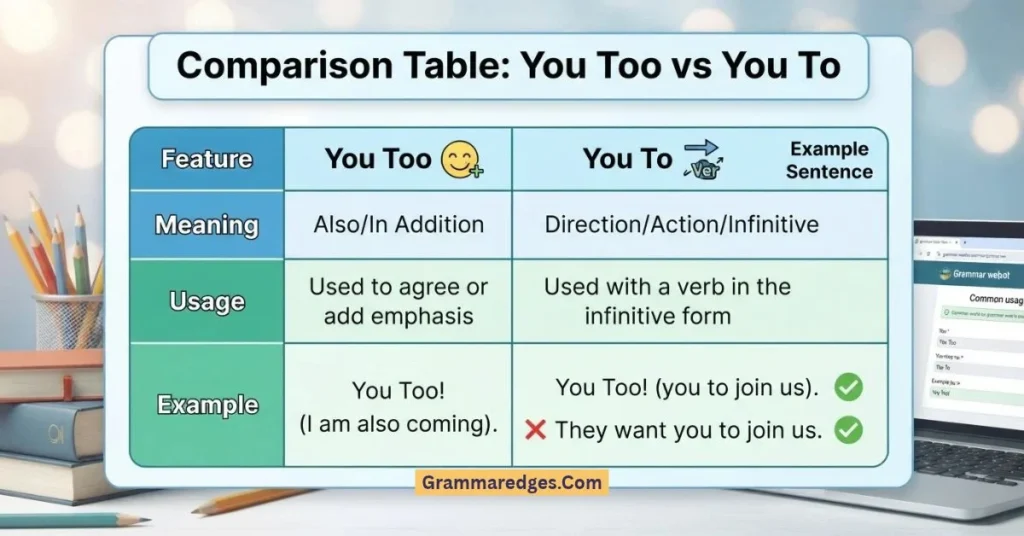
| Phrase | Meaning | Grammar Role | Example |
|---|---|---|---|
| You too | Also you | Adverb phrase | Have fun! You too! |
| You to | Part of verb phrase | Infinitive structure | I need you to help. |
| Too | Also | Adverb | I like coffee too. |
| To | Direction or verb marker | Preposition/particle | I want to go. |
FAQs : you to or you too
Is it correct to say “you too”?
Yes. “You too” is correct when replying to someone politely.
What does “you too” mean?
It means:
- same to you
- also you
Is “you to” ever correct?
Yes. It is correct when followed by a verb.
Example:
- I want you to listen.
Why do people confuse “too” and “to”?
Because both words sound the same in spoken English.
Is “you too” formal or informal?
It can be both. It works in:
- casual speech
- emails
- professional conversations
Can I use “you to” alone?
Usually no. It sounds incomplete without another word or verb.
Which is more common online?
“You too” is more common in texting and replies.
Conclusion
The difference between “you too” and “you to” is simple once you know the grammar rule. Use “you too” when you mean “also you” or “same to you.” This is the correct reply in conversations, texts, emails, and social media comments.
Use “you to” only when the sentence continues with a verb. In this case, “to” becomes part of an infinitive phrase, such as “I need you to help.”
Although the two phrases sound identical, their meanings are very different. That is why proofreading matters, especially in formal writing. Small grammar mistakes can change the clarity of your message.
If you remember one quick rule, let it be this:
- Replying politely? → you too
- Followed by a verb? → you to
Using the correct version will make your English clearer, more natural, and more professional in every situation.