If you have ever wondered whether “aunty” or “auntie” is correct, you are not alone. Both spellings are used in English, and the difference is mainly linked to region, style, and personal preference.
In everyday speech, both words refer to a person’s aunt. However, you may see auntie more often in American English, while aunty is common in British English and several Commonwealth countries.
The choice can also depend on how formal the writing is. A family member might be called “Auntie Sarah,” while formal writing may simply use “aunt.”
People often search for “aunty or auntie” because they want to write a card, email, social media post, family message, or school assignment correctly. This guide explains the difference in simple terms.
You will learn where both spellings came from, which version to use in different countries, common mistakes, and real-life examples.
Aunty or Auntie – Quick Answer
Both aunty and auntie are correct spellings.
- Aunty – common in British English and many Commonwealth varieties.
- Auntie – common in American English and also widely used elsewhere.
- Aunt – the standard and more formal form.
Examples:
- My aunty lives in London.
- My auntie lives in New York.
- I am visiting my Aunt Mary this weekend.
So, there is no spelling error in either aunty or auntie. Your choice usually depends on regional English and personal style.
The Origin of Aunty or Auntie
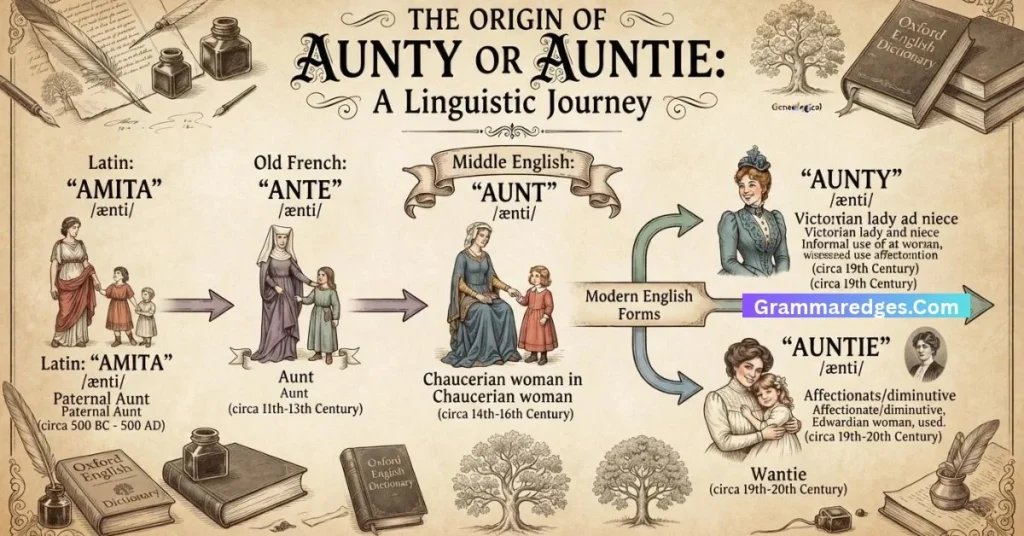
The word aunt comes from Old French ante, which came from Latin amita, meaning “father’s sister.” English later adopted the word through French.
The familiar forms aunty and auntie developed as affectionate or informal versions of aunt.
The endings -y and -ie are often used in English to make words sound more familiar or friendly. Similar patterns can be seen in words such as “granny” and “grannie.”
Over time, different English-speaking communities preferred different spellings. This is why aunty and auntie can both be found in dictionaries and everyday writing.
The spelling difference does not create a difference in basic meaning. Both words normally mean an aunt or a woman treated like an aunt.
British English vs American English Spelling
Regional preference is one of the main reasons you see both spellings.
In British English, aunty is a common informal form. Auntie is also used, especially as a warm or affectionate form.
In American English, auntie is generally more familiar as the informal spelling. “Aunty” may still appear, but it is less common.
| Variety | Common spelling | Example |
|---|---|---|
| British English | Aunty | My aunty sent me a gift. |
| British English | Auntie | Auntie Jane is visiting. |
| American English | Auntie | My auntie lives nearby. |
| Commonwealth English | Aunty | I am going to see my aunty. |
| Formal English | Aunt | My aunt lives in Canada. |
There is no strict grammar rule that makes one informal spelling universally correct. The important point is to match the style of your audience.
Which Spelling Should You Use?
Your audience is the best guide.
For American readers
Choose auntie if you want an informal and friendly word.
Example:
“I called my auntie last night.”
For British readers
Aunty is a natural choice, although auntie is also perfectly understandable and used.
Example:
“I am staying with my aunty this weekend.”
For Commonwealth English
In countries such as Pakistan, India, Australia, and other Commonwealth settings, aunty is widely familiar. In some places, the word may also be used respectfully for an older woman who is not a biological relative.
For formal writing
Use aunt when you want the safest and most neutral choice.
Example:
“My aunt works as a teacher.”
For a personal letter, greeting card, or family message, Aunty or Auntie can sound warmer.
Common Mistakes with Aunty or Auntie
Here are some mistakes people often make.
1. Thinking one spelling is always wrong
Incorrect idea: “Aunty is wrong because auntie is the correct spelling.”
Better: Both forms are accepted. Regional preference matters.
2. Using an informal form in formal writing
Informal:
I visited my auntie yesterday.
Formal:
I visited my aunt yesterday.
The first sentence is not grammatically wrong. The second simply sounds more neutral.
3. Mixing styles in the same piece
If you are writing for a specific audience, consistency helps.
For example, if a family website uses Aunty throughout an article, suddenly switching to Auntie can look inconsistent.
4. Confusing “aunt” with “aunty”
Aunt is the standard family term.
Aunty is an informal or affectionate form.
Both can describe the same person.
Aunty or Auntie in Everyday Examples
The best spelling often depends on the situation.
In Emails
Informal:
Hi Auntie Sarah,
I hope you are doing well.
More neutral:
Dear Aunt Sarah,
I hope you are doing well.
In News Writing
News reports usually prefer aunt because it is neutral and concise.
Example:
Police said the child was staying with her aunt.
“Aunty” would normally sound more personal or conversational.
On Social Media
Both informal forms work well.
Examples:
Happy birthday to my amazing aunty! ❤️
So happy to see my auntie today!
Social media is personal, so there is more freedom to choose the spelling you naturally use.
In Formal Writing
Use aunt when possible.
Example:
My aunt was an important influence on my education.
In Family Messages
The affectionate forms are often better.
Examples:
Love you, Auntie! ❤️
Thank you for everything, Aunty!
Aunty or Auntie – Google Trends & Usage Data
Search interest for aunty and auntie varies by country and English variety. Generally, aunty has a strong presence in British and Commonwealth English, while auntie is especially familiar in American English.
Usage can also change depending on context. Family conversations, children’s writing, greetings, and social media tend to use the affectionate forms more often than formal documents.
Google Trends can show differences in search interest over time, but search volume should not be treated as a strict measure of which spelling is grammatically correct. A spelling may be searched more because people are unsure about it.
The safest conclusion is simple: both “aunty” and “auntie” are established English forms, while “aunt” is the most neutral choice.
Aunty vs Auntie vs Aunt: Comparison Table
| Word | Meaning | Style | Common Use |
|---|---|---|---|
| Aunt | Female relative | Neutral/formal | Formal writing |
| Aunty | Informal form of aunt | Friendly | British/Commonwealth English |
| Auntie | Informal form of aunt | Friendly/affectionate | American and international English |
| Auntie’s | Belonging to an aunt | Informal | Family conversations |
| Aunts | More than one aunt | Neutral | General writing |
FAQs About Aunty or Auntie
Is “aunty” or “auntie” correct?
Both aunty and auntie are correct. They are informal forms of aunt, and regional preferences often determine which spelling people use.
Is “aunty” British or American?
Aunty is especially common in British English and Commonwealth varieties. American English more commonly uses auntie, although both forms can be understood.
Is “auntie” more correct than “aunty”?
No. Neither spelling is universally more correct. Auntie and aunty are both accepted informal forms of “aunt.”
Which spelling should I use in formal writing?
Use aunt for the most neutral and formal style. For a personal letter or family message, aunty or auntie may sound warmer.
Do “aunty” and “auntie” have the same meaning?
Yes. In most contexts, they have the same basic meaning: an affectionate or informal way to refer to an aunt.
Why do some people spell it “aunty”?
The spelling aunty developed as an informal form of aunt and is especially common in British and Commonwealth English.
Can I use “auntie” for someone who is not my aunt?
Yes. In informal speech, auntie can be used as a warm or respectful term for a woman who is not a biological aunt, depending on the culture and context.
Conclusion
So, aunty or auntie? The simple answer is that both are correct. They are informal and affectionate forms of the standard word aunt.
Choose aunty if you are following British or Commonwealth usage, especially in countries where this spelling feels natural. Choose auntie if you are writing mainly for an American audience or simply prefer that spelling.
For formal documents, professional writing, and neutral English, aunt is usually the safest choice.
The key is not to worry about treating one informal spelling as wrong. Your audience, region, and writing style should guide your choice. Whether you write “My aunty helped me” or “My auntie helped me,” the meaning remains clear.