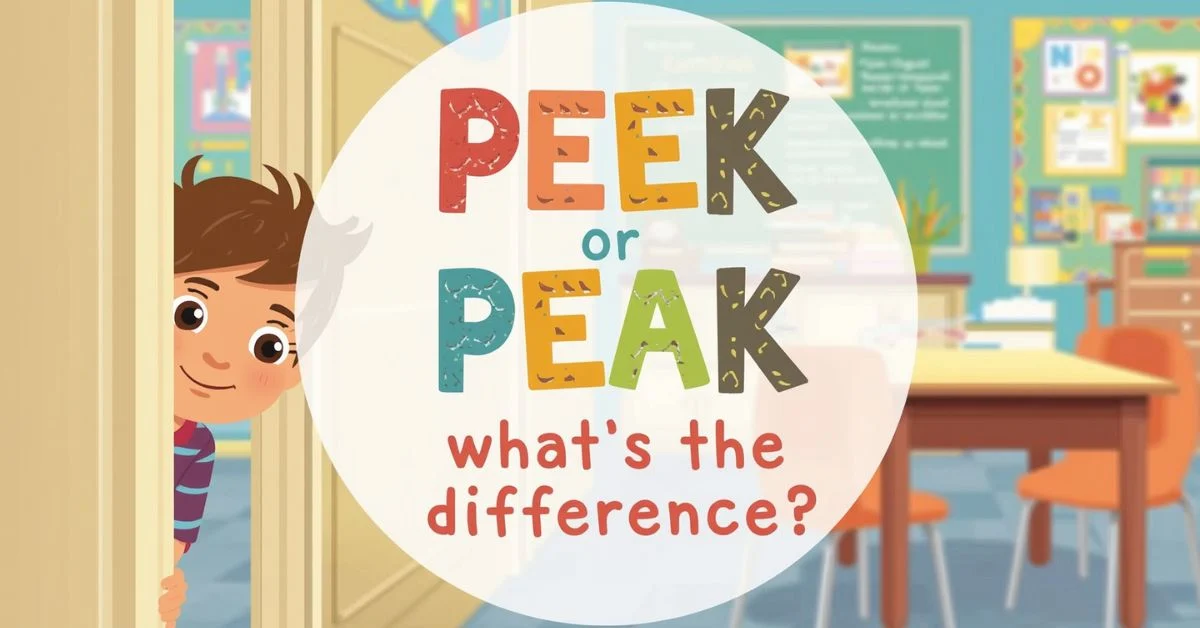
Have you ever typed “peek or peak” and stopped to wonder which word is correct? You are not alone. These two words sound exactly the same, but they have very different meanings. That makes them easy to mix up in texts, emails, schoolwork, and social media posts.
The good news is that the difference is simple once you connect each word with its meaning. Peek is about looking quickly or secretly. Peak is about the highest point, such as the top of a mountain or the best point in someone’s career.
People often search for “peek or peak” because both words are pronounced /piːk/. They are homophones, which means they sound alike but have different spellings and meanings. English also has a third word, pique, that sounds the same.
In this guide, you will learn the difference between peek and peak, their origins, spelling rules, common mistakes, real-life examples, and which word to use in different situations.
Peek or Peak – Quick Answer
The quick answer is:
- Peek = to take a quick or secret look.
- Peak = the highest point or top level of something.
Examples
Peek:
“I took a quick peek inside the box.”
Peak:
“The climbers finally reached the mountain peak.”
Another easy example:
Peek: “She peeked through the door.”
Peak: “The athlete is at the peak of her career.”
So, if you are looking, use peek.
If you mean the top, highest point, or maximum level, use peak.
Oxford defines peek as looking quickly or secretly, while peak can refer to reaching the highest point or value. (Oxford Learner’s Dictionaries)
Easy Memory Trick
Think of the two ee letters in peek as two little eyes.
p + ee + k = peek = look 👀
For peak, think of the A as the pointed top of a mountain.
peak = highest point ⛰️
This simple trick can help you remember the spelling when you are writing quickly.
The Origin of Peek or Peak
Although peek and peak sound alike today, they developed from different word histories.
Where Did “Peek” Come From?
The verb peek dates back to Middle English. Dictionary sources connect it with older forms meaning to look secretly or furtively. Its exact development is not completely certain, but it has been associated with words such as peep and keek, both connected with looking. (Dictionary)
The word first appeared as a verb. Later, English speakers began using peek as a noun for a quick look.
For example:
- “She peeked through the window.”
- “I took a quick peek.”
The noun use is now completely normal in everyday English.
Where Did “Peak” Come From?
Peak has a different history. Its noun form is linked to older words meaning a pointed object, point, or summit. Dictionary sources trace it through Middle English forms and ultimately to Old English pīc, connected with a pointed instrument or point. (Dictionary)
Over time, peak came to mean the pointed top of a mountain.
Later, its meaning became more general.
Today, we can talk about:
- the peak of a mountain
- the peak of a career
- peak performance
- peak demand
- peak season
- peak hours
The verb peak means to reach the highest point or level.
For example:
“Sales peaked in December.”
Why Do Peek and Peak Have Different Spellings?
English contains many homophones. These are words that sound alike but have different meanings and spellings.
Peek and peak are a good example.
Their similar pronunciation can cause confusion, especially when you hear a word rather than see it written. The spelling must therefore be chosen from the meaning of the sentence.
British English vs American English Spelling
There is no major British-versus-American spelling difference between peek and peak.
Both British and American English use:
- peek for a quick or secret look
- peak for the highest point
The spelling stays the same.
| Meaning | British English | American English | Example |
|---|---|---|---|
| Quick look | peek | peek | Take a peek inside. |
| Secret look | peek | peek | He peeked through the window. |
| Highest point | peak | peak | We reached the peak. |
| Maximum level | peak | peak | Demand reached its peak. |
| Highest performance | peak | peak | She is at her peak. |
Oxford lists peek and peak as separate homophones, with the same basic distinction in meaning. (Oxford Learner’s Dictionaries)
So, unlike words such as colour/color or centre/center, you do not need to change the spelling based on whether your audience uses British or American English.
What About Other English-Speaking Countries?
The same distinction is normally used in countries such as:
- Canada
- Australia
- New Zealand
- India
- Pakistan
- South Africa
The important thing is not the country. It is the meaning.
If you mean look, write peek.
If you mean highest point, write peak.
Which Spelling Should You Use?
Choosing between peek and peak depends on what you want to say, not where your reader lives.
For American Readers
Use peek when someone looks quickly or secretly.
“Take a peek at this photo.”
Use peak for a highest point.
“The company reached its peak last year.”
For British and Commonwealth Readers
The same rule applies.
“Have a peek inside.”
“The mountain peak was covered in snow.”
There is no need to change these spellings for British English.
For Global Audiences
If you write for an international audience, focus on clarity.
The easiest rule is:
Peek = look.
Peak = top or highest point.
This works across most standard forms of English.
A Professional Writing Tip
If you are writing an email, report, article, academic paper, or business document, do not choose the word based on how it sounds.
Choose it based on the meaning.
For example:
❌ “Please take a peak at the document.”
✅ “Please take a peek at the document.”
The first sentence means you should take a “highest point” at the document, which is not what the writer intends.
Common Mistakes with Peek or Peak
These words are often confused because they are homophones.
Here are some of the most common mistakes.
1. “Take a Peak”
❌ “Take a peak at this report.”
✅ “Take a peek at this report.”
The phrase take a peek means to take a quick look.
2. “Sneak Peak”
This is one of the most common errors online.
❌ “Here is a sneak peak of our new product.”
✅ “Here is a sneak peek of our new product.”
A sneak peek means a quick or secret look at something before it is officially released.
Merriam-Webster specifically notes that sneak peek is the correct phrase. (Merriam-Webster)
3. “Mountain Peek”
❌ “We reached the mountain peek.”
✅ “We reached the mountain peak.”
A mountain has a peak, not a peek.
4. “Peak Inside”
❌ “Can I peak inside?”
✅ “Can I peek inside?”
You are asking to look inside, so peek is correct.
5. “At the Peek of His Career”
❌ “He was at the peek of his career.”
✅ “He was at the peak of his career.”
The highest point of a career is its peak.
6. “Peaked Through the Window”
❌ “She peaked through the window.”
✅ “She peeked through the window.”
The past tense of peek is peeked.
The past tense of peak is peaked.
The meaning tells you which one you need.
Peek or Peak in Everyday Examples
These words appear in many kinds of writing.
In Emails
When asking someone to look at something:
“Could you take a peek at the attached file?”
“Please have a quick peek at the updated schedule.”
Here, peek is correct because the person needs to look at something.
In News Writing
News articles often use peak when discussing numbers, prices, traffic, temperatures, or activity.
“Temperatures are expected to peak this afternoon.”
“Traffic reached its peak during the evening rush.”
Here, peak means the highest level.
Oxford gives examples of peak for reaching the highest point or value, including economic and performance contexts. (Oxford Learner’s Dictionaries)
On Social Media
You may see:
“Sneak peek coming soon!”
“Take a peek at our new collection.”
Both use peek because the reader is being invited to look.
You may also see:
“Peak summer vibes.”
Here, peak suggests the highest or strongest level of summer.
In Formal Writing
Peak is common in reports and research:
“Demand peaked in July.”
“The graph shows a peak in sales during December.”
Peek is less common in formal academic writing because it has a more casual meaning.
Still, it can be perfectly correct when the context calls for it.
Peek or Peak – Google Trends & Usage Data
People search for “peek or peak” because these words are frequently confused. The main reason is pronunciation: both words are pronounced /piːk/.
Search interest can also vary by context. People often look up the pair when checking phrases such as:
- sneak peek
- take a peek
- mountain peak
- peak performance
- peak season
- peak hours
There is no meaningful British-versus-American spelling split for these two words. The same spellings are standard in both varieties.
Search behavior also changes by topic. Peak appears often in discussions about travel, mountains, business, sports, energy, traffic, prices, and performance. Peek appears more often around previews, photos, products, entertainment, and casual conversation.
A useful point is that search engines may show results for all three homophones: peek, peak, and pique. Merriam-Webster and Oxford both identify these as homophones with different meanings. (Merriam-Webster)
Because search interest changes over time and by region, Google Trends should be treated as a snapshot of search behavior rather than a measure of dictionary correctness.
The spelling rule remains simple:
Looking = peek.
Highest point = peak.
Peek vs Peak: Comparison Table
| Word | Meaning | Part of Speech | Example | Memory Tip |
|---|---|---|---|---|
| Peek | A quick or secret look | Noun/Verb | Take a peek inside. | Two “e” letters look like eyes. |
| Peak | Highest point or top | Noun/Verb/Adjective | We reached the peak. | Think of a mountain top. |
| Peeked | Looked quickly or secretly | Verb | She peeked outside. | Past tense of peek. |
| Peaked | Reached the highest point | Verb | Sales peaked in June. | Past tense of peak. |
| Peeking | Looking quickly | Verb | He is peeking through the door. | Look = peek. |
| Peaking | Reaching the highest level | Verb | Demand is peaking now. | Maximum = peak. |
What About “Pique”?
There is one more word worth knowing.
Pique also sounds like peek and peak, but its meaning is different.
It often means to arouse interest, curiosity, or a feeling.
“The strange headline piqued my curiosity.”
Merriam-Webster explains that pique is commonly used with interest or curiosity. (Merriam-Webster)
So remember:
Peek = look
Peak = highest point
Pique = arouse interest
FAQs About Peek or Peak
1. Is it “peek” or “peak” at something?
Use peek when you mean to look quickly or secretly.
Correct: “Take a peek at this.”
2. Is it “sneak peek” or “sneak peak”?
The correct phrase is sneak peek.
It means a quick or early look at something before its official release.
3. Is it “peak of my career” or “peek of my career”?
The correct phrase is peak of my career.
It means the highest or most successful point of your career.
4. Is “peak” a verb?
Yes. Peak can be a verb meaning to reach the highest point.
Example: “Sales peaked in December.”
5. Is “peek” a verb?
Yes. Peek can be a verb meaning to look quickly or secretly.
Example: “She peeked through the window.”
6. Are peek and peak pronounced the same?
Yes. They are homophones and are normally pronounced /piːk/. Oxford lists peek, peak, and pique as homophones. (Oxford Learner’s Dictionaries)
7. What is the easiest way to remember peek vs peak?
Remember:
Peek = see.
The two e letters can remind you of eyes.
Peak = top.
Think of the top of a mountain.
Conclusion
The difference between peek or peak is easy once you connect each spelling with its meaning. Peek means to take a quick, secret, or brief look. Peak means the highest point, top, or maximum level of something.
For example, you peek through a door, take a peek at a message, or watch a sneak peek of a new movie. But you reach a mountain peak, achieve peak performance, or reach the peak of your career.
The spelling does not change between British and American English, so this is not a regional spelling issue. It is a meaning issue.
When in doubt, use this simple rule: peek = look, peak = highest point. Once you remember that, you can avoid common mistakes such as “sneak peak” and “take a peak.” And if you see pique, remember that it is the third homophone and usually relates to arousing interest or curiosity.