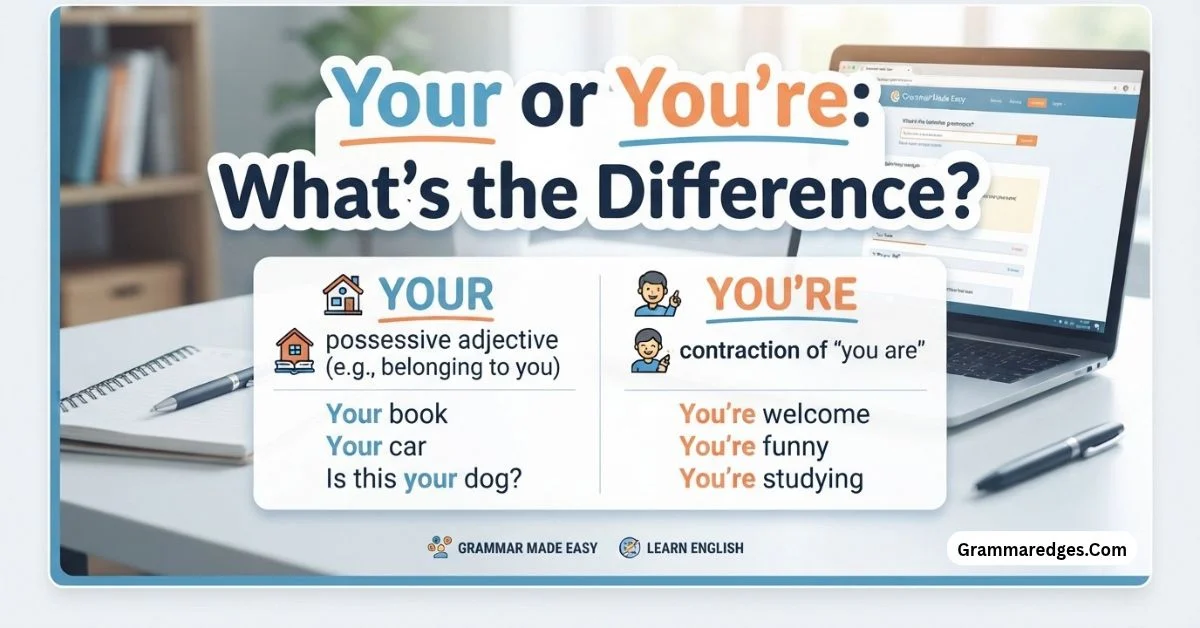
Your shows ownership, while you’re is a contraction of “you are.” Use your before a noun to show that something belongs to someone. Use you’re when you can replace it with “you are” without changing the sentence’s meaning. For example, “Your phone is ringing” is correct, while “You’re late” means “You are late.”
Key Takeaways
- Your shows possession or ownership, as in “your book.”
- You’re is the shortened form of “you are,” as in “you’re welcome.”
- Replace you’re with “you are” to check whether it fits.
- Never use your to mean “you are.”
- Both words are correct, but they serve different purposes in a sentence.
What Is the Difference Between Your and You’re?
The difference between your or you’re is simple: one shows ownership, and the other means “you are.”
Although these words sound exactly alike in American English, their meanings and grammatical roles are different. This makes them easy to confuse when writing a text message, email, school assignment, or social media post.
Think of it this way:
- Your = something belongs to you.
- You’re = you are.
For example:
- “Is this your jacket?” The jacket belongs to you.
- “You’re wearing a jacket.” This means “You are wearing a jacket.”
Both sentences are grammatically correct because each word has a different job.
The mistake happens when writers choose a word based on how it sounds instead of what the sentence means. Fortunately, one quick test can help you choose the correct word every time.
When to Use Your
Use your when you want to show that something belongs to, relates to, or is associated with the person you are speaking to.
In grammar, your is a possessive determiner, traditionally called a possessive adjective in many grammar lessons. It comes before a noun or a noun phrase.
For example:
- Your house is beautiful.
- I like your new shoes.
- Please bring your notebook tomorrow.
- Your answer is correct.
- What is your favorite movie?
- Your dog looks friendly.
In each sentence, your connects the person being addressed to something associated with them.
Examples of Your in Sentences
Here are more examples of how to use your naturally in everyday American English.
| Sentence | Why Your Is Correct |
|---|---|
| Where is your phone? | The phone is associated with you. |
| I love your idea. | The idea is yours. |
| Your coffee is getting cold. | The coffee is intended for you. |
| Please check your email. | The email account is yours. |
| Your team played well. | The team is associated with you. |
| Is this your seat? | The seat is assigned to you. |
Notice that your usually appears before a noun, such as phone, idea, coffee, or team.
Important: You do not always have to own something physically to use your. You can say “your opinion,” “your responsibility,” or “your turn.” The word can express a relationship, connection, or responsibility, not just legal ownership.
When to Use You’re
Use you’re when you mean “you are.” It is a contraction formed by combining the pronoun you with the verb are. The apostrophe replaces omitted letters.
You can use you’re before an adjective, a present participle ending in -ing, or certain other expressions.
For example:
- You’re very kind.
- You’re doing a great job.
- You’re my best friend.
- You’re going to love this movie.
- You’re responsible for the project.
- You’re always welcome here.
Each sentence works because you’re can be expanded to “you are.”
Examples of You’re in Sentences
| Sentence | Expanded Form |
|---|---|
| You’re amazing. | You are amazing. |
| You’re late for work. | You are late for work. |
| You’re learning quickly. | You are learning quickly. |
| You’re right about that. | You are right about that. |
| You’re a good listener. | You are a good listener. |
| You’re invited to the party. | You are invited to the party. |
Try expanding you’re into “you are” whenever you are unsure. If the sentence still makes sense, you’re is probably correct.
For example:
“You’re going to enjoy your vacation.”
Replace the contraction:
“You are going to enjoy your vacation.”
The sentence still makes sense, so you’re is correct. The same sentence also contains your because “your vacation” refers to the vacation associated with you.
Your vs. You’re: Quick Comparison Table
This table summarizes the main differences between the two words.
| Feature | Your | You’re |
|---|---|---|
| Meaning | Belonging or relating to you | You are |
| Grammar role | Possessive determiner | Contraction |
| Apostrophe | No | Yes |
| Usually followed by | A noun or noun phrase | An adjective, verb form, or other expression |
| Example | Your car is clean. | You’re very helpful. |
| Quick test | Does it show a relationship or possession? | Can you replace it with “you are”? |
Remember that both words are correct English. The right choice depends on what you want to communicate.
Common Your or You’re Mistakes
Many people confuse your and you’re because they sound the same. These common expressions are worth learning because they appear frequently in messages, conversations, and online writing.
Your Welcome or You’re Welcome?
The correct expression is “You’re welcome.”
This phrase means “You are welcome.” It is commonly used when responding to someone who says thank you.
- Correct: You’re welcome!
- Incorrect: Your welcome!
Here, welcome describes the person being addressed, so the contraction you’re is needed.
Your Right or You’re Right?
The correct choice depends on the meaning.
Use “you’re right” to say that someone is correct.
- Correct: You’re right about the answer.
- Incorrect: Your right about the answer.
Use “your right” when referring to something associated with a person, such as a legal right or the right side.
- Example: You have the right to express your opinion.
- Example: Your right hand is on the table.
The words may sound alike, but the meanings are different.
Your Going or You’re Going?
Use “you’re going” when you mean “you are going.”
- Correct: You’re going to the store.
- Incorrect: Your going to the store.
However, your can be correct when it comes before a noun or a gerund phrase used as a noun.
- Example: Your going to the store surprised me.
In this sentence, “your going to the store” is the subject of the sentence. It refers to the act of going, rather than directly stating “you are going.”
This is a more advanced construction, but it shows why context matters.
Your the Best or You’re the Best?
The correct expression is “You’re the best!”
It means “You are the best.”
- Correct: You’re the best friend anyone could ask for.
- Incorrect: Your the best friend anyone could ask for.
However, your is correct in a sentence such as “Your best friend is waiting outside.” Here, your describes whose friend is being discussed.
How to Remember Your vs. You’re
Use these three simple tricks to avoid confusion.
1. Try the “you are” test.
Replace you’re with “you are.” If the sentence makes sense, use you’re.
Example:
“___ going to love this.”
“You are going to love this.”
The correct answer is you’re.
2. Look for ownership or a relationship.
If the word refers to something associated with the person you are addressing, use your.
Example:
“Where is ___ backpack?”
You are asking about a backpack associated with the person. The correct answer is your.
3. Remember the apostrophe.
The apostrophe in you’re signals that letters have been omitted from “you are.” It does not show ownership.
Compare these sentences:
- You’re holding your umbrella.
- You’re = you are.
- Your umbrella = the umbrella associated with you.
Once you understand this distinction, choosing the correct word becomes much easier.
Can You Use Your and You’re in the Same Sentence?
Yes! You can use both words in the same sentence when each one has the correct meaning.
Examples include:
- You’re responsible for your homework.
- You’re going to enjoy your new job.
- I hope you’re happy with your purchase.
- You’re welcome to bring your friends.
- You’re making progress with your English grammar.
In the sentence “You’re responsible for your homework,” you’re means “you are,” while your shows whose homework is being discussed.
Using both words correctly is a good way to test whether you understand their different grammatical functions.
Frequently Asked Questions
1. What is the difference between your and you’re?
Your indicates possession or a relationship, while you’re means “you are.” For example, “your computer” refers to a computer associated with you, while “you’re busy” means “you are busy.” The easiest way to check you’re is to replace it with “you are” and see whether the sentence still makes sense.
2. Is it your welcome or you’re welcome?
“You’re welcome” is correct when responding to someone who thanks you. It means “You are welcome.” Your welcome is generally incorrect in this expression because the sentence does not describe something belonging to the other person. However, your welcome could be grammatically correct in a different context, such as discussing someone’s welcome message.
3. How do I remember your vs. you’re?
Remember that your relates to something associated with you, while you’re means “you are.” When writing a sentence, substitute “you are” for you’re. If the sentence sounds correct, use the contraction. If you are describing a person’s belongings, responsibilities, or relationships, your is usually the right choice.
4. Are your and you’re pronounced the same?
Yes. In standard American English, your and you’re are generally pronounced alike, although the exact pronunciation can vary by accent and context. Because they sound similar, you cannot reliably identify the correct spelling by listening alone. Instead, consider the meaning and grammatical role of the word in the sentence.
5. Can your and you’re both be correct?
Yes. Both words are correct English, but they are not interchangeable. Your shows possession or association, while you’re is short for “you are.” You can even use them together, as in “You’re going to enjoy your vacation.” Each word has a different meaning in that sentence.
Conclusion
Understanding your or you’re is easier when you remember one simple rule: your shows possession or association, while you’re means “you are.” Use your in phrases such as “your book” and “your idea.” Use you’re in sentences such as “you’re welcome” and “you’re doing great.”
Whenever you feel unsure, try replacing you’re with “you are.” If the sentence still makes sense, the contraction is correct. With a little practice, you can avoid this common grammar mistake in emails, schoolwork, social media posts, and everyday writing. Keep these rules handy, and your English writing will become clearer and more accurate.