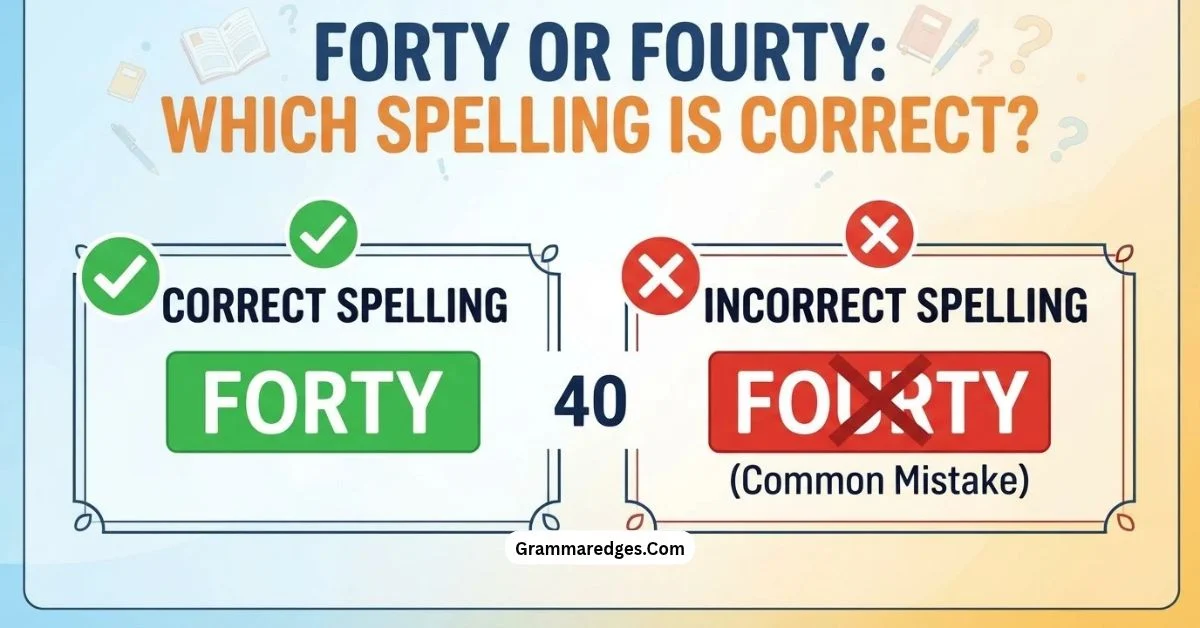
Forty is the correct spelling of the number 40. Fourty is a common spelling mistake and is not accepted in standard modern English. Although the word four contains a “u,” the word forty does not. This spelling is the same in American, British, Canadian, and Australian English.
Key Takeaways
- Forty is correct; fourty is incorrect in standard English.
- The number 40 is spelled without the letter “u.”
- Both American and British English use forty.
- The correct ordinal forms include fortieth and forty-first.
- Use forty when writing about ages, money, measurements, and quantities.
Is It Forty or Fourty?
If you have ever wondered whether to write forty or fourty, the answer is simple: always use forty when spelling the number 40 in standard English.
The confusion makes sense. The number 4 is spelled four, and the number 14 is spelled fourteen. So, adding a “u” to create fourty might seem logical.
However, English spelling does not always follow predictable patterns. The accepted spelling of 40 is forty, without the “u.”
Look at these examples:
- Correct: She is forty years old.
- Incorrect: She is fourty years old.
- Correct: The store has forty employees.
- Incorrect: The store has fourty employees.
The same rule applies to formal documents, school assignments, online articles, text messages, and professional emails.
What Does Forty Mean?
Forty is the number 40. It comes after thirty-nine and before forty-one.
It is a cardinal number, which means it expresses a quantity or amount.
Here are a few everyday examples:
- There are forty students in the classroom.
- I waited forty minutes for the bus.
- The jacket costs forty dollars.
- My grandfather is turning forty this year.
- The building has forty rooms.
In each sentence, forty tells the reader how many, how much, or how long.
The word can also appear in larger numbers, such as forty-two, forty-five, and one hundred forty. Its spelling remains the same.
Why Is Forty Spelled Without a U?
The main reason people write fourty is that they try to follow the spelling of four. Although this seems reasonable, the modern English spelling developed differently.
The Connection Between Four and Forty
Consider these related number words:
| Number | Correct spelling |
|---|---|
| 4 | Four |
| 14 | Fourteen |
| 24 | Twenty-four |
| 40 | Forty |
| 44 | Forty-four |
| 400 | Four hundred |
Notice that four keeps its “u” in several forms, but forty does not.
English number words have developed over many centuries. Their spellings do not always follow a simple rule that allows you to build one word directly from another. The spelling of forty is one of those exceptions that is best learned as a standard form.
A Brief History of the Spelling
The word forty comes from older English number forms related to the word four. Over time, the spelling changed as English developed, eventually settling on forty.
Older writing sometimes used forms that differ from modern spelling. That historical variation helps explain why fourty may appear in older texts or historical discussions. However, it does not make fourty the correct spelling in modern standard English.
The easiest rule to remember is this: four has a “u,” but forty does not.
Forty vs. Fourty: Key Differences
The two spellings look similar, but they are not interchangeable in standard writing.
| Feature | Forty | Fourty |
|---|---|---|
| Correct spelling | Yes | No |
| Meaning | The number 40 | No separate standard meaning |
| Letter “u” | Absent | Present |
| American English | Correct | Incorrect |
| British English | Correct | Incorrect |
| Formal writing | Accepted | Avoid |
The word forty is the correct choice in every ordinary context where you mean the number 40. Fourty is generally a misspelling caused by the influence of four.
For example:
- Correct: We invited forty guests to the party.
- Incorrect: We invited fourty guests to the party.
The difference is only one letter, but the correct spelling makes your writing clearer and more professional.
How to Use Forty in a Sentence
You can use forty in many everyday situations. Here are examples showing how it works in different contexts.
Forty in Ages and Time
When discussing someone’s age or a period of time, use forty if you choose to spell out the number.
Examples:
- My mother is forty years old.
- He has worked at the company for forty years.
- We drove for forty minutes before stopping.
- She will turn forty next month.
When forty comes before a noun as part of a compound adjective, use hyphens where appropriate.
For example:
- She is a forty-year-old teacher.
- They bought a forty-year-old house.
However, when describing someone’s age after the verb, do not hyphenate the number and noun.
Correct: She is forty years old.
Forty in Money and Measurements
The same spelling applies when writing prices, quantities, distances, and measurements.
Examples:
- The book costs forty dollars.
- The road is forty miles long.
- We need forty pounds of flour.
- The temperature reached forty degrees.
- The package weighs forty ounces.
For financial writing, the word forty is also used when spelling out an amount. For example, $40 can be written as “forty dollars” in ordinary prose.
Always follow the specific instructions on a financial or legal form if it requires a particular format.
Forty in Compound Numbers
When writing numbers from 41 to 49 in words, keep the spelling forty.
- 41 — forty-one
- 42 — forty-two
- 43 — forty-three
- 44 — forty-four
- 45 — forty-five
- 46 — forty-six
- 47 — forty-seven
- 48 — forty-eight
- 49 — forty-nine
In standard American English, compound numbers from twenty-one through ninety-nine are generally hyphenated when written as words.
For example:
Correct: Forty-two people attended the meeting.
Incorrect: Fourty two people attended the meeting.
Remember that the spelling forty never changes to fourty in these combinations.
Forty, Forty-First, and Fortieth: What’s the Difference?
These words are related, but they serve different purposes.
| Word | Meaning | Example |
|---|---|---|
| Forty | The number 40 | Forty people arrived. |
| Forty-first | Position number 41 | She finished forty-first. |
| Fortieth | Position number 40 | He celebrated his fortieth birthday. |
Use forty when counting quantities. Use fortieth when describing the position or order of something. Use forty-first for the position immediately after fortieth.
Notice that none of these forms includes the “u” found in four.
Examples:
- Today is her fortieth birthday.
- He lives on the forty-first floor.
- This is my fortieth visit to the city.
Avoid spellings such as fourtieth and fourty-first in standard English.
Is Forty the Same in American and British English?
Yes. Forty is the correct spelling in both American and British English.
Some English words have regional spelling differences. For example, American English uses color, while British English commonly uses colour. But forty does not follow that pattern.
| Variety of English | Correct spelling |
|---|---|
| American English | Forty |
| British English | Forty |
| Canadian English | Forty |
| Australian English | Forty |
The spelling remains the same across these varieties. Writing fourty is not a British alternative to the American spelling.
If you are writing for a US audience, use forty in essays, business communication, websites, and everyday messages.
Common Mistakes to Avoid
Even experienced writers sometimes make spelling mistakes with number words. Here are a few errors to watch for.
1. Adding a “u” because of four
Incorrect: I saved fourty dollars.
Correct: I saved forty dollars.
2. Misspelling the ordinal form
Incorrect: She celebrated her fourtieth birthday.
Correct: She celebrated her fortieth birthday.
3. Forgetting the hyphen in compound numbers
Incorrect: We counted forty five books.
Correct: We counted forty-five books.
4. Assuming British English uses fourty
Incorrect: Fourty is the British spelling.
Correct: Both American and British English use forty.
5. Using words when numerals are more suitable
In some reports, data tables, scientific writing, and financial summaries, writing 40 may be clearer than writing forty. The choice depends on the document’s style guide and context. When you spell the number out, however, forty is always the standard form.
Frequently Asked Questions
1. Is it forty or fourty?
Forty is correct. Fourty is a common misspelling and should be avoided in standard English. Although the number four contains a “u,” the number 40 is spelled without it. This rule applies to American English, British English, and other major English varieties.
2. Why is forty spelled without a u?
The spelling developed from older English forms over time. Although forty is related to four, its modern spelling does not preserve the “u.” English number names contain irregular patterns, so it is best to remember forty as the standard spelling rather than trying to construct it from four.
3. How do you spell 40 in words?
The number 40 is spelled forty. For example, “I have forty books” is correct. If you are writing a compound number, use forms such as forty-one, forty-two, and forty-nine. The ordinal form for position 40 is fortieth.
4. Is fourty ever correct?
In modern standard English, fourty is not the accepted spelling of the number 40. You might encounter it as a historical spelling, a typo, or part of a deliberately unusual name or username. For everyday, academic, and professional writing, use forty.
5. Is forty spelled differently in the UK and the US?
No. American and British English both use forty. Unlike words such as color and colour, this number does not have a standard regional spelling variation. If you are writing for an American audience, forty is the correct choice.
Conclusion
When deciding between forty or fourty, remember that forty is the only correct spelling of the number 40 in standard modern English. The confusion comes from the word four, which contains a “u,” but English spelling does not always follow predictable patterns.
Use forty for ages, prices, quantities, and measurements, and remember that fortieth and forty-first follow the same spelling pattern.
If you are writing a school assignment, professional email, website article, or everyday message, choosing forty will help keep your writing accurate and clear.