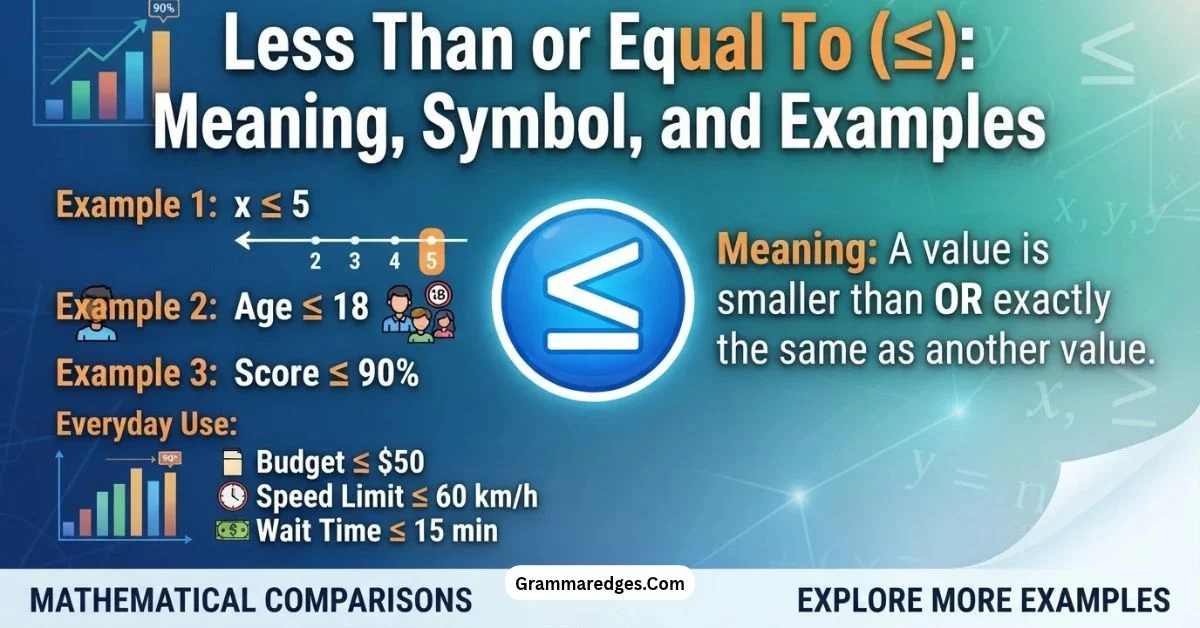
The phrase less than or equal to is commonly used in mathematics, science, technology, education, and everyday communication. It describes a value that is either smaller than another value or exactly the same. The symbol ≤ represents this relationship and helps people express limits, conditions, and comparisons clearly.
For example, if a rule says that a student must score less than or equal to 50 points, a score of 40 or 50 meets the requirement. However, a score of 51 does not.
People often search for the meaning of less than or equal to because they want to understand mathematical symbols, solve equations, interpret instructions, or recognize the symbol in digital messages. It can also appear in spreadsheets, computer programming, scientific research, and professional documents.
In this guide, you will learn what less than or equal to means, where it comes from, how to use it correctly, and how it differs from similar mathematical expressions.
1. Meaning and Definition of Less Than or Equal To
Less than or equal to means that one number is smaller than another number or has exactly the same value.
The mathematical symbol for this expression is ≤.
It combines two mathematical relationships:
- Less than (<): The first value is smaller than the second.
- Equal to (=): Both values have the same value.
When these relationships are combined, the result is less than or equal to.
Simple Examples
Consider the expression:
x ≤ 10
This means that x can be any value smaller than 10 or exactly 10.
Some possible values include:
- x = 3
- x = 7
- x = 9
- x = 10
All these values satisfy the expression.
However, x = 11 does not satisfy it because 11 is greater than 10.
How to Read the Symbol
The expression 5 ≤ 8 is read as “five is less than or equal to eight.”
Since five is smaller than eight, the statement is true.
Similarly, 8 ≤ 8 is also true because both numbers are equal.
However, 9 ≤ 8 is false because nine is greater than eight.
Why Is It Important?
This symbol makes mathematical statements shorter and easier to understand. Instead of writing a long sentence about acceptable values, you can express the same idea using a single symbol.
For example, a school might set an age limit of 18 years for a particular activity. If the requirement is that participants must be 18 or younger, it can be written as:
Age ≤ 18
This expression clearly includes the age of 18 as well as every lower age.
Understanding this symbol is essential for solving inequalities, interpreting graphs, and reading numerical conditions correctly.
2. Background and Origin of the Symbol
Mathematical symbols developed over centuries to make calculations and written explanations more consistent. Before modern mathematical notation became widespread, mathematicians often described relationships using words and sentences.
As mathematics advanced, written symbols became increasingly useful. They allowed complicated ideas to be expressed in a compact form and helped readers understand relationships without relying on long explanations.
The less-than and greater-than symbols, < and >, are commonly associated with the English mathematician Thomas Harriot, whose mathematical work was published in the early seventeenth century.
The symbols for less than or equal to and greater than or equal to developed from these basic comparison symbols by adding a line underneath them.
The additional line communicates that equality is also permitted.
Therefore:
- < means less than.
- ≤ means less than or equal to.
- > means greater than.
- ≥ means greater than or equal to.
This notation is now widely recognized in school mathematics, university-level research, scientific publications, and computer-based calculations.
Why Does the Symbol Have a Line?
The line underneath the less-than symbol represents the possibility of equality. Without it, the expression excludes values that are exactly equal.
For example:
x < 5 does not include 5.
x ≤ 5 includes 5.
That small difference can change the answer to an equation, the acceptable range in a scientific experiment, or the conditions used by a computer program.
Modern mathematical notation allows people around the world to communicate these relationships without translating long descriptions into different languages.
3. Usage in Different Contexts
The less-than-or-equal-to relationship appears in many situations where values must be compared or kept within a defined limit.
In Mathematics
Students use the symbol when solving inequalities.
For example:
x + 2 ≤ 8
Subtracting 2 from both sides gives:
x ≤ 6
The answer includes every real number that is less than or equal to 6.
The symbol is also used in number lines, graphs, algebra, and mathematical proofs.
In Education
Teachers may use this expression to explain scoring limits, age requirements, or acceptable measurements.
For example, if a student needs a score of 70 or lower to qualify for a particular category, the condition could be represented as:
Score ≤ 70
The precise interpretation depends on the rules of the activity.
In Business and Finance
Businesses use numerical limits to manage budgets, expenses, inventory, and spending.
For example:
Monthly expenses ≤ $2,000
This means that expenses must not exceed $2,000.
A total of $1,800 meets the condition, and a total of $2,000 also meets it.
A total of $2,100 does not.
In Computer Programming
Programmers use comparison operators to check whether values satisfy particular conditions.
Many programming languages use <= instead of the single mathematical symbol ≤.
For example, a condition in a programming language might look like this:
if (age <= 18)
This checks whether the value of age is less than or equal to 18.
If the condition is true, the program can perform a specified action.
In Everyday Life
The same idea appears in ordinary instructions.
Examples include:
- Keep the temperature at or below 25°C.
- Spend no more than $50.
- Submit a file that is 10 MB or smaller.
- Arrive within 15 minutes of the scheduled time.
In each case, the maximum stated value is included.
4. Meaning in Chat, WhatsApp, Instagram, and TikTok
On social media and messaging platforms, mathematical symbols sometimes appear in captions, comments, profiles, and conversations.
The symbol ≤ usually keeps its standard mathematical meaning, even when it appears in a casual message. However, the surrounding conversation may determine how the writer intends the comparison to be understood.
Meaning in Chat
Someone might write:
“Time needed ≤ 10 minutes.”
This means the task should take no more than 10 minutes.
Another example is:
“Budget ≤ $20.”
The person is indicating that the budget should not exceed $20.
Meaning on WhatsApp
On WhatsApp, people may use the symbol when discussing plans, expenses, scores, or limits.
For example:
“Our travel time should be ≤ 2 hours.”
This means the journey should take two hours or less.
The symbol is not a special WhatsApp feature or an established slang term. It is simply mathematical notation used in a message.
Meaning on Instagram
Instagram users may include mathematical comparisons in educational posts, fitness updates, captions, or infographics.
For example:
“Screen time ≤ 3 hours.”
The intended meaning is that screen time should be three hours or less.
In a statistics or educational post, the symbol may describe a data range or numerical condition.
Meaning on TikTok
TikTok creators may use the symbol in videos about mathematics, coding, science, studying, or personal challenges.
For example:
“Complete the challenge in ≤ 60 seconds.”
This means the challenge must be completed within 60 seconds, including exactly 60 seconds.
Does It Have a Secret or Romantic Meaning?
There is no widely established romantic or slang meaning associated with ≤ by itself. It does not automatically mean love, flirting, attraction, or a particular emotion.
If someone uses it in a dating conversation, interpret it according to the surrounding words.
For instance, “Distance ≤ 10 miles” probably describes a distance preference rather than an emotional message.
Tip: When you see this symbol online, read the full sentence before deciding what the sender means.
5. Meaning in Physics, Medical, and Aircraft Terminology
The less-than-or-equal-to symbol is especially useful in technical fields because measurements and operating conditions often have maximum or minimum limits.
Meaning in Physics
In physics, the symbol expresses relationships between measurable quantities.
For example:
v ≤ 20 m/s
This means that the velocity represented by v is no greater than 20 meters per second, assuming the quantities are defined as nonnegative speeds or velocities in the relevant context.
Another example is:
T ≤ 300 K
This states that the temperature T is at most 300 kelvin.
Scientists use inequalities to describe experimental conditions, physical constraints, measurement ranges, and theoretical relationships.
The exact interpretation depends on the quantity and the surrounding equation.
Meaning in Medical Terminology
Medical professionals and researchers use inequalities to communicate thresholds, study criteria, laboratory ranges, and research conditions.
For example:
Age ≤ 12 years
This identifies people aged 12 or younger.
A research protocol might also define eligibility using a numerical measurement that must remain below or equal to a specified threshold.
However, the symbol alone does not determine whether a medical result is healthy, abnormal, or dangerous. That interpretation depends on the test, units, clinical context, and applicable medical guidance.
Patients should not use an isolated inequality to diagnose themselves.
Meaning in Aircraft Terminology
In aviation, inequalities may appear in flight manuals, engineering calculations, aircraft performance data, and operating limitations.
For example:
Crosswind component ≤ 15 knots
This would express a limit of 15 knots or less for the crosswind component in the particular context where that value applies.
It is only an illustrative example, not a universal aviation limit.
Aircraft have specific operating procedures and limitations. Actual values depend on the aircraft type, configuration, conditions, and applicable documentation.
Similarly, an engineering calculation might specify that a measured load must remain at or below a defined maximum.
In all three fields, the central principle is the same: the stated boundary is included.
6. Common Misconceptions
Although the symbol is straightforward, several common mistakes can lead to incorrect answers.
Misconception 1: It Means Only Less Than
Some people assume that ≤ means the first number must always be smaller than the second.
That is incorrect.
The symbol also allows both values to be equal.
For example:
6 ≤ 6
This statement is true because six equals six.
Misconception 2: It Is the Same as Less Than
The symbols < and ≤ are related but not identical.
The expression 4 < 4 is false because four is not smaller than itself.
However, 4 ≤ 4 is true because equality is permitted.
Misconception 3: The Symbol Always Describes a Maximum
The symbol itself describes a mathematical relationship, not necessarily a practical maximum.
In an expression such as x ≤ 10, the value of x is limited to 10 or below. In other contexts, the same notation simply compares two variables.
Its practical meaning depends on the equation or statement.
Misconception 4: It Is Internet Slang
Although it appears in online conversations, ≤ is not inherently a slang expression.
Its usual meaning remains mathematical unless the writer clearly establishes another meaning.
Misconception 5: Every Programming Language Uses ≤
Many programming languages use <= rather than the single-character symbol ≤.
Typing the mathematical symbol directly into source code may not work as a comparison operator. The correct syntax depends on the language and environment.
Recognizing these differences helps prevent mistakes in homework, digital communication, and technical work.
7. Similar Terms and Alternatives
Several mathematical expressions look similar but communicate different relationships.
| Symbol or term | Meaning | Example |
|---|---|---|
| < | Less than | 3 < 7 |
| ≤ | Less than or equal to | 5 ≤ 5 |
| > | Greater than | 9 > 4 |
| ≥ | Greater than or equal to | 8 ≥ 8 |
| = | Equal to | 6 = 6 |
| ≠ | Not equal to | 5 ≠ 7 |
Less Than (<)
The less-than symbol means the first value must be smaller than the second.
For example, 2 < 6 is true.
However, 6 < 6 is false.
Greater Than or Equal To (≥)
This symbol expresses the opposite directional relationship.
For example, x ≥ 10 means x can be 10 or any number greater than 10.
Equal To (=)
The equals sign indicates that both sides have the same value.
For example, 4 + 3 = 7.
Unlike an inequality, a simple equality does not express a range of permitted values.
Other Ways to Write the Same Idea
In ordinary English, less than or equal to can be expressed using phrases such as:
- At most
- No greater than
- Not more than
- Up to and including
- Less than or equal to
For example, “The file must be 5 MB or smaller” expresses the same basic condition as file size ≤ 5 MB.
These alternatives can make technical information easier for readers who are unfamiliar with mathematical notation.
8. How to Respond When Someone Uses It
If someone sends you the symbol ≤ in a message, you usually do not need a special response. Simply understand the comparison and reply according to the subject.
When Discussing Time
Message: “I can stay for ≤ 30 minutes.”
Possible response: “Okay, we can finish within 30 minutes.”
When Discussing Money
Message: “My budget is ≤ $100.”
Possible response: “Got it. I’ll look for options costing $100 or less.”
When Discussing a Task
Message: “The final file must be ≤ 10 MB.”
Possible response: “Understood. I’ll make sure the file is no larger than 10 MB.”
When the Meaning Is Unclear
If the symbol appears without enough context, ask a simple question.
For example:
“Do you mean the value can equal that number too?”
This is useful when the distinction between a strict limit and an inclusive limit affects a decision.
The best response is usually direct and practical. There is no need to interpret the symbol emotionally or assume that it contains a hidden message.
9. Differences From Similar Words and Expressions
The expressions “less than,” “less than or equal to,” “at most,” and “up to” are often used in similar situations, but their precise meanings deserve attention.
Less Than vs. Less Than or Equal To
The key difference is whether the boundary value is included.
- x < 10: x must be smaller than 10.
- x ≤ 10: x can be smaller than 10 or equal to 10.
If x = 10, the first condition is false, while the second is true.
At Most vs. At Least
“At most” means no more than a particular value.
For example, “at most five guests” allows five guests or fewer.
“At least” means no less than a particular value.
For example, “at least five guests” requires five guests or more.
Therefore, “at most” corresponds to ≤, while “at least” corresponds to ≥ when expressing numerical limits.
Up To vs. Less Than
In everyday English, “up to 10” often includes 10, especially when describing quantities, capacities, or limits. However, the precise meaning can depend on the wording and context.
When exact mathematical precision matters, writing ≤ 10 removes the ambiguity.
No More Than vs. Not Equal To
“No more than 10” means a value cannot exceed 10, but it may equal 10.
“Not equal to 10” means the value must be anything except 10. It can be smaller or greater.
These expressions are not interchangeable.
Understanding the boundary condition is often the most important part of interpreting an inequality correctly.
10. Relevance in Online Conversations and Dating Apps
The less-than-or-equal-to symbol can be useful in digital conversations because it communicates limits without requiring a long sentence.
On dating apps, users might discuss practical preferences such as distance, age ranges, travel time, or spending limits. Mathematical notation could appear when someone wants to express one of these conditions briefly.
For example:
“Travel distance ≤ 20 miles.”
This communicates a distance of 20 miles or less, provided the measurement is being used as intended.
Similarly, a person discussing a planned date might write:
“Waiting time ≤ 15 minutes.”
The intended meaning is that the waiting time should not exceed 15 minutes.
However, such usage is not a universal dating-app convention. Most people are more likely to write “within 20 miles” or “15 minutes or less.”
Does It Indicate Romantic Interest?
No. The symbol does not independently indicate attraction, affection, commitment, or rejection.
Its meaning depends on the surrounding conversation. If someone sends only the symbol, you may need additional context to understand the intended comparison.
Why Is It Useful Online?
The symbol offers three practical benefits:
- Brevity: It communicates a numerical condition in a compact form.
- Precision: It makes clear whether the boundary value is included.
- Flexibility: It can be used in educational posts, technical discussions, captions, and messages.
For everyday dating conversations, simple language is often more natural. Use the mathematical symbol when both people understand it and the comparison benefits from precise notation.
Conclusion
The symbol ≤ means less than or equal to. It describes a value that is smaller than another value or exactly equal to it. This makes it different from the less-than symbol (<), which excludes equality.
The expression is widely used in mathematics, education, science, medicine, aviation, programming, business, and everyday communication. It can also appear in WhatsApp messages, Instagram captions, TikTok videos, and dating-app conversations when people discuss numerical limits or preferences.
Remember that the boundary value is always included when the symbol is used in its standard mathematical sense. For example, x ≤ 10 allows x to equal 10, but x < 10 does not.
Although the symbol may appear in casual digital messages, it has no universal secret or romantic meaning. Its interpretation depends on context. By understanding the symbol and comparing it with related expressions such as greater than or equal to, you can read mathematical statements, follow instructions, and communicate numerical limits more accurately.