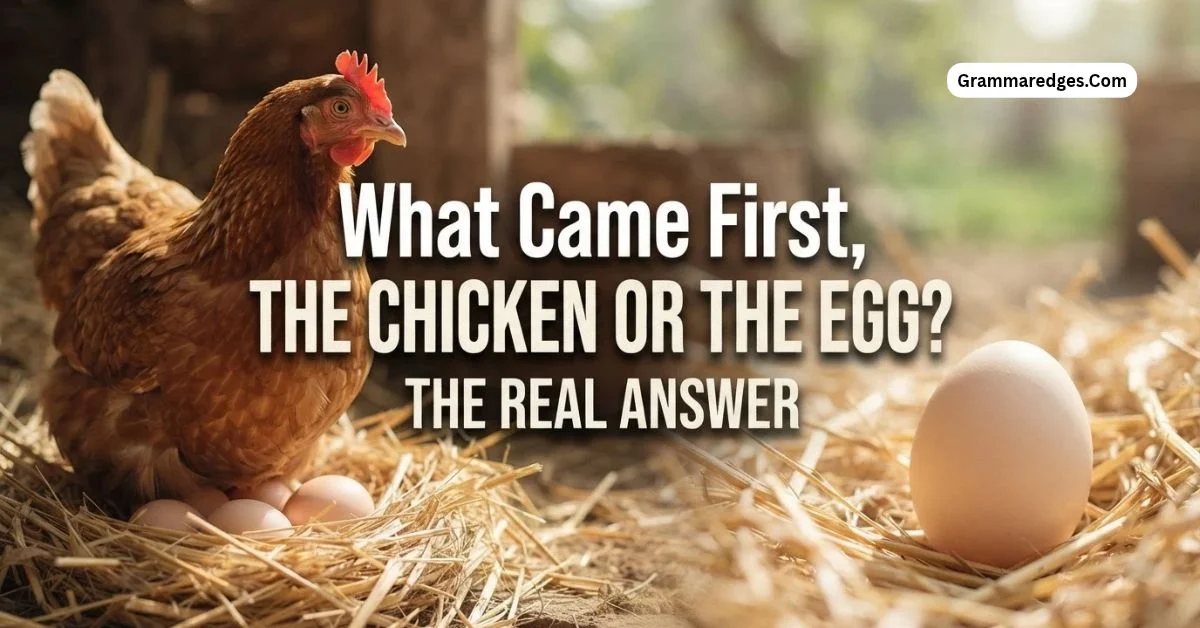
“What came first, the chicken or the egg?” is one of the most famous questions in science, philosophy, and everyday conversation. It asks us to think about how something can begin when it seems to depend on something else. Chickens hatch from eggs, but eggs are laid by chickens. So, which one started the cycle?
People search for this question for different reasons. Some want to know the scientific explanation, while others are interested in its philosophical meaning. It is also used in conversations to describe problems where two things depend on each other and neither seems to have a clear starting point.
Although the question sounds simple, it connects to evolution, genetics, reproduction, and human reasoning. Scientists can explain how egg-laying animals existed long before modern chickens appeared. Philosophers, meanwhile, use the question to explore the ideas of cause and effect.
In this article, we will examine the meaning, history, scientific answer, common misconceptions, and everyday uses of this famous question.
1. Meaning and Definition
The phrase “what came first, the chicken or the egg?” describes a question about origins. It asks which of two connected things existed before the other when each appears to depend on the other.
In its literal meaning, the question compares a chicken with the egg from which a chicken can hatch. A chicken must develop inside an egg, but a chicken also lays eggs. This creates an apparent circle: each seems to require the other to exist.
However, the answer depends on what we mean by “the egg.”
If we mean an egg in general, the egg came first. Many animals, including ancient fish, reptiles, and other egg-laying creatures, reproduced through eggs millions of years before chickens evolved.
If we mean an egg laid specifically by a modern chicken, the question becomes more complicated. Evolution does not usually produce a completely new species in one sudden step. Instead, small genetic changes accumulate across many generations.
Eventually, a bird very similar to a chicken produced an egg containing the genetic combination that would develop into what we classify as the first true chicken. Under this definition, the egg came first because the bird inside it qualified as a chicken before the egg was laid by a fully recognized chicken.
The figurative meaning
Beyond biology, this question describes situations where two events depend on each other.
For example:
- A business needs customers to grow, but it needs growth to attract more customers.
- A person needs work experience to get a job, but needs a job to gain experience.
- A website needs visitors to become popular, but popularity often helps attract visitors.
These are examples of a chicken-and-egg problem.
In simple terms: The phrase asks which of two closely connected things began first, especially when each seems to depend on the other.
2. Background and History
The chicken-and-egg question has roots in ancient philosophy. People have long wondered how life begins, whether every event has a cause, and whether a chain of causes can continue forever.
Ancient Greek thinkers explored similar questions about beginnings and the nature of existence. Aristotle, for example, discussed the relationship between animals and reproduction. He believed that living creatures came from other living creatures and considered questions about whether the world and life had a beginning.
The modern version of the question became a memorable way to express a broader philosophical problem: if one thing must come from another, how can the chain ever start?
How evolution changed the discussion
Scientific discoveries eventually provided a clearer biological explanation. Evolution shows that modern species developed gradually from earlier populations.
Domestic chickens are descended primarily from the red junglefowl, a wild bird native to parts of South and Southeast Asia. Domestication and selective breeding shaped the chickens people raise today.
Long before the ancestors of domestic chickens existed, many other animals already reproduced by laying eggs. Egg-laying reproduction is an ancient biological strategy, not something that began with chickens.
This distinction is important because the question sometimes treats chickens and eggs as if they appeared at the same moment. In reality, both have long evolutionary histories, and eggs existed first by an enormous margin.
Why the question remains popular
The question survives because it combines a familiar example with a difficult idea. Almost everyone understands that chickens hatch from eggs and that chickens lay eggs.
It is also flexible enough to apply to many areas of life. Teachers use it to introduce evolution and critical thinking. Philosophers use it to discuss causation. Business professionals use it to describe situations in which progress in one area depends on progress in another.
The question is therefore more than a puzzle about farm animals. It is a simple way to explore how beginnings work and why some problems appear impossible to solve.
3. What Came First: The Chicken or the Egg? The Scientific Answer
From a scientific perspective, the egg came first.
Eggs existed long before chickens evolved. Many ancient animals reproduced through eggs, including fish and other early vertebrates. Reptile-like ancestors also laid eggs long before modern birds appeared.
Chickens belong to the bird family, and birds evolved from theropod dinosaurs. These dinosaurs were part of a much older evolutionary history in which egg-laying reproduction was already well established.
Therefore, if the question refers to eggs in general, there is no serious scientific mystery: eggs came first.
How did the first chicken appear?
Evolution occurs through inherited genetic variation across generations. Mutations and other genetic changes can create differences between individuals. Natural selection, genetic drift, and other processes influence how these differences spread through populations.
Over many generations, ancestral birds gradually developed into the populations from which modern domestic chickens emerged.
There was not necessarily one dramatic moment when a non-chicken suddenly laid an egg and produced a completely unrelated animal. Species boundaries are classifications that humans apply to populations changing over time.
Still, the familiar explanation is useful: a bird that was almost, but not quite, a modern chicken laid an egg. The developing embryo inherited genetic variations that placed it within the group we identify as chickens.
In that sense, the egg containing the first chicken came before the first chicken itself.
Does science give one final answer?
The answer depends on how the question is defined.
- Eggs in general: The egg came first.
- The first chicken and the egg containing it: The egg came first.
- An egg laid by an already classified modern chicken: The chicken must exist before it can lay that particular egg.
The third interpretation changes the question by defining the egg according to the identity of the parent rather than the animal developing inside it.
The scientific conclusion is straightforward: egg-laying animals existed long before chickens, and evolutionary change explains how chickens developed from ancestral birds.
4. Usage in Different Contexts
The chicken-and-egg question appears in casual conversations, educational discussions, workplace meetings, and debates. Its meaning changes slightly depending on the situation.
In everyday conversation
Friends and family may ask the question as a joke, a riddle, or a conversation starter.
Someone might ask it during dinner simply to see how others respond. Another person might use it to start a discussion about science or philosophy.
The question is popular because it has a familiar setup but encourages different kinds of answers.
In education and science
Teachers may use the question to introduce evolution, genetics, reproduction, and the history of life.
It helps students understand that modern animals did not appear suddenly. Instead, species develop through changes across generations.
The question can also encourage students to define their terms carefully. Before answering, they must decide whether they mean any egg or an egg produced by a chicken.
In business and professional fields
In professional discussions, the phrase usually describes a circular dependency.
For example, a startup may need funding to develop a product, but investors may want evidence that the product will succeed before providing funding.
A manager might say, “We have a chicken-and-egg problem: customers want more features, but we need more customers to afford development.”
The expression does not necessarily mean that a problem has no solution. It highlights the difficulty of deciding which part to address first.
In technology and marketing
Online platforms often face a similar challenge. A new marketplace needs sellers to attract buyers, but sellers may not join until enough buyers are available.
The same problem can affect social networks, delivery services, and online communities.
A common solution is to focus on one side first, offer incentives, or build a small community in which both sides can find value.
In every context, the phrase encourages people to identify the dependency and find a practical starting point.
5. Meaning in Chat, WhatsApp, Instagram, and TikTok
On social media and messaging platforms, “what came first, the chicken or the egg?” can be a literal science question, a joke, a philosophical statement, or a metaphor for a confusing situation.
Its meaning usually depends on the surrounding conversation.
In chat messages
Someone might send the question to start a playful debate.
Example:
Person A: What came first, the chicken or the egg?
Person B: The egg. Dinosaurs laid eggs long before chickens existed.
The question may also appear when someone wants to discuss a situation in which the cause and effect are difficult to separate.
On WhatsApp
On WhatsApp, the phrase can appear in group chats, family discussions, or conversations with friends.
Example:
“Bro, what came first, the chicken or the egg? 😂”
This message may be intended as humor rather than a serious request for scientific information.
A thoughtful reply could explain that eggs existed before chickens, while a playful reply could keep the conversation light.
On Instagram
Instagram users may encounter the question in captions, comments, memes, or educational posts.
Creators can use it to encourage engagement by asking followers to share their opinions.
Example caption:
“Some questions never get old. 🐣 What came first, the chicken or the egg?”
The caption invites comments without requiring followers to have scientific knowledge.
On TikTok
On TikTok, the question can work as a short educational video, a comedy sketch, or a debate prompt.
A creator might explain the evolutionary answer in a few seconds or use the question to introduce a surprising scientific fact.
Users may also use it figuratively when discussing trends, relationships, or online popularity.
For example, a creator might ask whether a trend became popular because celebrities used it or whether celebrities used it because it was already popular.
Across these platforms, the phrase is not a special slang term with one fixed meaning. It is a familiar question whose interpretation depends on the conversation.
6. Meaning in Physics, Medical, and Aircraft Terminology
The phrase “what came first, the chicken or the egg?” is not a standard technical term in physics, medicine, or aviation. However, the underlying idea of determining causes and sequences appears in all three fields.
In physics
Physics investigates how events occur, how systems change, and how causes relate to outcomes.
The chicken-and-egg question can serve as an analogy for causation, time, and the origins of a physical system.
For example, scientists studying the early universe ask how its earliest conditions relate to the development of matter, stars, and galaxies.
However, the chicken-and-egg analogy does not itself explain any physical law. Questions about the origin of the universe require scientific models and evidence rather than a simple comparison between two dependent things.
In medical science
In medicine, the idea is especially relevant to distinguishing cause from correlation.
Suppose a study finds that people with poor sleep are more likely to experience stress. Researchers must ask whether poor sleep contributes to stress, stress causes poor sleep, or both influence each other.
This is a chicken-and-egg problem because the direction of causation may not be immediately clear.
Medical researchers use study design, longitudinal data, experiments where appropriate, and other evidence to investigate these relationships.
The phrase is a useful analogy, but it is not a formal medical diagnosis or a recognized medical procedure.
In aircraft and aviation terminology
There is no standard aircraft component, flight maneuver, or aviation procedure officially known as “what came first, the chicken or the egg?”
Nevertheless, the analogy can help explain planning and design dependencies.
For instance, aircraft designers may need to balance an aircraft’s weight, engine performance, fuel capacity, and structural requirements. Changes in one area can affect the others.
An aviation project may also depend on testing, certification, manufacturing, and training, with progress in one area influencing the rest.
In such situations, the phrase can describe a planning challenge. It should not be confused with official aviation terminology, safety procedures, or technical instructions.
7. Common Misconceptions
Several misunderstandings make the chicken-and-egg question seem more mysterious than it is.
Misconception 1: Eggs only exist because chickens lay them
This is incorrect. Many animals laid eggs millions of years before chickens existed. Fish, reptiles, and ancestral dinosaurs all belong to the long history of egg-laying life.
Misconception 2: The first chicken appeared suddenly
Evolution is a gradual process. Populations change across generations, and the development of a species usually cannot be reduced to one perfectly clear dividing line.
The first chicken is a useful way to describe the idea, but real evolutionary history is more complicated than one dramatic birth.
Misconception 3: Science has no answer
Science provides a strong answer when the terms are clearly defined. Eggs came before chickens in evolutionary history.
The apparent difficulty comes from treating all eggs as though they were chicken eggs.
Misconception 4: The question is only a joke
Although it is often used humorously, the question also introduces serious topics such as evolution, causation, logic, and circular dependency.
It can be useful in education and professional problem-solving.
Misconception 5: The chicken must always come first because it lays eggs
This argument assumes that the egg must be laid by a modern chicken. It ignores eggs laid by other animals and the evolutionary history of birds.
It also overlooks the distinction between the animal inside an egg and the animal that laid it.
The key lesson is that definitions matter. Once we clarify what “chicken” and “egg” mean, the scientific answer becomes much easier to understand.
8. Similar Terms and Alternatives
Several expressions communicate ideas similar to the chicken-and-egg question.
Chicken-and-egg problem
This is the most direct alternative. It describes a situation in which two things depend on each other, making it difficult to determine which should happen first.
Example: “Getting a job without experience is a chicken-and-egg problem.”
Cause and effect
This expression refers to the relationship between an event and its consequences.
Example: “We need to understand the cause-and-effect relationship before changing the process.”
Unlike the chicken-and-egg question, cause and effect does not necessarily involve circular dependency.
Circular dependency
A circular dependency occurs when one thing depends on another, which eventually depends on the first.
Example: Two software components may each require the other to function.
This term is common in computing, systems design, and organizational planning.
Which came first?
This is a simpler alternative that can be used when asking about the order of events.
Example: “Which came first: the invention or the discovery?”
A catch-22
A catch-22 describes a situation in which conflicting conditions prevent someone from making progress.
Example: “I need experience to get hired, but I need to get hired to gain experience.”
A catch-22 is related to a chicken-and-egg problem, but the expressions are not always interchangeable. A chicken-and-egg problem focuses on mutual dependence, while a catch-22 often involves a trap created by rules or circumstances.
Choosing the right expression helps communicate whether the problem involves origins, causation, mutual dependence, or conflicting requirements.
9. How to Respond to the Question
The best response depends on whether the person wants a scientific explanation, a philosophical discussion, or a humorous answer.
Give the scientific answer
If someone asks seriously, you can say:
“The egg came first. Egg-laying animals existed long before chickens evolved.”
This is the clearest answer when the word “egg” refers to eggs in general.
Explain the evolutionary answer
For a slightly more detailed reply, say:
“Chickens evolved from ancestral birds, and a bird very similar to a chicken eventually produced an egg containing the first animal we would classify as a chicken.”
This answer introduces evolution without making the process sound instantaneous.
Keep it funny
If the conversation is casual, you might reply:
- “The egg. The chicken was just running late. 😂”
- “The egg had a head start by millions of years.”
- “Let’s ask the chicken’s parents!”
- “Whichever came first, breakfast is still waiting.”
These responses work well in friendly chats and social media comments.
Give a philosophical answer
If the person wants to discuss deeper ideas, you could say:
“It depends on how we define the chicken and the egg. The scientific answer is the egg, but the question also explores how we understand beginnings and causes.”
In a professional discussion
If someone uses the expression to describe a business problem, avoid getting stuck on the literal animal question.
Instead, identify the two dependent factors and ask which one can be developed first.
For example, a business might attract its first customers through introductory offers before investing heavily in a larger platform.
The most useful response is the one that matches the person’s purpose. A quick factual answer is enough for casual curiosity, while a deeper explanation can open the door to a meaningful discussion.
10. Differences From Similar Questions and Expressions
The chicken-and-egg question is often confused with other questions about beginnings, origins, and causation. However, these expressions emphasize different ideas.
| Expression | Main meaning | Example |
|---|---|---|
| What came first, the chicken or the egg? | Which of two connected things existed first? | Did eggs exist before chickens? |
| Cause and effect | How one event produces or influences another | Did the policy change cause sales to rise? |
| Circular dependency | Two or more things depend on each other | Buyers need sellers, and sellers need buyers. |
| Which came first? | Asking about the order of two events | Did the idea come before the invention? |
| Catch-22 | A situation that blocks progress through conflicting conditions | You need a job to gain experience, but experience to get a job. |
| Origin question | Asking where something began | How did birds evolve? |
The key difference is that the chicken-and-egg question combines an origin problem with apparent mutual dependence.
A simple question about which event happened first may have a clear historical answer. A circular dependency may require a practical solution rather than an answer about the distant past.
For example, a company does not need to determine which came first in every sense before solving a customer-and-product problem. It may only need to decide which side to support first.
The expression is most useful when it highlights a genuine dependency rather than when it replaces careful analysis.
11. Relevance in Online Conversations and Dating Apps
The chicken-and-egg question can be a playful way to start a conversation online. Because it is familiar and open-ended, it gives people an easy opportunity to share an opinion.
As a conversation starter
Someone might send the question to a friend or post it in a group chat to encourage discussion.
It can reveal whether another person prefers scientific explanations, philosophical arguments, or humorous replies.
On dating apps
A light question can help break the ice when two people are getting to know each other.
For example:
“What came first, the chicken or the egg? I need to know if we’re compatible. 😂”
This kind of message is playful rather than romantic by itself. It works best when the conversation already has a relaxed tone or when both people enjoy unusual questions.
Other possible conversation starters include:
- “Would you rather know how the universe began or how it will end?”
- “Do you think everything happens for a reason?”
- “What’s a question you could debate for hours?”
- “Are you more interested in science or philosophy?”
These questions can encourage a more interesting conversation than a simple greeting.
What does it mean if someone sends it?
Do not assume that the person is flirting or sending a hidden romantic message. They may simply be joking, testing your knowledge, or looking for something interesting to discuss.
Look at the surrounding messages, the relationship, and the person’s usual communication style before interpreting their intentions.
If you are unsure, answer naturally and ask a follow-up question. For example, “I’d say the egg because of evolution. What do you think?”
This keeps the exchange friendly and gives the other person a chance to explain their point of view.
Conclusion
The question “what came first, the chicken or the egg?” may sound like a simple riddle, but it connects to evolution, philosophy, causation, and everyday problem-solving. The scientific answer is that the egg came first because egg-laying animals existed millions of years before chickens evolved. Even the first animal we would classify as a chicken developed inside an egg produced by an ancestral bird.
Beyond biology, the phrase describes situations in which two things depend on each other, such as gaining experience before finding a job or attracting buyers before recruiting sellers. It also appears in chats, social media posts, educational discussions, and dating-app conversations.
The most important point is to understand the context. Sometimes the question needs a scientific answer, while other times it is simply a fun way to start a discussion. By defining the terms clearly, we can solve the puzzle and use its deeper lesson to understand complicated problems in everyday life.