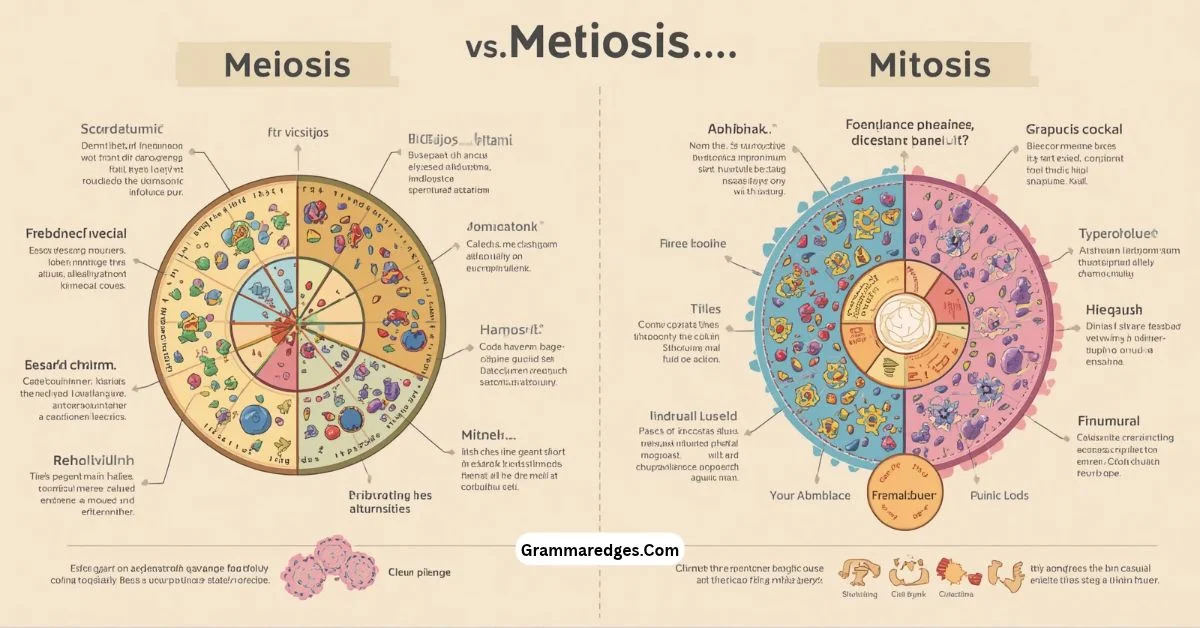
Meiosis and mitosis are two types of cell division, but they serve different purposes. Mitosis produces two genetically similar diploid cells for growth, repair, and cell replacement. Meiosis produces four genetically different haploid cells used in sexual reproduction. Meiosis also reduces the chromosome number by half and creates variation through processes such as crossing over.
Key Takeaways
- Mitosis produces two daughter cells that are usually genetically similar to the original cell.
- Meiosis produces four genetically different haploid cells.
- Mitosis is important for growth, repair, and cell replacement.
- Meiosis creates gametes, such as sperm and eggs, for sexual reproduction.
- Crossing over and independent assortment make meiosis an important source of genetic variation.
What Is Mitosis?
Mitosis is a type of cell division that produces two daughter cells from one parent cell. The daughter cells generally contain the same number of chromosomes as the original cell.
In humans, most body cells are diploid, meaning they contain 46 chromosomes arranged in 23 pairs. When a human cell undergoes mitosis, each resulting daughter cell normally receives a complete set of 46 chromosomes.
Mitosis is essential throughout life. Your body uses it to make new cells as you grow and to replace cells that become old, damaged, or worn out.
Purpose of Mitosis
Mitosis is mainly associated with:
- Growth
- Tissue repair
- Cell replacement
- Asexual reproduction in some organisms
For example, when your skin needs to replace damaged cells after a minor injury, cells divide through mitosis.
What Mitosis Produces
One parent cell undergoes nuclear division and eventually forms two daughter cells.
The chromosome number stays the same.
Human example:
46 chromosomes → mitosis → 46 chromosomes + 46 chromosomes
The daughter cells are generally genetically similar to the parent cell and to each other, although mutations can sometimes create differences.
What Is Meiosis?
Meiosis is a specialized form of cell division that produces cells with half the usual chromosome number.
It is used to make gametes, or reproductive cells. In humans, these include sperm and eggs.
Unlike mitosis, meiosis involves two rounds of cell division: meiosis I and meiosis II. However, the DNA is replicated only once before these two divisions.
In humans, a starting diploid cell has 46 chromosomes. After meiosis, the resulting cells are haploid and have 23 chromosomes.
Human example:
46 chromosomes → meiosis → four cells with 23 chromosomes each
When a sperm cell and an egg cell combine during fertilization, their chromosomes come together again. This restores the diploid chromosome number in the resulting fertilized cell.
Purpose of Meiosis
Meiosis is important because it:
- Produces haploid gametes
- Reduces chromosome number by half
- Supports sexual reproduction
- Creates genetic variation
That genetic variation is one of the major reasons siblings can inherit different combinations of traits from their parents.
Meiosis vs Mitosis: Key Differences
The easiest way to understand meiosis vs mitosis is to compare their purpose, number of divisions, products, and chromosome numbers.
| Feature | Mitosis | Meiosis |
|---|---|---|
| Main purpose | Growth, repair, and cell replacement | Production of gametes |
| Number of divisions | 1 | 2 |
| Daughter cells produced | 2 | 4 |
| Chromosome number | Maintained | Reduced by half |
| Human starting cell | Diploid, 46 chromosomes | Diploid, 46 chromosomes |
| Human resulting cells | Diploid, 46 chromosomes | Haploid, 23 chromosomes |
| Genetic similarity | Usually similar | Genetically different |
| Crossing over | No | Yes, during meiosis I |
| Role in reproduction | Not directly involved in making gametes | Essential for sexual reproduction |
| Cell types | Most somatic cells | Cells that give rise to gametes |
The biggest difference is simple:
Mitosis makes more cells while maintaining chromosome number. Meiosis makes reproductive cells while reducing chromosome number and increasing genetic variation.
Meiosis vs Mitosis Stages
Both processes involve organized chromosome movement, but meiosis is more complex because it has two consecutive divisions.
Stages of Mitosis
Mitosis is commonly described using four main stages:
- Prophase — Chromosomes condense and become easier to move.
- Metaphase — Chromosomes line up near the center of the cell.
- Anaphase — Sister chromatids separate and move toward opposite sides.
- Telophase — New nuclei form around the separated chromosomes.
Cytokinesis then divides the cell’s cytoplasm, producing two daughter cells.
A simple memory aid is:
PMAT — Prophase, Metaphase, Anaphase, Telophase.
Stages of Meiosis
Meiosis has two rounds:
Meiosis I
- Prophase I
- Metaphase I
- Anaphase I
- Telophase I
Meiosis II
- Prophase II
- Metaphase II
- Anaphase II
- Telophase II
One especially important event occurs during prophase I: homologous chromosomes pair up and can exchange sections of DNA through crossing over.
After meiosis I, homologous chromosomes have separated. During meiosis II, sister chromatids separate.
The two divisions ultimately produce four haploid cells.
Why Does Meiosis Create Genetic Variation?
One of the most important differences between meiosis vs mitosis is genetic variation.
Meiosis produces genetically different cells because of several processes.
Crossing Over
During prophase I, homologous chromosomes pair up. They can exchange corresponding sections of DNA.
This process is called crossing over.
It creates new combinations of genetic information on chromosomes.
Independent Assortment
During meiosis I, chromosome pairs line up independently of one another. This means different combinations of chromosomes can enter the resulting cells.
Random Fertilization
Although fertilization happens after meiosis rather than during it, it adds another source of variation. Any sperm can potentially combine with an egg, producing a new genetic combination.
Together, these processes help explain why children from the same parents can have different combinations of inherited traits.
Mitosis vs Meiosis in the Human Body
A useful way to distinguish these processes is to consider where they are used.
Mitosis is associated with ordinary body cells, also called somatic cells. It helps the body grow and maintain tissues.
For example, cells in tissues such as the skin can divide through mitosis to replace cells that have been lost or damaged.
Meiosis, on the other hand, is connected to the production of reproductive cells. In humans, the final products are sperm and eggs.
This difference can be summarized as:
Mitosis = body maintenance
Meiosis = reproductive cell production
There are important biological details behind this simplified explanation, but it provides a useful starting point for understanding the two processes.
Easy Way to Remember the Difference
If you’re studying biology, remember these three points:
1. Mitosis = Maintain
Mitosis maintains the chromosome number.
One cell becomes two similar cells.
2. Meiosis = Make Gametes
Meiosis helps make reproductive cells.
One starting cell ultimately produces four haploid cells.
3. Meiosis = More Variation
Meiosis includes processes such as crossing over and independent assortment, which contribute to genetic diversity.
A simple comparison is:
Mitosis: 1 division → 2 cells → same chromosome number
Meiosis: 2 divisions → 4 cells → half chromosome number
This shortcut is especially useful when reviewing for a biology test.
Common Questions About Meiosis and Mitosis
Is meiosis or mitosis longer?
Meiosis is generally more complex because it involves two rounds of division rather than one. Meiosis I includes pairing of homologous chromosomes and crossing over, while meiosis II separates sister chromatids. The exact time required can vary depending on the organism and cell type.
Does mitosis produce two or four cells?
Mitosis produces two daughter cells from one parent cell. The two cells generally retain the same chromosome number as the original cell. In humans, a typical diploid cell undergoing mitosis produces two diploid daughter cells.
Does meiosis produce haploid or diploid cells?
Meiosis produces haploid cells. In humans, haploid cells contain 23 chromosomes. This is half the 46 chromosomes found in typical diploid body cells. Having half the chromosome number allows fertilization to restore the diploid number.
Why is meiosis important?
Meiosis is important because it produces reproductive cells with half the normal chromosome number and contributes to genetic variation. Without chromosome reduction, combining two reproductive cells during fertilization would continually increase chromosome number across generations.
Does DNA replicate before meiosis and mitosis?
Yes, DNA replication occurs before both processes, but it happens only once before meiosis. Meiosis then has two successive divisions. In mitosis, DNA replication is followed by one cell division.
What is the main difference between mitosis and meiosis?
The main difference is their biological purpose and outcome. Mitosis produces two genetically similar cells while maintaining chromosome number. Meiosis produces four haploid cells and creates genetic variation, making it essential for sexual reproduction.
Conclusion
Understanding meiosis vs mitosis becomes much easier when you focus on their purpose and final products. Mitosis involves one division and produces two cells with the same chromosome number as the original cell.
It supports growth, repair, and normal cell replacement. Meiosis involves two divisions and produces four haploid cells with half the chromosome number.
It is essential for producing gametes and contributes to genetic variation through processes such as crossing over and independent assortment. If you remember “mitosis maintains” and “meiosis makes reproductive cells,” the core difference becomes much easier to recall.