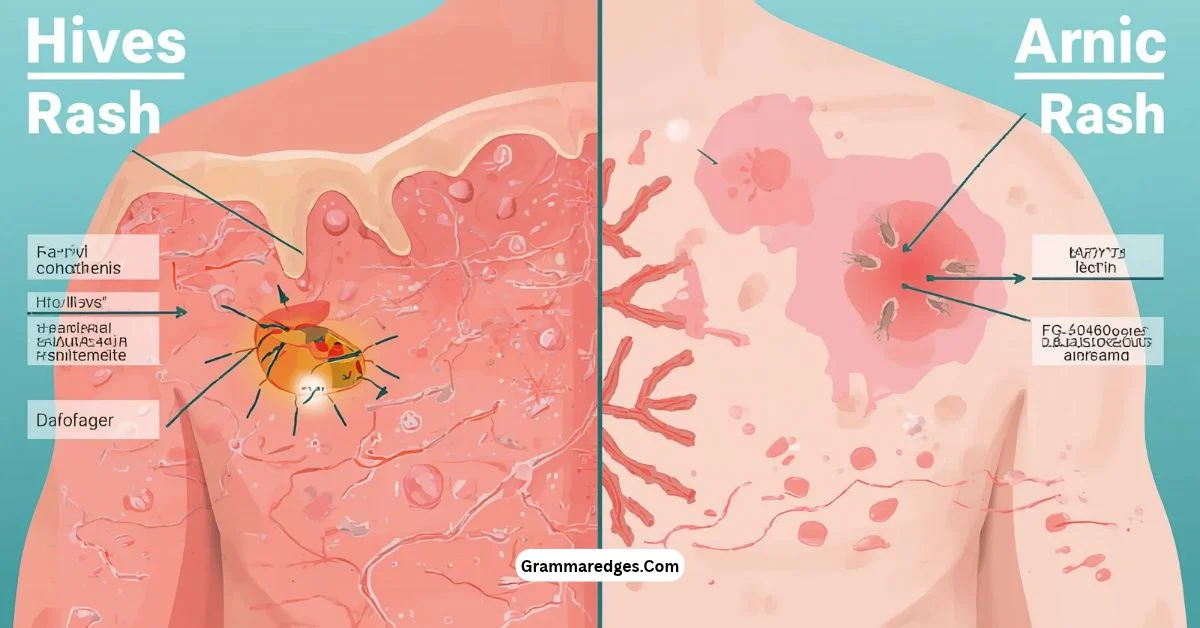
Hives are a specific type of skin reaction that causes raised, often itchy welts that can appear suddenly and usually fade within 24 hours. A rash is a broader term for changes in skin color, texture, or appearance and can include bumps, patches, scales, blisters, or raw skin.
Key Takeaways
- Hives are a type of skin reaction, while “rash” is a general term for many skin changes.
- Hives usually appear as raised, itchy welts that change shape or location and often disappear within 24 hours.
- Other rashes may cause dryness, scaling, blisters, crusting, pain, or persistent patches.
- Hives can result from allergies, infections, medications, physical triggers, or sometimes an unknown cause.
- Breathing problems, throat swelling, or swelling of the tongue or lips require emergency medical attention.
What Are Hives?
Hives, medically called urticaria, are raised areas of swollen skin that often itch intensely. They can be small or large, round or irregular, and may join together into larger patches.
Hives can look red or pink on lighter skin. On brown or Black skin, they may be skin-colored, darker, lighter, purple, gray, or brown, so color alone is not a reliable way to identify them.
One of the most useful clues is their behavior. Individual hives often disappear within 24 hours, although new welts can develop somewhere else. They may seem to move around the body because old welts fade while new ones appear.
Hives can also burn or sting rather than simply itch. Some people develop deeper swelling called angioedema, particularly around the lips, eyelids, face, or throat.
The American Academy of Dermatology notes that hives can appear as raised spots, patches, or larger plaques and may occur anywhere on the skin.
Common Signs of Hives
Typical clues include:
- Sudden appearance
- Raised welts or patches
- Intense itching
- Burning or stinging
- Welts that change shape
- Individual welts that usually disappear within 24 hours
- New welts appearing as older ones fade
- Possible swelling of the deeper skin
Hives are sometimes associated with allergic reactions, but not every case is caused by an allergy. Triggers can include infections, medications, heat, cold, pressure, exercise, sunlight, or other physical factors. In many cases, the exact cause is not identified.
What Is a Skin Rash?
A rash is a broad description, not one specific disease.
A rash means that the skin has changed in appearance or texture. It may become red, darker, lighter, swollen, dry, bumpy, scaly, blistered, or irritated.
Many different conditions can cause a rash. Examples include:
- Contact dermatitis
- Eczema
- Psoriasis
- Infections
- Allergic reactions
- Heat rash
- Medication reactions
- Irritation from chemicals or products
Some rashes are itchy, while others are painful, burning, tender, or barely noticeable.
For example, contact dermatitis can cause redness, itching, dryness, scaling, blisters, oozing, crusting, burning, or tenderness. The reaction may remain in the area where the irritating or allergenic substance contacted the skin.
This is why simply asking, “Is it a rash?” does not identify the underlying condition. A healthcare professional may need to consider the appearance, location, timing, symptoms, exposures, medications, and other health information.
Hives vs Rash: Key Differences
| Feature | Hives | Other Skin Rashes |
|---|---|---|
| Meaning | A specific skin reaction called urticaria | Broad term describing many skin changes |
| Typical appearance | Raised welts or swollen patches | May be flat, raised, scaly, dry, blistered, or raw |
| Itching | Often intense | May or may not itch |
| Duration | Individual hives often disappear within 24 hours | Can last days, weeks, or longer depending on the cause |
| Movement | New welts may appear as old ones disappear | Usually remains in the affected area until the cause improves |
| Texture | Usually smooth and raised | Can be dry, rough, scaly, blistered, or crusted |
| Common causes | Allergies, infections, medications, physical triggers, unknown causes | Dermatitis, eczema, infections, allergies, irritation, and many other conditions |
| Swelling | May occur, including angioedema | Depends on the underlying condition |
The biggest practical difference is how the skin changes over time. A hive tends to appear quickly, change shape, and fade relatively quickly. Many other rashes remain visible in the same area and may gradually become dry, scaly, blistered, crusted, or irritated.
Appearance
Hives are generally raised and smooth. They may be individual welts or larger connected patches.
A general rash can have many different appearances. It might be flat or raised and may involve scaling, peeling, blisters, crusting, or raw skin.
Because many skin conditions can resemble one another, appearance alone is not always enough to determine the cause.
How Long They Last
Duration can be an especially useful clue.
An individual hive usually disappears within 24 hours, although new hives can continue to appear. Acute episodes may resolve within days or weeks. Hives that continue or recur for more than six weeks are generally classified as chronic hives.
Other rashes may last much longer depending on their cause. For example, dermatitis can continue while the skin remains exposed to an irritant or allergen.
How They Feel
Hives are commonly very itchy, although burning or stinging can occur.
Other rashes may itch too, but they can also cause dryness, pain, tenderness, burning, cracking, or fluid-filled blisters.
For example, eczema can cause dry, scaly skin, intense itching, inflammation, and sometimes oozing or crusting.
Causes and Triggers
Hives can have many triggers. Food and medication allergies are possible causes, but infections and physical triggers such as cold, heat, pressure, exercise, or sunlight can also play a role.
Rashes have an even wider range of possible causes. Contact with soaps, cosmetics, plants, metals, chemicals, or other irritants can cause dermatitis. Eczema, infections, psoriasis, and medication reactions can also produce rashes.
Therefore, hives do not automatically mean that you have an allergy, and a rash does not automatically mean that you have an infection.
How They Change Over Time
This is one of the strongest clues.
Hives often appear suddenly and then fade, sometimes in a completely different location. A rash caused by dermatitis or eczema generally remains in the affected area and changes gradually.
Still, this is only a general pattern—not a reliable way to diagnose a skin condition yourself.
Can Hives Be Caused by an Allergy?
Yes. Allergic reactions can cause hives, particularly reactions to certain foods, medications, insect stings, or other allergens.
However, hives also occur without a clearly identified allergy. Physical triggers, infections, and other immune-related processes can cause them.
If hives appear together with swelling of the lips, tongue, mouth, or throat, wheezing, difficulty breathing, dizziness, or fainting, the situation may represent anaphylaxis, a serious allergic reaction requiring emergency medical care.
Hives vs Common Types of Rash
Hives vs Contact Dermatitis
Contact dermatitis usually develops after the skin encounters an irritating or allergenic substance.
Unlike typical hives, contact dermatitis can produce dry, rough, scaly, cracked, blistered, oozing, or crusted skin. It often affects the area exposed to the substance.
Hives are usually smoother, raised, and more temporary.
Hives vs Eczema
Eczema, including atopic dermatitis, commonly causes itchy, dry, inflamed, or scaly skin. Scratching can make the skin raw and may lead to additional irritation.
Hives, by contrast, are typically raised welts that come and go relatively quickly.
Because both conditions can itch intensely, the duration and texture of the skin changes can provide useful clues.
How Are Hives and Rashes Treated?
Treatment depends on the underlying cause.
For mild hives, healthcare professionals may recommend antihistamines to control itching and swelling. Avoiding known triggers can also help prevent additional episodes.
For other rashes, treatment may involve removing an irritant, treating an underlying infection, controlling inflammation, or using other therapies appropriate for the diagnosed condition.
Avoid assuming that the same treatment works for every rash. A cream or medication that helps one condition may not be appropriate for another.
If a rash is severe, persistent, widespread, or repeatedly returns, getting a professional diagnosis is safer than repeatedly treating it based only on appearance.
When Should You Seek Medical Care?
Get emergency medical help if hives or a rash occur with:
- Trouble breathing
- Trouble swallowing
- Swelling of the tongue or throat
- Significant swelling of the lips or mouth
- Wheezing
- Fainting or severe dizziness
These can be signs of a serious allergic reaction. Anaphylaxis can become life-threatening and requires prompt emergency treatment.
A rash also deserves medical attention if it:
- Covers most of the body
- Spreads rapidly
- Becomes painful
- Blisters or develops open sores
- Occurs with fever or significant illness
- Involves the eyes, lips, mouth, or genital area
- Shows signs of infection such as pus, increasing warmth, swelling, or pain
The American Academy of Dermatology recommends medical evaluation for these warning signs because some serious conditions can initially resemble an ordinary rash.
Frequently Asked Questions
Can hives be mistaken for a rash?
Yes. Hives are actually a type of skin eruption and can look like a general rash. The key clues are their raised, usually smooth welts and their tendency to appear and disappear quickly. Individual hives commonly fade within 24 hours, while many other rashes remain longer and may develop scaling, blisters, crusting, or raw skin.
Are hives always caused by allergies?
No. Allergies can cause hives, but they are not the only possible trigger. Infections, medications, temperature changes, pressure, exercise, sunlight, and other physical triggers may cause hives. Sometimes no specific cause is found.
How long do hives usually last?
An individual hive usually disappears within 24 hours, although new welts can continue to appear. An episode of acute hives may continue for days or weeks. Hives that persist or recur for more than six weeks are considered chronic.
Can a rash turn into hives?
A rash does not necessarily “turn into” hives because rash is a broad description, while hives are a specific reaction. However, the same trigger—such as an allergy or medication—can cause hives in one situation and another type of rash in another.
Are hives contagious?
Hives themselves are generally not contagious. However, an infection can sometimes trigger hives. If the underlying illness is contagious, that infection—not the hives themselves—may spread to other people.
Conclusion
When comparing hives vs rash, remember that the terms are not equal categories. Hives are a specific type of skin reaction, while a rash is a general term for many changes in the skin.
Hives are usually raised, itchy welts that appear suddenly and individual lesions often disappear within 24 hours. Other rashes can be dry, scaly, blistered, painful, crusted, or persistent.
The appearance and timing can offer useful clues, but they cannot always identify the cause. If skin symptoms are widespread, rapidly spreading, painful, associated with fever, or accompanied by breathing difficulty or swelling of the mouth or throat, seek appropriate medical care promptly.