
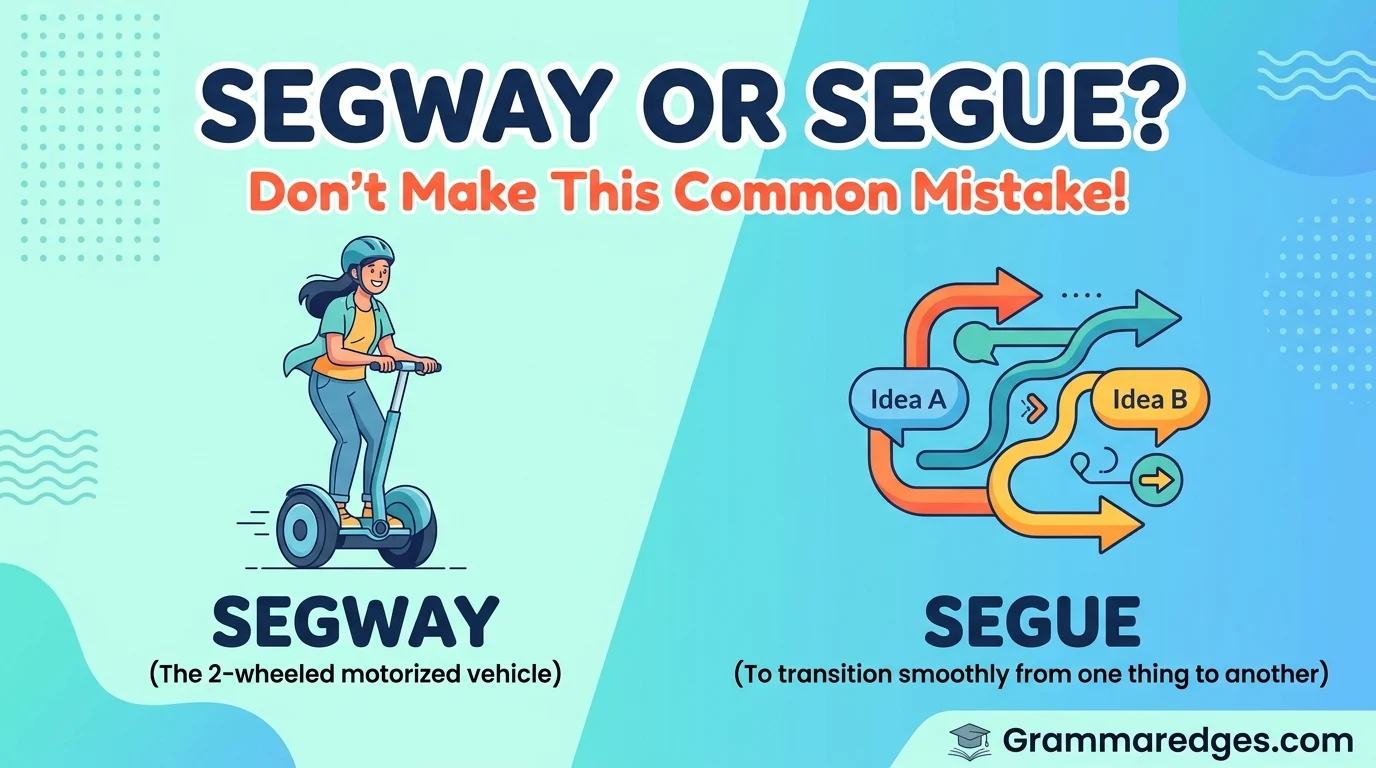
Have you ever wondered whether to write Segway or segue? These two words sound exactly alike, but their meanings are completely different.
One describes a smooth transition between topics or ideas, while the other refers to a popular personal transportation brand.
This similarity often creates confusion in everyday conversations, emails, and professional writing. So, which spelling is correct, and how can you avoid mixing them up? In this guide, you’ll discover the meaning, pronunciation, key differences, and easy sentence examples of Segway and segue so you can use the right word with confidence.
Key Takeaways
- Segue means a smooth transition between topics, activities, scenes, or ideas.
- Segway refers to a personal transportation brand and its products.
- Both words are pronounced approximately like “SEG-way.”
- Segue can function as both a noun and a verb.
- Writing “segway” when you mean a transition is a common spelling mistake.
Segue vs. Segway: Quick Comparison
The easiest way to understand these words is to compare their meanings and everyday uses.
| Feature | Segue | Segway |
|---|---|---|
| Meaning | A smooth transition | A transportation brand |
| Word type | Noun and verb | Proper noun |
| Pronunciation | SEG-way | SEG-way |
| Origin | Italian | Brand name |
| Main use | Speaking and writing | Personal transportation |
| Capitalization | Usually lowercase | Capitalized as a brand |
| Example | Let’s segue into another topic. | We rented a Segway. |
Both spellings are correct in their proper contexts. However, they cannot be used interchangeably.
For example, if you want to introduce another subject during a meeting, you should write:
“Let me segue into our next discussion.”
Writing “Let me Segway into our next discussion” is incorrect because you are not talking about a transportation device.
What Does Segue Mean?
Segue is a word that describes a smooth or natural movement from one thing to another. It can refer to changing subjects in a conversation, moving between sections of a presentation, or connecting different musical pieces.
The word comes from Italian, where segue means “it follows.” It originally appeared in musical instructions to indicate that one passage should continue into the next without a break. Its meaning later expanded into everyday English. Canada.ca+1
Today, people commonly use segue in conversations, meetings, presentations, podcasts, articles, and storytelling.
For example:
“Her question provided a natural segue into the next discussion.”
This means her question helped the speaker move smoothly to another subject.
Segue as a Verb
As a verb, segue describes the action of moving smoothly from one topic, activity, or situation to another.
It is particularly useful when you want to describe a natural change instead of an abrupt interruption.
Examples:
- The teacher will segue into the next lesson after answering questions.
- The podcast host segued from sports into entertainment.
- She used a personal story to segue into her main presentation.
- The conversation slowly segued toward future plans.
- The movie segues from a quiet scene into an exciting sequence.
The verb can also change forms depending on the sentence.
| Form | Example |
|---|---|
| Base form | I segue into another topic. |
| Third-person singular | She segues into the discussion. |
| Past tense | He segued into a new subject. |
| Present participle | They are segueing into the next section. |
Notice that the standard present participle is segueing, not segwaying. Canada.ca+1
Segue as a Noun
Segue also works as a noun. In this form, it refers to the transition itself rather than the action of moving between subjects.
For example:
“That was a clever segue into the final question.”
Here, segue describes the connection that made the change of topic feel natural.
More examples:
- The host created a smooth segue between the two interviews.
- His joke was an unexpected segue into the serious discussion.
- The final scene provides a perfect segue into the sequel.
- We need a better segue between these two presentation slides.
A simple way to remember the difference is that the verb describes making a transition, while the noun identifies the transition.
What Does Segway Mean?
Segway is a proper brand name associated with self-balancing personal transportation devices. These electric vehicles generally have two wheels, a standing platform, and a handlebar that helps the rider control movement.
Unlike segue, the word Segway has nothing to do with changing subjects in a conversation.
For example:
“My friends and I took a Segway tour around the city.”
This sentence refers to riding personal transportation devices rather than moving between topics.
Here are more examples:
- The tourists rented Segways to explore the area.
- He learned how to balance on a Segway.
- The company offers guided Segway tours.
- We saw several people riding Segways in the park.
- She watched a demonstration of a self-balancing Segway.
Remember that Segway should normally begin with a capital S when referring to the brand.
If you are writing about a general transition, use segue instead.
Why Are Segway and Segue Pronounced the Same?
One of the biggest reasons people confuse these words is their pronunciation.
Both are generally pronounced “SEG-way.” The unusual spelling of segue makes it difficult for some readers to recognize the word when they hear it for the first time.
Segue comes from Italian, while Segway is a brand name. Their similar sounds do not mean they share the same meaning or spelling. English meaning – Cambridge Dictionary+1
Consider these examples:
- “Let’s segue into the next topic.”
- “Let’s ride the Segway around the park.”
When spoken, the words sound alike. However, their meanings become clear from the surrounding sentences.
This is why you should use context rather than pronunciation to choose the correct spelling.
Segway or Segue: Examples in Sentences
Looking at both words in complete sentences can make their differences easier to remember.
Examples of Segue
Use segue when discussing a smooth transition between subjects, activities, or ideas.
- The speaker used a funny story as a segue into the main presentation.
- Let’s segue from the introduction to the important details.
- Her question created a natural segue into our next discussion.
- The movie smoothly segues into its final scene.
- The radio host segued into a new song without interruption.
- We need a better segue between these two paragraphs.
- His comments helped segue the conversation toward business.
- The teacher used an example to segue into the next lesson.
Examples of Segway
Use Segway when referring to the transportation brand or its products.
- We rented a Segway during our vacation.
- The guide explained how to operate the Segway safely.
- They enjoyed a guided Segway tour through the city.
- My brother wants to learn how to ride a Segway.
- Several tourists were using Segways near the park.
- She watched a video about Segway transportation.
- The group stopped to take pictures beside their Segways.
- He bought a Segway for personal transportation.
These examples show that the words belong to completely different contexts. Segue is related to language and transitions, while Segway is related to transportation.
When Should You Use Segue or Segway?
Choosing the correct spelling becomes simple when you understand what your sentence is describing.
Use segue when:
- You are changing from one conversation topic to another.
- A speaker moves smoothly between presentation sections.
- A song continues into another musical piece.
- A story moves naturally between scenes.
- You are describing a connection between two ideas.
Use Segway when:
- You are discussing the transportation brand.
- Someone is riding a Segway.
- You are describing a Segway tour.
- You are talking about the company’s personal transportation products.
Quick memory trick: A segue moves your conversation forward, while a Segway moves a person from one physical location to another.
Common Mistakes to Avoid
Even experienced writers sometimes confuse these words because they sound the same.
Here are some common mistakes and their corrections.
| Incorrect sentence | Correct sentence |
|---|---|
| Let me segway into another topic. | Let me segue into another topic. |
| That was a perfect segway. | That was a perfect segue. |
| She segwayed into the next subject. | She segued into the next subject. |
| We rented a segue for the tour. | We rented a Segway for the tour. |
| The speaker is segwaying into the conclusion. | The speaker is segueing into the conclusion. |
The most important thing to remember is that segway is not the standard spelling for a conversational or written transition.
Although people sometimes use it informally as a spelling mistake, edited American English should use segue for this meaning.
If you are unsure, ask yourself whether the sentence describes a transition or a vehicle. That simple question will help you choose the correct word.
Frequently Asked Questions
1. Is it Segway or segue?
Both words are correct, but their meanings are different. Segue describes a smooth transition between topics, activities, or ideas. Segway is a brand name associated with personal transportation devices. If you are changing subjects during a conversation, the correct spelling is segue.
2. What does segue mean in simple words?
Segue means to move smoothly from one thing to another. For example, when a speaker finishes discussing one subject and naturally introduces another, they segue into the next topic. It can also describe a smooth transition between songs, scenes, or activities.
3. Is segue pronounced like Segway?
Yes. In standard American English, segue is generally pronounced “SEG-way,” just like Segway. Their pronunciation is the main reason people confuse their spellings. You need to understand the sentence’s meaning to know which word is correct.
4. Can segue be used as a noun and a verb?
Yes. Segue can function as both a noun and a verb. As a verb, it describes moving smoothly into another subject. As a noun, it identifies the transition itself. For example, “She segued into the next topic” uses the verb, while “That was a smooth segue” uses the noun.
5. Is segway a spelling mistake?
It depends on the context. Segway is correct when referring to the transportation brand. However, using segway to describe a transition between topics is considered a spelling mistake in standard English. The correct word for that meaning is segue.
6. What is another word for segue?
Depending on the sentence, alternatives include transition, shift, move, progression, connection, and changeover. For example, instead of writing “That was a smooth segue into the next topic,” you could write “That was a smooth transition into the next topic.”
Conclusion
Understanding Segway or segue is easier once you learn that both words have different meanings despite sounding almost identical.
Use segue when describing a smooth transition between conversations, ideas, musical pieces, or activities. Choose Segway when talking about the personal transportation brand and its products.
Remember that segue can work as both a noun and a verb, making it useful in everyday conversations, professional presentations, and written content. If you ever feel confused about these spellings, focus on the meaning of your sentence rather than how the word sounds.
This simple difference will help you avoid a common writing mistake and use both words confidently.