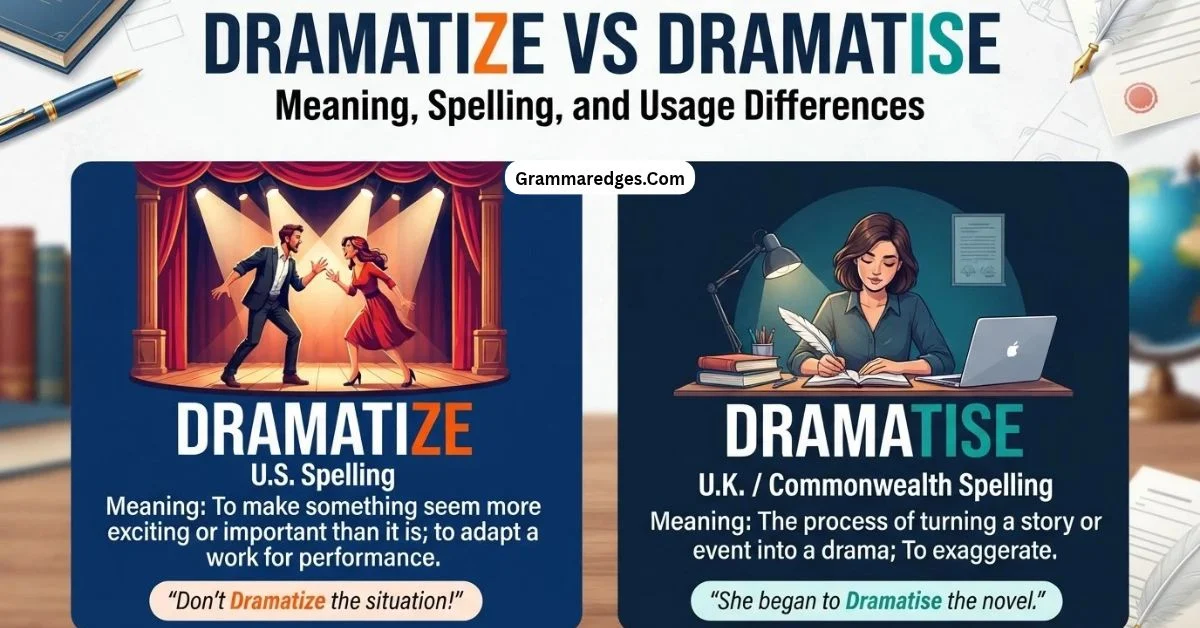
Have you ever wondered whether to write dramatize or dramatise? Both spellings are correct, but choosing the right one depends mainly on your audience and the type of English you use. This small spelling difference often confuses students, writers, bloggers, and professionals who want their writing to look natural and grammatically correct.
The word dramatize generally means to present something as a drama, adapt a story for performance, or make a situation appear more dramatic than it really is. The alternative spelling, dramatise, carries the same meaning but is preferred in British English and several other varieties of English.
Understanding this difference can help you write better essays, professional emails, social media posts, and articles. Whether you are writing for an American audience or readers in the United Kingdom, knowing which spelling to use makes your content more consistent.
In this guide, we will explore the meanings, origins, grammatical usage, common mistakes, and practical examples of both spellings so you can choose the right form confidently.
1. Grammar, Meaning, and Definition
The words dramatize and dramatise are two spelling variations of the same verb. They have identical meanings, pronunciation, and grammatical functions. The primary distinction is regional spelling preference rather than a difference in definition.
What Does Dramatize Mean?
Dramatize means to turn an event, story, or written work into a dramatic presentation. It can also mean to exaggerate an event or make something seem more serious, emotional, or exciting than it actually is.
For example:
- The director decided to dramatize the historical events for a television series.
- Please do not dramatize a minor disagreement.
- The documentary dramatizes the challenges faced by early explorers.
- She tends to dramatize everyday problems when she feels stressed.
In these examples, the word describes either adapting real or fictional events for dramatic presentation or emphasizing a situation excessively.
What Does Dramatise Mean?

Dramatise has exactly the same meanings as dramatize. The difference is that it is the preferred spelling in British English.
Examples include:
- The author plans to dramatise the novel for television.
- There is no need to dramatise such a small mistake.
- The school will dramatise the story during its annual performance.
Each sentence could use dramatize instead without changing its meaning.
Dramatize vs Dramatise: Quick Answer
| Feature | Dramatize | Dramatise |
|---|---|---|
| Meaning | To present dramatically or exaggerate | To present dramatically or exaggerate |
| Preferred in | American English | British English |
| Pronunciation | The same | The same |
| Part of speech | Verb | Verb |
| Correct spelling | Yes | Yes |
| Past tense | Dramatized | Dramatised |
| Noun form | Dramatization | Dramatisation |
Quick rule: Use dramatize for American English and dramatise for British English. Both are correct, so your choice should match your audience and preferred style guide.
2. Background and History
The difference between dramatize and dramatise reflects a wider pattern in English spelling. American and British English often use different endings for words that have the same meaning.
Both spellings are connected to drama, a word associated with theatrical performance and storytelling. The verb developed to describe the act of presenting a story dramatically, adapting written material for performance, or emphasizing an event for dramatic effect.
Why Does American English Use “-ize”?
American English commonly uses the -ize ending in words such as organize, realize, and dramatize. This spelling is widely accepted in American dictionaries and editorial styles.
The ending is not simply an American invention. The -ize form has a long history in English and is also accepted by some British dictionaries and style guides.
However, American publications generally favor dramatize, making it the safest choice when writing specifically for readers in the United States.
Why Does British English Use “-ise”?
British English commonly uses -ise in words such as organise, realise, and dramatise. This spelling is standard in many British publications, educational settings, and professional documents.
The preference varies among style guides. Some British publishers use -ize in certain words, so it would be inaccurate to say that every British writer must use -ise.
Countries such as Australia and New Zealand also commonly follow British-style spellings, although individual organizations may have their own rules.
How the Difference Developed
English spelling developed through centuries of language change, printing practices, dictionaries, and regional preferences. As American English developed its own conventions, spelling differences became more noticeable in published writing.
The distinction between dramatize and dramatise is one example of this broader pattern.
Other familiar comparisons include:
- Color vs colour
- Analyze vs analyse
- Organize vs organise
- Realize vs realise
- Recognize vs recognise
These variations generally do not indicate differences in meaning. Instead, they reflect the spelling conventions preferred by different English-speaking communities.
3. Usage in Different Contexts
Choosing between dramatize and dramatise becomes easier when you consider the context in which you are writing. The meaning stays the same, but regional expectations can influence which spelling looks most natural.
Academic Writing
In essays, research assignments, and school projects, follow the spelling convention recommended by your teacher, institution, or assigned style guide.
American English example:
“The playwright uses dialogue to dramatize the conflict between the characters.”
British English example:
“The playwright uses dialogue to dramatise the conflict between the characters.”
Both sentences are grammatically correct.
Professional Writing
In business reports, presentations, and workplace emails, consistency is more important than choosing one universally superior spelling.
American English example:
“The report dramatizes the potential consequences of poor planning.”
British English example:
“The report dramatises the potential consequences of poor planning.”
If your company uses an established editorial style, follow it throughout your documents.
Creative Writing
Writers use the word when describing adaptations, storytelling techniques, or emotional portrayals.
Examples:
- The filmmaker wants to dramatize the family’s journey.
- The novelist decided to dramatise the final chapter.
- The production dramatizes an important moment in history.
The choice depends on the intended readership rather than the genre.
Journalism and Blogging
News writers and bloggers may use either spelling depending on their publication’s location and editorial standards.
For example, an American entertainment blog might write, “The series dramatizes the singer’s early career.” A British publication might write, “The series dramatises the singer’s early career.”
For SEO articles, matching the spelling used by your intended audience can make the content feel more familiar. However, you should still prioritize readability, accuracy, and consistent usage.
Formal vs Informal Communication
Both forms are suitable for formal and informal writing. Neither is inherently more professional, intelligent, or grammatically correct than the other.
The best choice is the spelling that fits your audience.
4. Meaning in Chat, WhatsApp, Instagram, and TikTok
In online conversations, dramatize and dramatise usually retain their standard meanings. People may use them when describing someone who exaggerates a situation, reacts emotionally, or makes a small event seem much bigger than it is.
The spelling difference does not create a separate internet slang meaning.
In Text Messages
A person might write:
- “Don’t dramatize everything 😂”
- “You’re dramatizing a tiny problem.”
- “Why do you always dramatise our arguments?”
These messages suggest that someone believes another person is overreacting or exaggerating.
Depending on the relationship, the statement may be playful, frustrated, or critical.
On WhatsApp
WhatsApp users may use either spelling in personal messages, group chats, or status updates.
Examples:
- “Let’s not dramatize this situation.”
- “Bro, stop dramatising everything 😭”
- “It’s a small misunderstanding, not a disaster.”
Emojis can soften the tone, but they do not guarantee that a message will be received as a joke.
On Instagram and TikTok
On visual platforms, the word may appear in captions, comments, videos, and discussions about films or personal experiences.
Examples:
- “POV: You dramatize every minor inconvenience.”
- “When your friend dramatises a two-minute delay.”
- “This movie dramatizes real events in an interesting way.”
In entertainment discussions, the word may refer to fictionalized scenes or adaptations of real events. In humorous posts, it may describe exaggerated reactions to everyday situations.
Is Dramatize Slang?
No. Dramatize and dramatise are standard English words, not slang terms.
However, online users can apply them informally to describe overreacting, emotional storytelling, or turning ordinary experiences into entertaining content.
Always consider the surrounding message before deciding whether the word is meant humorously or critically.
5. Meaning in Physics, Medical, and Aircraft Terminology
The words dramatize and dramatise do not have special standard meanings in physics, medicine, or aviation simply because they appear in those fields. Their ordinary meanings remain the same.
Understanding this distinction helps prevent confusion when searching for technical definitions.
Dramatize in Physics
In physics, dramatize is not a standard technical term for a scientific law, force, measurement, or physical process.
A science teacher might dramatize a concept by using a demonstration, visual model, or classroom performance.
For example:
“The teacher used a practical demonstration to dramatize the effects of gravity.”
Here, the word means to make the concept more vivid or easier to understand. It does not name a particular physical phenomenon.
Dramatize in Medical Contexts
In healthcare discussions, a person might use dramatize informally to describe how symptoms or medical events are portrayed.
For example:
“The television series dramatizes the challenges of working in an emergency department.”
This sentence describes a dramatic portrayal of medical work.
However, saying that a patient is dramatizing symptoms can sound dismissive. Symptoms should be assessed appropriately rather than judged solely by how a person expresses discomfort.
Neither spelling is a formal medical diagnosis or a recognized clinical term by itself.
Dramatize in Aircraft and Aviation Terminology
In aviation, dramatize may describe how a documentary, training film, or news report presents an aircraft incident.
Example:
“The documentary dramatizes the sequence of events leading to the emergency landing.”
The word refers to the presentation of events, not an aircraft component or aviation procedure.
For technical aviation writing, use established terminology for actual procedures, systems, and incidents. Do not confuse a dramatic portrayal with an official technical description.
Important Clarification
In all three fields, the spelling choice follows the same regional conventions:
- American English: dramatize
- British English: dramatise
The subject matter does not change the spelling rule.
6. Common Misconceptions
Several misconceptions can make this spelling choice more confusing than necessary.
Misconception 1: Dramatize Is Correct, but Dramatise Is Wrong
This is incorrect. Both are accepted English spellings. Dramatize is generally preferred in American English, while dramatise is common in British English.
Misconception 2: The Two Words Have Different Meanings
They do not have different standard definitions. Both can mean adapting a story for dramatic presentation or exaggerating a situation.
The sentence’s context determines which meaning is intended.
Misconception 3: Dramatise Is Always British and Dramatize Is Always American
These are useful general guidelines, not absolute rules. Some British dictionaries and style guides accept -ize spellings, and individual publications may choose different conventions.
When in doubt, follow your publisher’s or institution’s preferred style.
Misconception 4: Dramatize Always Means Overreacting
The word has more than one meaning. A director can dramatize a novel without exaggerating anything unfairly. In that context, the word means adapting the story for dramatic presentation.
For example:
“The director dramatized the author’s life for a television film.”
This does not necessarily suggest dishonesty or overreaction.
Misconception 5: One Spelling Is More Formal
Neither form is automatically more formal or professional. Both work in academic, literary, business, and everyday contexts.
Misconception 6: Changing the Ending Changes the Pronunciation
The two spellings are generally pronounced the same way. The difference is primarily written, not spoken.
How to Avoid These Mistakes
Remember three simple principles:
- Both spellings are correct.
- Their standard meanings are the same.
- Choose one regional convention and use it consistently.
These rules will help you avoid unnecessary corrections and improve the consistency of your writing.
7. Similar Terms and Alternatives
Several English words are related to dramatize and dramatise, but they do not always mean exactly the same thing.
| Word | Meaning | Example |
|---|---|---|
| Dramatize | Present something dramatically or exaggerate it | The film dramatizes the event. |
| Dramatise | British-style spelling of dramatize | The film dramatises the event. |
| Exaggerate | Make something seem greater or more serious than it is | Do not exaggerate the problem. |
| Depict | Represent something in words, images, or art | The novel depicts village life. |
| Portray | Present or describe a person, event, or situation | The actor portrays a historical figure. |
| Adapt | Change a work for a different format or purpose | They adapted the book for television. |
| Embellish | Add details that make a story more interesting, sometimes beyond the facts | He embellished the story. |
| Sensationalize | Present something in an exaggerated way to attract attention | The headline sensationalizes the incident. |
Which Alternative Should You Choose?
Use exaggerate when you specifically mean making something seem larger, worse, or more important than it is.
Use adapt when changing a book, story, or other work into a film, play, or television production.
Use portray or depict when you want to describe how a person, event, or idea is represented.
Use sensationalize when the presentation deliberately emphasizes shocking or exciting elements to attract attention.
Use dramatize or dramatise when you mean presenting something dramatically or making it seem more dramatic.
These alternatives can improve your writing by helping you express the precise meaning you intend.
8. How to Respond When Someone Uses Dramatize or Dramatise
Your response depends on the context. Someone may be discussing a film, criticizing an exaggerated reaction, or simply asking about spelling.
If Someone Says You Are Dramatizing
If the comment is friendly, you can respond humorously:
- “Maybe a little, but it makes the story more interesting! 😂”
- “I’m just adding some excitement.”
- “Okay, perhaps I made it sound bigger than it was.”
If the comment feels dismissive, you can respond calmly:
- “I understand your point, but this situation matters to me.”
- “I’m explaining how I feel, not trying to exaggerate.”
- “Let’s discuss what happened without judging each other’s reactions.”
You do not have to agree that you are overreacting simply because someone uses the word.
If Someone Uses the British or American Spelling
You generally do not need to correct them. Both forms are accepted.
If you are discussing spelling, you could say:
“Both are correct. Dramatize is more common in American English, while dramatise is widely used in British English.”
If Someone Asks About a Film
You can clarify the intended meaning by asking whether they mean that the film adapts a real event or exaggerates what happened.
For example:
“Do you mean the film presents the events dramatically, or that it changes the facts?”
This question separates artistic presentation from factual exaggeration.
If You See the Word on Social Media
Read the full sentence before responding. A humorous caption may not require a serious answer, while a criticism of your behavior may deserve a thoughtful reply.
The key is to understand the context rather than assume that the word always carries a negative meaning.
9. Differences From Similar Words
Although dramatize and dramatise are interchangeable spelling variants, their related words may express different ideas.
Dramatize vs Exaggerate
Dramatize can mean adapting a story for performance or making an event more dramatic. Exaggerate specifically means representing something as greater, worse, or more important than it really is.
Example:
- “The play dramatizes the historical event.” This describes a theatrical presentation.
- “He exaggerated the danger.” This suggests that the danger was presented as greater than it actually was.
Dramatize vs Dramatization
Dramatize is a verb, while dramatization is a noun.
Examples:
- “They will dramatize the story.”
- “Their dramatization of the story received positive feedback.”
The British spelling of the noun is dramatisation.
Dramatize vs Dramatic
Dramatize describes an action. Dramatic is an adjective that describes something striking, emotional, theatrical, or sudden.
Examples:
- “The filmmaker will dramatize the story.”
- “The film contains a dramatic ending.”
Dramatize vs Dramatise in Different Tenses

Both spelling patterns follow the same grammatical rules.
| Form | American English | British English |
|---|---|---|
| Base verb | Dramatize | Dramatise |
| Third-person singular | Dramatizes | Dramatises |
| Present participle | Dramatizing | Dramatising |
| Past tense | Dramatized | Dramatised |
| Past participle | Dramatized | Dramatised |
| Noun | Dramatization | Dramatisation |
The important point is to maintain the chosen spelling pattern throughout your writing.
10. Relevance in Online Conversations and Dating Apps
Online conversations often involve emotional reactions, misunderstandings, and playful storytelling. As a result, dramatize and dramatise can appear in messages about relationships, dating experiences, and disagreements.
The word itself does not have a special dating-app definition. Its meaning depends on the conversation.
In Dating Conversations
Someone might say:
“You’re dramatizing the situation. I only replied late because I was busy.”
Here, the speaker believes the other person is making too much of a delayed reply.
Another person might say:
“I don’t want to dramatize things, but I would appreciate more consistent communication.”
In this example, the speaker wants to discuss a concern without making it seem unnecessarily serious.
In Dating-App Profiles and Bios
People may use the word humorously to describe their personality.
Examples:
- “Professional overthinker who sometimes dramatizes everything.”
- “Here for good conversations, not unnecessary drama.”
- “I might dramatize a movie scene, but I promise I bring good energy.”
These are creative examples rather than established dating slang.
Can the Word Sound Rude?
Yes. Telling someone to stop dramatizing can sound dismissive, especially when they are expressing genuine concerns. However, friends or partners may also use the word jokingly when both understand the tone.
Pay attention to the relationship, the message’s wording, and the surrounding conversation.
Better Ways to Express Your Feelings
If you think someone is exaggerating, describe the specific behavior instead of labeling the person.
For example, rather than saying, “You always dramatize everything,” you could say, “I think we may be interpreting this situation differently.”
This approach encourages a clearer conversation and reduces the risk of turning a minor disagreement into a bigger conflict.
Ultimately, understanding the word’s meaning helps you communicate more accurately, whether you are chatting with friends, posting online, or discussing a relationship.
Conclusion
The difference between dramatize and dramatise is mainly a matter of regional spelling, not meaning. Both words describe presenting something dramatically, adapting a story for performance, or making a situation appear more serious or exciting than it really is.
American English generally prefers dramatize, while British English commonly uses dramatise. Both forms are acceptable, and neither is inherently more professional or grammatically correct than the other.
When writing articles, emails, school assignments, or social media posts, consider your audience and follow a consistent spelling style. Also, remember that the word does not always mean exaggerating; it can simply refer to adapting a story for a dramatic presentation.
Once you understand these distinctions, choosing between the two spellings becomes straightforward. For clear and confident writing, focus on context, consistency, and the meaning you want to communicate.
Read More Posts: