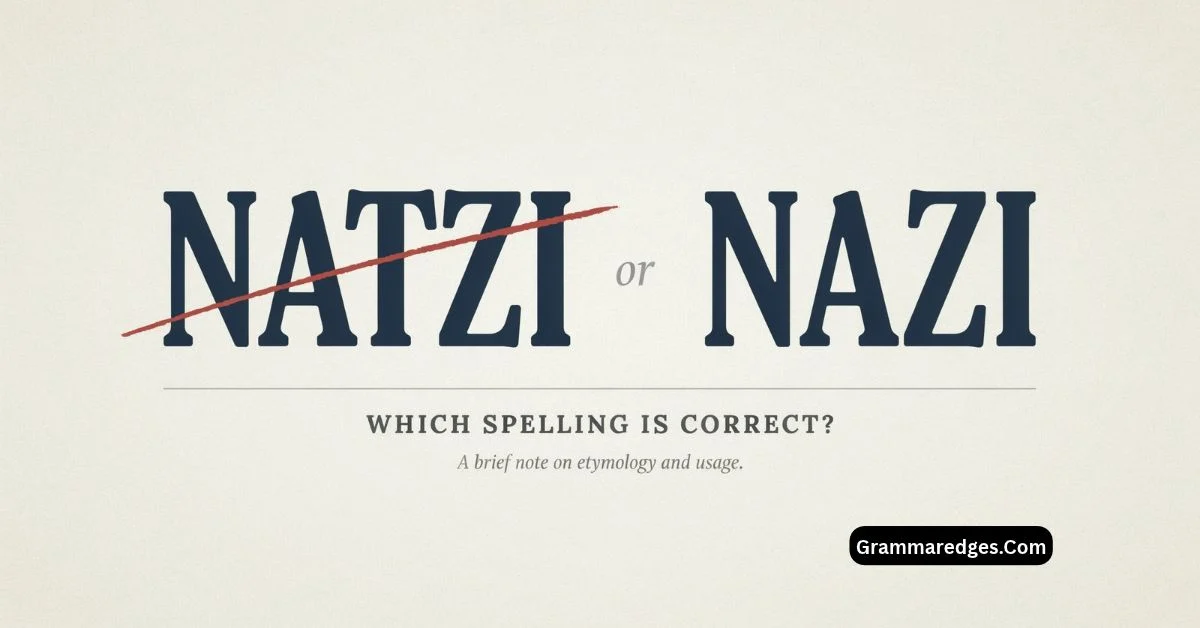
Have you ever typed “natzi” and wondered whether it should actually be “Nazi”? You are not alone. This spelling confusion often appears when people write about German history, World War II, school assignments, documentaries, news stories, or online discussions.
The answer is simple: Nazi is the correct spelling. Natzi is a misspelling and is not the standard English form.
The confusion usually comes from pronunciation. When spoken, Nazi can sound as though there is a “t” between the first and final parts of the word. This can lead writers to add an extra letter and produce natzi.
Knowing the correct spelling is especially important because this is a historical and political term. Accurate spelling helps keep your writing clear and professional. Whether you are writing an essay, email, article, social media post, or history report, use Nazi, not natzi.
Natzi or Nazi – Quick Answer
Nazi is the correct spelling.
Natzi is incorrect.
| Spelling | Correct? | Use |
|---|---|---|
| Nazi | ✅ Yes | Standard English |
| Natzi | ❌ No | Common misspelling |
| Nazzi | ❌ No | Misspelling |
| Natsi | ❌ No | Misspelling |
The correct form contains four letters:
N-A-Z-I
There is no “T” in Nazi.
Examples
- Correct: Nazi Germany played a major role in World War II.
- Correct: The book discusses Nazi propaganda.
- Incorrect: Natzi Germany played a major role in World War II.
- Incorrect: The book discusses Natzi propaganda.
Major dictionaries recognize Nazi as the standard form. Merriam-Webster gives its first known English use as 1930 and traces it to the German Nationalsozialist.
The Origin of Natzi or Nazi
The word Nazi has a German historical origin.
It is a shortened form of the German word Nationalsozialist, meaning National Socialist. The term was associated with the National Socialist German Workers’ Party (NSDAP), the political party led by Adolf Hitler.
The shortened form Nazi became established in German and later in English. Etymonline dates the English noun and adjective to around 1930.
Interestingly, the history of the nickname is more complicated than simply shortening a long word. Historical etymological sources note that Nazi was also connected with an older German nickname associated with the name Ignatz, which could refer to an awkward or foolish person. The shortened form also followed the pattern of Sozi, an abbreviation for Sozialist.
Why Does “Natzi” Exist?
Natzi is not an alternative historical spelling of Nazi in standard English.
The extra t most likely comes from pronunciation. Some speakers hear the consonant sound in Nazi and mentally divide it in a way that suggests “nat-zi.”
That can result in:
Nazi → Natzi
However, pronunciation does not change the standard spelling.
British English vs American English Spelling
There is no British-American spelling difference here.
Both British English and American English use:
Nazi
This is different from words such as:
- color / colour
- favorite / favourite
- center / centre
- organize / organise
With Nazi, the spelling remains the same in both major varieties of English.
Comparison Table
| Feature | American English | British English |
|---|---|---|
| Correct spelling | Nazi | Nazi |
| Incorrect spelling | Natzi | Natzi |
| Capitalization | Nazi | Nazi |
| Plural | Nazis | Nazis |
| Adjective | Nazi | Nazi |
| Common phrase | Nazi Germany | Nazi Germany |
| Extra “t” | ❌ No | ❌ No |
German dictionaries also give Nazi as the shortened form of Nationalsozialist. Duden lists the word as Na|zi and identifies it as a shortened form of Nationalsozialist.
So whether your readers are in the United States, United Kingdom, Canada, Australia, Pakistan, India, or another English-speaking country, the standard spelling is Nazi.
Which Spelling Should You Use?
Use Nazi in every standard English context.
For US Readers
Write:
- Nazi Germany
- Nazi Party
- Nazi policies
- Nazi propaganda
Do not write:
- Natzi Germany
- Natzi Party
For UK and Commonwealth Readers
The same rule applies.
Use Nazi rather than Natzi.
There is no British spelling called Natzi.
For Global English
If you are writing for an international audience, Nazi is the safest and correct form.
This is especially important in:
- School assignments
- Academic papers
- History articles
- News reports
- Books
- Educational websites
- Professional writing
A Simple Memory Trick
Remember:
Nazi = NA + ZI
There is no T.
If you remember N-A-Z-I, you can avoid the most common spelling mistake.
Common Mistakes with Natzi or Nazi
1. Adding an Extra T
❌ Natzi
✅ Nazi
This is the most common error.
2. Treating “Natzi” as a Variant
Some people assume that natzi is another accepted spelling.
It is not.
Nazi is the standard form.
3. Using the Wrong Capitalization
When referring to the historical movement or its members, Nazi is normally capitalized.
✅ Nazi Germany
❌ nazi Germany
4. Writing “Nazzi”
Another spelling sometimes seen online is Nazzi.
❌ Nazzi
✅ Nazi
5. Writing “Natsi”
Some writers may also produce:
❌ Natsi
The standard English spelling remains:
✅ Nazi
6. Using the Term Too Casually
The word has a serious historical meaning. In modern informal English, Nazi can sometimes be used as an insult for someone considered extremely strict or controlling.
For professional writing, it is usually better to choose a more precise word such as:
- strict
- controlling
- rigid
- demanding
- authoritarian
This keeps your meaning clear and avoids trivializing a serious historical term.
Natzi or Nazi in Everyday Examples
Here are examples showing how Nazi should appear in different types of writing.
In Emails
The attached report includes information about Nazi Germany during World War II.
For a school or professional email, always use the standard spelling.
In News Writing
The documentary examines the history of Nazi Germany.
News and historical writing require accurate terminology.
On Social Media
I watched a documentary about Nazi Germany last night.
Even in casual posts, Nazi remains the correct spelling.
In Academic Writing
The paper examines Nazi policies during the Second World War.
Academic writing should avoid the misspelling natzi.
In Formal Writing
The museum’s exhibition explains the impact of Nazi rule in Germany.
More Examples
- The historian wrote about Nazi Germany.
- The documentary examines Nazi propaganda.
- Students studied the rise of the Nazi Party.
- The museum contains documents from the Nazi era.
- The book discusses Nazi persecution.
Natzi or Nazi – Google Trends & Usage Data
Searches for “natzi or nazi” are generally spelling-intent searches. People often search the phrase when they are unsure about the correct spelling while writing an essay, reading historical material, or creating online content.
The broader term Nazi has far greater established usage because it is the standard historical term. Searches can also increase when people are discussing:
- World War II
- German history
- Adolf Hitler
- Historical documentaries
- School and university lessons
- Museums and historical events
- Books and films about World War II
Search interest can vary by country and by current events, so it is better not to treat a particular Google Trends number as a permanent fact.
The important language point is consistent across regions: Nazi is the accepted spelling, while natzi is generally a spelling error.
Nazi vs Natzi: Comparison Table
| Variation | Correct? | Meaning | Recommended Use |
|---|---|---|---|
| Nazi | ✅ | Historical/political term | Use this |
| Natzi | ❌ | Misspelling of Nazi | Avoid |
| Nazzi | ❌ | Misspelling | Avoid |
| Natsi | ❌ | Misspelling in this context | Avoid |
| Nazism | ✅ | Nazi political ideology | Use when appropriate |
| National Socialist | ✅ | Full political term | Formal historical context |
| Nazi Party | ✅ | Common name for NSDAP | Historical writing |
FAQs About Natzi or Nazi
1. Is it Natzi or Nazi?
Nazi is correct. Natzi is a misspelling. The correct spelling is N-A-Z-I.
2. Is Natzi a real word?
In standard English, natzi is not the accepted spelling of the historical term. Writers normally mean Nazi when they use it.
3. Why do people spell Nazi as Natzi?
The mistake usually comes from pronunciation. Some people hear the word as if it contains a “t” sound and therefore insert t when writing it.
4. Is “Natzi” the British spelling?
No. British English uses Nazi, just like American English. There is no standard British spelling Natzi.
5. Should Nazi be capitalized?
Yes, when referring to the historical Nazi movement, party, or its members, Nazi is normally capitalized.
6. What is the plural of Nazi?
The standard plural is Nazis.
Example:
Historians study the actions of the Nazis during World War II.
7. What is the difference between Nazi and Nazism?
Nazi can refer to a member of the Nazi Party or describe something connected with the movement. Nazism refers to the political ideology associated with the Nazi movement.
Conclusion:
If you are wondering whether the correct spelling is natzi or Nazi, the answer is clear: Nazi is the correct standard spelling. Natzi is a common misspelling caused mainly by pronunciation or by adding an unnecessary t.
The word Nazi comes from the German Nationalsozialist and became an established historical term in the early 20th century. It is used in phrases such as Nazi Germany, Nazi Party, and Nazi propaganda.
There is also no difference between American and British English spelling. Both use Nazi.
For schoolwork, professional writing, news articles, social media, and everyday communication, remember the simple rule: Nazi has no T. If you see Natzi, treat it as a spelling mistake and replace it with Nazi. Accurate spelling is especially important when writing about serious historical subjects.