
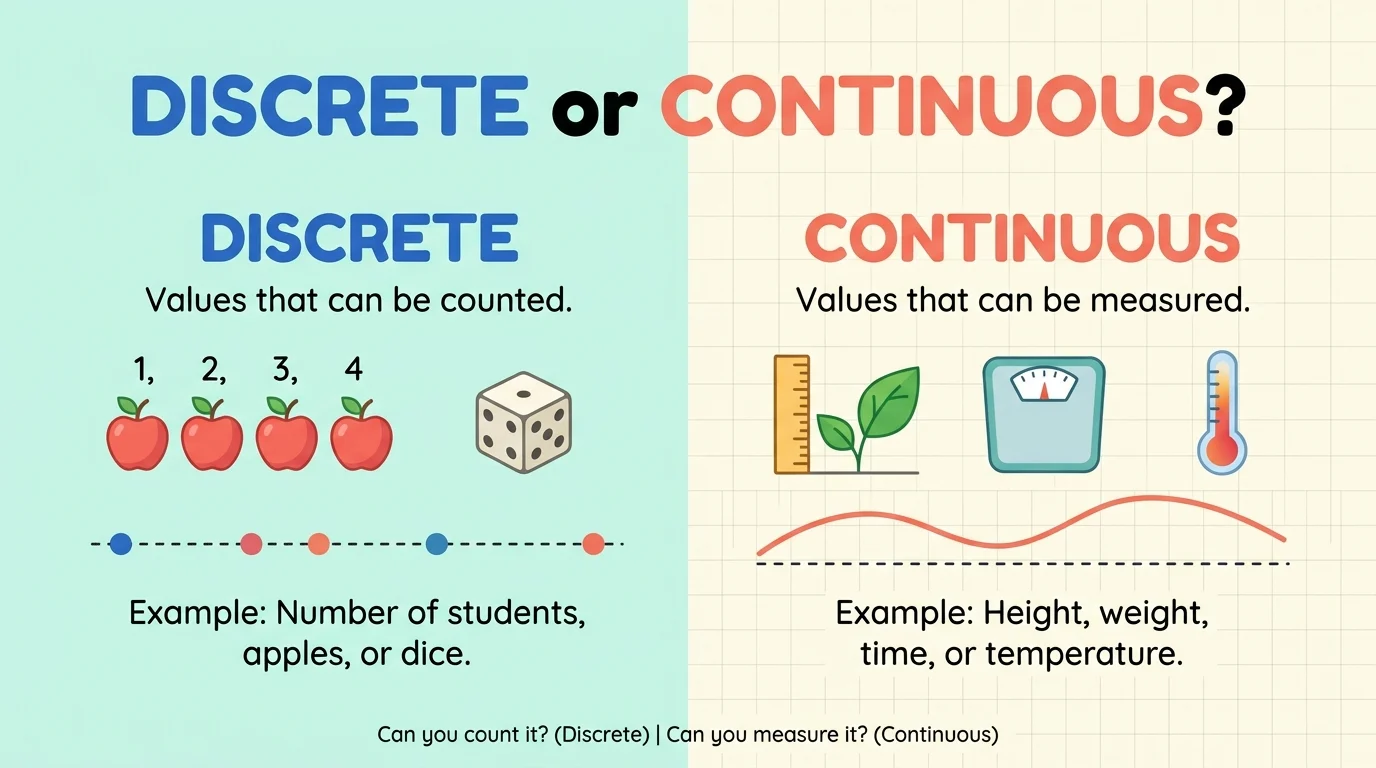
Discrete or continuous is one of the most common questions students ask when learning statistics and mathematics. Although both describe numerical data, they represent two different ways of understanding information.
Discrete data involves counting separate values, such as the number of students, books, or cars. Continuous data involves measuring quantities, such as height, weight, temperature, and time.
Knowing the difference can help you solve statistics questions, understand variables, and avoid common mistakes in data analysis. In this guide, you’ll discover simple definitions, real-life examples, comparison tables, and easy ways to identify whether a variable is discrete or continuous.
Key Takeaways
- Discrete data involves counting separate items or events.
- Continuous data involves measuring quantities that can take different values within a range.
- Discrete values are countable, while continuous values can theoretically include fractions and decimals.
- The number of pets is discrete, but the weight of those pets is continuous.
- The way a value is recorded does not always determine the type of variable.
What Does Discrete or Continuous Mean?
When studying statistics, data is often divided into different categories to make information easier to understand and analyze. Two important types of numerical data are discrete and continuous.
Both describe quantities, but they differ in how their values are obtained.
Discrete data comes from counting things. For example, you can count the number of books on a shelf, people in a room, or cars in a parking lot.
Continuous data comes from measuring things. Examples include the height of a person, the temperature outside, and the time needed to complete a task.
Understanding these terms helps students, researchers, and professionals choose the correct methods for collecting and analyzing information.
What Is Discrete Data?
Discrete data is numerical information that consists of separate, countable values. These values have distinct differences between them and cannot take every possible value within a range.
Most basic examples involve whole numbers because you cannot normally count a fraction of an individual object.
For example:
- 5 students in a classroom
- 3 dogs in a house
- 12 books on a table
- 8 cars in a parking lot
- 4 phone calls received in one hour
You can have 3 or 4 books, but you cannot have 3.5 individual books in an ordinary counting situation.
Discrete data can have a limited number of possible values or an unlimited but countable number of values. Therefore, it is not always correct to say that discrete data must be finite.
What Is Continuous Data?
Continuous data is numerical information that can take any theoretically possible value within a particular range.
Unlike discrete data, it is not restricted to separate counting numbers. It can include fractions, decimals, and values between two measurements.
For example:
- A person’s height: 5.7 feet
- A package’s weight: 2.45 pounds
- Water temperature: 24.6°C
- A running time: 12.38 seconds
- A road’s length: 15.75 miles
You can measure these quantities with different levels of precision. For instance, a person’s height might be recorded as 170 centimeters, 170.5 centimeters, or 170.52 centimeters.
The underlying measurement can theoretically have even more precise values.
Discrete vs. Continuous: Key Differences
The main difference between discrete and continuous data is that discrete data is counted, while continuous data is measured.
Although both types use numbers, they represent different kinds of information.
Here is a simple comparison:
| Feature | Discrete Data | Continuous Data |
|---|---|---|
| Meaning | Separate, countable values | Measurable values within a range |
| Collection | Counting | Measuring |
| Possible values | Countable values | Any theoretical value in an interval |
| Decimals | Not always possible | Generally possible |
| Gaps | Has distinct possible values | No gaps in its theoretical range |
| Examples | Number of students | Student height |
| Other examples | Number of pets | Pet weight |
| Common use | Counting events | Measuring quantities |
For example, imagine a teacher wants to collect information about a classroom.
The number of students is discrete because students are counted individually. However, the average height of those students is continuous because height is measured and can include decimal values.
This example shows that two numerical measurements from the same situation can belong to different data types.
Examples of Discrete Data
Discrete data appears in everyday situations whenever someone counts separate objects, people, or events.
Here are some common examples:
| Example | Possible Values | Why It Is Discrete |
|---|---|---|
| Number of children | 0, 1, 2, 3 | Children are counted individually |
| Number of pets | 1, 2, 3, 4 | Pets are separate animals |
| Books on a shelf | 5, 6, 7, 8 | Individual books are counted |
| Cars in a garage | 0, 1, 2, 3 | Cars cannot be divided into individual fractional counts |
| Phone calls | 2, 3, 4, 5 | Calls are counted as separate events |
| Exam questions answered correctly | 10, 11, 12 | Correct answers are counted |
More Everyday Examples
1. Number of students
A classroom might have 20, 25, or 30 students. The number is discrete because students are counted as individual people.
2. Number of website visitors
A website owner can count how many people visit a page each day. The result might be 500 or 501 visitors, not 500.5 individual visitors.
3. Number of goals
A soccer team might score 0, 1, 2, or 3 goals during a match. Goals are separate events, making the variable discrete.
4. Number of products sold
A store can sell 15, 20, or 35 individual products. The total number sold is discrete data.
5. Number of emails received
If someone receives 45 emails in one day, the number of emails is a discrete value because each email is counted separately.
Examples of Continuous Data
Continuous data is commonly used when measuring physical quantities, time, or other values that can change gradually.
The following examples make the concept easier to understand.
| Example | Possible Values | Why It Is Continuous |
|---|---|---|
| Height | 5.5, 5.65, 5.72 feet | Height can be measured precisely |
| Weight | 140.5, 140.75 pounds | Weight can include fractions |
| Temperature | 20.5, 21.25°C | Temperature changes gradually |
| Distance | 2.5, 2.75 miles | Distance can have decimal values |
| Time | 10.25, 10.50 seconds | Time can be measured in smaller units |
| Speed | 45.5, 46.75 mph | Speed can vary within a range |
More Everyday Examples
1. Human height
A person might be 5 feet 8 inches tall. Another person might be slightly taller or shorter. Height is continuous because it can theoretically take many values between two measurements.
2. Body weight
A person’s weight might be 150 pounds or 150.6 pounds. It is continuous because weight is measured rather than counted.
3. Temperature
Weather temperatures can change gradually. A thermometer might show 70°F, 70.5°F, or 70.25°F.
4. Travel distance
A journey might cover 10 miles, 10.5 miles, or 10.75 miles. Distance is continuous because measurements can include smaller units.
5. Running time
An athlete’s running time might be 12.4 seconds or 12.45 seconds. Time is continuous because it can be measured with increasing precision.
How to Tell Whether Data Is Discrete or Continuous
If you are completing a statistics assignment or analyzing a dataset, identifying the correct data type can sometimes be confusing.
Use these three steps to make the decision easier.
Step 1: Identify What Is Being Recorded
First, understand what the numbers represent.
Are you recording the number of objects, or are you measuring a quantity?
For example:
- Number of books = Counting
- Weight of books = Measuring
- Number of employees = Counting
- Working hours = Measuring
This first step helps you understand the nature of the information.
Step 2: Decide Whether You Are Counting or Measuring
Ask yourself whether the value comes from counting individual items or measuring something.
If you count separate objects or events, the result is usually discrete.
If you measure height, weight, distance, or time, the result is usually continuous.
Step 3: Check Whether Values Between Two Numbers Are Possible
Consider two possible values and ask whether another valid value can exist between them.
For example:
- Number of students: 20 or 21. You cannot have 20.5 individual students.
- Height: 5.5 or 5.6 feet. A height of 5.55 feet is also possible.
If the possible values are separate and countable, the variable is discrete. If all intermediate values are theoretically possible within the range, it is continuous.
Is Age, Time, Money, or Temperature Discrete or Continuous?
Some examples can be confusing because their classification depends on how the information is defined or recorded.
| Variable | Classification | Explanation |
|---|---|---|
| Age in completed years | Discrete | Recorded as whole-year values |
| Exact age | Continuous | Can include years, months, days, and smaller units |
| Time duration | Continuous | Can be measured in fractions of a second |
| Money in cents | Discrete | Recorded in separate currency increments |
| Exact temperature | Continuous | Can theoretically take intermediate values |
| Shoe size | Discrete | Available in specific size increments |
| Number of heartbeats | Discrete | Individual beats are counted |
| Heart rate measurement | Depends on definition | Beats per minute is often recorded as a count |
Why is age sometimes discrete and sometimes continuous?
If a survey asks someone how old they are in completed years, the recorded values are discrete. However, a person’s exact age changes continuously over time. The difference comes from the way age is defined and recorded.
What about money?
Money is a useful example because its classification depends on the unit. If you record amounts in cents, the possible recorded values are separate increments. However, financial amounts can also be modeled as continuous in some statistical situations.
This is why understanding the research question is important before choosing a data type.
Why Are Discrete and Continuous Variables Important in Statistics?
Understanding these two types of variables helps people organize information and select suitable statistical methods.
Researchers use discrete variables when studying counts, such as the number of customers visiting a store or the number of accidents reported in a city.
They use continuous variables when examining measurements, such as average height, product weight, travel time, or temperature.
These differences can also affect the probability models used in statistical analysis.
For example:
- Discrete probability distributions describe probabilities associated with individual countable values.
- Continuous probability distributions describe probabilities across ranges of possible measurements.
Recognizing the correct variable type helps prevent mistakes when interpreting data, creating charts, and drawing conclusions.
Frequently Asked Questions
1. What Is the Main Difference Between Discrete and Continuous?
The main difference is how the values are obtained. Discrete data comes from counting separate items or events, while continuous data comes from measuring quantities. For example, the number of students in a school is discrete, whereas their heights are continuous.
2. Is Age Discrete or Continuous?
Age can be either discrete or continuous, depending on how it is recorded. Age rounded to completed years is discrete because it uses whole-number values. Exact age is continuous because it changes gradually and can be measured in smaller units, such as months, days, and seconds.
3. Is Time Discrete or Continuous?
Time is generally continuous because it can be measured using increasingly smaller units, including seconds, milliseconds, and fractions of a second. However, when time is recorded in fixed intervals, such as whole minutes, the recorded values are discrete.
4. Can Continuous Data Have Decimal Values?
Yes. Continuous data can include decimal and fractional values because measurements can be recorded with different levels of precision. For example, a person’s weight might be 150 pounds, 150.5 pounds, or 150.75 pounds. However, decimals alone do not determine whether data is continuous.
5. Is Money Discrete or Continuous?
Money is usually treated as discrete when recorded in the smallest available currency unit, such as cents in the United States. However, some statistical models treat monetary amounts as continuous when the exact underlying amount is being analyzed rather than individual cent increments.
Conclusion
Understanding whether data is discrete or continuous makes statistics and mathematics much easier. Both are important types of quantitative information, but they describe different ways of working with numbers.
Discrete data represents separate values obtained through counting, such as the number of students, books, or cars. Continuous data represents measurements such as height, weight, temperature, and time.
The easiest way to remember the difference is to ask whether you are counting something or measuring it. Also, remember that some variables, including age and money, can be classified differently depending on how they are recorded.
Once you understand these differences, identifying discrete or continuous variables becomes much simpler.