
Mangoes or Mangos is a common spelling question that confuses many English writers. If you are unsure which plural form is correct, the good news is that both spellings are accepted in standard English.
Mangoes is the traditional form, while mangos is a shorter alternative with the same meaning. Both words refer to more than one mango, so neither is grammatically wrong.
However, understanding their spelling differences can help you choose the right form for your writing. In this guide, you will discover which spelling is preferred in American English, why both forms exist, and how to use them correctly in sentences.
Key Takeaways
- Mangoes and mangos are both grammatically correct.
- Both spellings refer to more than one mango.
- Neither spelling changes the meaning or pronunciation.
- Mangoes is a familiar traditional spelling in English.
- Mangos is also accepted in American dictionaries and everyday writing.
- Choose one spelling and use it consistently.
Mangoes or Mangos: Which One Is Correct?
If you have ever wondered whether to write mangoes or mangos, you are not alone. Both spellings appear in English, which can make this simple plural noun confusing.
The good news is that you do not have to choose between a correct and incorrect spelling. Both forms are accepted.
Mangoes is the traditional plural spelling. It follows a common English pattern in which some nouns ending in -o add -es to become plural. For example, we write potatoes, tomatoes, and heroes.
Mangos uses the shorter ending by adding only -s. This spelling is also recognized and widely understood.
Here are two examples:
- We bought five mangoes from the grocery store.
- We bought five mangos from the grocery store.
Both sentences are correct. The choice depends on your writing preference, audience, or preferred style guide.
What Is the Difference Between Mangoes and Mangos?
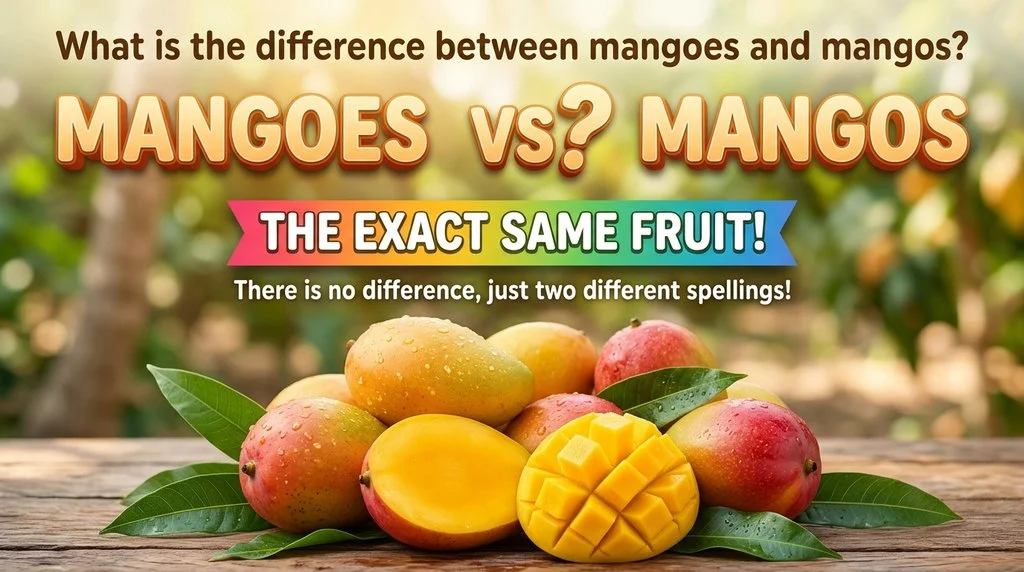
The main difference between these words is their spelling. They do not have separate definitions or refer to different varieties of fruit.
1. Meaning and Pronunciation
Both words are plural forms of the singular noun mango.
A mango is a tropical fruit with sweet, juicy flesh and a large seed in the middle. When you talk about more than one, you can use either plural form.
For example:
- One mango is enough for my smoothie.
- Three mangoes are enough for the fruit salad.
- Three mangos are enough for the fruit salad.
The last two examples communicate exactly the same idea.
There is also no meaningful difference in their pronunciation. Both forms are generally pronounced the same way in everyday English.
2. Spelling Differences
The only visible difference is the letter combination at the end.
| Singular | Plural | Spelling pattern |
|---|---|---|
| Mango | Mangoes | Add -es |
| Mango | Mangos | Add -s |
The first form contains an extra letter, while the second is shorter.
Neither spelling is a grammatical error. You can use both in everyday conversations, recipes, school assignments, and other types of writing.
Why Does Mango Have Two Plural Spellings?
English spelling rules are not always consistent. Some nouns ending in the letter o form their plurals by adding -s, while others add -es.
For example:
| Singular | Plural |
|---|---|
| Potato | Potatoes |
| Tomato | Tomatoes |
| Hero | Heroes |
| Echo | Echoes |
| Piano | Pianos |
| Photo | Photos |
| Radio | Radios |
| Mango | Mangoes or mangos |
Many traditional spelling guides teach that nouns ending in a consonant followed by o often take -es. However, this is a general pattern, not an absolute rule.
There are exceptions, and some nouns have more than one accepted plural form.
Mango is one of those words. Over time, both mangoes and mangos became established in English usage.
That is why you should not assume that every noun ending in o must follow the same spelling pattern.
Which Spelling Is Better in American English?
If you are writing for an American audience, you can confidently use either mangoes or mangos.
Both forms are recognized by established dictionaries. The Cambridge Dictionary lists both plural forms, and Oxford’s Advanced American Dictionary also recognizes both spellings.
However, mangoes is a familiar traditional choice and is a safe option when you are unsure which form to use.
Mangos is equally acceptable when your preferred publication or writing style uses the shorter version.
Consider these situations:
- School assignments: Follow your teacher’s preferred spelling.
- Professional writing: Follow your company’s style guide.
- Blog posts: Choose the spelling that best matches your site’s existing content.
- Recipes: Either spelling works naturally.
- Social media: Use whichever version you prefer.
The most important thing is consistency. Avoid switching between mangoes and mangos without a reason in the same article.
Mangoes vs. Mangos: Examples in Sentences
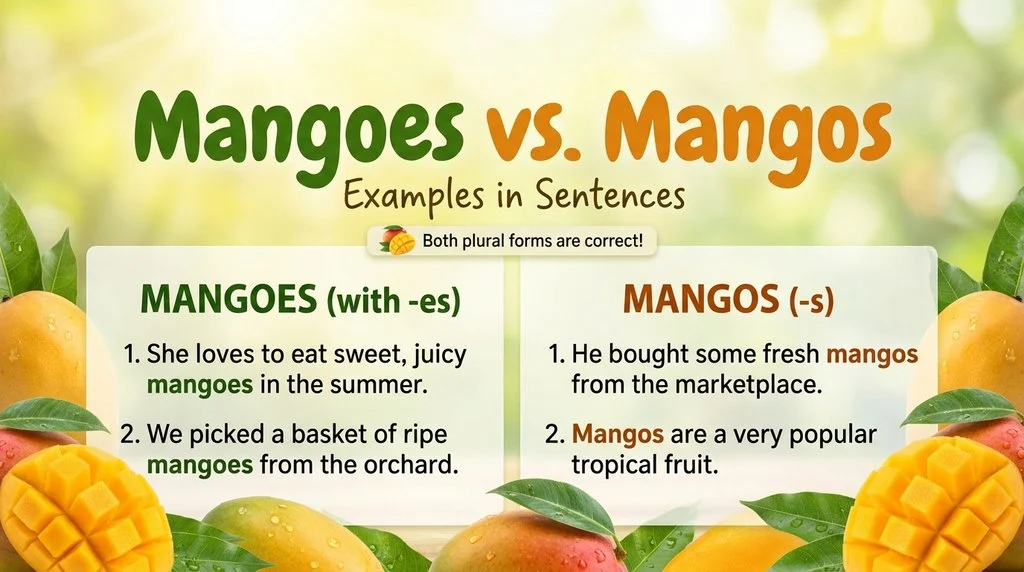
Seeing both forms in real sentences can make the difference easier to understand. Here are some practical examples.
Examples Using Mangoes
- I bought three fresh mangoes from the local grocery store.
- Mangoes taste delicious when they are fully ripe.
- My mother uses mangoes to prepare homemade juice.
- We added sliced mangoes to our summer fruit salad.
- These mangoes are sweeter than the ones we bought last week.
- The farmer grows several varieties of mangoes.
- Fresh mangoes are available at the market during the summer.
- She packed two mangoes for her lunch.
- The children enjoyed eating cold mangoes after school.
- We need four mangoes to prepare this dessert.
Examples Using Mangos
- I picked two ripe mangos from the tree.
- These mangos are perfect for making smoothies.
- The store sells fresh mangos throughout the season.
- We purchased six mangos for the family gathering.
- She cut the mangos into small pieces.
- My favorite snack is sliced mangos with a little lime juice.
- The farmer packed the mangos into large boxes.
- Those mangos look fresh and delicious.
- We used three mangos to prepare the fruit drink.
- The children shared their mangos with their friends.
Notice that both sets of examples communicate the same meaning. Only the spelling changes.
Other Words That End in O
The mangoes or mangos question is part of a larger English spelling pattern.
Some nouns ending in o take -es, while others take only -s. A few accept both forms.
Here are some useful examples:
| Singular | Plural |
|---|---|
| Tomato | Tomatoes |
| Potato | Potatoes |
| Hero | Heroes |
| Echo | Echoes |
| Volcano | Volcanoes or volcanos |
| Tornado | Tornadoes or tornados |
| Avocado | Avocados or avocadoes |
| Piano | Pianos |
| Photo | Photos |
| Zoo | Zoos |
These examples show why it is important to check individual words rather than depend on one spelling rule.
If you are unsure about a plural noun, consult a reliable dictionary or your preferred style guide.
Common Mistakes to Avoid
Although both plural forms are correct, writers sometimes make mistakes when using them.
Here are a few things to remember:
1. Do not treat mangos as a misspelling.
Mangos is an accepted plural form. It is not automatically incorrect just because it does not contain -es.
2. Do not use mangoes as a singular noun.
Mangoes refers to more than one fruit. When discussing one fruit, use mango.
3. Do not assume both forms have different meanings.
Mangoes and mangos refer to the same thing. There is no difference in the fruit they describe.
4. Avoid unnecessary spelling changes.
If you begin an article using mangoes, continue using mangoes unless you have a specific editorial reason to change it.
5. Do not apply the -es rule to every word ending in o.
English has several exceptions, so check the accepted plural spelling of each noun.
Frequently Asked Questions
1. Is it mangoes or mangos?
Both mangoes and mangos are correct. They are accepted plural forms of mango and refer to two or more fruits. You can use either spelling in American English. Mangoes is a familiar traditional choice, while mangos is also a recognized alternative.
2. Which spelling is correct in American English?
Both spellings are correct in American English. Established dictionaries recognize mangoes and mangos. If you are unsure which one to choose, mangoes is a familiar traditional option. However, using mangos is not a grammatical mistake.
3. Why does mango have two plural forms?
English allows spelling variations in some plural nouns. Words ending in o may take -s or -es, depending on the individual word. Mango developed two accepted forms: mangoes and mangos. Both are now recognized in standard English dictionaries.
4. What is the singular of mangoes?
The singular form of mangoes is mango. For example, you would say, “I ate one mango” when talking about a single fruit. When referring to several fruits, you can write “I ate three mangoes” or “I ate three mangos.”
5. Is mangos grammatically correct?
Yes, mangos is grammatically correct. It is an accepted plural spelling of mango, not a spelling mistake. You can use it in informal and formal writing, provided it matches the style you want to follow.
6. Is mangoes more common than mangos?
Mangoes is a familiar and traditional spelling, and it is frequently used in English-language writing. Mangos is also established and accepted. Usage can vary between publications, dictionaries, and writers, so it is best to follow your chosen style guide.
7. Do mangoes and mangos have different meanings?
No. Both spellings describe two or more mango fruits. They do not represent different fruit varieties, flavors, or meanings. The only difference is the way the plural word is written.
Conclusion
When choosing between mangoes or mangos, you do not need to worry about making a grammatical mistake. Both spellings are correct plural forms of mango, and both have the same meaning.
Mangoes is a familiar traditional spelling, while mangos offers a shorter accepted alternative. For American English writing, either option works in recipes, blog posts, school assignments, and everyday communication.
If you are unsure, choose mangoes as your default spelling. Most importantly, maintain consistency throughout your writing and follow any dictionary or style guide required by your publication.
Now you can confidently use either form whenever you write about these delicious tropical fruits.