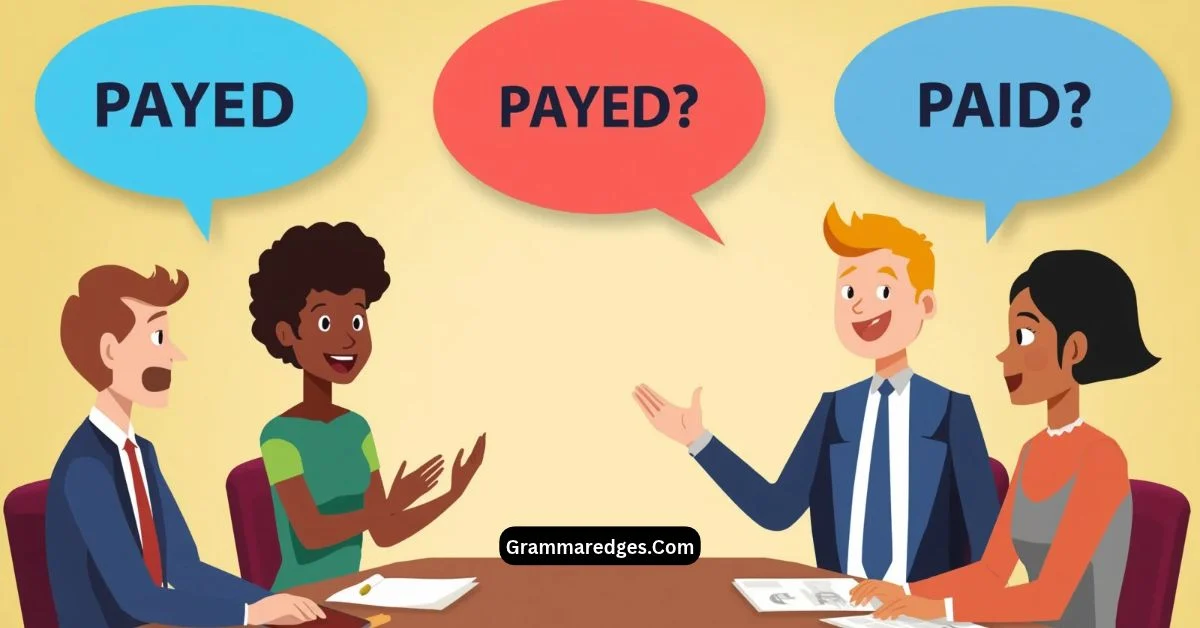
Have you ever written “payed” and wondered if you should use “paid” instead? You are not alone. The question “payed or paid” often confuses English learners, students, and even fluent writers. Both words sound the same, but they do not have the same meaning.
In most cases, paid is the correct word. It is the past tense and past participle of pay when you mean giving money, settling a bill, or receiving money. For example, “I paid the bill yesterday” is correct.
But there is an interesting exception. Payed is also a real word, although it is rarely used. It appears mainly in nautical or technical language when pay means to let out or loosen a rope, cable, or chain.
This difference is important in emails, school assignments, business writing, websites, and everyday messages. Knowing which word fits your sentence can prevent simple spelling errors. In this guide, you will learn the meaning, origin, British and American usage, common mistakes, examples, and an easy rule for remembering payed or paid.
Payed or Paid – Quick Answer
Paid is the correct spelling when you mean giving or receiving money.
Use paid for bills, debts, purchases, salaries, fees, and other financial situations.
Examples of “paid”
- I paid the bill yesterday.
- She paid for the tickets.
- We have paid the full amount.
- He was paid on Friday.
Payed has a special meaning. It can be used in nautical language when something such as a rope or cable is let out.
Example of “payed”
- The sailors payed out the rope.
- The crew payed out more cable.
Easy rule
Money → paid
Rope or cable → payed
If you are talking about money, paid is almost certainly the word you need.
The Origin of Payed or Paid
The word pay has a long history in English. It came into Middle English through Anglo-French and is connected to the Latin pacare, meaning “to pacify” or “to appease.”
Over time, the meaning of pay became closely linked with settling debts and giving someone what is owed.
The normal past form became paid. This makes pay an irregular verb. It does not follow the simple pattern of adding -ed.
For example:
- pay → paid
- say → said
- buy → bought
- make → made
This is why payed is normally wrong when you are talking about money.
However, English also has a nautical use of pay. The phrase pay out means to let out or release a rope, cable, or chain. The past form of this specialized use can be payed.
So, the two forms exist because they developed for different meanings. They are not interchangeable spellings.
British English vs American English Spelling
There is no important British English versus American English spelling difference between paid and payed.
Both British and American English use paid when talking about money.
| Meaning | British English | American English |
|---|---|---|
| Give money | paid | paid |
| Settle a bill | paid | paid |
| Settle a debt | paid | paid |
| Receive payment | paid | paid |
| Let out a rope or cable | payed | payed |
British English Example
I paid for the meal.
American English Example
I paid for the meal.
Both sentences are correct.
The key issue is meaning, not region. Whether you write for a British or American audience, use paid for normal financial situations.
Which Spelling Should You Use?
The correct choice depends on the meaning of your sentence.
For US English
Use paid when writing about:
- Money
- Bills
- Salaries
- Taxes
- Purchases
- Loans
- Fees
- Debts
Example:
I paid my credit card bill yesterday.
For UK and Commonwealth English
Use paid for the same financial meanings.
She paid the rent on time.
The spelling payed is still limited to special technical uses.
For a Global Audience
If your content is written for readers around the world, paid is the safest choice when discussing money.
Use payed only when your subject involves a specialized nautical meaning.
For most emails, essays, reports, websites, and business documents, remember:
If money is involved, use paid.
Common Mistakes with Payed or Paid
Because many English verbs form their past tense with -ed, it is easy to make a mistake with pay.
Mistake 1: “I payed the bill.”
❌ I payed the bill.
✅ I paid the bill.
The sentence is about money, so paid is correct.
Mistake 2: “She payed for dinner.”
❌ She payed for dinner.
✅ She paid for dinner.
Mistake 3: “We have payed the invoice.”
❌ We have payed the invoice.
✅ We have paid the invoice.
Mistake 4: Saying “payed” is never correct
❌ Payed is never a word.
✅ Payed can be correct in specialized nautical writing.
Example:
The crew payed out the cable.
Here, payed means that the cable was released or allowed to run out.
A Simple Memory Trick
Remember:
PAID = money
PAYED = rope or cable
This quick trick can help you avoid the mistake.
Payed or Paid in Everyday Examples
These words can appear in different types of writing.
In Emails
Use paid when discussing financial matters.
I have paid the invoice.
The customer has already paid the balance.
Please confirm that the fee has been paid.
In News
News reports often use paid when talking about money.
The company paid millions of dollars in damages.
Workers were paid on Friday.
The government paid for the new project.
On Social Media
Informal posts also use paid.
Finally paid off my loan!
I paid for the tickets today.
Who paid for dinner?
In Formal Writing
Use paid in business and academic writing when discussing financial matters.
The full amount must be paid before the deadline.
All fees must be paid in advance.
In Nautical Writing
Payed can appear in technical or maritime writing.
The crew payed out the anchor cable.
Here, the word has nothing to do with money.
Payed or Paid – Google Trends & Usage Data
The search phrase “payed or paid” is mainly searched by people who want to check the correct past form of pay.
The word paid is much more common in everyday English. It is used in many situations involving money, including salaries, shopping, bills, invoices, taxes, loans, and services.
The word payed is much less common because its main use is specialized. It is most likely to appear in nautical or technical material.
Search patterns can vary between countries, but there is no major US-versus-UK difference in the normal use of these words. American, British, Canadian, Australian, and other English-speaking writers generally use paid for financial meanings.
It is also important not to confuse overall search volume with spelling preference. Paid has many everyday uses, so its total search activity reflects much more than the payed or paid spelling question.
For content aimed at general readers, the practical rule remains simple: use paid when you mean payment.
Payed vs Paid: Comparison Table
| Word | Meaning | Usage | Example |
|---|---|---|---|
| paid | Gave money | Very common | I paid the bill. |
| paid | Settled a debt | Very common | She paid her loan. |
| paid | Received money | Very common | He was paid today. |
| paid | Completed a payment | Very common | We have paid in full. |
| payed | Let out a rope or cable | Rare/technical | They payed out the rope. |
| pay | Present tense | Very common | I pay every month. |
| paying | Present participle | Very common | I am paying now. |
FAQs About Payed or Paid
Is “payed” a correct word?
Yes. Payed is a valid but rare word. It is mainly used in nautical contexts when talking about letting out or slackening a rope, cable, or chain.
Is it “paid” or “payed” for a bill?
Use paid.
I paid the bill.
Payed is incorrect when you mean giving money.
What is the past tense of “pay”?
The normal past tense of pay is paid.
I paid for the meal yesterday.
Is “payed” ever correct in English?
Yes. It can be correct when pay means to let out or slacken a rope, cable, or chain.
Do British people use “payed”?
British speakers normally use paid when talking about money. Payed is limited to its specialized technical meaning.
Is “I have payed” correct?
Usually, no. If you mean that you have made a payment, write:
I have paid.
How can I remember paid and payed?
Use this simple rule:
Money = PAID
Rope or cable = PAYED
It is an easy way to remember the difference.
Conclusion
The difference between payed or paid is simple once you understand what each word means. In normal English, paid is the correct past tense and past participle of pay when you are talking about money.
Use paid for bills, purchases, salaries, fees, debts, invoices, loans, and other financial matters. For example, “I paid the bill” and “She has paid the invoice” are both correct.
Payed is a real word, but it has a very narrow use. It mainly appears in nautical or technical writing, where it can mean letting out or slackening a rope, cable, or chain.
There is no major British-American spelling difference here. Both British and American English use paid for normal financial meanings. If you are writing an email, essay, article, report, or business document, paid is almost always the correct choice.
The easiest rule is money = paid; rope or cable = payed. Keep this rule in mind, and you can quickly choose the right spelling whenever you are unsure.