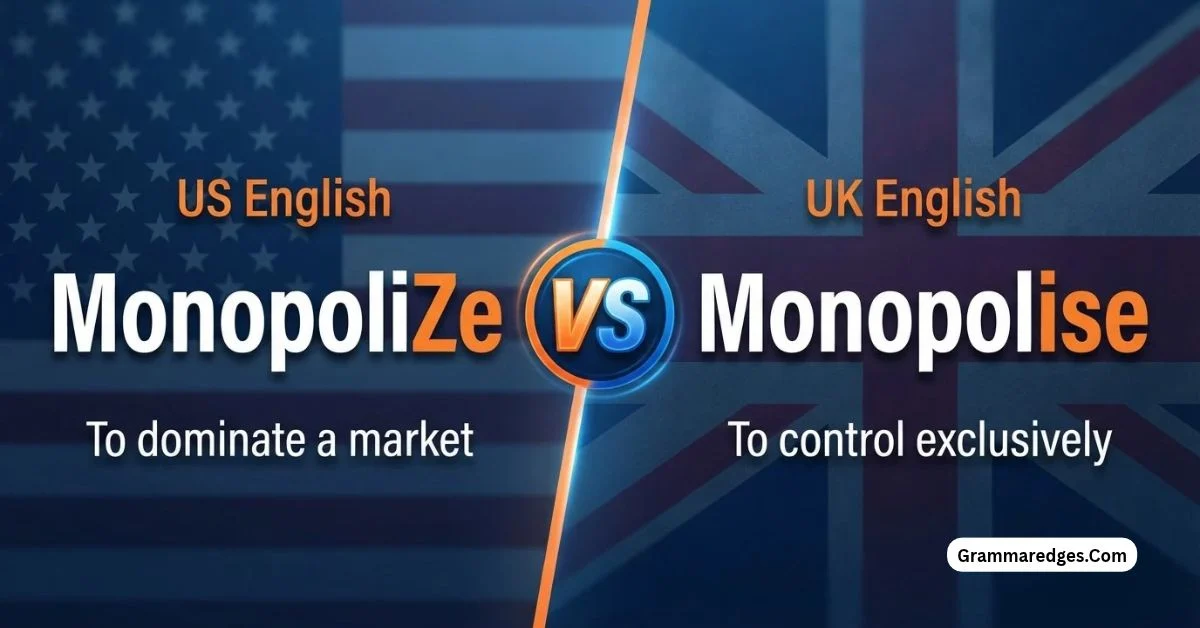
Have you ever wondered whether to write monopolize or monopolise? Both spellings are correct, but the version you should use depends mainly on the variety of English you follow. This spelling difference often confuses students, writers, bloggers, professionals, and people learning English as a second language.
The words monopolize and monopolise have the same meaning: to control something completely or to dominate a particular activity, market, conversation, or resource. The difference is not in pronunciation or definition but in regional spelling conventions.
American English generally uses monopolize, while British English typically uses monopolise. The same distinction appears in other words, such as organize and organise or realize and realise.
Understanding this difference helps you write more naturally and maintain consistency in academic papers, business documents, social media posts, and website content. In this guide, we will explain the meaning, history, regional usage, common mistakes, related words, and practical examples of both spellings so you can choose the right version confidently.
1. Grammar, Meaning, and Definition
The words monopolize and monopolise are verbs. They describe the act of gaining or maintaining excessive control over something, often leaving little opportunity for other people or organizations to participate.
Although the spelling changes between American and British English, the meaning remains exactly the same.
What Does Monopolize Mean?
Monopolize means to dominate, control, or take exclusive possession of something. It can describe economic power, personal behavior, conversations, or access to resources.
For example:
- A company may monopolize a market by controlling most of its available products or services.
- One person might monopolize a conversation by speaking continuously and preventing others from contributing.
- A student could monopolize the teacher’s attention by asking questions throughout the entire lesson.
- A business might monopolize a particular resource, making it difficult for competitors to obtain it.
In each situation, the central idea is control that limits the participation or opportunities of others.
What Does Monopolise Mean?
Monopolise has the same definition as monopolize. It is simply the spelling commonly used in British English and other varieties that follow British spelling conventions.
Examples include:
- One company should not monopolise an entire industry.
- Please do not monopolise the conversation during dinner.
- The manager should avoid allowing one employee to monopolise every important task.
These sentences communicate the same ideas as their American English equivalents.
Is Monopolize a Noun or a Verb?
Monopolize and monopolise are verbs. Their related noun is monopoly, which describes exclusive control over a market, product, service, or other area.
The word monopolization is commonly used in American English, while monopolisation is common in British English.
Here is a quick comparison:
| Word | American English | British English |
|---|---|---|
| Verb | Monopolize | Monopolise |
| Noun | Monopoly | Monopoly |
| Action noun | Monopolization | Monopolisation |
| Person or company | Monopolizer | Monopoliser |
Quick answer: Use monopolize for American audiences and monopolise for British audiences. Both are correct, and neither changes the intended meaning.
2. Background and Origin of the Words
The difference between monopolize and monopolise comes from the spelling conventions that developed in different English-speaking regions.
Both words are connected to monopoly, a term associated with exclusive control over the supply or sale of something. The word ultimately comes from Greek roots associated with selling and being alone or single.
Over time, monopoly became an important term in economics, business, law, and everyday language. The verb monopolize developed to describe the act of obtaining or exercising such control.
How Did the Two Spellings Develop?
English spelling is not completely uniform around the world. American and British English developed different preferences for certain word endings, particularly those involving -ize and -ise.
American English generally favors the ending -ize in words such as:
- Organize
- Realize
- Recognize
- Prioritize
- Monopolize
British English commonly uses -ise in the same words:
- Organise
- Realise
- Recognise
- Prioritise
- Monopolise
These differences are mainly conventional. They do not indicate that the words have different meanings or that one spelling is more grammatically correct than the other.
It is worth noting that British English also permits -ize in many words, particularly in styles that follow Oxford spelling conventions. Therefore, it would be inaccurate to claim that every British publication must use monopolise.
Why Does Regional Spelling Matter?
Regional spelling matters because readers expect consistency. An American publication generally follows American conventions, while a British publication may follow British conventions or a specific editorial style guide.
For example, an American business report might say, “The company attempted to monopolize the market.” A British newspaper could write, “The company attempted to monopolise the market.”
Both sentences are correct.
The important lesson is that English spelling varies by region, publisher, and style guide. Knowing these conventions helps writers communicate professionally without treating legitimate spelling variations as errors.
3. Usage in Different Contexts
Monopolize and monopolise can be used in several contexts. Although the word is often associated with business and economics, it also describes ordinary social situations in which someone dominates an activity or takes more than their fair share of attention.
Business and Economics
In business, the verb describes a company or organization that gains excessive control over a market, product, service, or resource.
Examples:
- The corporation tried to monopolize the local market.
- New regulations aim to prevent companies from monopolising essential services.
- A dominant supplier may monopolize access to a critical resource.
In this context, the word can have legal or economic significance. However, using the word alone does not prove that a company has committed an illegal act. Whether conduct violates competition law depends on the relevant jurisdiction and circumstances.
Everyday Conversations
In everyday English, monopolize often describes someone who talks too much or dominates a discussion.
Examples:
- Please do not monopolize the conversation.
- He tends to monopolise family gatherings.
- She monopolized the meeting by speaking for most of the hour.
This usage is generally informal and can express frustration when someone prevents others from participating.
Education and Workplaces
In schools, colleges, and workplaces, the word can describe a person who occupies too much time, attention, or shared resources.
Examples:
- One student should not monopolize the classroom discussion.
- The supervisor monopolised the meeting with unnecessary explanations.
- Try not to monopolize the shared equipment.
Writing and Professional Communication
In professional writing, monopolize or monopolise is appropriate when describing dominance, control, or limited access.
Choose the spelling that matches the publication’s preferred English variety. If you are writing for a US company, use monopolize. If your organization follows conventional British spelling, use monopolise unless its style guide specifies otherwise.
4. Meaning in Chat, WhatsApp, Instagram, and TikTok
On social media and messaging platforms, monopolize and monopolise usually retain their ordinary dictionary meaning. However, the tone may become more playful, sarcastic, affectionate, or critical depending on the conversation.
Neither spelling has a separate, established meaning unique to WhatsApp, Instagram, or TikTok.
In Text Messages
Someone might send:
- “Stop monopolizing the conversation 😂”
- “You always monopolise the group chat!”
- “Don’t monopolize all my time today 😅”
The first two messages suggest that someone is dominating a discussion. The third may be playful, depending on the relationship and surrounding conversation.
On WhatsApp
In a group chat, one participant may send many messages in a row, leaving little room for others to respond. Another person might jokingly say, “You’re monopolizing the group!”
This does not necessarily indicate a serious disagreement. It could simply be a friendly reminder to let other people participate.
On Instagram and TikTok
The term can appear in captions, comments, or discussions about attention and influence.
For example:
- “One creator is monopolizing the entire discussion.”
- “Don’t monopolise the comments with unrelated promotions.”
- “This trend has monopolized my For You page.”
In the last example, the writer uses the word figuratively. The trend has appeared so frequently that it seems to dominate the person’s feed.
Does Spelling Change the Online Meaning?
No. Monopolize and monopolise mean the same thing online.
The spelling may provide a clue about the writer’s preferred English variety, but it does not reliably reveal their location or nationality. People also use spellcheckers, keyboards, and editorial tools with different regional settings.
5. Meaning in Physics, Medical, and Aircraft Terminology
Monopolize and monopolise are ordinary English verbs rather than specialized technical terms in physics, medicine, or aviation. Their meanings do not change simply because they appear in a scientific or professional discussion.
However, the word can still be used naturally in these fields when someone or something dominates a resource, process, or activity.
In Physics
Physics does not assign monopolize a separate technical definition. The word may be used in explanatory writing to describe a dominant effect or a situation in which one factor controls most of a system’s available resources.
Example:
“The strongest signal appeared to monopolize the receiver’s available bandwidth.”
Here, monopolize describes the allocation or use of a resource. It is not itself a physics principle.
For technical accuracy, writers should distinguish this everyday wording from established terms such as interference, signal saturation, or bandwidth allocation.
In Medical and Healthcare Contexts
In healthcare, the word may describe the excessive use of a professional’s time or the concentration of resources in one area.
Examples:
- One patient should not monopolize an emergency team’s attention when other patients also need assessment.
- A single department may monopolise limited equipment during a busy shift.
These are ordinary descriptive uses. Monopolize is not a medical diagnosis, treatment, or recognized clinical term in these examples.
In Aircraft and Aviation Terminology
In aviation, monopolize may describe how a person or activity occupies a limited resource, such as training time or access to a shared facility.
Example:
“One training exercise should not monopolize the simulator for the entire day.”
The word does not have a special meaning in aircraft design, flight mechanics, or standard aviation terminology simply because it is used in an aviation-related sentence.
Important distinction: In all three fields, monopolize and monopolise retain their ordinary meaning of dominating or controlling something. Specialized terminology should be used whenever technical precision is required.
6. Common Misconceptions About Monopolize and Monopolise
Several misunderstandings make this spelling pair more confusing than it needs to be.
Misconception 1: Monopolize Is Correct, but Monopolise Is Wrong
This is incorrect. Monopolize is standard in American English, while monopolise is widely used in British English and other varieties following British conventions.
Both spellings are legitimate.
Misconception 2: The Words Have Different Meanings
They do not. The spelling difference does not change the definition, grammatical function, or basic pronunciation.
For example, “The company monopolized the market” and “The company monopolised the market” express the same idea.
Misconception 3: Monopolise Is Always British and Monopolize Is Always American
This is an oversimplification. Although these are the usual regional preferences, British publications may use -ize under particular style conventions. Some writers also use different varieties of English because of their education, workplace, or personal preferences.
Misconception 4: Monopolize Only Applies to Businesses
The word is frequently used in economics, but it also applies to conversations, attention, time, resources, and activities.
For example, someone who speaks throughout a meeting may monopolize the discussion without having any connection to business ownership.
Misconception 5: Monopolizing Someone’s Time Is Always Negative
The word often suggests excessive control, but context determines its tone. Friends may use it jokingly, while colleagues may use it as a criticism.
Misconception 6: Every Dominant Company Has a Legal Monopoly
Not necessarily. A company may dominate a particular market without satisfying the legal definition of a monopoly in a given jurisdiction. Economic analysis and applicable laws determine the distinction.
Understanding these points helps you choose the appropriate spelling and use the word accurately.
7. Similar Terms and Alternatives
Several English words are related to monopolize and monopolise. However, they are not always interchangeable because each one emphasizes a slightly different type of control or influence.
| Word | Meaning | Example |
|---|---|---|
| Dominate | Have greater power or influence | She dominated the discussion. |
| Control | Direct or manage something | The firm controls its distribution network. |
| Corner | Secure most or all of a supply | The buyer tried to corner the market. |
| Command | Exercise authority or influence | The product commands a high price. |
| Occupy | Take up space or time | The task occupied the entire afternoon. |
| Hog | Take more than a fair share, usually informally | He hogged the microphone. |
| Overshadow | Make something else seem less important | One announcement overshadowed the others. |
| Concentrate | Bring resources or attention together | The team concentrated its efforts on one project. |
Which Alternative Should You Choose?
Use dominate when emphasizing power or influence. Choose control when the focus is on directing or managing something. Use hog in informal conversations when someone takes more than their fair share.
For example:
- “He monopolizes every meeting” emphasizes that he leaves little room for others.
- “He dominates every meeting” emphasizes his strong influence.
- “He hogs the microphone” is more informal and critical.
These alternatives help writers avoid repeating the same word while preserving the intended meaning.
8. How to Respond When Someone Says You Are Monopolizing Something
If someone says you are monopolizing a conversation, meeting, resource, or person’s time, your response should depend on their tone and the situation.
The word may be used as a genuine criticism, a friendly joke, or a request for more balanced participation.
If the Comment Is Serious
A calm response can show that you understand the concern.
Examples:
- “You’re right. I’d like to hear what everyone else thinks.”
- “Thanks for pointing that out. I’ll give others a chance to speak.”
- “I didn’t realize I was taking up so much time.”
- “Let’s make sure everyone gets an opportunity to contribute.”
These responses are useful in classrooms, meetings, and group discussions.
If the Comment Is Playful
If a friend says you are monopolizing the group chat, you can respond humorously.
Examples:
- “Sorry, I had a lot to say today! 😂”
- “Okay, your turn now!”
- “I’ll give everyone else the spotlight.”
- “Guilty! Let’s hear from someone else.”
The right response depends on whether the other person is genuinely annoyed or simply teasing you.
If You Disagree
Sometimes you may feel that you are participating normally rather than dominating the conversation. You can ask for clarification without becoming defensive.
For example:
“I didn’t mean to take over the discussion. Could you tell me when you felt I wasn’t leaving enough room for others?”
This approach encourages a constructive conversation and helps you understand the other person’s perspective.
If Someone Else Is Monopolizing a Discussion
You can politely redirect the conversation:
- “That’s an interesting point. I’d also like to hear from others.”
- “Let’s give everyone a chance to share their ideas.”
- “Could we pause here and invite another perspective?”
The goal is not to embarrass anyone but to create a more balanced discussion.
9. Differences Between Monopolize and Similar Words
Although monopolize, dominate, control, and monopolise are related, their meanings are not identical in every situation.
Monopolize vs. Dominate
Monopolize often suggests taking exclusive or excessive control, leaving little room for others. Dominate is broader and can describe having the strongest influence without excluding everyone else.
Example:
- “She monopolized the conversation” suggests that she took up most of the speaking time.
- “She dominated the conversation” suggests that she strongly influenced the discussion.
Monopolize vs. Control
Control means directing, managing, or having power over something. It does not necessarily imply that others are being excluded.
Example:
“The manager controls the budget” is neutral and may describe a normal job responsibility.
“The manager monopolizes access to the budget information” suggests that the manager keeps control in a way that restricts others.
Monopolize vs. Corner
Corner is often used in business to describe acquiring enough of a commodity or supply to gain substantial influence over its market. Monopolize has a broader meaning and can apply to both economic and everyday situations.
Monopolize vs. Organize
These words may look similar because they share the -ize or -ise ending, but they have different meanings.
- Organize: Arrange things systematically or coordinate an activity.
- Monopolize: Dominate or take exclusive control of something.
For example, organizing a meeting means arranging it. Monopolizing a meeting means taking up an excessive share of the discussion.
Monopolize vs. Monopolise
This is the simplest comparison: the words differ in spelling conventions, not meaning. The choice depends on the English variety or style guide you are following.
10. Relevance in Online Conversations and Dating Apps
The word monopolize can be useful when discussing attention, communication, and boundaries in online relationships. On dating apps and messaging platforms, it often describes someone who expects too much attention or dominates a conversation.
In Dating App Chats
Someone might say:
“Sorry, I don’t want to monopolize your evening. You can reply whenever you’re free.”
This sentence suggests consideration for the other person’s time. It does not automatically imply romantic interest; the meaning depends on the relationship and the surrounding conversation.
Another example is:
“You’ve monopolized my thoughts today.”
This is a figurative expression that may sound affectionate or flirtatious. It suggests that the person has been thinking about someone frequently.
When Someone Wants Too Much Attention
A person may feel uncomfortable if a match expects immediate replies throughout the day or becomes upset when they speak with other people.
In this situation, it is important to communicate boundaries clearly rather than assuming that every request for attention is controlling.
A possible response is:
“I enjoy talking with you, but I can’t be available all the time. Let’s keep our conversations comfortable for both of us.”
In Social Media Relationships
The word can also describe a person who dominates a shared online space, repeatedly interrupts discussions, or expects every conversation to focus on them.
However, sending frequent messages does not automatically mean someone is monopolizing another person’s time. Communication styles differ, and both people should have room to express their preferences.
Is Monopolize a Dating Slang Term?
No. Monopolize is an established English verb, not a dating-specific slang expression. Its use in romantic conversations is an extension of its ordinary meaning.
When interpreting the word online, pay attention to tone, context, and the relationship between the people involved.
Conclusion
The difference between monopolize vs monopolise is simple: monopolize is the standard spelling in American English, while monopolise is widely used in British English. Both words mean to dominate or take excessive control of something, whether it is a business market, a conversation, shared resources, or another person’s attention.
Neither spelling is universally better. The right choice depends on your intended audience, publication requirements, and preferred English variety. If you write for an American audience, choose monopolize. If you follow conventional British spelling, monopolise is generally appropriate.
Remember that both forms have the same pronunciation and grammatical function. They are verbs, and their related noun, monopoly, has the same spelling in both varieties. By understanding these conventions, you can avoid common spelling mistakes and communicate more confidently in academic, professional, and casual writing. Above all, remain consistent throughout your content and follow your organization’s style guide whenever one is available.