Have you ever heard someone say “hear, hear” during a speech and wondered whether they meant “here, here”? These expressions sound exactly alike, which makes them easy to confuse in writing. However, only one is the standard expression used to show agreement or support.
The correct phrase is “hear, hear,” which people use to express approval, agreement, or enthusiasm about something another person has said. The phrase “here, here” is generally a spelling mistake when someone intends to show agreement.
This confusion often appears in social media comments, text messages, online discussions, workplace conversations, and formal debates. Because English contains many homophones—words that sound alike but have different meanings—it is important to understand the difference between these expressions.
In this guide, we will explore the meaning, background, grammar, and usage of “hear, hear” and “here, here.” You will also learn how to use the phrase correctly in everyday conversations, professional settings, and online communication.
1. Meaning and Definition of Hear Hear or Here Here
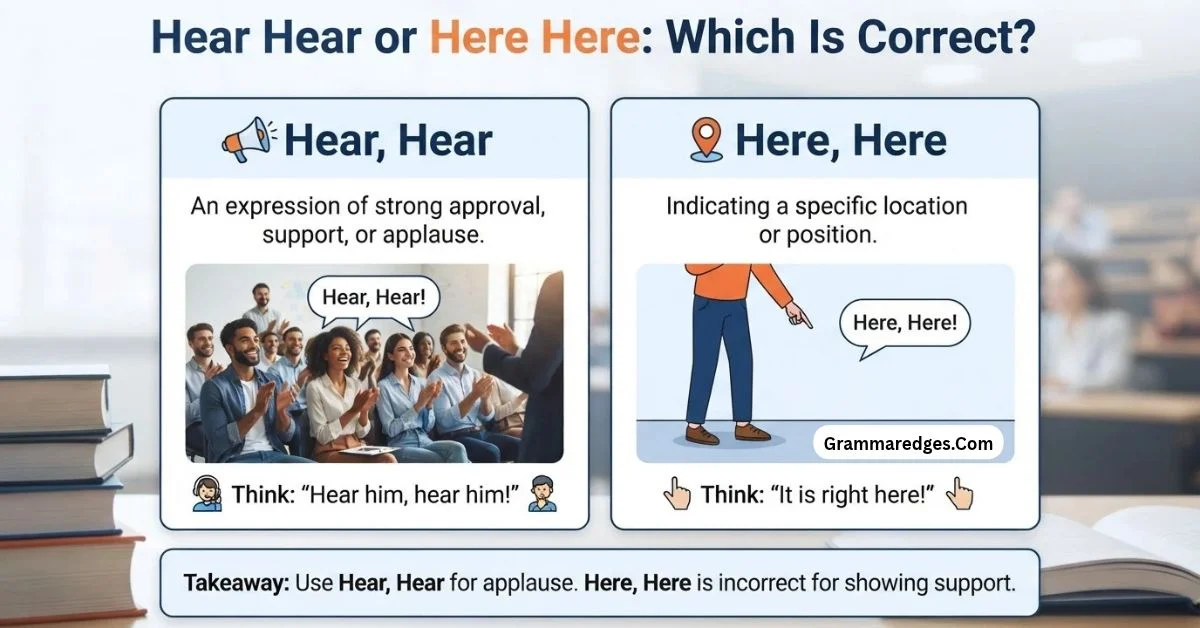
The expression “hear, hear” is an interjection used to show strong agreement with a statement, opinion, or idea. It communicates that the speaker believes something is worth listening to and deserves recognition.
For example, imagine someone at a meeting says, “Everyone deserves to be treated with respect.” Another person might respond, “Hear, hear!” This response means, “I agree completely,” or “That is absolutely right.”
By contrast, “here, here” refers to the words “here” repeated twice. The word “here” usually identifies a place, location, or presence. Although the combination can be used creatively in a sentence, it is not the standard spelling of the expression used to show agreement.
Examples of Hear Hear
- Hear, hear! We should appreciate everyone’s hard work.
- Hear, hear! That is exactly what I wanted to say.
- “We need to protect our environment.” “Hear, hear!”
- Hear, hear! Honesty should always come first.
Examples of Here Here
- Put the two books here, here beside the computer. This is possible in a context where someone is indicating two specific locations, although the sentence would usually be written more naturally another way.
- “Place the labels here and here,” the teacher explained.
Notice that the second example uses “here” to indicate locations, not agreement.
The simple rule: Use “hear, hear” when you want to express approval or agreement. Use “here” when you are talking about a location or presence.
2. Background and Origin of Hear, Hear
The expression “hear, hear” has a long history in English and is particularly associated with public speeches, political debates, and formal gatherings.
The phrase developed from an older expression, “hear him” or “hear him, hear him,” which encouraged an audience to listen to a speaker. Over time, the shorter form “hear, hear” became a conventional way to express approval of someone’s words.
Historically, the expression was common in parliamentary discussions and public meetings. When a speaker made a statement that listeners supported, members of the audience could call out “Hear, hear!” to show agreement. The phrase served as a verbal signal that the speaker had made an important or convincing point.
Today, the expression remains associated with British parliamentary traditions, but it is also understood in other English-speaking countries, including the United States, Canada, Australia, and New Zealand.
Although people may use applause, emojis, or short comments to express approval online, “hear, hear” continues to communicate agreement in both spoken and written English.
Why Do People Write Here Here Instead?
The confusion occurs because “hear” and “here” are homophones. They have the same pronunciation in many English accents but different spellings and meanings.
When someone hears the phrase without seeing it written, it is easy to choose the wrong spelling. This is especially common among people who have encountered the expression mainly through conversation rather than reading.
Understanding the phrase’s history makes the correct spelling easier to remember: it originally encouraged people to listen to a speaker.
3. Usage in Different Contexts
“Hear, hear” can appear in several situations, ranging from formal public speeches to relaxed conversations among friends. Its meaning remains essentially the same: the speaker agrees with or approves of something that has been said.
In Everyday Conversations
People may use the expression when a friend shares an opinion they strongly support.
Example:
Friend: “We should spend more time with our families.”
You: “Hear, hear! Time together is important.”
In casual conversation, the expression can sound enthusiastic or slightly formal, depending on the speaker’s personality.
In Professional Settings
In workplaces, “hear, hear” can show agreement during meetings and discussions.
Examples:
- Hear, hear! Our team deserves recognition for this achievement.
- “We should communicate more clearly with customers.” “Hear, hear!”
- Hear, hear! That is a sensible approach to the problem.
The phrase can be appropriate when colleagues are expressing support for a shared goal. However, it may sound theatrical in a highly casual workplace, so alternatives such as “I agree” or “Absolutely” may feel more natural.
In Speeches and Public Debates
This is one of the expression’s most traditional uses. Audience members may say “Hear, hear!” to support a speaker’s argument or acknowledge a particularly effective point.
In Social Media Comments
Online, the phrase often appears beneath posts about fairness, personal achievements, community issues, or inspirational statements.
Example:
Post: “Kindness costs nothing, but it can change someone’s day.”
Comment: “Hear, hear! We need more kindness in the world.”
In writing, the phrase can stand alone as a complete expression of agreement.
4. Hear Hear Meaning in Chat, WhatsApp, Instagram, and TikTok
On messaging apps and social platforms, “hear, hear” generally means “I agree,” “Well said,” or “Exactly!” It allows users to support another person’s opinion without writing a lengthy response.
The phrase is not a special internet acronym or a hidden slang term. It is an established English expression that has carried its meaning into digital communication.
Hear Hear on WhatsApp
On WhatsApp, someone might use the phrase in a group chat when another member shares a reasonable suggestion.
Example:
Person A: “Let’s make sure everyone gets invited to the celebration.”
Person B: “Hear, hear! Nobody should feel left out.”
It can also appear in family chats, community groups, and work conversations.
Hear Hear on Instagram
Instagram users may write “Hear, hear!” beneath posts that express opinions about friendship, kindness, social responsibility, or personal growth.
Example:
Caption: “Support your friends when they are succeeding, not only when they are struggling.”
Comment: “Hear, hear! Real friendship means celebrating others.”
The expression works well when a user wants to show agreement without taking attention away from the original post.
Hear Hear on TikTok
On TikTok, the phrase can appear in comments responding to videos about everyday experiences, relationships, social issues, or humorous observations.
Example:
Creator: “You do not owe everyone an explanation for your personal choices.”
Comment: “Hear, hear! Protect your peace.”
Depending on the context, the comment may communicate sincere support or playful agreement.
Can You Use Here Here Online?
You can write “here, here” when you are literally indicating locations, but it is not the conventional spelling when agreeing with someone’s statement.
For example:
- Correct: “Hear, hear! That was a brilliant speech.”
- Incorrect for the intended meaning: “Here, here! That was a brilliant speech.”
A useful reminder is that “hear” relates to listening, while “here” relates to a place.
5. Meaning in Physics, Medical, and Aircraft Terminology
The expressions “hear, hear” and “here, here” are ordinary English phrases rather than specialized technical terms. Neither has a standard technical definition in physics, medicine, or aviation.
Nevertheless, the words “hear” and “here” can appear in these fields in their ordinary senses or in technical contexts that should not be confused with the expression of agreement.
In Physics
The word “hear” can relate to sound waves and human hearing. Sound is produced by vibrations that travel through a medium, such as air, and can be detected by the ear.
The word “here” can indicate a particular position in space. In a physics problem, a teacher might say, “Measure the force here,” while pointing to a location on a diagram.
Neither word combination, “hear, hear” nor “here, here,” is a standard physics formula or principle.
In Medical Terminology
“Hear” is relevant to hearing assessments, auditory function, and hearing loss. Healthcare professionals may discuss a patient’s ability to hear sounds or understand speech.
“Here” may be used in ordinary clinical instructions, such as asking a patient to point to a particular area.
However, “hear, hear” is not a recognized medical diagnosis, treatment, or clinical term. If you encounter the phrase in a medical conversation, its meaning will generally depend on ordinary English usage.
In Aircraft Terminology
In aviation, “here” may be used informally to indicate a location on an aircraft diagram or inside a cabin. The word “hear” relates to listening and auditory communication, including a pilot’s ability to hear radio transmissions.
Pilots and air traffic controllers use standardized communication procedures to reduce misunderstandings. “Hear, hear” is not a standard aviation command or technical aviation expression.
Important distinction: In all three fields, the meaning depends on context. Do not treat the everyday expression “hear, hear” as specialized terminology.
6. Common Misconceptions About Hear Hear and Here Here
Several misunderstandings explain why people frequently confuse these expressions.
Misconception 1: Here Here Is Equally Correct for Agreement
This is the most common mistake. Because both phrases sound identical, people sometimes assume either spelling is acceptable.
In standard written English, “hear, hear” is the established expression of agreement. “Here, here” is generally an error when used with that intended meaning.
Misconception 2: Hear Hear Means Someone Cannot Hear Properly
Although the word “hear” relates to the sense of hearing, the expression does not usually describe a person’s physical hearing ability.
Instead, it signals approval or agreement with another person’s statement.
Misconception 3: The Phrase Is Only Used in Politics
The expression has strong historical connections to speeches and parliamentary debate, but it can also appear in ordinary conversations, workplace discussions, online comments, and social gatherings.
Misconception 4: Hear Hear Is an Acronym
“Hear, hear” is not an acronym or abbreviation. It is an established expression derived from an older call encouraging people to listen.
Misconception 5: It Is Always Formal
The phrase can sound formal or traditional, especially when spoken aloud. However, people also use it humorously or casually in online discussions.
The tone depends on the context, the speaker, and the relationship between the people communicating.
7. Similar Terms and Alternatives
If you want to express agreement without using “hear, hear,” several alternatives can communicate the same general idea.
| Expression | Meaning | Best context |
|---|---|---|
| I agree | You share the person’s opinion | Everyday and professional |
| Well said | The person expressed an idea effectively | Speeches and comments |
| Absolutely | You strongly agree | Casual and professional |
| Exactly | The statement matches your view | Conversations and chats |
| True that | You believe the statement is correct | Informal conversations |
| Couldn’t agree more | You strongly share the opinion | Casual and professional |
| Amen to that | You strongly support the statement | Informal or faith-related contexts |
| So true | You believe the statement is accurate | Social media and messaging |
| Here, here | Usually a misspelling when agreement is intended | Avoid for this meaning |
Choosing the Right Alternative
For a professional email, “I agree” or “That is a good point” may sound more natural than “Hear, hear!”
For a social media comment, “Exactly!” or “Well said!” may feel more conversational.
For a public speech or a humorous discussion, “Hear, hear!” can add enthusiasm and personality.
Choose an expression that suits the tone of the conversation rather than relying on the same phrase every time.
8. How to Respond to Hear Hear
If someone says “Hear, hear!” after you make a statement, they are usually expressing agreement or approval. You do not need to give a special response, but you can acknowledge their support.
Your response can depend on the setting and your relationship with the other person.
Casual Responses
- “Glad you agree!”
- “Exactly!”
- “That’s what I think, too.”
- “I’m happy we’re on the same page.”
Professional Responses
- “Thank you. I’m glad we agree.”
- “I appreciate your support.”
- “I’m pleased that we share the same view.”
- “Thank you for reinforcing that point.”
Responses in Online Conversations
If someone comments “Hear, hear!” on your post, you could reply:
- “Thanks for agreeing!”
- “Well said by you, too!”
- “Absolutely—we need more of that.”
- “Glad this resonates with you.”
What If Someone Writes Here Here?
If a person writes “here, here” while clearly expressing agreement, you can usually understand what they mean without correcting them.
In an informal conversation, responding naturally is often the best choice. If you are editing an article, essay, or professional document, you can quietly correct it to “hear, hear.”
9. Differences Between Hear Hear and Similar Words
The easiest way to understand this expression is to compare the meanings of the two homophones.
| Feature | Hear | Here |
|---|---|---|
| Part of speech | Usually a verb | Usually an adverb |
| Basic meaning | To perceive sound | In or at this place |
| Example | I can hear the music. | Please sit here. |
| Expression of agreement | “Hear, hear!” | Not the standard form |
| Memory clue | Ears and listening | Location and place |
Hear vs. Here in Sentences
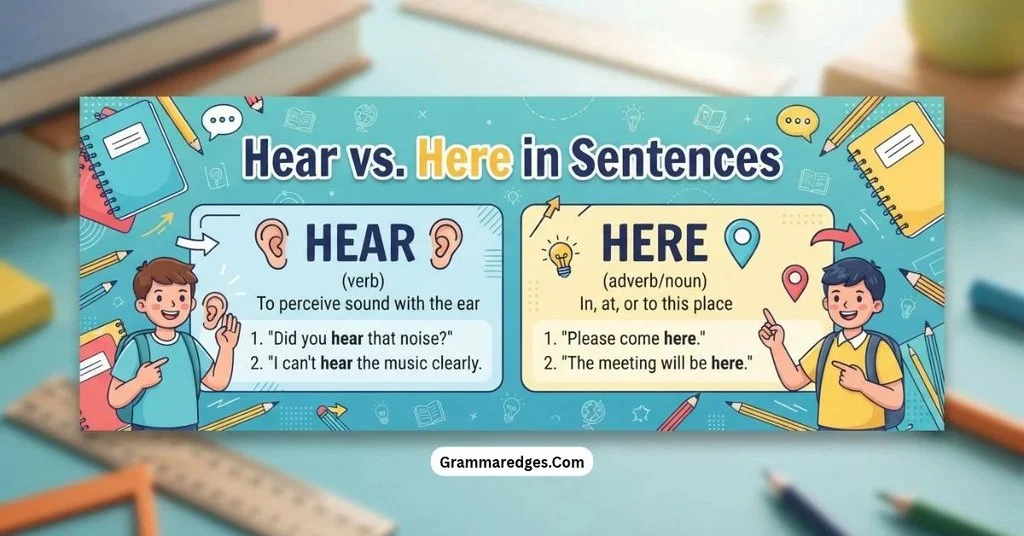
Hear: “I can hear what you are saying.”
This sentence refers to the ability to perceive sound.
Here: “Please leave your bag here.”
This sentence identifies a location.
Hear, hear: “Hear, hear! Everyone should have an equal opportunity.”
This expression communicates agreement with the statement.
Here, here: “Put one box here and another here.”
This sentence can use the word “here” twice to identify two locations, although punctuation and phrasing may vary with context.
The central difference is grammatical as well as semantic. “Hear” is a verb associated with listening, while “here” usually identifies a place. When you are supporting an opinion, the conventional expression is “hear, hear.”
10. Relevance in Online Conversations and Dating Apps
Online communication relies on short expressions that communicate a reaction quickly. “Hear, hear” can help users show agreement without writing a detailed explanation.
On social platforms, it may be used to support discussions about personal boundaries, mutual respect, friendship, equality, or everyday experiences.
In Dating App Conversations
Suppose someone writes on a dating profile, “Honesty and kindness matter more than expensive gifts.”
A person who agrees might respond:
“Hear, hear! Good communication and kindness are important in any relationship.”
This response communicates shared values and can help start a meaningful conversation.
In Relationship Discussions
The phrase can also express agreement about boundaries, trust, and healthy communication.
Example:
Person A: “Both people should feel comfortable saying what they need.”
Person B: “Hear, hear! Mutual respect matters.”
In this context, the expression shows support for the idea rather than romantic interest by itself.
Does Hear Hear Have a Flirty Meaning?
No. “Hear, hear” does not inherently mean flirting, attraction, or romantic interest.
Its primary meaning is agreement or approval. However, the surrounding conversation may give it a playful or flirtatious tone.
For example, if someone jokes, “The best dates involve good food and great company,” replying “Hear, hear!” may sound warm and playful. It still does not prove that the person is romantically interested.
Remember: Interpret the phrase in context. A single expression of agreement cannot reliably reveal someone’s intentions or feelings.
Conclusion
The difference between “hear, hear” and “here, here” is simple once you understand their meanings. “Hear, hear” is the correct expression for showing agreement, approval, or enthusiasm, while “here” usually refers to a location. Although the two words sound alike, they are not interchangeable when expressing support for someone’s statement.
The phrase has historical roots in public speeches and formal debates, but it remains useful in everyday conversations, workplace discussions, social media comments, and messaging apps. You can also choose alternatives such as “Exactly,” “Well said,” or “I agree” when you want a more modern or conversational tone.
Whenever you are unsure which spelling to use, remember that “hear, hear” encourages people to listen to a statement worth supporting. With this simple memory trick, you can avoid a common English spelling mistake and use the expression confidently in your writing.
Read More Posts: