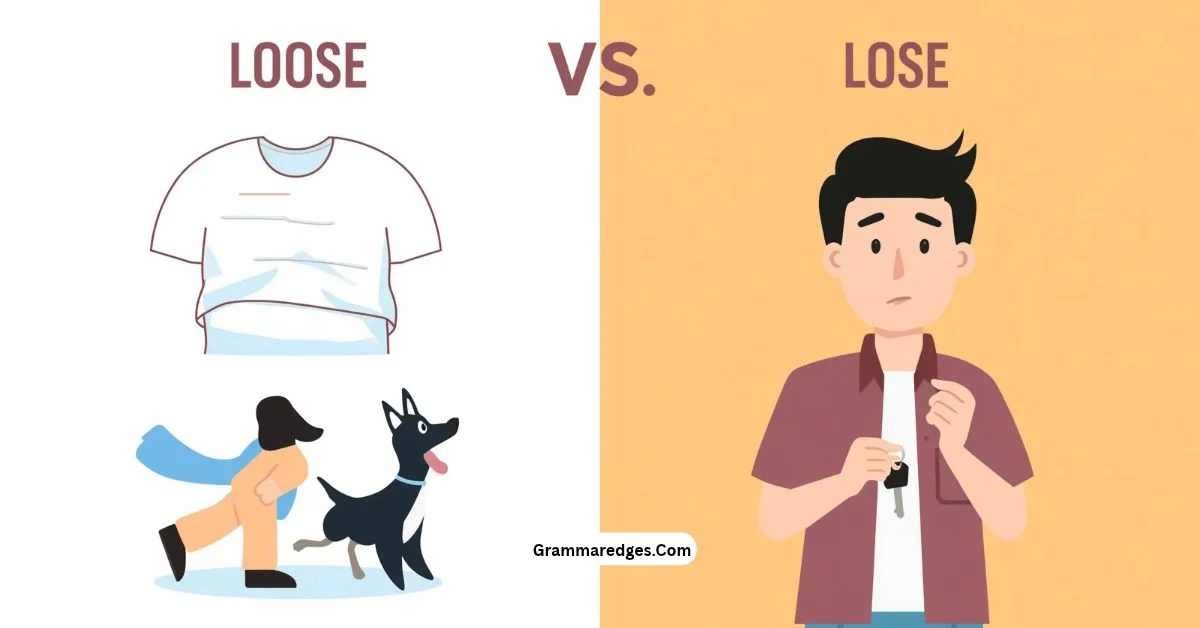
Loose usually means not tight, not firmly attached, or free, while lose is a verb meaning to misplace something, no longer have something, or fail to win. For example, “My shirt is loose” describes its fit, while “I might lose my shirt” describes what may happen to it.
Key Takeaways
- Loose usually describes something that is not tight or firmly fixed.
- Lose is a verb meaning to misplace, no longer have, or fail to win.
- Loose rhymes with “goose” and ends with an s sound.
- Lose rhymes with “choose” and ends with a z sound.
- Remember: loose = extra space; lose = something is gone or not won.
What Is the Difference Between Loose and Lose?
Loose and lose are different words with different meanings and grammatical roles. Their similar spelling makes them easy to confuse, especially when typing quickly.
The easiest distinction is:
Loose = not tight.
Lose = no longer have, misplace, or fail to win.
For example:
- My shoes are loose.
- I do not want to lose my shoes.
In the first sentence, loose describes the shoes. In the second, lose describes an action. This adjective-versus-verb distinction is one of the clearest ways to separate the two words.
Loose: Meaning and Use
Loose is most commonly an adjective. It describes something that is not tight, firmly attached, controlled, or exact.
For example:
- The button is loose.
- This jacket is too loose.
- The dog got loose from the yard.
- There is a loose connection in the cable.
- She wore loose clothing.
Cambridge Dictionary also lists meanings connected with things that are not firmly fastened, clothing that does not fit closely, and something that is not exact.
Loose can also be a verb, although this use is much less common in everyday American English. As a verb, it can mean to release, set free, or make something less tight.
Lose: Meaning and Use
Lose is a verb. It describes an action or situation in which someone no longer has something, cannot find something, experiences a loss, or fails to win.
For example:
- I might lose my keys.
- We could lose the game.
- She does not want to lose her job.
- He needs to lose weight.
- Try not to lose focus.
Dictionary.com explains that lose can refer to coming to be without something or suffering defeat.
This is why “I don’t want to loose my phone” is incorrect when you mean that you do not want to misplace your phone.
The correct sentence is:
I don’t want to lose my phone.
Loose vs Lose: Side-by-Side Comparison
| Feature | Loose | Lose |
|---|---|---|
| Main role | Usually adjective | Verb |
| Basic meaning | Not tight or firmly fixed | Misplace, no longer have, or fail |
| Pronunciation | /luːs/ | /luːz/ |
| Ending sound | s sound | z sound |
| Example | My shirt is loose. | Don’t lose your shirt. |
| Common phrase | loose clothing | lose weight |
| Related word | loosen | lost |
The spelling difference is small, but the meaning is significant. Loose has two o’s, while lose has one o.
How to Use “Loose” in a Sentence
Use loose when you are describing something that is not tight, secure, fixed, or closely controlled.
Examples
- My shoes are too loose.
The shoes do not fit tightly. - The screw is loose.
The screw is not firmly attached. - She prefers loose clothes.
Her clothes do not fit tightly around her body. - The dog is running loose.
The dog is free and not being restrained. - There is a loose wire behind the computer.
The wire is not firmly secured. - The story is a loose adaptation of the original book.
The adaptation does not follow the original exactly.
A useful test is to replace loose with “not tight.” If the sentence still makes sense, loose is probably the correct choice.
For example:
The knot is loose.
→ The knot is not tight.
That works, so loose is correct.
How to Use “Lose” in a Sentence
Use lose when you are talking about an action involving something disappearing from your possession, a failure to win, or a reduction or loss.
Examples
- Don’t lose your wallet.
Don’t misplace your wallet. - Our team might lose the game.
Our team might fail to win. - I always lose my sunglasses.
I often misplace them. - She wants to lose weight.
She wants to reduce her body weight. - Don’t lose hope.
Don’t stop having hope. - I don’t want to lose my job.
I don’t want to stop having my job.
A useful test is to replace lose with “misplace,” “fail,” or “no longer have,” depending on the sentence.
For example:
I might lose my keys.
→ I might misplace my keys.
Because the replacement works, lose is correct.
Loose vs Lose Pronunciation
Pronunciation provides another useful clue.
Loose is pronounced like “goose” or “moose.” It ends with an s sound:
loose → /luːs/
Lose is pronounced like “choose” or “shoes.” It ends with a z sound:
lose → /luːz/
Dictionary and grammar references consistently distinguish the final sounds of the two words.
Try saying these pairs aloud:
- loose — goose
- lose — choose
- loose — moose
- lose — shoes
The pronunciation difference can help you remember which word you need when writing.
Common Mistakes With Loose and Lose
These mistakes are especially common because the words look so similar.
Lose Weight
Correct:
I want to lose weight.
Incorrect:
I want to loose weight.
Why? Lose is the verb meaning to reduce or no longer have something. Loose does not mean “reduce weight.”
Lose a Game
Correct:
Our team could lose the game.
Incorrect:
Our team could loose the game.
Why? Lose means fail to win. Loose does not have that meaning.
Lose Your Keys
Correct:
Be careful not to lose your keys.
Incorrect:
Be careful not to loose your keys.
Here, lose means misplace or no longer have the keys.
Loose Clothing
Correct:
She likes to wear loose clothing.
Incorrect:
She likes to wear lose clothing.
Here, loose describes clothing that does not fit tightly. Cambridge gives this as one of the standard meanings of the adjective loose.
Loose Change
Correct:
I found some loose change in my pocket.
Here, loose change refers to coins that are not kept in a wallet, container, or other organized form.
Compare:
I don’t want to lose my loose change.
Both words are correct in the same sentence, but they perform different jobs:
- lose = misplace
- loose = not contained or secured
This is a useful example because it shows how different the two words really are.
Easy Memory Trick for Loose vs Lose
Here is one simple trick:
Loose has two O’s because there is extra room.
Think:
LOOSE = ROOMY
A loose shirt has extra space. A loose screw is not firmly secured.
Lose has one O because something is gone.
Think:
LOSE = GONE
You lose your keys. You lose a game. You lose your phone.
You can also remember the basic formula:
Loose = not tight
Lose = misplace or fail
If you can replace the word with “not tight,” choose loose.
If you can replace it with “misplace,” “no longer have,” or “fail to win,” choose lose.
What About Loose, Lost, and Loosen?
These three related words can create another layer of confusion.
Loose
Loose usually describes a condition.
- The button is loose.
- My pants are loose.
Lose
Lose is the present-tense verb.
- Don’t lose your phone.
- We might lose the match.
Lost
Lost is a form of lose.
- I lost my phone yesterday.
- They lost the game.
Loosen
Loosen means to make something less tight.
- Please loosen the knot.
- He loosened his tie.
So:
Loose = not tight
Lose = misplace or fail
Lost = past form of lose
Loosen = make less tight
Keeping these four words separate can eliminate many common spelling mistakes.
Practice: Loose or Lose?
Test yourself with these sentences.
- Don’t ___ your passport.
- My shoelaces are too ___.
- We could ___ the match.
- She prefers ___ sweaters.
- I don’t want to ___ my wallet.
- The screw is ___.
- He wants to ___ weight.
- The dog got ___ from its leash.
Answers
- lose
- loose
- lose
- loose
- lose
- loose
- lose
- loose
The pattern becomes much easier when you focus on meaning rather than spelling alone.
Frequently Asked Questions
Is it lose or loose weight?
The correct phrase is “lose weight.” Lose is a verb meaning to reduce or no longer have something. Loose means not tight or not firmly fixed, so “loose weight” is incorrect in standard English.
Is it loose or lose a game?
The correct phrase is “lose a game.” If a team loses a game, it fails to win. Loose does not mean “fail to win.” For example: “Our team might lose the game tonight.”
Is loose an adjective or a verb?
Loose is usually an adjective, especially when it means not tight or not firmly attached. For example, “The handle is loose.” It can also be used as a verb meaning to release or set free, although that use is less common in everyday writing.
How can I remember loose vs lose?
Use this simple rule: loose = not tight; lose = misplace or fail. The extra o in loose can remind you of extra space, while lose means something is gone or you failed to win.
Conclusion
The difference between loose vs lose becomes simple once you focus on meaning. Loose usually describes something that is not tight, firmly attached, or restricted, while lose describes an action such as misplacing something, no longer having it, or failing to win. Remember the quick rule: loose = not tight; lose = misplace or fail.
When you are unsure, check the sentence. If you mean “not tight,” use loose. If you mean “misplace,” “no longer have,” or “fail to win,” use lose. With a few examples and regular practice, this commonly confused pair becomes much easier to use correctly.