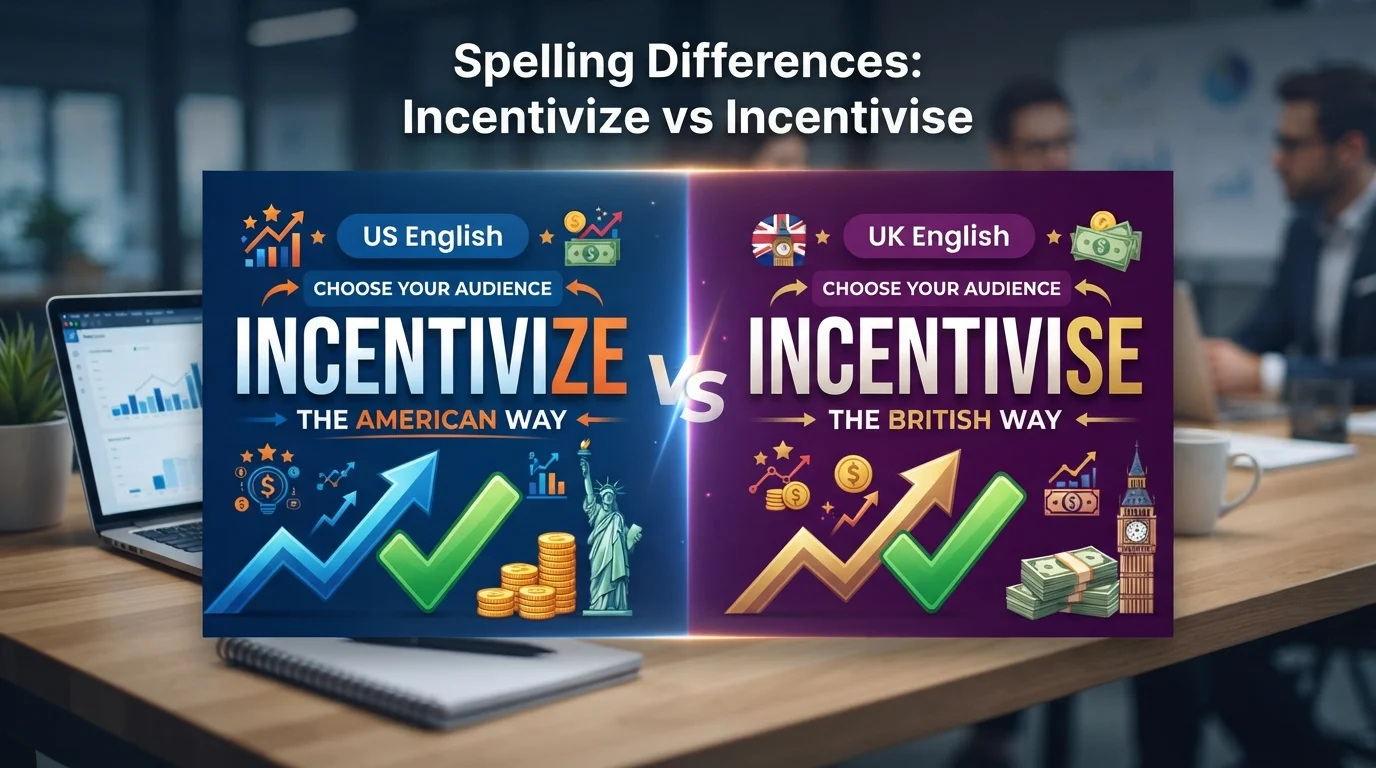
Choosing between incentivize vs incentivise can be confusing if you are unsure about American and British English spelling rules.
Both words have the same meaning, but the correct choice depends on your audience and writing style. In the United States, incentivize is the preferred spelling, while incentivise is commonly used in British English.
If you are writing a business email, an academic paper, or website content, knowing this small difference can help you write more clearly and professionally. In this guide, you’ll discover their meanings, key differences, sentence examples, and tips for choosing the right spelling.
Key Takeaways
- Incentivize is the standard choice for American English writing.
- Incentivise is commonly used in British English.
- Both spellings mean to encourage an action through an incentive.
- The correct choice depends on your audience and preferred style guide.
- Encourage, motivate, and reward can be useful alternatives.
Incentivize vs Incentivise: What’s the Difference?
The main difference between incentivize and incentivise is their spelling. Both are verbs that describe encouraging someone to do something by providing a reason, reward, or benefit.
American English generally favors words ending in -ize, which makes incentivize the preferred choice for US readers. British English commonly uses incentivise, although British spelling conventions are not entirely uniform.
The two words serve the same purpose in a sentence. You can use either one when discussing employee bonuses, customer rewards, educational programs, or government policies.
| Feature | Incentivize | Incentivise |
|---|---|---|
| Preferred regional usage | American English | Common British English |
| Meaning | Encourage through an incentive | Encourage through an incentive |
| Part of speech | Verb | Verb |
| Present participle | Incentivizing | Incentivising |
| Past tense | Incentivized | Incentivised |
| Example | We incentivize employees. | We incentivise employees. |
Oxford and Cambridge dictionaries recognize incentivise as a British English spelling variant of incentivize.
Incentivize Is the Preferred American Spelling
If you are writing for an American audience, choose incentivize. This spelling is appropriate for US business reports, academic assignments, marketing materials, emails, and website content.
Examples:
- The company plans to incentivize employees with performance bonuses.
- Our new loyalty program will incentivize customers to make repeat purchases.
- The government hopes to incentivize businesses to invest in renewable energy.
- Teachers can incentivize students by recognizing their progress.
In each example, the verb describes an attempt to encourage a particular action.
For a US-focused website, using incentivize consistently is the clearest approach.
Incentivise Is Common in British English
British writers commonly use incentivise, especially in professional communication, business reports, and discussions about public policy.
Examples:
- The company hopes to incentivise employees with additional benefits.
- The retailer will incentivise customers to return with special offers.
- The council plans to incentivise residents to recycle more.
- The school introduced rewards to incentivise students to read regularly.
These sentences have the same meanings as their American counterparts. Only the spelling changes.
However, British English does not require every word ending in -ize to change to -ise. Some British publications and style guides retain -ize in words such as organize and recognize. Follow the spelling conventions required by your publisher or organization.
What Does Incentivize or Incentivise Mean?
To incentivize or incentivise means to encourage someone to take an action by offering an incentive. An incentive may be money, a discount, recognition, extra time off, or another benefit.
The word is especially common in business, economics, education, marketing, and public policy. Dictionary definitions describe it as encouraging behavior by providing a reward or reason to act.
Consider this example:
The business introduced a bonus program to incentivize employees to reach their monthly targets.
The bonus is the incentive, and reaching the targets is the desired action.
Here are three more examples:
- Marketing: The store offers discounts to incentivize first-time buyers.
- Education: The teacher uses reading rewards to incentivize regular practice.
- Public policy: Officials introduce tax benefits to incentivize investment.
In each situation, the goal is to influence behavior by making a particular action more appealing.
Incentivize vs Incentivise Examples in Sentences
Seeing both spellings in similar sentences makes the distinction easier to understand.
Business and Workplace Examples
American English:
- We need to incentivize employees to improve customer service.
- The company incentivized its sales team with annual bonuses.
- Managers are incentivizing staff to complete training.
- The new policy aims to incentivize long-term investment.
British English:
- We need to incentivise employees to improve customer service.
- The company incentivised its sales team with annual bonuses.
- Managers are incentivising staff to complete training.
- The new policy aims to incentivise long-term investment.
Notice that the meaning, grammar, and sentence structure remain the same. The spelling of the verb and its related forms changes to match the chosen regional convention.
Everyday and Educational Examples
The word can also describe incentives outside the workplace.
- American: Parents may incentivize children to finish their homework by offering extra playtime.
- British: Parents may incentivise children to finish their homework by offering extra playtime.
- American: The library introduced a reading challenge to incentivize participation.
- British: The library introduced a reading challenge to incentivise participation.
These examples show that the word is not limited to money or business. An incentive can be any suitable reward or benefit that encourages an action.
Comparison Table: American vs British English
Use this table when deciding which form belongs in your writing.
| Writing situation | Recommended spelling |
|---|---|
| US business email | Incentivize |
| American academic paper | Incentivize |
| US marketing campaign | Incentivize |
| UK report following -ise spellings | Incentivise |
| British business communication | Incentivise is common |
| International website | Follow one consistent style |
| Publication with a required style guide | Follow its rules |
For a website targeting readers in the United States, incentivize is the better default. It matches common American spelling conventions and helps maintain consistency with words such as organize, prioritize, and modernize.
If your content targets multiple countries, choose a primary spelling standard for each version of the website rather than switching between forms randomly.
Related Word Forms and Spelling Rules
The spelling difference continues when the verb appears in other grammatical forms.
| American English | British English | Usage |
|---|---|---|
| Incentivize | Incentivise | Base verb |
| Incentivizes | Incentivises | Third-person singular |
| Incentivized | Incentivised | Past tense or past participle |
| Incentivizing | Incentivising | Present participle |
| Incentivization | Incentivisation | Noun form |
Examples:
- The manager incentivizes employees with bonuses.
- The company incentivised customers last year.
- We are incentivizing participation through rewards.
- The policy focuses on the incentivization of innovation.
The noun incentive is spelled the same way in both varieties of English. It refers to something that encourages a person to act, such as a reward, benefit, or financial advantage.
One useful writing tip: although incentivization is a valid noun, it can sound formal or technical. In some sentences, simpler wording such as offering rewards or providing incentives is easier to read.
Synonyms and Alternatives to Incentivize
Sometimes a simpler word communicates the same idea more clearly. Choose an alternative based on the meaning you want to express.
| Alternative | Meaning | Example |
|---|---|---|
| Encourage | Support an action | We encourage employees to share ideas. |
| Motivate | Give someone a reason to act | The bonus motivates the team. |
| Reward | Give something in recognition | We reward employees for strong performance. |
| Entice | Attract through an appealing offer | The discount entices new customers. |
| Stimulate | Encourage activity or growth | The policy stimulates investment. |
| Persuade | Convince someone to act | We persuaded customers to try the service. |
These words are related but not always interchangeable. For example, reward describes giving a benefit, while incentivize emphasizes using a benefit to encourage a particular behavior.
Choose the simplest word that expresses your intended meaning.
Common Mistakes to Avoid
1. Treating one spelling as universally incorrect
Incentivize and incentivise are both accepted spellings. The choice depends on regional conventions and editorial preferences.
2. Mixing American and British spellings
Using organize in one paragraph and incentivise in another may create inconsistency in a US-focused article. Check your document for similar variations.
3. Assuming every incentive must be financial
An incentive can be a bonus, but it can also be recognition, flexible hours, a discount, or another benefit.
4. Using unnecessarily complicated language
Instead of writing, “The initiative will incentivize greater participation,” you could write, “The initiative will encourage more people to participate.”
Both versions can be correct. The simpler option may be better for general readers.
Frequently Asked Questions
1. Is it incentivize or incentivise?
Both are correct. Incentivize is the preferred spelling in American English, while incentivise is common in British English. Both words mean to encourage someone to do something by offering an incentive.
2. Is incentivise considered incorrect in the USA?
It is an accepted spelling variant, but it is not the usual choice for standard American English writing. If your audience is in the United States, use incentivize unless a specific style guide says otherwise.
3. What is the difference between incentivize and incentivise in meaning?
There is no difference in their basic meaning. Both verbs describe encouraging an action through an incentive or motivating benefit. The distinction is primarily regional spelling, not definition or grammatical function.
4. What is the past tense of incentivize?
The past tense is incentivized in American English. In British English that follows the -ise spelling, the corresponding form is incentivised.
Example: “The company incentivized employees with bonuses.”
5. What is the noun form of incentivize?
The basic noun is incentive, which refers to something that encourages action. Incentivization is another noun form describing the process of creating or providing incentives, although providing incentives is often clearer.
6. What is another word for incentivize?
Common alternatives include encourage, motivate, stimulate, and entice. Use encourage for a general audience, motivate when emphasizing a person’s willingness to act, and entice when an attractive offer is involved.
Conclusion
Choosing between incentivize vs incentivise is simple once you understand the difference between American and British spelling. Both words describe encouraging someone to take action by offering a reward, benefit, or other motivation. The meaning stays the same, regardless of which spelling you use.
For US-focused articles, business documents, emails, and academic writing, choose incentivize. For British English content that follows -ise spellings, incentivise is a natural choice. Remember that some British style guides also accept -ize forms, so check your publication’s requirements when necessary.
The most important rule is consistency. Select the spelling that suits your audience, use it throughout your document, and choose clear examples that show how incentives work in real situations. With that approach, you can use either form confidently and professionally.