
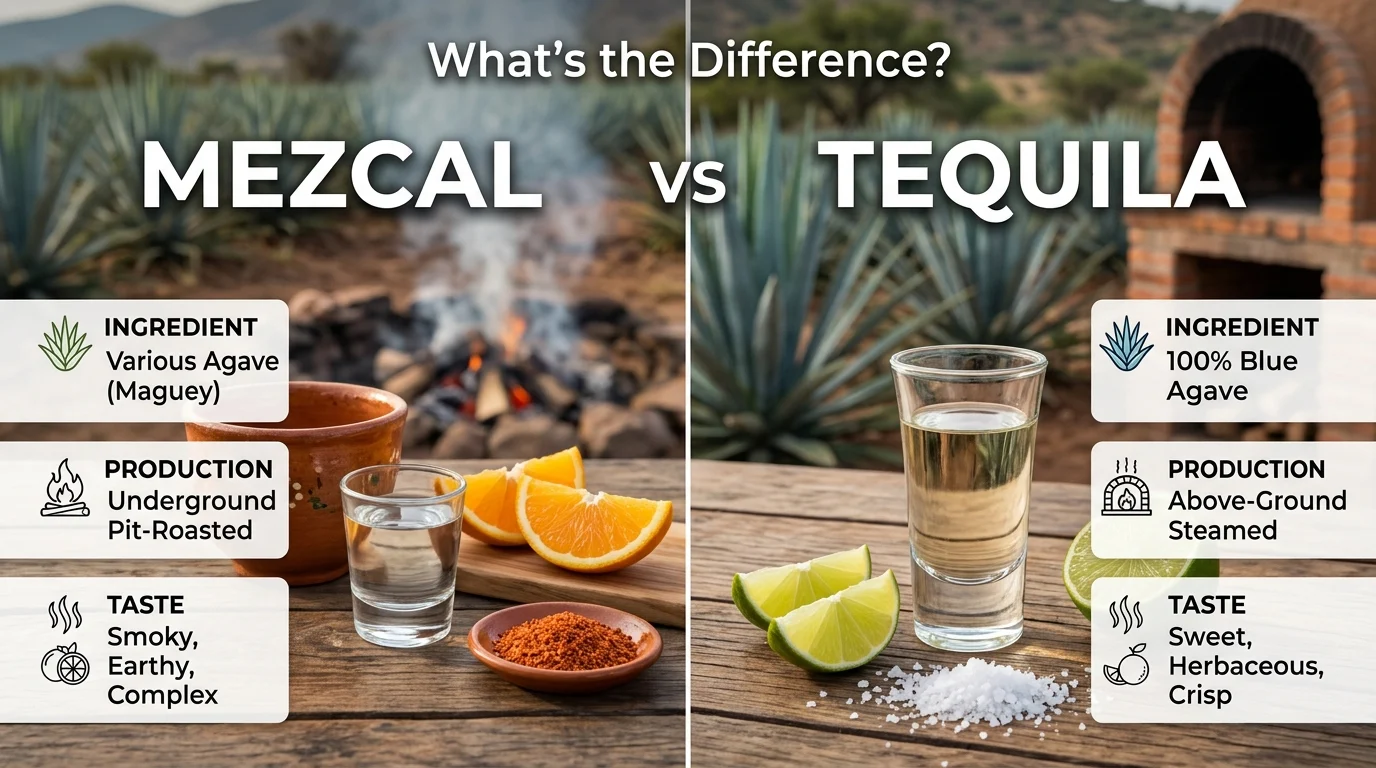
Mezcal vs tequila is a common comparison among people who enjoy Mexican spirits or want to understand the differences between these two popular alcoholic drinks.
Although both beverages come from Mexico and are made from agave plants, they have different production methods, flavors, origins, and traditions.
Tequila is widely recognized for its smooth, crisp taste, while mezcal is often known for its smoky character and complex flavor. However, there is much more to the difference than simply how these drinks taste.
Understanding their ingredients, manufacturing processes, alcohol content, and regional backgrounds can help you make a better choice.
If you are exploring Mexican culture, reading a cocktail menu, shopping for a bottle, or learning about spirits for the first time, knowing what separates mezcal from tequila makes the experience more enjoyable. This guide explains their similarities, differences, common misconceptions, and the best ways to enjoy each one.
1. Meaning and Definition of Mezcal and Tequila
Mezcal and tequila are traditional Mexican alcoholic beverages produced from the agave plant. Although they belong to the same broad family of spirits, they are not identical. Their differences come from the types of agave used, geographical production rules, cooking techniques, and distillation methods.
What Is Mezcal?
Mezcal is a distilled alcoholic beverage made from the cooked hearts of agave plants, commonly called piñas. It is traditionally associated with Oaxaca, Mexico, although legally recognized mezcal production takes place in several Mexican states.
One of mezcal’s most recognizable characteristics is its smoky flavor. This taste often develops because producers cook agave hearts in underground ovens using heated stones and other traditional materials.
Mezcal can be made from several agave varieties, including:
- Espadín
- Tobalá
- Tepeztate
- Arroqueño
- Madrecuixe
Different agave varieties produce different flavor profiles. Some mezcals taste earthy, herbal, fruity, or floral, while others have noticeable smoky notes.
What Is Tequila?
Tequila is another Mexican distilled spirit, but it has stricter production requirements. It must be made from at least 51% blue Weber agave and produced in designated regions of Mexico under official regulations.
Unlike mezcal’s traditional underground cooking process, tequila producers commonly cook agave hearts in industrial ovens or specialized autoclaves.
Tequila generally has a cleaner, sweeter, and more straightforward agave flavor, although aging can add notes of vanilla, oak, caramel, and spices.
The Basic Difference
The simplest way to understand these beverages is that tequila is a specific type of agave spirit with strict production rules, while mezcal is a broader category covering several traditional agave spirits.
Both have distinctive identities and are important parts of Mexican food and drink culture.
2. Background and History of Mezcal vs Tequila
The history of mezcal and tequila is closely connected to Mexico’s relationship with the agave plant. Indigenous communities used agave for many purposes long before modern distilleries became established.
Historical Background of Mezcal
Agave has played an important role in Mexican life for centuries. Indigenous communities used different agave varieties to produce food, fibers, building materials, and fermented beverages.
Mezcal’s history developed through traditional agave processing and the introduction of distillation techniques during the colonial period. Over generations, different communities developed their own production methods.
Oaxaca eventually became particularly famous for mezcal production. Small family-operated distilleries, known as palenques, helped preserve traditional techniques.
Today, mezcal represents more than an alcoholic beverage. It also reflects regional identity, craftsmanship, agriculture, and cultural traditions.
Historical Background of Tequila
Tequila developed in the western Mexican region surrounding the town of Tequila in Jalisco.
Its production became increasingly organized as distillation techniques developed and commercial production expanded. Over time, the drink gained recognition beyond Mexico.
The blue Weber agave became the defining ingredient, and official regulations eventually established where and how tequila could be produced.
Modern tequila is now one of Mexico’s most internationally recognized exports. It is used in classic cocktails, restaurants, bars, and celebrations worldwide.
How Their Histories Differ
Although both beverages share an agave-based heritage, their historical development followed different paths.
| Historical factor | Mezcal | Tequila |
|---|---|---|
| Cultural origin | Various Mexican regions | Jalisco and designated regions |
| Traditional production | Small-scale artisanal methods | Traditional and industrial methods |
| Agave varieties | Several approved varieties | Blue Weber agave |
| Cultural association | Regional craftsmanship | Internationally recognized spirit |
| Production identity | Diverse regional traditions | More standardized regulations |
Both drinks continue to evolve while maintaining strong connections to Mexican heritage.
3. Usage in Different Contexts: Restaurants, Social Media, and Professional Fields
The terms mezcal and tequila appear in many situations. Their meanings usually remain connected to alcoholic beverages, but the context can influence how people discuss them.
Usage in Restaurants and Bars
Restaurant menus often list mezcal and tequila separately because they have different flavor profiles.
For example:
- A customer may choose tequila for a Margarita.
- Someone interested in smoky flavors may prefer mezcal.
- A bartender may use mezcal to create a distinctive cocktail.
- A restaurant may offer tequila and mezcal tasting experiences.
Bartenders also use these spirits differently depending on the drink’s ingredients and intended flavor.
Usage in Social Media
On social platforms, people mention these beverages when sharing cocktail recipes, restaurant experiences, travel photographs, or nightlife content.
Common examples include:
- “Trying mezcal for the first time!”
- “A classic tequila cocktail never disappoints.”
- “Which one do you prefer, mezcal or tequila?”
- “Exploring traditional Mexican spirits.”
These expressions generally refer to the actual drinks rather than hidden internet slang.
Usage in Professional Fields
Both terms are important in several professional industries.
Hospitality: Bartenders, restaurant managers, and beverage specialists use these terms to describe drink selections and cocktail ingredients.
Agriculture: Farmers and researchers discuss agave varieties, cultivation, harvesting, and sustainability.
Food and beverage production: Distillers examine fermentation, cooking, distillation, and quality control.
International trade: Importers, exporters, and distributors use these names when identifying regulated Mexican spirits.
Understanding the distinction helps professionals communicate accurately about ingredients, production methods, and product classifications.
4. Meaning in Chat, WhatsApp, Instagram, and TikTok
Mezcal and tequila do not have universally established alternative meanings in everyday digital communication. When someone uses these words in a WhatsApp message, Instagram caption, or TikTok video, they are usually talking about the beverages.
However, the surrounding conversation can influence their meaning.
Mezcal in Chat
Someone might write:
- “Have you ever tried mezcal?”
- “This mezcal has a really smoky flavor.”
- “Let’s visit an authentic mezcal bar.”
These messages generally indicate an interest in drinking, restaurants, or Mexican culture.
Tequila in Chat
Tequila often appears in casual conversations about parties, cocktails, celebrations, and nightlife.
Examples include:
- “We ordered tequila shots last night.”
- “I prefer tequila in my cocktails.”
- “Do you like silver or aged tequila?”
Instagram and TikTok Usage
On Instagram, creators may use these words in food photography, travel posts, cocktail tutorials, and restaurant reviews.
On TikTok, mezcal and tequila commonly appear in:
- Cocktail preparation videos.
- Mexican food and travel content.
- Beverage comparisons.
- Bartending tutorials.
- Taste-testing challenges.
- Educational videos about agave spirits.
Popular Caption Examples
Mezcal captions:
- “A little smoky, a little special.”
- “Discovering the flavors of mezcal.”
- “Traditional taste, unforgettable experience.”
Tequila captions:
- “Good moments and classic cocktails.”
- “A taste of Mexican tradition.”
- “Keeping it classic with tequila.”
The important point is that neither term automatically represents a secret message, romantic signal, or internet abbreviation. Context determines what the sender intends to communicate.
5. Meaning in Physics, Medical, and Aircraft Terminology
Sometimes people encounter unfamiliar words while studying science, medicine, or aviation and wonder whether they have technical meanings.
Mezcal and tequila, however, are beverage names rather than established technical terms in these professional fields.
Mezcal and Tequila in Physics
Neither word has a standard meaning in physics.
Physicists do not generally use mezcal or tequila to describe energy, motion, force, electricity, or scientific measurements.
However, scientific methods can be used to study these beverages. For example, researchers may examine their chemical composition, ethanol concentration, fermentation processes, and temperature changes during production.
Mezcal and Tequila in Medical Terminology
Neither term is a recognized medical diagnosis, disease, treatment, or anatomical term.
Both beverages contain alcohol, which is relevant to medical discussions about alcohol consumption, metabolism, and potential health risks.
Excessive alcohol consumption can affect the liver, brain, heart, and other organs. Therefore, medical professionals may discuss tequila and mezcal when explaining the effects of alcoholic beverages.
Mezcal and Tequila in Aircraft Terminology
In aviation, neither word has a standard technical definition.
Aircraft professionals use specific terminology to describe navigation, engines, flight controls, fuel systems, and safety procedures.
If these words appear in an aviation-related conversation, they are more likely to refer to a beverage, company name, location, or unrelated reference.
Remember: Mezcal and tequila are primarily beverage terms, not scientific or aviation abbreviations.
6. Common Misconceptions About Mezcal and Tequila
Several misconceptions make it difficult for people to understand these two Mexican spirits. Here are some common misunderstandings and the facts behind them.
Misconception 1: Mezcal and Tequila Are Exactly the Same
This is incorrect. Both are agave-based spirits, but they have different production requirements, ingredients, and flavor characteristics.
Tequila follows specific blue Weber agave regulations, while mezcal can use several approved agave varieties.
Misconception 2: All Mezcal Tastes Smoky
Many people associate mezcal with smoke, but not every bottle has the same intensity.
Its flavor depends on the agave variety, cooking technique, fermentation, and distillation process. Some varieties offer fruity, floral, herbal, or earthy notes.
Misconception 3: Tequila Is Always Smooth
Tequila can have different flavor profiles depending on its production and aging.
Blanco tequila may taste fresh and peppery, while aged varieties can have richer vanilla, oak, and caramel characteristics.
Misconception 4: Mezcal Is Always Stronger
Neither category is automatically stronger than the other. Both can have different alcohol concentrations depending on the producer and product.
Checking the alcohol by volume (ABV) on the bottle is the best way to compare their strength.
Misconception 5: Every Agave Spirit Is Tequila
This is another common misunderstanding. Agave spirits include different categories, and tequila is only one of them.
Mezcal also has its own production regulations and regional identity.
Misconception 6: Expensive Bottles Are Always Better
Price does not automatically determine quality. Production methods, agave varieties, craftsmanship, aging, and personal taste all influence the experience.
7. Similar Terms and Alternatives
Mezcal and tequila belong to a wider family of Mexican and international alcoholic beverages. Understanding related terms makes beverage menus easier to navigate.
Here are some related beverages:
| Beverage | Main ingredient | General characteristics |
|---|---|---|
| Mezcal | Several agave varieties | Often smoky, earthy, or herbal |
| Tequila | Blue Weber agave | Fresh, sweet, peppery, or aged |
| Raicilla | Approved agave varieties | Distinctive regional agave spirit |
| Bacanora | Agave angustifolia | Traditional Sonoran spirit |
| Sotol | Desert spoon plant | Herbal and earthy |
| Pulque | Fermented agave sap | Thick, fermented, and low in alcohol compared with distilled spirits |
Which Alternatives Should You Consider?
If you enjoy tequila but want something different, mezcal can provide a more varied and sometimes smoky flavor experience.
If you prefer traditional regional spirits, raicilla or bacanora may be interesting alternatives.
Sotol is another option, although it is not technically an agave spirit because it comes from the desert spoon plant.
Pulque is different from all these beverages because it is fermented rather than distilled.
These drinks have their own histories and production traditions, so they should not be treated as interchangeable products.
8. How to Respond When Someone Mentions Mezcal or Tequila
Your response depends on the situation and what the other person wants to discuss. Someone might mention these beverages while planning a party, recommending a restaurant, or talking about personal preferences.
Here are some natural responses.
If Someone Asks About Your Preference
You can answer:
- “I usually prefer tequila because of its cleaner flavor.”
- “I enjoy mezcal because of its smoky character.”
- “Both are interesting, but it depends on the cocktail.”
If Someone Recommends Mezcal
You might respond:
- “That sounds interesting. What does it taste like?”
- “I’ve never tried that particular variety.”
- “Is it more smoky or fruity?”
If Someone Recommends Tequila
Possible replies include:
- “Which type would you recommend?”
- “I enjoy a good tequila Margarita.”
- “Is it blanco, reposado, or añejo?”
If You Are Ordering at a Restaurant
You can ask the bartender:
- “Which spirit works better in this cocktail?”
- “Do you have a mezcal tasting option?”
- “Can you explain the difference between these two bottles?”
Asking questions is a simple way to learn more without pretending to be an expert.
9. Differences Between Mezcal and Similar Words
Although mezcal and tequila are related, their differences are important when discussing ingredients, production, and taste.
The following comparison highlights the main distinctions.
| Feature | Mezcal | Tequila |
|---|---|---|
| Main ingredient | Multiple approved agave varieties | Blue Weber agave |
| Production regions | Several designated Mexican states | Specific designated Mexican regions |
| Cooking process | Often underground ovens | Commonly industrial ovens or autoclaves |
| Flavor | Often smoky, earthy, or complex | Often fresh, sweet, or peppery |
| Production style | Artisanal, ancestral, and other regulated methods | Traditional and industrial methods |
| Aging options | Joven, reposado, añejo | Blanco, joven, reposado, añejo, extra añejo |
| Famous region | Oaxaca | Jalisco |
| Cocktails | Mezcal Margarita, Oaxaca Old Fashioned | Margarita, Paloma, Tequila Sunrise |
Understanding Tequila Aging Categories
Tequila is commonly divided into several categories:
- Blanco: Generally unaged or aged for a short period.
- Joven: A young tequila that may be blended or adjusted under applicable regulations.
- Reposado: Aged in oak containers for at least two months.
- Añejo: Aged for at least one year.
- Extra Añejo: Aged for at least three years.
Mezcal also has regulated categories, including joven, reposado, and añejo.
However, aging is only one factor that affects flavor. The agave variety and production process are equally important when evaluating a bottle.
Which One Is Better?
There is no universal winner.
Tequila may be a better choice if you enjoy a crisp agave taste and classic cocktails. Mezcal may appeal more if you appreciate complex, earthy, and smoky flavors.
The best option depends on your personal preferences and the type of drinking experience you want.
10. Relevance in Online Conversations and Dating Apps
Mezcal and tequila sometimes appear in online conversations, especially when people discuss restaurants, nightlife, travel, and social activities.
On dating apps, mentioning either beverage does not automatically carry a romantic or hidden meaning. It usually communicates an interest in drinks, cocktails, or going out.
Mezcal in Dating Conversations
Someone might write:
- “I know a great place for mezcal cocktails.”
- “Have you ever tried traditional Oaxacan mezcal?”
- “We should explore a Mexican restaurant sometime.”
These messages can be casual conversation starters or suggestions for a date.
Tequila in Dating Conversations
Tequila can also appear when people discuss their favorite drinks or weekend activities.
Examples include:
- “What’s your favorite tequila cocktail?”
- “Are you more of a Margarita or Paloma person?”
- “I know a nice restaurant with a great cocktail menu.”
Are These Words Flirting Signals?
Not necessarily. A person mentioning mezcal or tequila is not automatically expressing romantic interest.
You should consider the complete message, relationship, and conversation before interpreting its meaning.
For example, “Let’s try a new mezcal bar together” may be an invitation to spend time together, but it does not necessarily indicate romantic intentions.
How to Keep the Conversation Natural
If someone mentions either beverage, you can ask about their preferences, favorite cocktails, or restaurant recommendations.
You can also suggest a coffee shop, restaurant, or another alcohol-free activity if that better matches your preferences.
The main idea is to understand the context instead of assigning an invented meaning to ordinary beverage names.
Conclusion
Understanding mezcal vs tequila becomes easier when you compare their ingredients, production methods, history, and flavor profiles. Both beverages come from Mexico and are made from agave, but they have important differences.
Tequila must use blue Weber agave and follow specific production regulations, while mezcal can be produced from several approved agave varieties. Mezcal is often associated with smoky and earthy flavors, whereas tequila commonly offers fresh, sweet, and peppery notes.
Neither beverage is automatically better because the right choice depends on personal taste and intended use. If you are exploring Mexican traditions, reading a cocktail menu, or discussing drinks online, knowing these differences helps you make informed decisions.
Ultimately, both spirits represent distinctive parts of Mexico’s rich beverage culture and deserve appreciation for their individual characteristics.