
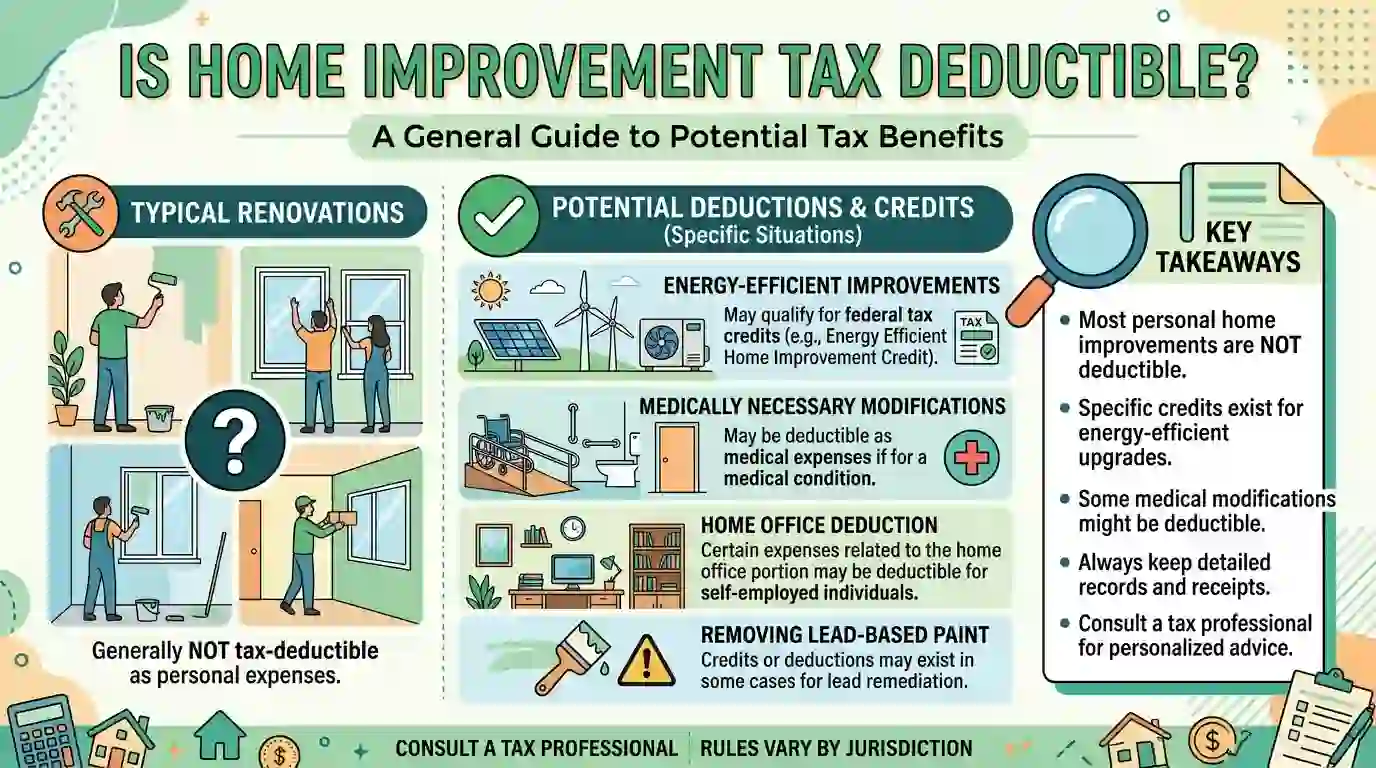
Is home improvement tax deductible? Generally, no. The IRS does not allow homeowners to deduct ordinary renovation or repair costs from their federal income taxes. However, qualifying improvements may increase your home’s cost basis, potentially reducing capital gains taxes when you sell. Special tax rules may also apply to rental properties, medical improvements, and business use.
Key Takeaways
- Most home improvements are not immediately tax deductible for homeowners.
- Major upgrades can increase your home’s adjusted cost basis.
- Routine repairs, such as painting and fixing leaks, generally do not qualify.
- Rental properties and qualifying home offices have different tax rules.
- Certain medical improvements may qualify for itemized medical deductions.
- Federal residential energy improvement credits ended for qualifying property placed in service after December 31, 2025.
Is Home Improvement Tax Deductible?
Introduction
Home improvements can make your property more comfortable, attractive, and valuable. Whether you are remodeling a kitchen, replacing an old roof, adding a bathroom, or installing new windows, these projects can cost thousands of dollars. Naturally, many homeowners want to know whether they can recover some of that money through tax savings.
So, is home improvement tax deductible under U.S. federal tax rules? In most cases, homeowners cannot deduct renovation expenses directly from their taxable income. However, certain improvements offer tax benefits over time, especially when you sell your property or use part of it for business or rental purposes.
Understanding the difference between repairs, improvements, deductions, and tax credits can help you make better financial decisions. This guide explains which expenses may qualify, how the rules work, and what records you should keep.
What Does Home Improvement Tax Deductible Mean?
The phrase “home improvement tax deductible” refers to whether homeowners can subtract renovation or upgrade expenses from their taxable income when filing a federal tax return.
For example, someone who spends $15,000 remodeling a kitchen may wonder whether that amount can reduce their annual tax bill. Usually, the answer is no if the property is their personal residence.
However, the IRS treats certain home improvements differently from everyday repairs. A qualifying capital improvement may increase your property’s adjusted cost basis, which can reduce your taxable profit when you eventually sell the home.
This distinction is important because a tax deduction, a tax credit, and a cost-basis adjustment are three different things.
Why Do Homeowners Look for Home Improvement Tax Deductions?
Home renovation projects can put pressure on household budgets. Understanding available tax benefits helps homeowners plan expenses and avoid missing legitimate tax savings.
Here are some common reasons people research these rules:
- Reduce tax bills: Find out whether renovation costs qualify for deductions or credits.
- Save money when selling: Learn how capital improvements affect taxable gains.
- Plan major projects: Understand the possible tax benefits before spending money.
- Manage rental properties: Identify expenses that may qualify as business deductions or depreciation.
- Improve accessibility: Explore tax treatment for medically necessary home modifications.
Are Home Improvements Tax Deductible?
For most people who own and live in their homes, renovation expenses are not deductible on a federal income tax return. The IRS generally considers these costs personal expenses.
However, there are important exceptions and other ways to receive tax benefits.
The following situations deserve attention.
1. Capital Improvements Can Reduce Future Taxes
A capital improvement adds value to your property, extends its useful life, or adapts it to a new purpose.
Examples include:
- Adding a bedroom or bathroom.
- Installing a new roof.
- Building a garage or deck.
- Replacing an entire plumbing system.
- Installing central air conditioning.
- Modernizing a kitchen.
- Adding a swimming pool.
You generally cannot deduct these expenses immediately. Instead, you add eligible costs to your home’s adjusted cost basis.
For example, suppose you purchased a home for $300,000 and later spent $40,000 on qualifying improvements. Your adjusted basis could increase to $340,000, assuming no other basis adjustments.
If you eventually sell the property for $450,000, your taxable gain may be lower because your adjusted basis is higher.
The IRS explains these rules in Publication 530. Internal Revenue Service+1
2. Home Repairs Usually Do Not Qualify
Repairs keep your property in good working condition. They do not necessarily add value or extend the home’s useful life.
Common examples include:
- Repainting interior or exterior walls.
- Fixing leaking faucets.
- Repairing broken windows.
- Patching small roof leaks.
- Fixing damaged flooring.
- Cleaning and maintaining gutters.
These expenses generally do not qualify for personal tax deductions or increase your home’s cost basis.
However, the IRS may treat repair work as part of a capital improvement when it forms part of a larger remodeling or restoration project.
For example, repairing damaged walls during a complete home renovation may become part of the overall improvement cost. Internal Revenue Service+1
3. Rental Property Improvements May Qualify for Tax Benefits
If you own a rental property, different tax rules apply.
You may deduct ordinary and necessary operating expenses, such as qualifying maintenance and repair costs. However, major improvements usually must be capitalized and recovered through depreciation over time.
For example:
- Fixing a broken rental property faucet may qualify as a repair expense.
- Replacing the entire roof generally counts as an improvement.
- Adding another bedroom is generally a capital improvement.
- Repainting between tenants may qualify as a maintenance expense.
The exact treatment depends on the nature of the work and applicable IRS rules.
Rental property owners should review IRS Publication 527 before claiming expenses. Internal Revenue Service+1
4. Home Office Improvements May Be Deductible
Self-employed individuals who use part of their homes for business may qualify for home office deductions.
The IRS generally requires the space to be used regularly and exclusively for business, with certain exceptions.
For example, if you use a dedicated room as your primary business office, some qualifying expenses may be deductible.
The rules generally include:
- Direct expenses related only to the office may be fully deductible, subject to applicable limits.
- Indirect expenses, such as whole-house utilities, may qualify based on the business-use percentage.
- Qualifying improvements may be recovered through depreciation rather than deducted immediately.
Suppose your home office occupies 10% of your home’s total area. Some eligible shared expenses may be allocated using that business-use percentage.
Employees who work remotely generally cannot claim the federal home office deduction as an unreimbursed employee business expense.
Read IRS Publication 587 for the complete requirements. Internal Revenue Service
5. Medically Necessary Home Improvements May Qualify
Certain home improvements made primarily for medical care may qualify as itemized medical expenses.
Examples include:
- Installing wheelchair ramps.
- Widening doorways for wheelchair access.
- Adding accessible bathroom equipment.
- Installing support bars.
- Modifying stairs for accessibility.
- Adjusting kitchen cabinets for medical needs.
There is an important limitation.
If a permanent improvement increases your home’s value, you generally must subtract that increase from the improvement’s cost to calculate the potentially deductible medical expense.
For example, imagine a medically necessary modification costs $12,000 and increases your home’s value by $3,000. The potentially eligible medical expense is $9,000.
You can generally deduct only qualifying medical expenses exceeding 7.5% of your adjusted gross income (AGI), provided you itemize deductions.
See IRS Publication 502 for details. Internal Revenue Service
6. Energy-Efficient Home Improvements and Tax Credits
Energy-efficient upgrades have historically offered federal tax benefits.
Examples included qualifying:
- Exterior windows and doors.
- Insulation.
- Heat pumps.
- Energy-efficient heating equipment.
- Home energy audits.
- Residential solar systems.
However, homeowners need to understand an important change for 2026.
Under the One Big Beautiful Bill Act, the federal Energy Efficient Home Improvement Credit (Section 25C) and Residential Clean Energy Credit (Section 25D) ended for qualifying property placed in service or expenditures made after December 31, 2025, respectively.
This means homeowners generally cannot claim these federal credits for qualifying projects completed in 2026.
However, eligible projects completed during 2025 may still qualify when filing the applicable 2025 tax return in 2026.
State, local, and utility incentives may have different requirements and deadlines.
Check the IRS energy credit guidance before planning an energy upgrade. Internal Revenue Service+1
Home Repairs vs. Capital Improvements: Comparison Table
Understanding the difference between repairs and improvements can help you avoid incorrect tax claims.
| Project | General IRS treatment |
|---|---|
| Painting a bedroom | Personal repair, not deductible |
| Fixing a leaking faucet | Personal repair, not deductible |
| Installing a new roof | Capital improvement |
| Adding a bathroom | Capital improvement |
| Building a garage | Capital improvement |
| Replacing old plumbing | Capital improvement |
| Fixing broken windows | Personal repair, not deductible |
| Adding central air conditioning | Capital improvement |
| Installing wheelchair ramps | May qualify as a medical expense |
| Repairing a rental property’s plumbing | May qualify as a rental expense |
Important: Capital improvement status does not automatically mean an expense is deductible. For a personal residence, it generally means the eligible cost can increase your adjusted basis.
Common Mistakes Homeowners Should Avoid
Homeowners sometimes misunderstand tax rules and claim expenses that do not qualify. Avoid these five mistakes.
1. Treating every renovation as a deduction: A new kitchen or bathroom usually increases your home’s basis instead of reducing your current taxable income.
2. Confusing repairs with improvements: Fixing a small leak is different from replacing an entire plumbing system.
3. Ignoring business-use requirements: Simply working on a laptop at home does not automatically qualify you for a home office deduction.
4. Forgetting improvement records: Missing receipts can make it harder to establish your adjusted cost basis when selling your property.
5. Assuming old energy credits still apply: Federal residential energy credits ended for qualifying expenditures or installations after December 31, 2025.
How to Keep Records of Home Improvements
Good recordkeeping can help you support legitimate tax benefits and calculate your home’s adjusted basis when you sell it.
Follow these simple steps:
- Keep receipts for materials and professional labor.
- Save contractor invoices and payment confirmations.
- Maintain copies of permits and inspection documents.
- Record the completion dates of major projects.
- Separate routine repairs from capital improvements.
- Keep records of insurance payments and reimbursements.
- Save property purchase and closing documents.
For example, if you replace your roof in 2026, keep the contractor’s invoice, proof of payment, and project details with your other property records.
You may need these documents years later when calculating your taxable gain from a home sale.
Frequently Asked Questions
1. Can I deduct home improvements on my federal taxes?
Generally, no. The IRS considers most improvements to a personal residence personal expenses. However, qualifying improvements can increase your home’s adjusted cost basis, potentially reducing taxable capital gains when you sell. Special rules may also apply to rental properties, home offices, and medically necessary modifications.
2. Is replacing a roof tax deductible?
Replacing a roof on your personal residence is generally not immediately tax deductible. However, the cost usually qualifies as a capital improvement that increases your home’s adjusted basis. If you replace the roof on a rental property, you generally recover the cost through depreciation rather than deducting it as an ordinary repair.
3. Can I deduct a new kitchen on my taxes?
A new kitchen generally does not qualify for an immediate federal tax deduction when installed in your personal home. However, a qualifying kitchen renovation may increase your property’s adjusted cost basis. Keep receipts for cabinets, countertops, appliances, materials, and professional installation.
4. Are home repairs tax deductible?
Home repairs on a personal residence are generally not tax deductible. Expenses such as painting, fixing leaks, and repairing broken windows are considered personal costs. However, qualifying repairs to rental properties or business-use areas may receive different tax treatment under IRS rules.
5. Can I deduct home improvements when I sell my house?
You generally cannot deduct improvements directly from your income when selling your home. However, qualifying capital improvements increase your adjusted cost basis, which reduces the gain used to calculate potential capital gains taxes. You may also qualify for the primary residence capital gains exclusion if you meet IRS ownership and use requirements.
6. Are home improvements tax deductible for rental properties?
Some rental property expenses qualify for deductions, while major improvements generally require capitalization and depreciation. For example, routine maintenance may qualify as an operating expense, while a new roof or additional room usually counts as a capital improvement. Keep separate records for repairs and major upgrades.
7. Can I deduct home improvements for medical reasons?
Yes, certain medically necessary home modifications may qualify as itemized medical expenses. Examples include wheelchair ramps, accessible bathrooms, and widened doorways. However, if an improvement increases your home’s value, you generally must subtract that increase from its cost. Only qualifying expenses exceeding 7.5% of AGI are deductible.
8. Are energy-efficient home improvements tax deductible in 2026?
The federal residential Energy Efficient Home Improvement Credit and Residential Clean Energy Credit ended for qualifying installations or expenditures after December 31, 2025. Eligible projects completed in 2025 may still qualify when filing 2025 returns in 2026. State and local incentives may remain available, depending on their rules.
Conclusion
So, is home improvement tax deductible? For most homeowners, ordinary renovation and repair expenses do not qualify for immediate federal tax deductions. However, that does not mean every home improvement offers no tax benefit.
Major upgrades, such as a new roof, additional bedroom, or kitchen renovation, can increase your home’s adjusted cost basis and potentially reduce capital gains taxes when you sell. Rental property owners and eligible self-employed individuals may also receive tax benefits under different IRS rules. Medically necessary modifications can qualify for itemized medical deductions when they meet specific requirements.
Before starting a major project, understand how the IRS classifies the expense. Keep your invoices, receipts, and payment records, and check current federal and state tax rules. A qualified tax professional can help you identify legitimate savings and avoid costly filing mistakes.

