
Cheetahs and leopards are two fascinating wild cats that often confuse people because they have spotted coats and similar body shapes. However, these animals have different physical features, hunting techniques, habitats, and lifestyles. When comparing cheetah vs leopard, the most noticeable difference is their speed. Cheetahs are the fastest land animals, while leopards are powerful hunters known for their strength, climbing abilities, and adaptability.
People frequently search for this comparison to understand how to identify these big cats and learn which animal is faster, stronger, or more dangerous. Although both belong to the cat family, they have developed different skills to survive in the wild.
In this article, we will explore their meanings, backgrounds, physical characteristics, behavior, habitats, and common misconceptions. You will also discover how these animals are discussed on social media and in everyday conversations.
1. Meaning & Definition
A cheetah and a leopard are two different species of wild cats. Both are recognized by their spotted coats, but their appearance and natural abilities make them easy to distinguish when you know what to look for.
What Is a Cheetah?
A cheetah is a large wild cat scientifically known as Acinonyx jubatus. It is famous for its incredible running speed and ability to chase prey across open grasslands.
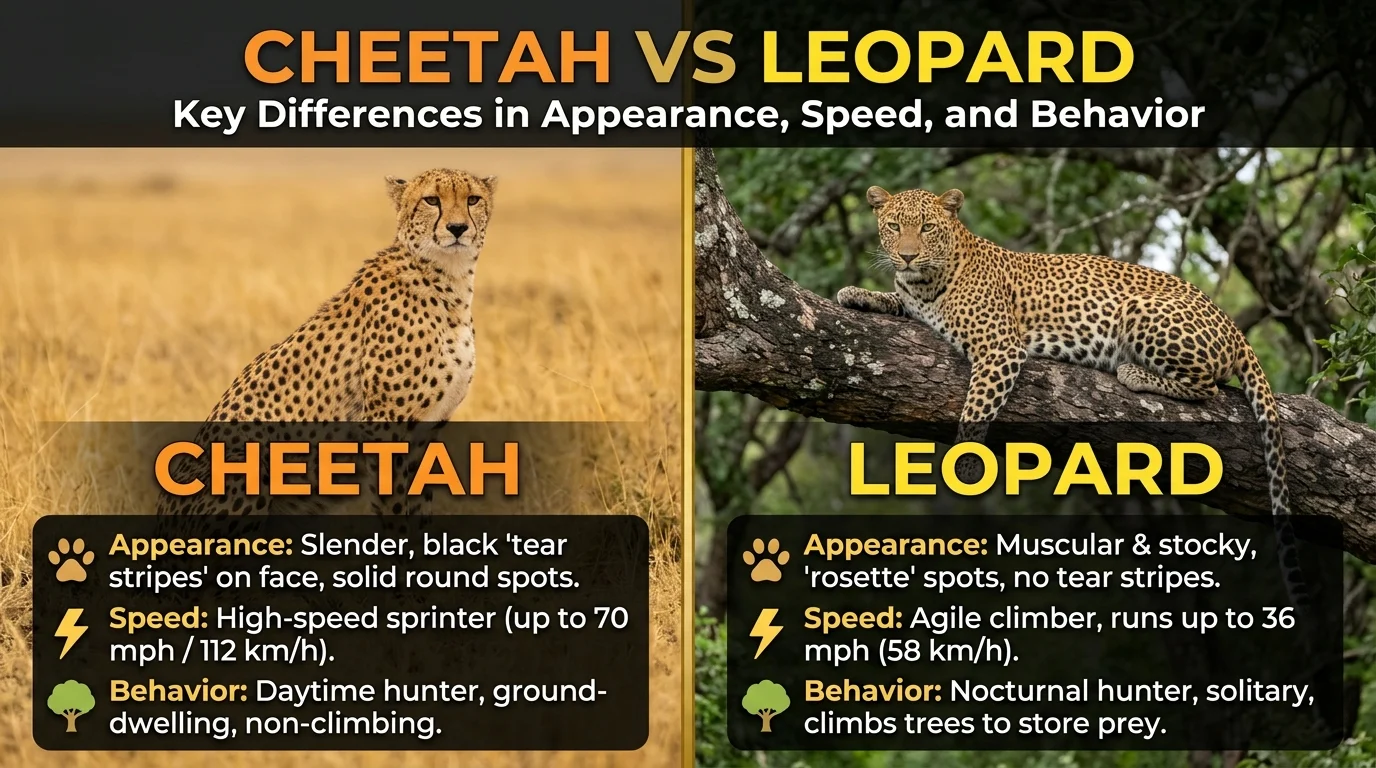
Cheetahs have slim bodies, long legs, small rounded heads, and relatively lightweight frames. Their coats are covered with solid black spots, and they have distinctive black lines running from the inner corners of their eyes down toward their mouths. These markings are commonly called tear marks.
Cheetahs rely on speed and acceleration to catch animals such as gazelles and other small-to-medium-sized prey.
What Is a Leopard?
A leopard is a powerful wild cat scientifically known as Panthera pardus. It belongs to the same genus as lions, tigers, and jaguars.
Leopards have muscular bodies, strong legs, broad heads, and long tails. Their coats feature dark spots arranged into beautiful patterns called rosettes. Unlike cheetahs, most leopards do not have distinctive black tear lines on their faces.
Leopards are excellent climbers and often carry their prey into trees to protect it from other predators. They can survive in forests, grasslands, mountains, and other environments.
Quick Definition Comparison
| Feature | Cheetah | Leopard |
|---|---|---|
| Scientific name | Acinonyx jubatus | Panthera pardus |
| Family | Felidae | Felidae |
| Body type | Slim and lightweight | Muscular and strong |
| Coat pattern | Solid black spots | Rosette-shaped markings |
| Face | Black tear marks | No prominent tear marks |
| Main ability | High-speed running | Strength and climbing |
The easiest way to remember the difference is that cheetahs are built for speed, while leopards are built for strength, stealth, and versatility.
2. Background and Natural History
Cheetahs and leopards have existed for thousands of years and have adapted to different environments. Although they share the same broader cat family, their evolutionary histories have produced different physical abilities and survival strategies.
Background of Cheetahs
Cheetahs have a long evolutionary history and are particularly associated with African grasslands and open habitats. Their bodies have evolved to support rapid acceleration and high-speed movement.
Unlike many other big cats, cheetahs have semi-retractable claws that provide additional traction when running. Their lightweight skeletons, flexible spines, and large nasal passages also help support their remarkable athletic performance.
Today, most wild cheetahs live in Africa, although a critically small population of Asiatic cheetahs survives in Iran.
Cheetahs generally hunt during daylight hours, which helps them use their excellent eyesight to locate prey.
Background of Leopards
Leopards have a much wider natural distribution than cheetahs. They are found across parts of Africa and Asia, including forests, mountains, savannas, and dry regions.
Their muscular bodies and powerful jaws make them effective hunters. Leopards are also highly adaptable and can live in environments where other large predators struggle to survive.
One of their most interesting behaviors is carrying captured prey into trees. This helps protect their food from scavengers and competing predators.
Leopards usually hunt at night or during low-light periods, although their activity patterns can change depending on their surroundings.
How Their Evolution Shaped Their Abilities
The two animals developed different physical advantages because they use different hunting strategies.
- Cheetahs developed long legs, flexible backs, and lightweight bodies for chasing prey.
- Leopards developed muscular limbs, powerful jaws, and climbing abilities for capturing and protecting prey.
- Cheetahs generally benefit from open spaces.
- Leopards can adapt to a much broader range of habitats.
Their differences show how two closely related animals can develop completely different survival techniques.
3. Cheetah vs Leopard: Speed, Strength, and Physical Differences
One of the biggest reasons people compare these animals is their physical performance. Both are impressive predators, but their abilities serve different purposes.
Speed Comparison
Cheetahs are the fastest land animals. They can reach approximately 60–70 miles per hour (97–113 km/h) in short bursts under suitable conditions.
Leopards are considerably slower. They are not built for extended high-speed chases. Instead, they depend on stealth, short bursts of movement, and surprise attacks.
Strength Comparison
Leopards generally have the advantage in muscular strength. Their powerful shoulders, jaws, and forelimbs allow them to climb trees while carrying heavy prey.
Cheetahs are lighter and less muscular. Their bodies prioritize acceleration rather than the strength needed for wrestling large animals.
Physical Comparison Table
| Characteristic | Cheetah | Leopard |
|---|---|---|
| Maximum speed | Around 60–70 mph | Around 36 mph |
| Body structure | Slim and athletic | Stocky and muscular |
| Weight | Approximately 46–159 lb | Approximately 37–198 lb |
| Climbing ability | Limited compared with leopards | Excellent |
| Claws | Semi-retractable | Fully retractable |
| Hunting method | High-speed chase | Stealth and ambush |
| Face markings | Black tear lines | No distinctive tear lines |
| Coat pattern | Solid spots | Rosettes |
Note: These are approximate ranges. Actual speed and body size vary by individual, age, and subspecies.
Which Animal Is More Powerful?
A leopard is generally stronger because of its muscular body and powerful hunting equipment. However, this does not mean it is better at every physical activity.
A cheetah has a clear advantage in speed and acceleration. A leopard has an advantage in climbing, grappling, and carrying prey.
Their bodies are designed for different purposes, so comparing them using only one physical characteristic does not tell the whole story.
4. Usage in Different Contexts: Everyday Language, Social Media, and Professional Fields
The names cheetah and leopard appear in different contexts beyond wildlife discussions. People use them in conversations, educational content, sports comparisons, business branding, and entertainment.
Everyday Conversations
In everyday language, people commonly mention cheetahs when discussing speed, quickness, or athletic performance.
For example:
- “He runs like a cheetah.”
- “That athlete is as fast as a cheetah.”
- “The leopard is an incredible climber.”
The word leopard is often associated with strength, stealth, beauty, and independence.
Social Media Usage
On social platforms, these animals are popular subjects for wildlife videos, educational posts, photography, and comparison content.
Creators may publish videos explaining how to distinguish their coats, showing their hunting behavior, or comparing their speed and strength.
Common content ideas include:
- Cheetah vs leopard differences.
- Which big cat is faster?
- How to identify leopard rosettes.
- Why cheetahs have tear marks.
- Which animal is the better climber?
Professional and Educational Fields
In professional settings, these animals are discussed in several areas:
Wildlife Biology: Researchers study their behavior, reproduction, genetics, and survival.
Conservation: Wildlife organizations monitor populations and work to protect natural habitats.
Zoology: Students learn about their classification, physical structures, and evolutionary adaptations.
Photography and Filmmaking: Wildlife photographers capture their hunting techniques, movements, and interactions with nature.
Both animals are important subjects in wildlife education because their different adaptations provide useful examples of evolution and biodiversity.
5. Meaning in Chat, WhatsApp, Instagram, and TikTok
Cheetah and leopard are not commonly recognized as standard internet slang terms. Their meanings in digital conversations usually depend on the context in which someone uses them.
Cheetah Meaning in Chat
When someone calls another person a cheetah, they may be making a playful comparison about speed.
For example:
- “You’re a cheetah! You finished that task so quickly.”
- “He runs like a cheetah.”
- “She’s the cheetah of our team.”
In these examples, the word represents quick movement, fast performance, or impressive efficiency.
Leopard Meaning in Chat
The word leopard may represent confidence, strength, independence, or an attractive spotted appearance.
For example:
- “That leopard outfit looks amazing.”
- “She’s strong like a leopard.”
- “Leopard energy!”
The meaning depends on the conversation and the person’s intention.
WhatsApp and Instagram
On WhatsApp and Instagram, users may share pictures, videos, reels, and captions featuring these animals.
Common examples include:
- “Speed is my superpower. 🐆”
- “Silent but powerful.”
- “Born to be wild.”
- “Fast like a cheetah.”
The 🐆 emoji is officially called the leopard emoji, although people sometimes use it to represent cheetahs or big cats generally.
TikTok Meaning
On TikTok, cheetahs and leopards often appear in wildlife comparisons, animal facts, funny videos, and educational content.
Creators may use these animals as symbols of different personalities:
- Cheetah: Speed, energy, and quick action.
- Leopard: Strength, confidence, and stealth.
However, these are creative interpretations rather than official slang definitions.
6. Meaning in Physics, Medical, and Aircraft Terminology
The terms cheetah and leopard are primarily zoological names. They do not have standard technical meanings in physics, medicine, or aviation. However, their names can appear in specialized discussions, product names, and analogies.
Cheetah in Physics
In physics, the cheetah is sometimes used as a practical example when explaining motion, acceleration, velocity, and distance.
For instance, a physics teacher might use a running cheetah to explain how speed is calculated.
The basic speed formula is:
\[ \text{Speed}=\frac{\text{Distance}}{\text{Time}} \]
A cheetah running 100 meters in 5 seconds would have an average speed of 20 meters per second.
This is a simplified mathematical example rather than a claim about a typical cheetah sprint.
Leopard in Physics
A leopard may also appear in examples involving motion, force, gravity, and energy.
For instance, its movement while climbing a tree can help illustrate how animals apply force to move against gravity.
These examples are educational analogies, not special physics definitions.
Medical Terminology
Neither cheetah nor leopard is a standard medical diagnosis or anatomical term.
However, animal names sometimes appear in medical research, hospital names, medical products, and scientific projects.
The terms should not be confused with actual medical conditions.
Aircraft Terminology
In aviation, Cheetah and Leopard can appear as names for aircraft, military equipment, or aviation-related projects.
For example, the Atlas Cheetah is a South African fighter aircraft developed from the Mirage III design.
However, neither word represents a universal aircraft category or standard aviation measurement.
7. Common Misconceptions About Cheetahs and Leopards
Several misconceptions make it difficult for people to understand the differences between these animals. Their similar appearances contribute to the confusion.
Misconception 1: Cheetahs and Leopards Are the Same Animal
This is incorrect. They are two separate species with different scientific classifications, physical features, and hunting behaviors.
Misconception 2: Both Animals Have the Same Spots
Although their coats look similar from a distance, their patterns are different.
- Cheetahs have individual solid black spots.
- Leopards have dark rosettes, which usually contain lighter centers.
Misconception 3: Leopards Are Faster Than Cheetahs
Leopards are fast and athletic, but cheetahs are much faster in short-distance sprints.
Their bodies are designed for different types of movement.
Misconception 4: Cheetahs Are the Strongest Big Cats
Cheetahs are exceptional runners, but they are not the strongest members of the big cat family. Leopards have greater muscular strength and are better equipped for climbing and carrying prey.
Misconception 5: Both Animals Hunt in the Same Way
Cheetahs usually chase prey across open ground. Leopards generally rely on camouflage, patience, and ambush techniques.
Misconception 6: Leopards Cannot Live Near Humans
Leopards are highly adaptable and sometimes live near human settlements. However, this can create serious conflicts involving livestock, safety, and habitat loss.
Understanding these misconceptions makes it easier to identify both animals and appreciate their unique abilities.
8. Similar Terms and Alternatives
Cheetahs and leopards belong to the cat family, but several other animals are also commonly confused with them.
Understanding these related names can help readers recognize different wild cats.
Jaguar
A jaguar is a large wild cat native to the Americas. It has a muscular body and rosette-shaped markings, often with small spots inside the rosettes.
Jaguars are particularly known for their powerful bites.
Snow Leopard
A snow leopard lives in mountainous regions of Central and South Asia. It has thick fur, a long tail, and pale spotted markings that help it blend into snowy and rocky environments.
Cougar
A cougar is also called a mountain lion or puma. Unlike cheetahs and leopards, adult cougars generally have plain coats without prominent spots.
Tiger
A tiger is one of the largest wild cats. Its orange coat and black stripes make it easy to distinguish from spotted cats.
Quick Comparison
| Animal | Main Identification Feature |
|---|---|
| Cheetah | Solid black spots and tear marks |
| Leopard | Dark rosette patterns |
| Jaguar | Large rosettes, often with central spots |
| Snow leopard | Thick pale fur and long tail |
| Cougar | Mostly plain-colored coat |
| Tiger | Distinctive black stripes |
These animals have different habitats, physical structures, and hunting strategies, even though they belong to the same biological family.
9. How to Respond When Someone Mentions a Cheetah or Leopard
Your response depends on the conversation. Someone might mention these animals during a wildlife discussion, share a picture, or use them as a comparison.
Here are some natural ways to respond.
When Someone Talks About Cheetahs
If someone says a cheetah is their favorite animal, you could respond:
- “They’re incredible runners!”
- “I love how fast they can move.”
- “Their tear marks make them easy to recognize.”
- “Cheetahs are amazing animals.”
When Someone Talks About Leopards
You can respond with comments such as:
- “Their climbing skills are impressive.”
- “Leopards have beautiful coat patterns.”
- “They’re such powerful hunters.”
- “I love how well they blend into their surroundings.”
When Someone Asks Which Is Better
You can explain that neither animal is better in every category.
A cheetah is better adapted for speed, while a leopard is better adapted for strength, climbing, and stealth.
When Someone Shares a Wildlife Picture
If you are unsure which animal appears in the picture, look at its spots and face.
A cheetah usually has solid black spots and distinctive tear marks. A leopard usually has rosette-shaped markings and a more muscular appearance.
This simple identification method can help you respond confidently.
10. Relevance in Online Conversations and Dating Apps
Cheetahs and leopards can also appear in online conversations where people use animal comparisons to describe personalities, appearances, and behavior.
Although neither animal has a fixed dating-app meaning, both can represent different qualities depending on the context.
Cheetah as a Personality Comparison
Someone might describe a person as a cheetah because they are:
- Fast at making decisions.
- Energetic and active.
- Competitive.
- Quick to complete tasks.
- Always moving toward their goals.
For example, someone might write, “I’m a cheetah when it comes to achieving my goals.”
This is a figurative expression rather than a literal description.
Leopard as a Personality Comparison
A leopard may symbolize:
- Confidence.
- Independence.
- Strength.
- Mystery.
- A bold personality.
Someone might use a leopard reference in a dating profile to communicate confidence or an adventurous personality.
Animal References in Dating Profiles
People sometimes use wildlife photographs, animal emojis, and comparisons to make their profiles more interesting.
For example:
- “Fast thinker with cheetah energy.”
- “Quiet, confident, and independent.”
- “Wild at heart.”
- “Strong personality, calm attitude.”
These expressions are creative ways to describe personality traits. They should not be treated as universal dating slang or signs of someone’s actual character.
The best way to understand an animal reference in a dating conversation is to consider the surrounding message and ask what the person means if the intention is unclear.
11. Cheetah vs Leopard: Which Animal Would Win?
Another popular question is which animal would win in a direct confrontation.
There is no guaranteed outcome because the result would depend on the animals’ size, age, health, environment, and circumstances.
However, leopards generally have an advantage in a physical confrontation because they have stronger bodies, powerful jaws, and greater muscular strength.
Cheetahs are not built for prolonged physical fights. Their survival strategy depends more on speed and escaping danger.
| Category | Likely Advantage |
|---|---|
| Running speed | Cheetah |
| Physical strength | Leopard |
| Climbing | Leopard |
| Acceleration | Cheetah |
| Stealth hunting | Leopard |
| Open-ground chasing | Cheetah |
| Muscular build | Leopard |
This comparison highlights why these animals should not be judged by speed alone. Each has developed specialized abilities that help it survive in its natural environment.
Conclusion
Understanding cheetah vs leopard becomes much easier when you look at their physical features, hunting techniques, and natural abilities.
Although both animals have spotted coats, they are different species with unique characteristics. Cheetahs are famous for their incredible speed, slim bodies, solid black spots, and distinctive facial tear marks. Leopards are recognized by their rosette-shaped markings, muscular bodies, powerful jaws, and excellent climbing abilities.
The most important difference is how they survive in the wild. Cheetahs depend on speed to chase prey, while leopards use stealth, strength, and adaptability. Neither animal is superior in every category because each has evolved for a different purpose.
Learning these differences helps you identify them correctly and appreciate the important role both predators play in maintaining healthy ecosystems.


