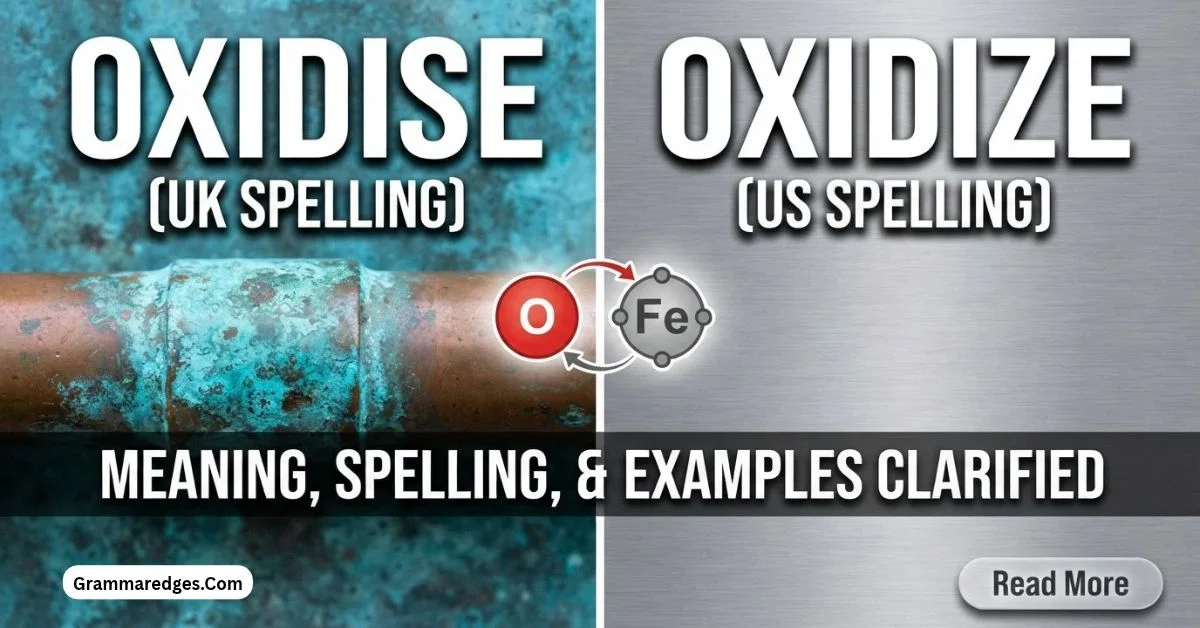
Have you ever wondered whether to write oxidise or oxidize? Both spellings are correct, but the right choice depends mainly on the variety of English you are using. This small spelling difference often confuses students, writers, scientists, and people who want to improve their English grammar.
The word oxidise is commonly used in British English, while oxidize is the preferred spelling in American English. Both words have exactly the same meaning: to undergo oxidation or cause a substance to undergo oxidation, a chemical process involving the loss of electrons.
You may encounter these spellings in chemistry textbooks, scientific articles, medical discussions, and everyday explanations about rust, combustion, and chemical reactions. Understanding the difference helps you write more clearly and maintain consistent spelling throughout your work.
In this guide, you will learn the meaning, history, usage, and differences between these two spellings, along with practical examples to help you choose the correct version for your audience.
1. Meaning and Definition of Oxidise or Oxidize
The words oxidise and oxidize are alternative spellings of the same verb. Neither spelling is incorrect. The main distinction is regional rather than grammatical or scientific.
Oxidise is the standard British English spelling, whereas oxidize is the standard American English spelling.
What Does Oxidise Mean?
To oxidise something means to cause it to undergo oxidation. In chemistry, oxidation is commonly defined as the loss of electrons by an atom, ion, or molecule during a chemical reaction.
For example, when iron reacts with oxygen and moisture, it can form rust. This process involves the oxidation of iron.
Example sentences:
- Iron can oxidise when exposed to air and moisture.
- The chemical reaction caused the metal to oxidise.
- Some substances oxidise more readily than others.
These examples use British English spelling.
What Does Oxidize Mean?
Oxidize has the same meaning as oxidise. The difference is that American English generally uses the letter z instead of s in this word.
Example sentences:
- Iron can oxidize when exposed to air and moisture.
- The chemical reaction caused the metal to oxidize.
- Some substances oxidize more readily than others.
The scientific meaning remains unchanged.
Which Spelling Should You Choose?
Your choice should depend on your intended audience and the spelling conventions of your publication.
| Feature | Oxidise | Oxidize |
|---|---|---|
| Main association | British English | American English |
| Meaning | To undergo or cause oxidation | To undergo or cause oxidation |
| Grammar | Verb | Verb |
| Pronunciation | Essentially the same | Essentially the same |
| Scientific meaning | Identical | Identical |
| Example | Iron may oxidise. | Iron may oxidize. |
Quick answer: Use oxidise for British English and oxidize for American English. Both spellings are correct, and neither changes the meaning of the word.
2. Background and History of the Two Spellings
The difference between oxidise and oxidize reflects a broader pattern in English spelling. British and American English share the same linguistic foundations, but their spelling conventions have developed in slightly different directions.
Many words ending in -ise or -ize illustrate this variation. Examples include organise/organize, recognise/recognize, and realise/realize.
How Did the Difference Develop?
The verb oxidize developed from the scientific term oxide, which refers to a chemical compound containing oxygen combined with another element or group. The related word oxidation describes the chemical process.
As scientific terminology expanded, the verb became useful for describing reactions involving oxygen and, in modern chemistry, electron loss.
The spelling with z has a long history in English and is widely used in American English. British English commonly uses the spelling with s, although the -ize form is also accepted by many British dictionaries and style guides.
This means the distinction is not as simple as saying that every British writer must use -ise. Some British publications prefer -ise, while others follow conventions that favour -ize.
Why Does American English Prefer Oxidize?
American English generally favours oxidize because the spelling aligns with common American conventions for words in this family.
For example:
- American English: The metal will oxidize over time.
- British English: The metal will oxidise over time.
Both sentences are grammatically correct.
Read More Posts: Flower Emoji 🌸 Meaning & Beautiful Ways to Use
Is Oxidise an Older or Less Scientific Form?
No. The spelling oxidise is not less scientific, outdated, or technically inferior. It remains a standard form in British English and other varieties that follow similar spelling conventions.
Likewise, oxidize is not exclusively a scientific spelling. It can be used in scientific writing, education, and general communication.
The important point is consistency. If your article begins with British spellings such as colour, organise, and centre, using oxidise will usually maintain the same style. If you are writing for an American audience, oxidize will generally be the better choice.
3. Usage in Different Contexts: Chat, Social Media, and Professional Fields
Although oxidise and oxidize are primarily scientific verbs, they can appear in several types of writing. The preferred spelling usually depends on the audience, subject, and publication style.
Academic and Educational Writing
Students may encounter both spellings in chemistry lessons, examination materials, research papers, and educational websites.
British English example:
“The magnesium will oxidise when it reacts with oxygen.”
American English example:
“The magnesium will oxidize when it reacts with oxygen.”
When writing an assignment, follow the spelling convention used by your teacher, textbook, or institution.
Professional and Technical Writing
Scientists, engineers, laboratory technicians, and industrial professionals use these words when discussing chemical reactions.
Examples include:
- The sample began to oxidise during storage.
- The treatment prevents the metal from oxidizing too quickly.
- The researcher measured the oxidation rate of the compound.
In professional writing, accuracy matters more than the choice between s and z. However, consistency is important because mixed spelling conventions can make a document appear poorly edited.
Chat and Everyday Communication
In casual conversations, people may use either spelling depending on where they learned English. Most readers can understand both forms.
For example:
- “Why does this metal oxidise so quickly?”
- “Does this ingredient oxidize when exposed to air?”
The word is less common in everyday texting than simpler alternatives such as rust, react with oxygen, or change chemically. Nevertheless, it may appear when people discuss skincare, cooking, metal objects, or science.
Social Media and Online Posts
On Instagram, TikTok, Facebook, and other platforms, the word may appear in educational captions, science videos, beauty discussions, and product explanations.
Examples:
- “Why does cut fruit oxidise and turn brown?”
- “This coating helps prevent metal from oxidizing.”
- “Learn how oxidation affects everyday materials.”
For social media content, use the spelling that matches your usual writing style or target audience.
Which Context Requires More Care?
Scientific reports, academic assignments, technical instructions, and professional publications deserve particular attention. In these settings, follow the relevant style guide and use one spelling consistently.
In a casual message, either form will usually be understood. In formal writing, consistency helps readers focus on the scientific information rather than regional spelling differences.
4. Meaning in Chat, WhatsApp, Instagram, and TikTok
The word oxidise or oxidize does not have a special, universally recognised meaning in chat or social media slang. It retains its ordinary scientific meaning when people use it in online conversations.
However, the topic being discussed can affect how readers understand the word.
Oxidise or Oxidize in WhatsApp Messages
On WhatsApp, people might use the word while asking questions about science, food, metal, or skincare.
Examples:
- “Why does my apple oxidise after cutting it?”
- “Will this jewellery oxidize if it gets wet?”
- “Can we stop the metal from oxidising?”
In these messages, the sender is discussing a chemical process rather than using a secret abbreviation or slang term.
Oxidise or Oxidize on Instagram
Instagram users may encounter the word in educational reels, beauty posts, or product reviews.
For example, a makeup discussion might mention that a foundation appears darker after application. Some users describe this change as oxidizing. However, changes in foundation colour can have several causes, so the term should not automatically be treated as a complete scientific explanation.
In skincare discussions, oxidation may refer to a product’s reaction with oxygen or changes in its ingredients over time.
Oxidise or Oxidize on TikTok
TikTok creators may use the word in short science demonstrations explaining why fruit changes colour, why metals rust, or how chemical reactions work.
A creator might write:
“Ever wondered why a sliced apple turns brown? Oxidation is part of the explanation.”
This is an educational use rather than a new internet slang definition.
Does Oxidize Have a Romantic or Flirty Meaning?
There is no widely established romantic or flirty meaning for oxidise or oxidize. If someone uses it in a dating conversation, the intended meaning will depend on the surrounding message.
For example, a person discussing a science degree might use the word literally. Another person might use it as a joke or creative metaphor.
Helpful tip: Do not assume that oxidize is slang just because you encounter it online. Read the full conversation to understand the intended meaning.
5. Meaning in Physics, Medical Science, and Aircraft Terminology
The words oxidise and oxidize appear in several scientific and technical fields. Their spelling may change between British and American English, but the underlying concept remains the same.
Oxidation in Physics and Chemistry
Oxidation is primarily a chemical concept rather than a standalone physical process. It is especially important when studying electrochemistry, batteries, corrosion, and reactions involving the transfer of electrons.
In modern chemistry, oxidation is defined by an increase in oxidation state, commonly associated with the loss of electrons.
For example, when zinc loses electrons, it undergoes oxidation:
Zn → Zn²⁺ + 2e⁻
This means a zinc atom forms a zinc ion by losing two electrons.
The term oxidise may appear in British textbooks, while oxidize is common in American educational materials. Both describe the same reaction.
Oxidation in Medical Science
In medicine and biology, oxidation plays an important role in metabolism, cellular processes, and the study of oxidative stress.
For instance, cells use chemical reactions involving oxidation to help release energy from nutrients. Oxidation also occurs in processes involving reactive oxygen species.
Oxidative stress refers to an imbalance between reactive substances and the body’s ability to manage them. It is a complex biological subject, and oxidation itself is not always harmful. Many normal biological processes depend on oxidation-reduction reactions.
Example:
“Certain cellular reactions oxidise nutrients to help release usable energy.”
An American publication might write:
“Certain cellular reactions oxidize nutrients to help release usable energy.”
Oxidation in Aircraft and Aviation
In aviation, oxidation can be relevant to aircraft maintenance, engine performance, and material degradation.
Metal components may oxidise when exposed to oxygen, heat, or environmental conditions. Depending on the material and circumstances, oxidation can contribute to surface changes or corrosion.
Aircraft maintenance teams inspect components and apply appropriate protective measures to reduce corrosion risks.
The term can also appear in discussions of combustion in aircraft engines. Fuel combustion involves complex chemical reactions, including oxidation processes.
However, oxidise and oxidize are not special aircraft commands, aviation codes, or standard abbreviations. They are ordinary technical verbs used when discussing relevant chemical processes.
Across these fields, the essential distinction remains spelling preference, not scientific meaning.
Read More Posts: Wellbeing or Well-Being: Which Spelling Is Correct?
6. Common Misconceptions About Oxidise and Oxidize
Several misunderstandings make this spelling comparison more confusing than it needs to be. Understanding the facts will help you use both forms correctly.
Misconception 1: Oxidise Is Incorrect English
This is false. Oxidise is a recognised spelling used in British English and other English varieties that follow similar conventions.
Correct example: “Iron can oxidise in damp conditions.”
Misconception 2: Oxidize Is Only American Slang
This is also incorrect. Oxidize is a standard English word used in scientific, educational, and professional writing. It is not slang.
Correct example: “The reaction causes the metal to oxidize.”
Misconception 3: The Two Spellings Have Different Meanings
The spellings do not represent different chemical processes. Both refer to oxidation.
The surrounding scientific context determines what substance is reacting and how the reaction occurs, not whether the verb contains an s or a z.
Misconception 4: Oxidation Always Means Rusting
Rusting is one example of oxidation, but oxidation is a much broader concept.
Oxidation can occur in metals, organic molecules, biological systems, and electrochemical reactions. Not every oxidation reaction produces rust, and not every visible colour change should automatically be described as oxidation without further evidence.
Misconception 5: British English Always Requires -ise
British English commonly uses oxidise, but some British dictionaries and publications accept or prefer oxidize.
The best choice depends on your preferred dictionary, editorial policy, and intended audience. Follow one convention throughout a document.
Misconception 6: Both Forms Can Be Mixed Freely in Formal Writing
Although both spellings are correct, switching randomly between them can create inconsistency.
For example, using oxidise in one paragraph and organize in another may look inconsistent if your publication follows a strict British English style.
The easiest solution is to choose a spelling convention before you begin writing and apply it consistently.
7. Similar Terms and Alternatives
Several words are related to oxidise and oxidize. Some are grammatical variations, while others describe related chemical concepts.
| Word | Meaning | Example |
|---|---|---|
| Oxidation | The chemical process of oxidation | Oxidation changed the metal’s surface. |
| Oxidised | British English past participle or adjective | The oxidised surface looked different. |
| Oxidized | American English past participle or adjective | The oxidized surface looked different. |
| Oxidising | British English present participle | The oxidising agent reacted with the sample. |
| Oxidizing | American English present participle | The oxidizing agent reacted with the sample. |
| Oxidant | A substance that accepts electrons in a redox reaction | The oxidant accepted electrons. |
| Reduce | To undergo reduction, the counterpart process in a redox reaction | The metal ion was reduced. |
| Rust | A corrosion product formed when iron or steel corrodes | The gate developed rust. |
| Corrode | To deteriorate through chemical or electrochemical reactions | The metal began to corrode. |
Oxidise vs. Oxidation
Oxidise is a verb, while oxidation is a noun.
- Verb: Oxygen can oxidise the substance.
- Noun: Oxidation changed the substance.
Oxidise vs. Rust
These words are related but are not interchangeable in every situation.
Oxidation is a broad chemical process. Rust refers to corrosion products that form when iron or iron-containing materials react under suitable conditions involving oxygen and moisture.
Oxidise vs. Reduce
Oxidation and reduction occur together in a redox reaction. Oxidation involves an increase in oxidation state, while reduction involves a decrease in oxidation state.
These terms describe opposite aspects of electron transfer, not alternative spellings.
Oxidise vs. Corrode
Corrosion describes the deterioration of a material through chemical or electrochemical reactions with its environment. Oxidation can contribute to corrosion, but corrosion may involve multiple processes.
Use the specific term that best describes the process you mean.
8. How to Respond When Someone Uses Oxidise or Oxidize
If someone uses either spelling in a message, you usually do not need to correct them. Both forms are valid, so the appropriate response depends on the conversation.
When Someone Asks About the Spelling
If a friend or classmate asks which form is correct, explain the regional difference.
Example:
Person: “Is it oxidise or oxidize?”
You: “Both are correct. Oxidise is common in British English, while oxidize is standard in American English.”
This answer is brief, accurate, and easy to understand.
When Someone Uses It in a Science Discussion
Respond to the scientific question rather than focusing on the spelling.
Example:
Person: “Why does iron oxidize when it gets wet?”
You: “Water and oxygen can help iron corrode, producing rust under suitable conditions.”
This keeps the discussion useful and relevant.
When Editing an Assignment
If you are proofreading a student’s work, check which English variety the assignment requires.
For a British English assignment, oxidise may be the preferred form. For an American English assignment, oxidize is generally the safer choice.
Do not mark one form wrong solely because it differs from your own regional preference.
When Writing a Professional Email
Use the spelling convention followed by your organisation or recipient.
For example:
“Please review the report on metal oxidation and corrosion.”
This sentence avoids the spelling variation by using the noun oxidation, which is spelled the same way in both varieties.
The main goal is clear communication. A spelling difference rarely needs a lengthy explanation unless the discussion specifically concerns English usage.
Read More Posts: You Too or You To: What’s the Correct Grammar in 2026 ?
9. Differences From Similar Words
Understanding related spelling patterns can make it easier to remember when to use oxidise and oxidize.
Oxidise vs. Oxidize
These are alternative spellings of the same verb.
- British English preference: oxidise
- American English preference: oxidize
Example: “The chemical may oxidise” and “The chemical may oxidize” communicate the same idea.
Organise vs. Organize
These verbs mean to arrange or coordinate something.
British English commonly uses organise, while American English uses organize. The difference follows a spelling pattern similar to oxidise/oxidize.
Recognise vs. Recognize
Both spellings mean to identify or acknowledge someone or something.
For example:
- British English: “I recognise that name.”
- American English: “I recognize that name.”
Analyse vs. Analyze
This is another related spelling comparison. Analyse is common in British English, while analyze is standard in American English.
The pattern is useful, but not every English word follows the same rule. For example, advertise is commonly spelled with s in both British and American English.
A Simple Rule to Remember
If you are writing for an American audience, oxidize, organize, recognize, and analyze are generally appropriate choices.
For a British audience, oxidise, organise, recognise, and analyse are common choices.
Always check the style guide when a publication specifies its own spelling conventions.
10. Relevance in Online Conversations and Dating Apps
Although oxidise and oxidize are not common dating-app slang, they can still appear in conversations between people with scientific interests, educational backgrounds, or professional connections.
On platforms such as Tinder, Bumble, and other dating apps, users might discuss chemistry, skincare, cooking, jewellery, or university subjects.
For example, someone might write:
“My chemistry project is about why certain metals oxidize.”
Another person might respond:
“That’s interesting! Does oxidation always cause visible changes?”
In this context, the word has its ordinary scientific meaning. It does not automatically communicate attraction, romantic interest, or a hidden emotional message.
Can Oxidize Be Used as a Joke?
Yes. People can use scientific terminology creatively in jokes, memes, or playful conversations. However, any metaphorical meaning would depend on the specific message rather than being a recognised definition of the word.
If someone says that a situation is “oxidizing” as part of a joke, look at the surrounding context before interpreting the intended meaning.
Should You Correct Someone’s Spelling on a Dating App?
Usually, no. If the person uses either standard spelling, there is no correction to make.
If you want to continue the conversation, respond to the subject itself. For example, you could ask what sparked their interest in chemistry or whether they work in a scientific field.
Why Context Matters
Online messages often lack the detail found in formal writing. A scientific term may be literal, humorous, or part of a personal discussion.
Rather than assuming that oxidise or oxidize has a hidden meaning, consider the topic, tone, and full message.
This approach helps avoid misunderstandings and keeps conversations natural.
Conclusion
The difference between oxidise or oxidize comes down to regional spelling preferences, not meaning. Oxidise is commonly used in British English, while oxidize is the standard choice in American English. Both describe the same chemical process and are acceptable in appropriate writing contexts.
You may encounter these words in chemistry, biology, medicine, aviation, education, and online discussions. They are not special chat abbreviations or established dating slang. Their meaning depends on the context in which they appear.
To choose correctly, consider your audience, follow the relevant style guide, and maintain consistency throughout your writing. If you are writing for American readers, use oxidize. If your publication follows British English conventions, oxidise is generally suitable.
Ultimately, neither spelling is universally better than the other. Choosing the form that matches your audience will help you communicate clearly and confidently.