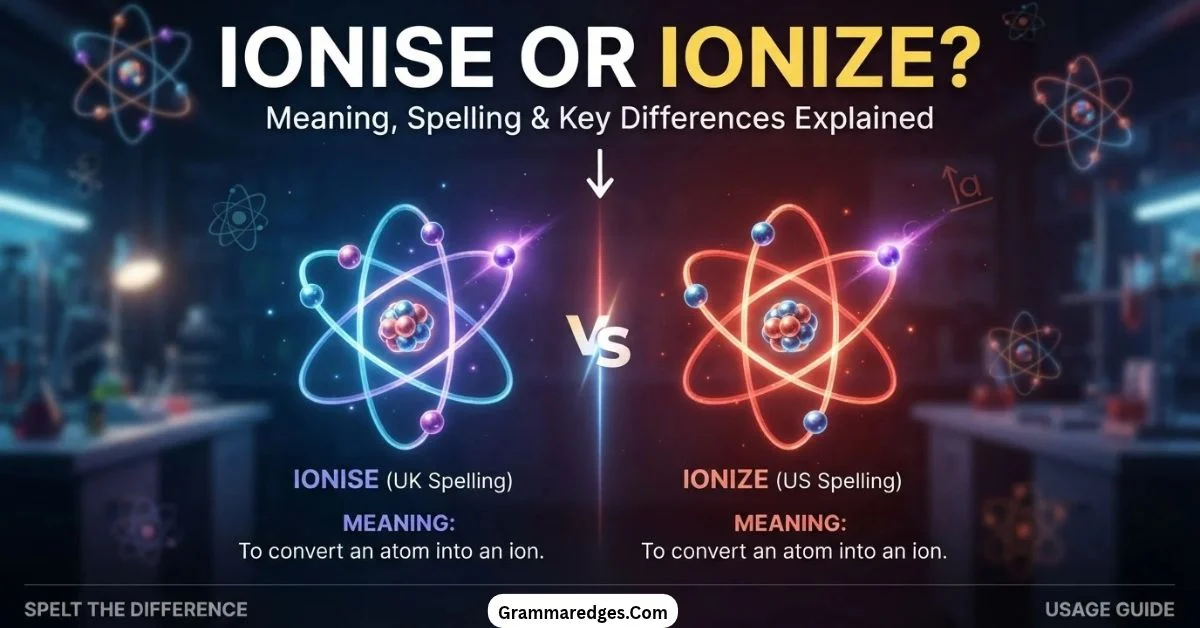
Have you ever wondered whether to write ionise or ionize? Both spellings are correct, but the right choice depends mainly on the variety of English you are using. This small spelling difference often confuses students, science enthusiasts, writers, and professionals who want their work to follow standard English rules.
The word ionize or ionise describes the process of converting an atom or molecule into an ion by adding or removing electrons. It appears frequently in physics, chemistry, medicine, and other scientific fields. You may also encounter it in educational articles, technical documents, research papers, and online discussions.
The main difference is regional spelling. Ionize is the standard spelling in American English, while ionise is commonly used in British English and other varieties that follow British spelling conventions. Neither spelling is inherently wrong.
In this guide, you will learn the meaning of both words, their background, their use in different contexts, common mistakes, and how to choose the appropriate spelling for your writing.
Ionise or Ionize: Meaning and Definition
The words ionise and ionize have exactly the same meaning. They are different spellings of the same verb, describing a scientific process in which an atom or molecule becomes electrically charged or a neutral particle produces charged particles.
An atom normally contains positively charged protons and negatively charged electrons. When an atom loses one or more electrons, it becomes a positively charged ion. When it gains electrons, it becomes a negatively charged ion.
This process is called ionisation in British English and ionization in American English.
What Does Ionize Mean?
Ionize means to convert an atom or molecule into an ion or to produce ions from a substance. It can happen through different processes, including exposure to radiation, high temperatures, electrical energy, or chemical interactions.
For example:
- Radiation can ionize atoms in a gas.
- Strong electrical energy can ionize air.
- X-rays can ionize atoms in biological tissue.
- Certain chemical reactions can produce ions in a solution.
What Does Ionise Mean?
Ionise has the same scientific definition as ionize. The only difference is the spelling convention.
For example:
- British English: Radiation can ionise atoms.
- American English: Radiation can ionize atoms.
Both sentences communicate the same information.
Which Spelling Should You Use?
Choose the spelling that matches your audience and publication style.
| Feature | Ionise | Ionize |
|---|---|---|
| English variety | British English | American English |
| Meaning | To produce ions | To produce ions |
| Related noun | Ionisation | Ionization |
| Related adjective | Ionisable | Ionizable |
| Scientific use | Correct | Correct |
Remember that scientific accuracy does not depend on which spelling you choose. What matters is using the correct term and applying one spelling convention consistently.
Background and History of the Word
The word ionize developed from the scientific term ion, which is used to describe an atom or molecule with an electrical charge. The concept became important as scientists investigated electricity, chemical reactions, and the structure of matter.
The word ion is associated with the work of English scientist William Whewell, who introduced scientific terminology in the nineteenth century. Michael Faraday’s investigations into electrolysis also helped establish the language used to describe electrically charged particles.
As scientific knowledge developed, researchers needed a verb to describe the process of producing ions. The English forms ionize and ionise became established through the spelling conventions used in different English-speaking countries.
Why Are There Two Spellings?
The difference comes from the broader spelling distinctions between American and British English.
American English often uses the ending -ize in words such as:
- Organize
- Recognize
- Realize
- Ionize
British English commonly uses -ise in these words:
- Organise
- Recognise
- Realise
- Ionise
However, British English is not completely uniform. Some British dictionaries and publishers also accept or prefer -ize spellings in certain words. The choice can depend on the dictionary, institution, or editorial style guide.
How Scientific Writing Uses Both Forms
Scientific terminology is shared internationally, but authors generally follow the spelling conventions of their publication or institution. An American research paper may use ionization, while a British textbook may use ionisation.
Neither form changes the scientific principle being described.
For students, researchers, and professional writers, the most practical approach is to follow the spelling requirements of the relevant school, journal, employer, or publisher. Consistency makes technical writing easier to read and more professional.
Usage in Different Contexts
Although ionise and ionize are primarily scientific terms, they appear in many different types of writing. Their meaning stays the same, but the context determines how much technical explanation a reader may need.
1. Academic Writing
Students often encounter the word in chemistry, physics, and environmental science.
Example: “High-energy radiation can ionize gas molecules.”
In a British English assignment, the same sentence may use ionise. Either spelling is suitable when it follows the required style.
2. Professional and Technical Documents
Engineers, laboratory technicians, and researchers may use the term when explaining instruments, radiation, electrical discharges, or chemical processes.
Example: “The device uses an electrical field to ionize the gas.”
Technical documents should prioritize clarity and consistent terminology.
3. Educational Content
Teachers and science writers use the word to explain how ions form and how energy interacts with matter.
Example: “When an atom loses an electron, it becomes positively charged.”
This explanation is especially useful for beginners because it describes the process without relying entirely on technical vocabulary.
4. Social Media and Online Discussions
The word is less common in casual conversation than words such as charge, energy, or reaction. However, it may appear in science videos, educational posts, discussions about radiation, or explanations of scientific equipment.
Example: “Can ultraviolet radiation ionize atoms?”
In these conversations, users may focus more on the science than on the spelling difference.
5. Scientific Publications
Researchers should follow the journal’s style guide. Some publications use American English, while others use British English or another established editorial convention.
The best rule is simple: choose the appropriate spelling once and maintain it throughout the document.
Meaning in Chat, WhatsApp, Instagram, and TikTok
Unlike many modern internet expressions, ionise and ionize are not widely established texting abbreviations or slang terms. They retain their ordinary scientific meaning when they appear in online conversations.
However, the platform and surrounding message can help you understand why someone used the word.
Ionize in WhatsApp Messages
On WhatsApp, someone might use the term while discussing schoolwork, science projects, or an educational video.
Example:
Person A: “What happens when radiation hits an atom?”
Person B: “It can ionize the atom by removing an electron.”
Here, the word has its scientific meaning. It is not a hidden WhatsApp code.
Ionise on Instagram
On Instagram, the term may appear in educational captions, science-themed posts, or discussions about scientific technology.
Example: “Learning how radiation can ionise matter.”
The spelling may indicate that the creator follows British English conventions, although the spelling alone does not establish where the person lives.
Ionize on TikTok
Science creators may use the term in short videos explaining plasma, radiation, or electrical phenomena.
Example: “Did you know that enough energy can ionize a gas?”
The word helps explain the scientific process being demonstrated.
Is Ionize a Slang Word?
No. Ionize is a standard scientific verb, not a commonly recognized slang expression. If someone uses it in a joke, meme, or unusual conversation, the meaning may be creative or context-dependent.
Do not assume it has a romantic, offensive, or secret meaning without evidence from the surrounding conversation.
Meaning in Physics, Medicine, and Aircraft Terminology
The word has particular importance in technical fields. Although the spelling varies, the underlying concept remains consistent.
Ionize in Physics
In physics, ionization occurs when an atom or molecule gains or loses electrons, or when a process creates ions from neutral particles.
Ionization can occur through collisions, radiation, electrical discharges, or other energy-transfer processes.
For example, a sufficiently energetic particle can knock an electron out of an atom. The remaining atom becomes a positively charged ion.
Ionization is important in the study of plasmas, gases, radiation, and electrical conductivity.
Example: “The incoming particles can ionize atoms in the gas.”
Ionise in Medicine
In medical contexts, the term often appears in discussions of ionizing radiation, medical imaging, and radiation therapy.
X-rays and gamma rays are examples of ionizing radiation because they can remove electrons from atoms. This ability is useful in medical imaging and certain cancer treatments, but it also means that exposure must be managed carefully.
The word ionize does not automatically mean that something is harmful. The effects depend on factors such as radiation type, energy, dose, exposure duration, and the tissue involved.
Example: “Ionising radiation can damage biological molecules, including DNA.”
Ionize in Aircraft and Aviation
In aviation, ionization may be discussed in relation to atmospheric electricity, plasma physics, electrical systems, and scientific instruments used in aircraft or atmospheric research.
For instance, high-energy radiation can ionize particles in the atmosphere. Ionization is also relevant to research involving lightning, electrical discharges, and the behavior of charged particles at high altitudes.
However, ionise is not a special aviation command or a standard word for operating an aircraft. Its meaning remains scientific.
Example: “Researchers study how energetic particles ionize gases in the upper atmosphere.”
Common Misconceptions About Ionise and Ionize
Several misunderstandings can make this spelling choice more confusing than necessary.
Misconception 1: Ionize Is Always Correct
Some writers believe that ionize is the only acceptable spelling because it is widely used in scientific literature.
Reality: Ionise is also correct and is common in British English.
Misconception 2: Ionise and Ionize Have Different Meanings
The different endings may suggest that the words describe separate processes.
Reality: They have the same definition. The spelling difference is regional or editorial.
Misconception 3: Ionize Is Internet Slang
Because unfamiliar words sometimes acquire special meanings online, readers may assume ionize is a texting expression.
Reality: It is a standard scientific term. Any unusual meaning would depend on a specific joke or conversation.
Misconception 4: Ionization Always Means Radiation Exposure
Ionization is frequently discussed in connection with radiation, but radiation is not the only way ions can form.
Reality: Ionization can also occur through collisions, electrical processes, and other physical or chemical interactions.
Misconception 5: British English Always Requires -ise
Many British writers use -ise, but some British style guides accept or prefer -ize for certain words.
Reality: Follow the relevant dictionary and style guide rather than assuming every British publication uses the same convention.
Similar Terms and Alternatives
Understanding related words makes it easier to use ionise and ionize accurately.
| Word | Meaning | Example |
|---|---|---|
| Ion | An electrically charged atom or molecule | A sodium ion carries a positive charge. |
| Ionization | The process of forming ions | Ionization can occur when radiation transfers enough energy. |
| Ionizing | Causing or capable of causing ionization | X-rays are ionizing radiation. |
| Ionized | Converted into ions or containing ions | The gas became ionized. |
| Deionize | To remove ions from a substance or medium | A treatment system can deionize water. |
| Electrify | To charge something electrically or supply electrical power | Static electricity can electrify an object. |
| Dissociate | To separate a molecule or compound into smaller species, often ions | A salt may dissociate into ions in water. |
These words are related to electricity or chemical processes, but they are not interchangeable in every sentence.
For example, ionize describes the formation of ions, while electrify can refer more broadly to giving an object an electrical charge. Similarly, dissociate describes separation and does not always mean that electrons have been removed from an atom.
Choose the word that expresses the process you actually mean.
How to Respond When Someone Uses Ionise or Ionize
Your response should depend on the context. If someone uses the word in a scientific discussion, answer the scientific question. If they ask about spelling, explain the regional difference.
If Someone Asks About the Meaning
You could respond:
“It means to convert an atom or molecule into an ion by adding or removing electrons.”
This short explanation works well in educational conversations.
If Someone Asks Which Spelling Is Correct
You could say:
“Both are correct. Ionize is standard in American English, while ionise is commonly used in British English.”
This answer resolves the confusion without suggesting that either spelling is universally wrong.
If Someone Uses It in a Science Discussion
Respond to the actual topic rather than focusing unnecessarily on spelling.
For example:
Person A: “Can radiation ionize atoms?”
Person B: “Yes. Ionizing radiation can transfer enough energy to remove electrons from atoms.”
If Someone Uses It in a Casual Message
If the meaning is unclear, ask a straightforward question:
“Do you mean ionize in the scientific sense, or are you using it in another way?”
This is better than guessing that the word has a hidden meaning.
Differences From Similar Words
The difference between ionise and ionize is straightforward, but several other spelling pairs follow a similar pattern.
| British-style spelling | American-style spelling |
|---|---|
| Ionise | Ionize |
| Ionisation | Ionization |
| Organise | Organize |
| Recognise | Recognize |
| Realise | Realize |
| Normalise | Normalize |
These pairs generally preserve their meaning across the two spelling systems.
However, not every word ending in -ise has an American equivalent ending in -ize. For example, advertise and surprise retain their spelling in American English.
It is also important to distinguish ionize from ionise versus ionize from energize. The first pair represents alternative spellings of the same verb. Energize is a different word that generally means to supply energy or make something more energetic.
Similarly, ionization is not identical to electrolysis. Electrolysis involves using electrical energy to drive a chemical reaction, whereas ionization refers to the formation of ions. The two concepts can overlap in certain scientific processes, but they describe different things.
When writing about science, choose terminology based on meaning first and regional spelling second.
Relevance in Online Conversations and Dating Apps
The words ionise and ionize are uncommon in everyday dating-app conversations. They are more likely to appear when someone mentions their education, discusses a science-related interest, shares an educational video, or makes a joke involving scientific terminology.
For example, someone might write, “I love learning about how the universe works and how radiation can ionize matter.”
In this situation, the word communicates an interest in science rather than a romantic signal.
Someone might also use ionize metaphorically in a creative message, perhaps to suggest that a person or experience creates a powerful reaction. Such usage is possible, but it is not a widely established dating-app expression with one fixed meaning.
If you encounter the word on a dating profile or in a direct message, consider the surrounding sentence before interpreting it.
For instance:
- Scientific context: The person is discussing chemistry, physics, or radiation.
- Humorous context: The word may be part of a science joke.
- Metaphorical context: The person may be using scientific language creatively.
- Unclear context: Ask what they mean instead of assuming a hidden message.
The same principle applies to WhatsApp, Instagram, TikTok, and other platforms. Context determines the intended message, while the spelling usually reflects a language preference.
Conclusion
Both ionise and ionize are correct spellings of the same scientific verb. The primary difference is regional: ionize is the standard form in American English, while ionise is widely used in British English and other varieties that follow British spelling conventions. Both describe the process of producing ions by adding or removing electrons or otherwise creating charged particles.
These terms are used in physics, chemistry, medicine, aviation-related research, educational content, and scientific publications. They are not established texting slang, although they can appear in online conversations about science or as part of creative jokes.
When choosing between the two spellings, consider your intended audience and follow the appropriate dictionary, publication, or institutional style guide. Most importantly, remain consistent throughout your writing. Understanding this simple distinction will help you write more clearly, avoid unnecessary spelling mistakes, and use scientific terminology with confidence.