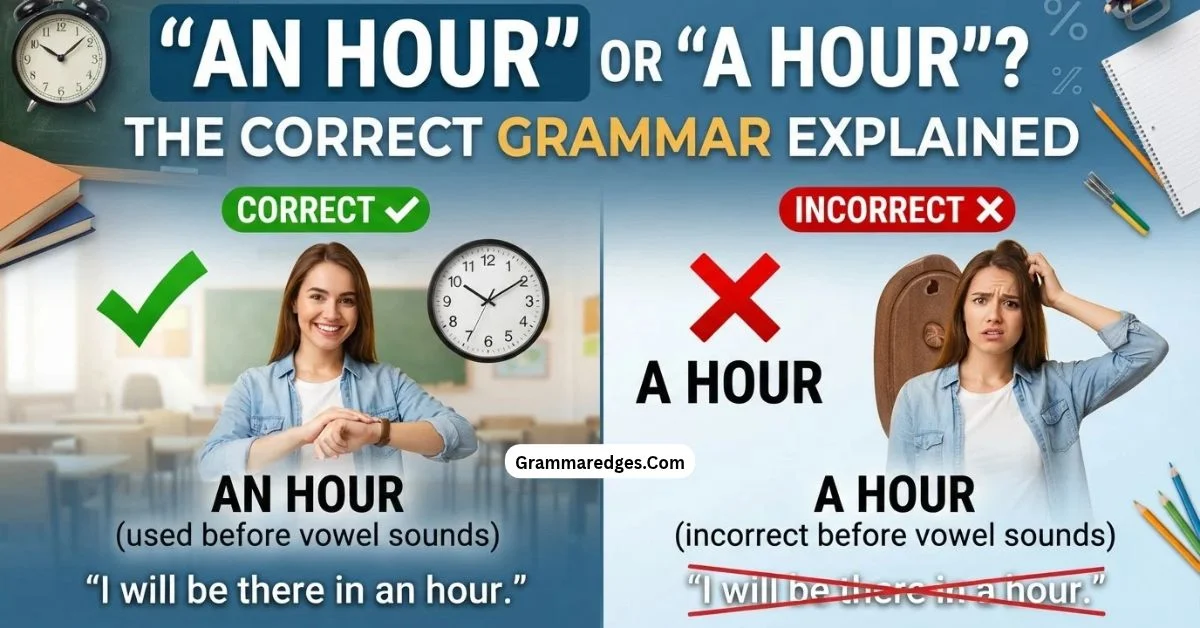
Have you ever wondered whether to write “an hour” or “a hour” in a sentence? Although both expressions may look reasonable at first, only one is grammatically correct in standard English. This small spelling and grammar question often confuses English learners, students, writers, and people who want to improve their everyday communication.
The correct expression is “an hour” because the word hour begins with a vowel sound. The letter h is silent, so the word starts with the sound /ow/, not an audible /h/. In English, we generally use an before words that begin with a vowel sound and a before words that begin with a consonant sound.
Understanding this rule can help you write clearer sentences, avoid common grammar mistakes, and communicate more confidently in emails, school assignments, social media posts, and professional documents.
In this guide, Grammaredges explains the difference between these expressions, provides practical examples, and explores related grammar rules that make choosing the correct article easier.
1. Grammar, Meaning, and Definition
The main difference between “an hour” and “a hour” is grammatical correctness. Both expressions are intended to refer to a period of 60 minutes, but only one follows standard English grammar.
What Does “An Hour” Mean?
An hour means a period of 60 minutes. It is the correct expression because hour begins with a vowel sound.
Examples:
- I waited for an hour.
- The meeting will last an hour.
- She studies English for an hour every day.
- We can finish this task in an hour.
- It takes about an hour to reach the airport.
In each sentence, the word an correctly precedes hour because the initial h is silent.
What Does “A Hour” Mean?
“A hour” is an incorrect expression in standard English. People may use it when learning English or when applying the article rule incorrectly, but it should generally be avoided in formal and informal writing.
Incorrect: I waited for a hour.
Correct: I waited for an hour.
The mistake usually happens when someone chooses an article based on the first written letter rather than the first spoken sound.
Why Is “An Hour” Correct?
English uses two indefinite articles: a and an.
- Use a before a consonant sound.
- Use an before a vowel sound.
For example:
- A house
- A university
- An apple
- An hour
Notice that university begins with the letter u, but its initial sound is /y/, a consonant sound. Therefore, we say “a university.” By contrast, the h in hour is silent, so we say “an hour.”
The essential rule is simple: Choose the article according to pronunciation, not spelling.
2. Background: Why English Uses “An Hour”
The distinction between “a” and “an” developed through the history of English pronunciation. Understanding this background can make the rule easier to remember.
Historically, the indefinite article developed from an older word meaning “one.” Over time, English speakers used different forms depending on the sounds that followed. The form an helped make pronunciation smoother before vowel sounds.
This pattern remains visible in modern English. We naturally say “an apple” rather than “a apple” because the extra consonant sound in an makes the transition between words easier.
The same principle explains why hour takes an. Although the word begins with the letter h, that letter is silent in standard pronunciation. The first sound is a vowel sound, making “an hour” the natural and grammatically correct choice.
Is the H Always Silent?
No. The letter h is pronounced in many English words, including house, happy, hotel, and history. These words generally take a because they begin with a consonant sound.
However, the h in hour is silent. The same is true of honest and honor in standard American English.
Examples:
- An hour
- An honest person
- An honor
- A happy child
- A hotel room
Some words have different pronunciations across accents or regions, which can occasionally affect article choice. For example, herb commonly has a silent h in American English but a pronounced h in many other varieties of English. Consequently, American English speakers often say “an herb,” while speakers who pronounce the h commonly say “a herb.”
The important lesson is that English articles depend on the spoken sound of the word that follows them.
3. Usage in Different Contexts
The expression “an hour” appears in everyday communication, academic writing, workplace conversations, and many other situations. Using the correct article makes your sentences sound natural and grammatically accurate.
Everyday Conversations
People frequently use “an hour” when discussing time, travel, waiting, or daily activities.
Examples:
- I’ll be there in an hour.
- Give me an hour to finish.
- We talked for an hour.
- The shop closes in an hour.
These sentences are natural and correct in everyday American English.
Academic and Educational Writing
Students use the expression when describing study sessions, examination periods, experiments, or classroom activities.
Examples:
- The students completed the exercise in an hour.
- I spent an hour reviewing my notes.
- The lecture lasted an hour.
In academic writing, the same grammar rule applies regardless of the complexity of the sentence.
Professional Communication
Correct article usage is also important in workplace emails, schedules, reports, and business conversations.
Examples:
- The meeting will begin in an hour.
- Please allow an hour for the presentation.
- We need an hour to review the proposal.
- The interview lasted approximately an hour.
Email Example
Incorrect: I will send you the updated document in a hour.
Correct: I will send you the updated document in an hour.
Formal and Informal Writing
Whether you are writing a formal report or a casual text message, “an hour” remains correct.
Formal: The inspection is expected to take approximately an hour.
Informal: I’ll call you in an hour.
The style changes, but the article does not. Remembering this rule helps you avoid a frequent grammatical error in almost any writing situation.
4. Meaning in Chat, WhatsApp, Instagram, and TikTok
On messaging and social media platforms, “an hour” usually refers to a period of 60 minutes. It does not have a special meaning simply because someone uses it online.
People use the phrase when arranging plans, explaining delays, describing waiting times, or discussing how long an activity takes.
Examples in Chat
- Give me an hour, and I’ll finish it.
- I’ll message you in an hour.
- I have been waiting for an hour.
- Can you stay for another hour?
Each example communicates a straightforward time-related meaning.
WhatsApp Messages
On WhatsApp, people may use “an hour” when responding to friends, family members, or colleagues.
Example:
“I’m busy right now. I’ll call you in an hour.”
This means the person expects to call approximately 60 minutes later.
Instagram and TikTok
The phrase can also appear in captions, comments, videos, and direct messages.
Examples:
- Spent an hour getting ready!
- Only an hour left until the event.
- I’ve been editing this video for an hour.
- One hour of hard work makes a difference.
In social media posts, people sometimes write “1 hour” instead of spelling out the words. Both forms can be appropriate, depending on the sentence and style.
For example:
- I waited for an hour.
- I waited for 1 hour.
The first version is often more natural in ordinary prose, while the second may be suitable for schedules, data displays, or informal posts.
Does “An Hour” Have a Hidden Meaning Online?
Usually, no. The phrase refers to time unless the surrounding conversation gives it another meaning. It is not a standard abbreviation, slang expression, or secret code on WhatsApp, Instagram, or TikTok.
Context always matters, but the basic meaning remains a period of 60 minutes.
5. Meaning in Physics, Medical, and Aircraft Terminology
The expression “an hour” also appears in scientific, medical, and aviation-related communication. The article rule remains the same in each field, although the surrounding terminology may be more specialized.
Physics and Science
In physics, an hour is a unit of time equal to 60 minutes or 3,600 seconds.
Examples:
- The experiment continued for an hour.
- The object traveled for an hour at a constant speed.
- The temperature was measured once every hour.
The standard symbol for an hour is h. For example, 2 h represents two hours. Scientific notation often uses symbols and numerals rather than spelling out the unit in ordinary prose.
However, when writing a complete sentence with the word hour, use the correct article:
“The experiment lasted an hour.”
Medical Terminology
In healthcare settings, time expressions are important when describing appointments, monitoring periods, treatments, and observations.
Examples:
- The patient waited for an hour.
- The appointment lasted an hour.
- The nurse monitored the patient for an hour.
In medical documentation, the exact time may need to be recorded according to the relevant clinical procedure. The grammar rule itself does not change.
Aircraft and Aviation Terminology
In aviation, time is used to describe flight duration, training, maintenance, and scheduling.
Examples:
- The flight lasted an hour.
- The pilot completed an hour of training.
- The aircraft remained on the ground for an hour.
Aviation professionals may record flight time using standardized formats and abbreviations. In ordinary English sentences, however, “an hour” is the correct expression.
Does the Field Change the Grammar Rule?
No. Whether you are discussing a physics experiment, a medical appointment, or an aircraft flight, the initial sound of hour determines which article to use.
Use “an hour” in standard English writing across all these fields.
6. Common Misconceptions About “An Hour” and “A Hour”
Several misunderstandings cause people to choose the wrong article. Learning to recognize them can help you avoid repeating the same mistake.
Misconception 1: Every Word Beginning With H Takes “A”
This is incorrect. Although many words beginning with h take a, some have a silent h.
Correct examples:
- An hour
- An honest answer
- An honor
Compare these with:
- A house
- A horse
- A helpful person
The difference comes from pronunciation.
Misconception 2: “An” Is Used Only Before Vowels
More precisely, an is used before vowel sounds, not simply before the letters a, e, i, o, and u.
For example, hour starts with a vowel sound despite its initial h. Similarly, university begins with a consonant sound despite starting with the letter u.
Misconception 3: “A Hour” Is Acceptable in Casual Texting
Informal communication often includes abbreviations, incomplete sentences, and deliberate spelling variations. Nevertheless, “a hour” is still nonstandard grammar.
If you want your writing to be correct, use “an hour” in texts, captions, emails, and professional documents.
Misconception 4: The Rule Changes in British English
The basic rule is the same in standard British and American English. Both use “an hour” because the h is silent in the usual pronunciation of the word.
Misconception 5: “An Hour” Always Means Exactly 60 Minutes in Practice
An hour is mathematically 60 minutes. However, in everyday conversation, phrases such as “I’ll be there in an hour” may refer to an approximate time rather than an exact arrival at the 60-minute mark.
The meaning depends on context, but the grammar remains unchanged.
7. Similar Terms and Alternatives
Learning related time expressions can help you use the correct article in more sentences.
| Expression | Correct? | Example |
|---|---|---|
| An hour | Yes | I’ll return in an hour. |
| A hour | No | Incorrect standard usage |
| One hour | Yes | The lesson lasted one hour. |
| An hour ago | Yes | She left an hour ago. |
| Half an hour | Yes | Wait for half an hour. |
| A half-hour | Yes | It was a half-hour meeting. |
| An hourly rate | Yes | The company pays an hourly rate. |
| A 60-minute break | Yes | We took a 60-minute break. |
“An Hour” vs. “One Hour”
Both expressions are correct, but they can have slightly different emphasis.
“An hour” is common when referring to an ordinary period of time.
Example: The journey takes an hour.
“One hour” can emphasize the number or distinguish it from another duration.
Example: The journey takes one hour, not two.
“Half an Hour” vs. “A Half-Hour”
Both are correct.
- We waited for half an hour.
- We had a half-hour meeting.
The first is a common time expression. The second uses half-hour as a compound modifier or noun.
“An Hour” vs. “Hourly”
These words are related but serve different grammatical purposes.
- An hour: a period of 60 minutes.
- Hourly: occurring every hour or calculated by the hour.
Examples:
“I worked for an hour.”
“I receive an hourly wage.”
Understanding these differences helps you choose the correct expression based on the meaning you want to communicate.
8. How to Respond When Someone Uses “A Hour”
If someone writes “a hour,” you usually do not need to correct them unless accuracy matters to the conversation. The best response depends on the situation and your relationship with the person.
In Casual Conversations
If a friend makes this mistake, you can simply understand the intended meaning and continue the conversation.
Example:
Friend: “I’ll be there in a hour.”
You: “Okay, see you in an hour!”
This response models the correct grammar without making the other person feel embarrassed.
In Educational Settings
If you are helping a student or English learner, explain the rule briefly.
Example:
“The correct phrase is ‘an hour’ because the h is silent, so the word begins with a vowel sound.”
Providing an example such as “an honest person” can make the rule easier to remember.
In Professional Writing
If the mistake appears in a business email, report, or formal document, correct it before sending or publishing the text.
Incorrect: Please wait for a hour before restarting the system.
Correct: Please wait for an hour before restarting the system.
Should You Correct Every Mistake?
No. Corrections should be useful and appropriate. In a casual chat, correcting every minor error may distract from the conversation. In educational or professional writing, however, accurate grammar can improve clarity and credibility.
The goal is to communicate effectively, not to criticize someone for making a common language mistake.
9. Differences From Similar Words and Expressions
The difference between “an hour” and “a hour” becomes easier to understand when compared with other expressions that follow the same pronunciation rule.
“An Hour” vs. “A House”
Use “an hour” because the h is silent. Use “a house” because the h is pronounced.
Examples:
- I need an hour to finish.
- I live in a house near the park.
“An Honest Person” vs. “A Helpful Person”
In standard American English, honest begins with a vowel sound because its h is silent. Helpful begins with a pronounced consonant sound.
Examples:
- She is an honest person.
- He is a helpful person.
“An Umbrella” vs. “A University”
Although both words begin with the letter u, they take different articles because their initial sounds differ.
- An umbrella
- A university
The word umbrella begins with a vowel sound. University begins with a /y/ consonant sound.
“An Hour” vs. “An Historic Event”
The article used before historic can vary with pronunciation and style. In modern American English, “a historic event” is common because the h is pronounced. Some speakers and styles use “an historic event,” particularly where the h is weak or silent.
By contrast, “an hour” is the standard choice because its initial h is silent in ordinary pronunciation.
These comparisons show why you should listen to the first sound instead of relying on the first letter alone.
10. Relevance in Online Conversations and Dating Apps
Correct grammar can make online communication easier to understand, especially when discussing plans, availability, or response times. On dating apps, people often use time expressions to arrange meetings or explain why they cannot reply immediately.
Examples:
- I’ll be ready in an hour.
- Can we meet in an hour?
- Give me an hour to get ready.
- I might reply in an hour because I’m working.
In each sentence, “an hour” is the grammatically correct choice.
Does Grammar Affect Online Impressions?
It can. Clear writing may help messages appear more polished, especially when communicating with someone for the first time. However, one minor grammar mistake does not necessarily reflect a person’s intelligence, personality, or communication skills.
If English is not someone’s first language, small errors are a normal part of learning.
Using Time Expressions Naturally
When arranging a date or online meeting, choose a phrase that clearly communicates your availability.
Natural examples include:
- I’ll be free in an hour.
- Let’s meet in an hour.
- I need about an hour to get ready.
- I’ll message you in an hour.
These expressions are friendly, direct, and easy to understand.
Remember that “an hour” refers to time. It does not automatically suggest romantic interest, rejection, or any hidden message. The surrounding conversation determines the intended meaning.
Conclusion
The correct expression is “an hour,” not “a hour.” The reason is simple: the h in hour is silent, so the word begins with a vowel sound. English uses an before vowel sounds and a before consonant sounds.
This rule applies across everyday conversations, academic writing, professional emails, social media posts, medical communication, scientific writing, and aviation terminology. It also explains related expressions such as “an honest person,” “a house,” and “a university.”
To avoid this common grammar mistake, focus on how a word is pronounced rather than simply looking at its first letter. With practice, choosing between a and an becomes much easier.
For more straightforward grammar explanations, examples, and spelling guides, visit Grammaredges. Remember this simple tip: whenever you refer to a period of 60 minutes, write “an hour” to keep your English clear, natural, and grammatically correct.