Have you ever stopped while writing a sentence because you were unsure whether to use their or there? You are not alone. These two English words sound exactly alike, but they have different meanings and grammatical functions. Choosing the wrong one can make your writing confusing, especially in school assignments, emails, social media posts, and professional communication.
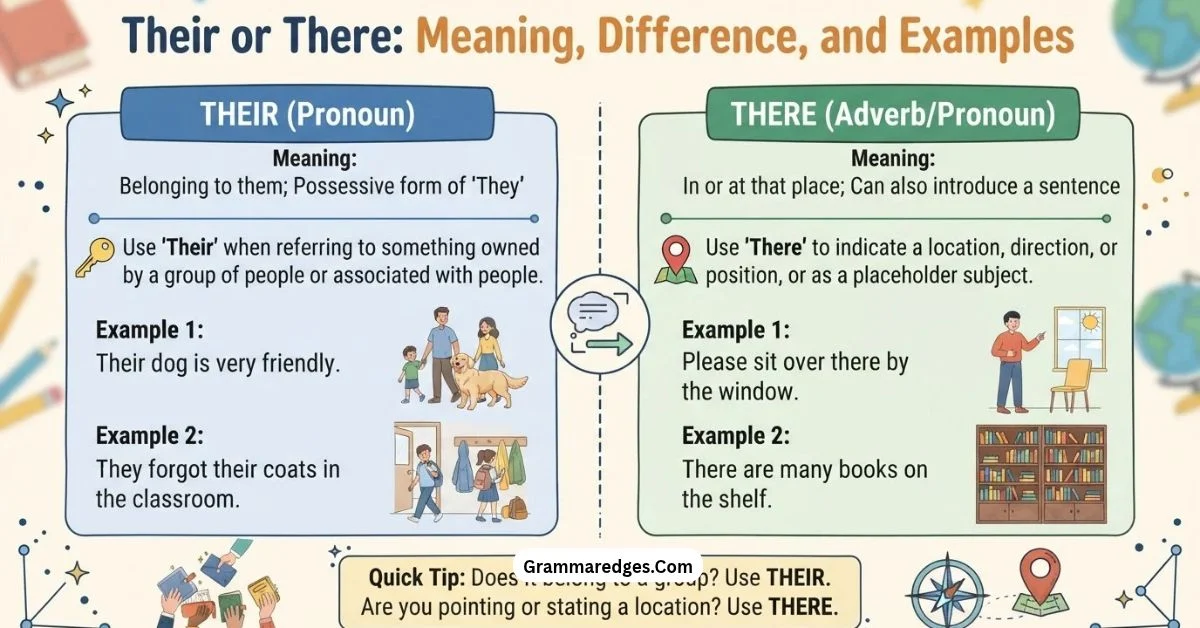
The main difference is simple: their shows possession, while there refers to a place or introduces the existence of something. For example, “Their house is beautiful” shows that the house belongs to someone. In contrast, “There is a house nearby” tells us that a house exists in a particular area.
People frequently search for this comparison because English has many words that sound alike but are spelled differently. Understanding their meanings, grammatical roles, and everyday uses can help you avoid common spelling mistakes.
In this guide, Grammaredges explains how to use these words correctly, with simple definitions, practical examples, common misconceptions, and helpful tips for improving your English grammar.
1. Their or There: Meaning and Definition
Although these words have the same pronunciation, they communicate different ideas. Understanding their individual meanings is the first step toward using them correctly.
What Does “Their” Mean?
Their is a possessive determiner that shows something belongs to, relates to, or is associated with two or more people or entities. It can also refer to one person when that person’s gender is unknown, irrelevant, or when they use they/them pronouns.
Examples:
- The students forgot their books.
- My friends invited me to their party.
- Everyone should bring their own lunch.
- The company changed their policies.
In each example, their connects an individual or group with something associated with them.
What Does “There” Mean?
There can refer to a place or help introduce the existence of something. Its meaning depends on how it is used in a sentence.
Examples:
- Put your shoes over there.
- We went there yesterday.
- There is a cat outside.
- There are three people waiting.
In the first two examples, there refers to a location. In the last two, it introduces something that exists or is present.
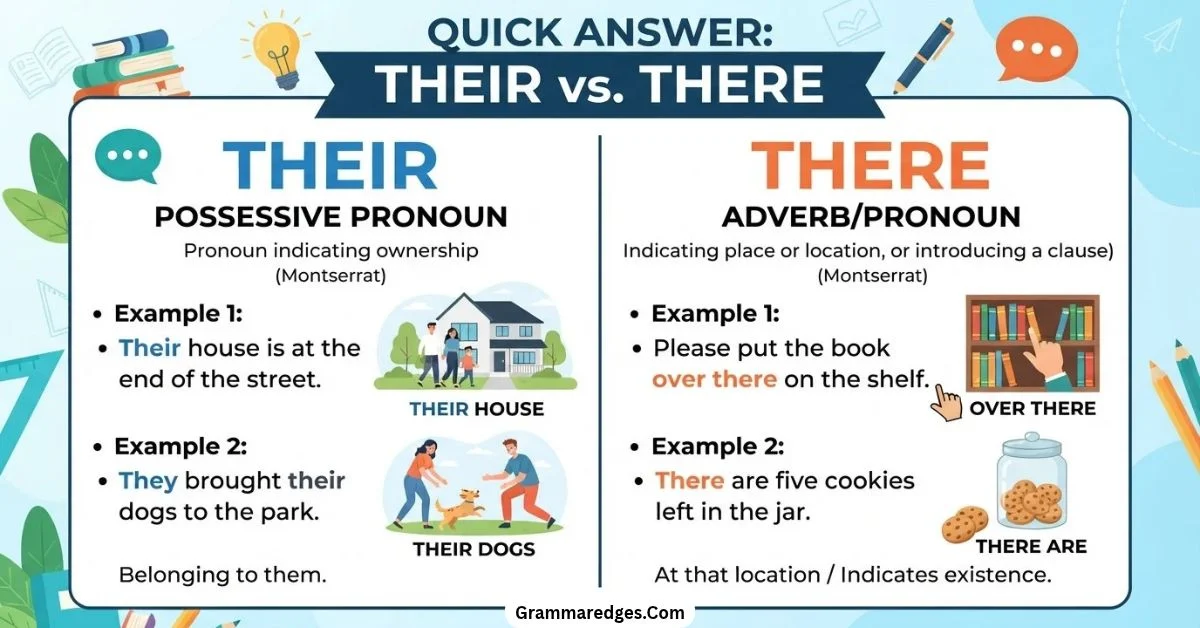
Quick Answer: Their vs. There
| Word | Meaning | Example |
|---|---|---|
| Their | Belonging to people or entities | Their car is new. |
| There | A place or the existence of something | There is a car outside. |
Easy memory trick: If you can replace the word with our or his, you probably need their. If you can replace it with here or use it to introduce something that exists, you probably need there.
2. Background: Why Their and There Are Confusing
The confusion between their and there is largely explained by English pronunciation. Both words are homophones, meaning they sound alike but have different spellings and meanings.
English contains many homophones, including two and too, write and right, and their and there. Because pronunciation alone cannot distinguish these words, writers must understand their meanings and grammatical roles.
The History of “Their”
The word their developed from Old Norse influences on English. It gradually replaced older English possessive forms in many contexts. Today, it is commonly used to show possession by plural groups.
Modern English also uses their as a singular, gender-neutral possessive. For example, “Someone left their umbrella here” is a natural and widely accepted sentence.
The History of “There”
The word there comes from Old English and has historically been associated with location. Over time, English developed its use in sentences such as “There is a problem” and “There are several options.”
In these sentences, there does not necessarily identify a physical place. Instead, it introduces the existence or presence of something.
Why Do People Mix Them Up?
Several factors make these words easy to confuse:
- Identical pronunciation: They sound alike in ordinary speech.
- Fast typing: People may select the wrong word when writing quickly.
- Autocorrect: Some tools fail to recognize the intended meaning.
- Limited grammar knowledge: Writers may not recognize possessive determiners or introductory expressions.
- Casual communication: Informal messages often receive less proofreading.
The best solution is to focus on meaning rather than sound. Once you understand what a sentence is communicating, choosing the correct spelling becomes much easier.
3. Usage in Different Contexts
Both words appear frequently in everyday English, but their grammatical roles determine where they belong.
In Everyday Conversation
People use their when discussing belongings, relationships, responsibilities, and characteristics.
Examples:
- They brought their children.
- The neighbors painted their house.
- The players celebrated their victory.
People use there when discussing locations or introducing information.
Examples:
- Your keys are over there.
- There is a restaurant around the corner.
- There are many ways to solve this problem.
In Academic Writing
Students often use these words in essays, assignments, and examinations.
Correct examples:
- Students should submit their assignments before Friday.
- There are several reasons for this conclusion.
- Researchers presented their findings.
- There is strong evidence supporting the argument.
Using the wrong word can distract readers and weaken the clarity of an otherwise good sentence.
In Professional Communication
Correct grammar is useful in business emails, reports, presentations, and workplace messages.
Examples:
- Employees should update their contact information.
- There will be a meeting at 10 a.m.
- The clients shared their feedback.
- There are two items that require approval.
In professional writing, proofreading is particularly important because small spelling mistakes can make a message appear careless.
On Social Media
Both words appear in captions, comments, and posts.
Examples:
- “Their outfits look amazing!”
- “There is so much love in this picture.”
- “I left my bag over there.”
Even though social media is informal, using the right word helps readers understand your meaning without confusion.
4. Their or There Meaning in Chat, WhatsApp, Instagram, and TikTok
Text messages and social media comments are common places to see their and there used incorrectly. Since both words sound alike, people may type whichever spelling comes to mind first.
However, neither word has a special slang meaning on WhatsApp, Instagram, or TikTok. Their standard English meanings remain the same across these platforms.
Their in Chat Messages
Use their to discuss something belonging to someone.
Examples:
- “Their new profile picture looks great.”
- “I love their sense of humor.”
- “They shared their vacation photos.”
- “Their friendship is so cute.”
These examples show possession or association.
There in Chat Messages
Use there to refer to a location or introduce something.
Examples:
- “I will meet you there.”
- “There is a new video on your page.”
- “Your message is still there.”
- “There are so many funny comments.”
Instagram and TikTok Captions
Here are a few natural examples for social media:
| Caption | Correct word |
|---|---|
| Their energy is unmatched. | Their |
| There is no place like home. | There |
| Their friendship is everything. | Their |
| There goes my weekend! | There |
| Everyone should enjoy their moment. | Their |
WhatsApp Conversation Example
Person A: “Did you see the new photos?”
Person B: “Yes! Their outfits look amazing.”
Person A: “I think they took the pictures over there.”
Both words are correct because the first refers to the outfits associated with the people, while the second identifies a location.
Remember: These are ordinary grammar words, not internet abbreviations. Their meanings do not change simply because you use them in a text message.
5. Meaning in Physics, Medical, and Aircraft Terminology
The words their and there are general English words rather than specialized scientific terms. However, they can appear in physics, medicine, and aviation writing as part of ordinary sentences.
Their and There in Physics
Physics articles and textbooks use their to describe properties associated with particles, objects, or systems.
Examples:
- Electrons can change their energy states.
- Scientists measured their velocities.
- Researchers examined their experimental results.
In contrast, there may introduce a physical phenomenon or indicate a position.
Examples:
- There is a force acting on the object.
- There are several possible explanations.
- The sensor is located there.
Neither word has a separate technical definition in physics.
Their and There in Medical Writing
Medical professionals use their to refer to patients, symptoms, records, and treatments.
Examples:
- Patients should discuss their symptoms with a doctor.
- Nurses updated their records.
- Individuals should follow their prescribed treatment plans.
The word there may introduce a medical finding or refer to a location.
Examples:
- There is swelling around the affected area.
- There are several treatment options.
- The patient waited there for the examination.
Their and There in Aircraft Terminology
Aviation manuals, safety reports, and pilot communications may contain both words in ordinary English sentences.
Examples using their:
- Pilots must check their instruments.
- Passengers should follow their crew’s instructions.
- Engineers inspected their maintenance records.
Examples using there:
- There is an aircraft on the runway.
- There are several safety checks before departure.
- The aircraft remained there until clearance was granted.
In aviation, accuracy is especially important. Technical instructions should use precise, standardized language rather than relying on context when ambiguity could affect safety.
Key point: Physics, medicine, and aviation do not assign unique technical meanings to their or there. Their grammatical functions remain the same in these fields.
6. Common Misconceptions About Their and There
Several misunderstandings contribute to spelling errors. Correcting them can make your writing more accurate.
Misconception 1: Both Words Mean the Same Thing
This is incorrect. Their indicates possession or association, while there refers to a place or introduces existence.
Incorrect: “There house is beautiful.”
Correct: “Their house is beautiful.”
Misconception 2: Their Is Only Used for Groups
Although their commonly refers to multiple people, it can also refer to one person.
Example: “Every student should bring their notebook.”
Here, their refers to each individual student.
Misconception 3: There Always Refers to a Physical Place
Not always. In the sentence “There is a problem,” the word introduces the existence of a problem rather than identifying a particular location.
Misconception 4: The Correct Word Depends on Pronunciation
Both words sound alike in standard pronunciation. Therefore, you must examine the meaning and grammatical structure of the sentence.
Misconception 5: Autocorrect Always Fixes the Mistake
Spell-checking tools may accept both words because both are correctly spelled English words. A sentence can therefore contain the wrong word without triggering a spelling warning.
Misconception 6: Informal Messages Do Not Need Correct Grammar
Friends may understand an incorrect sentence through context, but using the right word still improves readability and communication.
To avoid these mistakes, pause briefly before choosing the word. Ask yourself whether you mean possession, a location, or the existence of something. This simple habit can prevent many common errors.
7. Similar Terms and Alternatives
Understanding related words can help you distinguish their from there and avoid other common English mistakes.
Their, There, and They’re
The most important comparison includes a third word: they’re.
| Word | Meaning | Example |
|---|---|---|
| Their | Possession or association | Their dog is friendly. |
| There | Place or existence | There is a dog outside. |
| They’re | Contraction of “they are” | They’re waiting outside. |
Examples:
- Their: They brought their lunch.
- There: There is food on the table.
- They’re: They’re eating lunch.
A useful test for they’re is to replace it with “they are.” If the sentence still makes sense, they’re may be correct.
Other Related Words
Your vs. you’re
- Your shows possession: “Your phone is ringing.”
- You’re means “you are”: “You’re very helpful.”
Its vs. it’s
- Its shows possession: “The dog wagged its tail.”
- It’s means “it is” or “it has”: “It’s raining.”
To, too, and two
- To: “I went to school.”
- Too: “I want to go too.”
- Two: “I have two books.”
These examples demonstrate why English spelling requires attention to meaning, not just pronunciation.
Alternatives to Their and There
Sometimes, you can rewrite a sentence to make its meaning clearer.
Instead of “Their house is large,” you could write “The family’s house is large.”
Instead of “Put it there,” you could write “Put it beside the door.”
However, these are alternatives for particular sentences, not universal replacements. The best choice depends on the intended meaning.
8. How to Respond When Someone Uses Their or There Incorrectly
If someone confuses these words, your response should depend on the situation. A friendly correction is usually more helpful than criticism.
In Casual Conversations
If a friend writes, “There dog is cute,” you could gently respond:
- “Your sentence should use ‘their’ because you’re talking about the dog’s owners.”
- “I think you mean ‘their dog is cute.’”
- “Small grammar tip: ‘their’ shows possession.”
These corrections communicate the issue without making the other person feel embarrassed.
In Professional Communication
When reviewing a colleague’s email or document, make the correction directly and respectfully.
For example:
“Please change ‘there responsibilities’ to ‘their responsibilities’ in the second paragraph.”
For formal documents, it is also useful to proofread the surrounding sentences to catch other grammatical errors.
In School or Academic Work
Students can learn to identify the grammatical function of each word.
Ask questions such as:
- Does the word show ownership?
- Does it indicate a location?
- Does it introduce something that exists?
- Can it be replaced with “they are”?
These questions encourage understanding rather than memorization.
When Someone Corrects You
If another person points out your mistake, you can simply say:
- “Thanks for catching that!”
- “You’re right. I meant ‘their.’”
- “Thanks for the grammar tip.”
There is no need to overexplain a minor spelling error. The goal is clear communication, not perfect writing in every casual message.
9. Differences Between Their and There
The clearest way to understand these words is to compare their grammatical roles, meanings, and sentence structures.
| Feature | Their | There |
|---|---|---|
| Main function | Shows possession or association | Indicates place or introduces existence |
| Part of speech | Possessive determiner | Adverb or introductory word, depending on use |
| Answers which question? | Whose? | Where? or what exists? |
| Example | Their room is clean. | The room is over there. |
| Another example | They finished their work. | There is work to do. |
| Can indicate ownership? | Yes | No |
| Can introduce existence? | No | Yes |
Compare These Sentences
Example 1: Their books are on the table.
The word their indicates that the books belong to or are associated with certain people.
Example 2: There are books on the table.
The word there introduces the existence of books on the table.
Example 3: They left their bags there.
Both words appear in the same sentence. Their identifies whose bags they are, while there identifies where the bags were left.
A Simple Three-Step Test
- Check possession. If the word indicates ownership or association, use their.
- Check location or existence. If it identifies a place or introduces something that exists, use there.
- Check for “they are.” If those words fit in the sentence, consider they’re instead.
For example, “They’re leaving their bags there” is correct because each word performs a different grammatical function.
10. Relevance in Online Conversations and Dating Apps
Online conversations require quick, clear communication. Whether you are messaging a friend, writing a dating profile, or chatting with someone new, using their and there correctly can help your messages sound natural.
In Dating App Profiles
People often use these words when describing relationships, preferences, and experiences.
Examples:
- “Their kindness matters more than their appearance.”
- “There is nothing better than an honest conversation.”
- “Everyone deserves their own space.”
- “There are plenty of ways to get to know someone.”
These examples show how the words can appear in descriptions of personality, relationships, and expectations.
In Private Messages
Imagine someone sends this message:
“I love there smile.”
The intended meaning is probably “I love their smile,” because the person is referring to a smile associated with someone.
Another example:
“Are you still there?”
Here, there is correct because the sender is asking whether the other person remains present or available in the conversation.
Does the Mistake Change the Message’s Meaning?
Sometimes, context makes the intended meaning obvious. However, a mistake can still distract the reader or make a message harder to interpret.
For example:
- “Their waiting for you” should be “They’re waiting for you.”
- “I left it over their” should be “I left it over there.”
- “There messages are funny” should be “Their messages are funny.”
On dating apps, a minor grammar error is not necessarily a reflection of someone’s intelligence or personality. People type quickly, use different keyboards, and make mistakes. Clear communication and respectful interaction matter much more than perfection.
Ultimately, understanding these words helps you write messages that are easier to read and less likely to be misunderstood.
Conclusion
Understanding their or there is a simple but important part of learning English grammar. Although both words sound alike, they serve different purposes in sentences. Their shows possession or association, as in “Their house is beautiful.” There refers to a location or introduces the existence of something, as in “There is a house nearby.”
The easiest way to remember the difference is to focus on what your sentence means rather than how the word sounds. If you are talking about something that belongs to someone, choose their. If you mean a place or want to introduce something that exists, choose there. Remember that they’re is another related word meaning “they are.”
With regular practice, these distinctions become easier to recognize in emails, school assignments, social media captions, and everyday conversations. Keep these simple rules in mind, and you will be able to use all three words more confidently and accurately.