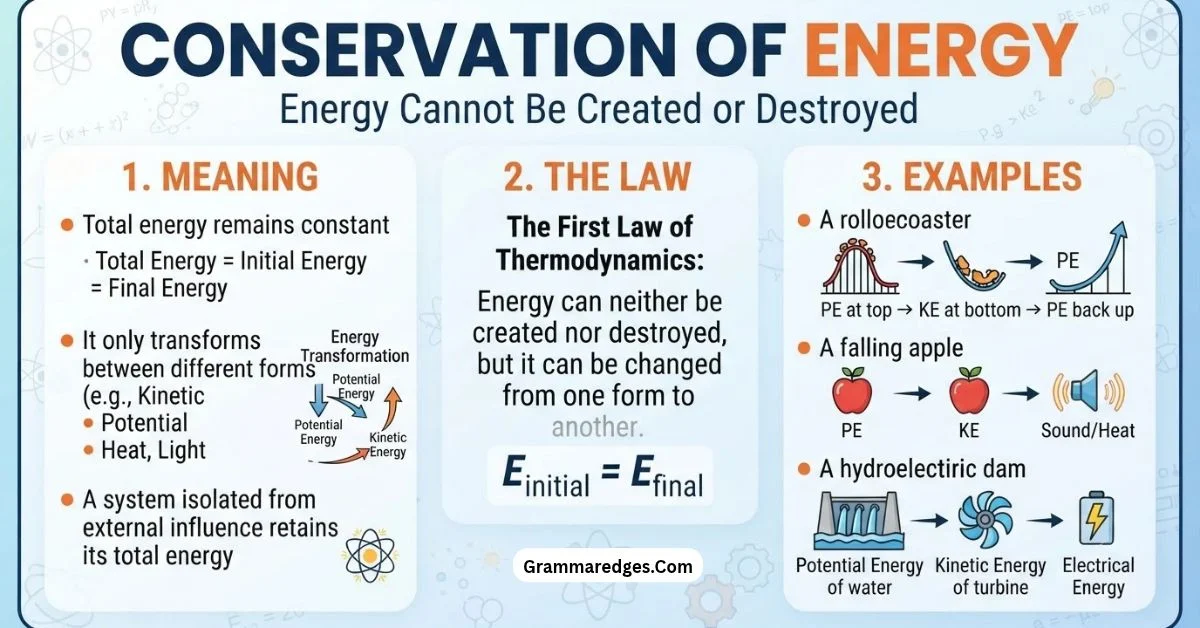
The phrase “energy cannot be created or destroyed” describes one of the most important principles in physics: the law of conservation of energy. It means that energy does not simply appear from nothing or disappear completely. Instead, it changes from one form into another or transfers from one object or system to another. For example, when you switch on a light, electrical energy is converted into light and heat. When you eat food, your body transforms chemical energy into movement, warmth, and other processes that keep you alive.
People often search for this phrase because they want to understand its scientific meaning, its connection to everyday life, or its use in philosophical and online conversations. Some people also use it as a metaphor for personal growth, relationships, and the idea that actions have lasting effects.
In this article, we will explore the meaning of energy conservation, its scientific background, its practical applications, common misconceptions, and how the phrase is used in modern communication.
1. Meaning and Definition
The statement “energy cannot be created or destroyed” means that the total amount of energy in an isolated system remains constant. Energy may change its form, move between objects, or spread into the surroundings, but it does not simply vanish.
This principle is known as the law of conservation of energy.
What does the phrase mean in simple words?
Imagine a battery powering a flashlight. The battery contains stored chemical energy. When the flashlight is switched on, that energy is converted into electrical energy and then into light and heat.
The original energy has not disappeared. It has changed form.
Here are some everyday examples:
- A moving car: Chemical energy from fuel is converted into motion, heat, and sound.
- A falling ball: Gravitational potential energy changes into kinetic energy as the ball falls.
- A phone battery: Stored chemical energy is converted into electrical energy that powers the screen and other components.
- A campfire: Chemical energy stored in wood becomes heat, light, and energy carried by the resulting gases.
- A human body: Chemical energy from food supports movement, body temperature, and biological processes.
The scientific principle
The law of conservation of energy can be expressed simply as:
Total energy before a change = Total energy after a change
This relationship applies when the system is properly defined and all relevant forms of energy are included.
For example, if a ball rolls across a floor and stops, its kinetic energy has not disappeared. Much of it has been transferred into thermal energy in the ball, floor, and surrounding air, along with a small amount of sound.
The important point is that energy conservation does not mean that energy remains in the same form or stays equally useful. Energy can become dispersed and more difficult to use for practical work.
Why is this principle important?
The law helps scientists explain motion, electricity, heat, chemical reactions, and countless other natural processes. It also provides engineers with a foundation for designing engines, power plants, batteries, and renewable energy systems.
In simple terms, energy changes, transfers, and transforms, but the total amount is conserved in an isolated system.
2. Background: Where Did the Idea Come From?
The principle that energy cannot be created or destroyed developed over centuries as scientists studied motion, heat, mechanical work, and the behavior of physical systems.
Early thinkers investigated how objects moved and how forces affected them. Later, scientists began identifying connections between different physical processes. For example, falling objects could produce motion, moving machinery could generate heat, and chemical reactions could produce both heat and mechanical effects.
These observations suggested that different forms of energy might be related rather than completely separate.
The development of energy conservation
During the nineteenth century, scientists made major contributions to the modern understanding of energy conservation.
James Prescott Joule investigated the relationship between mechanical work and heat. His experiments helped establish that mechanical energy could be converted into heat in a measurable way.
Julius Robert von Mayer also contributed to the development of the principle by examining relationships between heat, work, and physical processes.
Hermann von Helmholtz presented an influential formulation of the conservation principle in the nineteenth century, helping establish its importance in physics.
Their work contributed to the understanding that heat, motion, and other physical effects could be connected through energy transformations.
From classical physics to modern physics
In classical physics, conservation of energy is used to explain systems such as pendulums, engines, falling objects, and electrical circuits. Scientists can calculate how energy changes from one form to another without assuming that energy is created from nothing.
Modern physics expanded this understanding through Einstein’s theory of relativity. His famous equation is:
E = mc²
In this equation, E represents energy, m represents mass, and c represents the speed of light in a vacuum.
The equation shows that mass and energy are related. In processes such as nuclear reactions, some rest mass can be converted into other forms of energy, and energy can contribute to the creation of particles under suitable conditions.
This does not mean that the conservation principle is meaningless. Instead, it shows why modern physics considers the relationship between mass and energy.
In general relativity, conservation of energy is more subtle on the scale of the entire universe. A simple global energy total is not always definable in an expanding universe. However, local energy and momentum conservation remain fundamental principles.
The historical development of this idea transformed energy conservation into one of the central foundations of modern science.
3. Usage in Different Contexts: Chat, Social Media, and Professional Fields
The phrase “energy cannot be created or destroyed” is used in several contexts. Its meaning depends on whether someone is discussing scientific facts, personal philosophy, workplace behavior, or everyday experiences.
In everyday conversations
People often use the phrase to explain why something changes rather than disappears.
For example:
- “Energy cannot be created or destroyed, so the heat from the fire goes somewhere.”
- “The energy from the food we eat helps our bodies move.”
- “The energy used by this machine eventually becomes heat and other forms.”
In these examples, the phrase refers directly to physical energy.
In motivational conversations
Some people use the principle as a metaphor for personal development. They may suggest that effort, experience, or difficult emotions can be redirected into something constructive.
For example, someone might say, “Energy cannot be created or destroyed, so turn your frustration into motivation.”
This is a metaphor, not a scientific conclusion about emotions. Feelings are psychological experiences, and they do not have to follow the same interpretation that people apply to physical energy.
In professional fields
Engineers use energy conservation to evaluate how machines and systems perform. They compare the energy entering a system with the energy leaving it and the energy stored inside it.
Scientists use the principle when studying chemical reactions, physical motion, heat transfer, and electrical systems.
Environmental professionals also discuss energy transformations when examining how electricity is generated, how fuels are consumed, and how much energy is lost from a system in forms that are difficult to recover.
For example, a power plant converts energy from a fuel or another source into electricity. Not all the input energy becomes useful electrical output; some is transferred to the surroundings as heat.
Why context matters
In science, the statement has a precise meaning involving measurable physical quantities. In motivational discussions, it may simply express the idea that experiences can lead to new outcomes.
Understanding the difference helps prevent confusion between established scientific principles and personal interpretations.
4. Meaning in Chat, WhatsApp, Instagram, and TikTok
On social media, “energy cannot be created or destroyed” is often used as a caption, a thoughtful status, or a line in a motivational video.
Unlike common texting abbreviations such as “LOL” or “BRB,” the phrase is not a standard acronym or slang expression. It is a complete statement based on a scientific principle.
However, people frequently give it a broader, symbolic meaning when discussing relationships, personal growth, and emotional experiences.
WhatsApp meaning
On WhatsApp, someone might share the phrase in a status to express a reflective or philosophical thought.
Examples include:
- “Energy cannot be created or destroyed. Everything changes.”
- “Turn negative experiences into positive action.”
- “Every action creates a reaction. Choose wisely.”
The first statement refers to a scientific principle, while the others express broader motivational ideas.
Instagram meaning
On Instagram, the phrase may appear in captions accompanying photographs, inspirational posts, or content about self-improvement.
For example:
“Energy cannot be created or destroyed. I am learning to direct my time and effort toward what matters.”
Here, the word “energy” refers figuratively to attention, effort, and motivation rather than a measurable quantity of physical energy.
TikTok meaning
On TikTok, creators may use the phrase in educational videos, science explanations, motivational clips, or discussions about relationships.
A science creator might demonstrate how a moving object transfers energy. A motivational creator might use the same statement to encourage viewers to respond constructively to difficult experiences.
The intended meaning depends on the video’s subject and explanation.
Is it a secret message?
Not necessarily. Someone posting this phrase might be interested in physics, philosophy, personal development, or simply a memorable quotation.
It is not a recognized code for love, attraction, or hidden feelings. To understand a particular person’s intention, consider the surrounding content and the context of your relationship.
The phrase is popular as a reflective statement because it connects a simple scientific idea with questions about change, action, and how people interpret their experiences.
5. Meaning in Physics, Medical Science, and Aircraft Terminology
The conservation of energy has important applications across several technical fields. Although the basic principle remains the same, professionals apply it differently depending on the system they study.
Energy conservation in physics
Physics uses the principle to analyze motion, heat, electricity, light, and many other phenomena.
Consider a roller coaster at the top of a hill. It has gravitational potential energy because of its height. As it moves downward, some potential energy is converted into kinetic energy.
In an ideal system without friction or air resistance, the total mechanical energy remains constant. In a real roller coaster, some mechanical energy is converted into thermal energy and sound.
When all relevant forms of energy are included, the total remains conserved.
Energy conservation in medical science
The principle is also relevant to the human body.
Food contains chemical energy that the body uses to support cellular activity, muscle movement, temperature regulation, and other biological processes.
Medical and nutritional professionals study how the body obtains, stores, transforms, and uses energy. For example, the body can store some energy in fat and other chemical reserves, then use those stores when needed.
However, the body’s energy balance is more complex than a simple comparison of calories consumed and calories burned. Metabolism, hormones, activity, digestion, and other factors influence how energy is processed.
In medical contexts, the phrase describes a physical principle. It does not mean that every emotion, thought, or personal experience represents a transferable quantity of measurable energy.
Energy conservation in aircraft
Aircraft engineering relies heavily on energy conservation.
An aircraft engine converts chemical energy from fuel into mechanical work and other energy outputs. A jet engine produces thrust by accelerating gases, while a propeller-driven aircraft transfers energy through a rotating propeller that accelerates air.
During flight, an aircraft also exchanges energy with its surroundings through aerodynamic forces, drag, heat, and sound.
When an aircraft descends, gravitational potential energy decreases. Depending on the flight conditions, that energy can contribute to increased speed or be dissipated through aerodynamic drag and other processes.
During a climb, the aircraft gains gravitational potential energy. The engine must supply the necessary energy while also overcoming drag and accounting for other inefficiencies.
Why these applications matter
In physics, medicine, and aviation, energy accounting helps professionals explain what happens inside a system.
The same principle supports different practical goals: understanding motion, studying metabolism, improving fuel efficiency, and designing safer, more efficient machines.
6. Common Misconceptions About Energy Conservation
Although the phrase sounds straightforward, people sometimes misunderstand what it actually means.
Misconception 1: Energy never changes
Reality: Energy changes form constantly.
Electrical energy can become light and heat. Chemical energy can become motion. Gravitational potential energy can become kinetic energy.
Conservation means the total is maintained, not that every form stays unchanged.
Misconception 2: Energy cannot be transferred
Reality: Energy can move between objects and systems.
When a hot cup of coffee warms the surrounding air, thermal energy transfers from the hotter coffee to its cooler surroundings.
The energy changes location, even though it is not destroyed.
Misconception 3: Energy is always useful
Reality: Conserved energy is not necessarily available for useful work.
When a car brakes, much of its kinetic energy becomes thermal energy in the brakes, tires, and surrounding environment. The energy remains, but recovering it may be difficult.
This distinction is important in engineering and environmental science.
Misconception 4: The phrase proves that human emotions are physical energy that never disappears
Reality: Human emotions involve biological and psychological processes, including neural activity and chemical signaling. Although these processes involve physical energy, that does not establish that an emotion itself is a conserved substance that transfers unchanged from one person to another.
People can use the phrase metaphorically to describe how experiences influence later behavior, but that interpretation should not be confused with physics.
Misconception 5: Energy conservation means perpetual motion is possible
Reality: Energy conservation does not allow a machine to produce unlimited useful work without an energy source.
Real machines experience friction, electrical resistance, and other effects. These processes convert useful mechanical or electrical energy into less readily recoverable forms.
A perpetual-motion machine that produces more usable energy than it receives would conflict with established physical principles.
Misconception 6: Energy conservation is identical to conservation of matter
Reality: These concepts are related but not identical.
In ordinary chemical reactions, atoms are rearranged and the total mass is approximately unchanged. In nuclear reactions, mass and energy can be converted into one another.
Modern physics accounts for the relationship between mass and energy rather than treating them as completely separate quantities.
Understanding these distinctions makes the law easier to apply correctly.
7. Similar Terms and Alternatives
Several scientific expressions are closely related to “energy cannot be created or destroyed.” However, each has a slightly different meaning.
Law of conservation of energy
This is the standard scientific name for the principle. It states that energy is conserved in an isolated system.
Example: “The law of conservation of energy explains how potential energy becomes kinetic energy.”
Energy transformation
Energy transformation describes the process through which energy changes from one form to another.
Example: “A solar panel converts radiant energy from sunlight into electrical energy.”
Energy transfer
Energy transfer occurs when energy moves between objects or systems.
Example: “Heat transfer occurs when a warm object heats a cooler object.”
Conservation of mass-energy
This expression refers to the relationship between mass and energy in modern physics. It is particularly relevant in relativistic and nuclear processes.
Example: “Nuclear reactions require accounting for changes in mass and energy.”
First law of thermodynamics
The first law of thermodynamics expresses energy conservation in thermodynamic systems. It relates changes in a system’s internal energy to heat transfer and work.
Example: “The first law of thermodynamics helps engineers analyze heat engines.”
Energy efficiency
Energy efficiency describes how effectively a system converts its input energy into a desired useful output.
Example: “A more efficient motor produces the same useful output while requiring less input energy.”
Energy efficiency is not another name for conservation of energy. Rather, it describes how effectively energy is used.
Quick comparison
| Term | Main meaning |
|---|---|
| Conservation of energy | Total energy is conserved in an isolated system |
| Energy transformation | Energy changes from one form to another |
| Energy transfer | Energy moves between systems |
| Mass-energy equivalence | Mass and energy are related |
| First law of thermodynamics | Energy conservation applied to thermodynamic systems |
| Energy efficiency | How effectively input energy produces useful output |
These terms help explain different parts of the same broader scientific picture.
8. How to Respond to the Phrase
The best response depends on whether someone is discussing physics, sharing a motivational quote, or starting a philosophical conversation.
If someone mentions it in a science discussion
You can respond with a straightforward explanation.
Examples:
- “Exactly. Energy changes form, but the total is conserved in an isolated system.”
- “That is the law of conservation of energy.”
- “A good example is how electrical energy becomes light and heat in a bulb.”
These responses show that you understand the scientific principle.
If someone posts it as a motivational quote
You can respond positively without assuming the person is making a scientific claim about emotions.
Examples:
- “A good reminder that change can lead to new possibilities.”
- “I like the idea of turning difficult experiences into constructive action.”
- “Everything changes, and how we respond matters.”
These replies acknowledge the intended message.
If someone uses it in a philosophical discussion
You can ask a question to understand their perspective.
For example:
- “Do you mean that scientifically or as a metaphor for life?”
- “How do you think this idea applies to personal growth?”
- “Do you think experiences change us rather than simply disappear?”
Such questions invite a deeper conversation without assuming that the scientific law proves a particular philosophical belief.
If you disagree with the interpretation
You can respectfully distinguish the science from the metaphor.
For example:
“The conservation of energy is a real physical principle, but applying it to emotions or relationships is a metaphor rather than a direct scientific conclusion.”
This is a clear and balanced way to respond.
The goal is to understand the context before deciding whether the phrase needs a scientific explanation, a thoughtful comment, or a simple acknowledgment.
9. Differences From Similar Words and Expressions
The phrase is sometimes confused with other statements about energy, change, and human behavior. Understanding the differences makes its meaning clearer.
Energy versus force
Energy and force are different physical quantities.
Energy measures the capacity to transfer heat or perform work. Force describes an interaction that can change an object’s motion or shape.
For example, pushing a box involves applying force. If the box moves, work may be done and energy may be transferred.
Energy versus power
Energy is the quantity transferred or used, while power measures the rate at which energy is transferred or work is done.
A watt is a unit of power, while a joule is a unit of energy.
For example, two devices can use the same amount of energy but consume it at different rates.
Conservation versus creation
In ordinary language, people say they “created energy” when they start exercising, become motivated, or generate electricity.
Scientifically, these expressions usually describe a transformation or transfer. A generator converts mechanical energy into electrical energy rather than creating energy from nothing.
Similarly, when a person says they have created positive energy, they usually mean that they have encouraged a positive atmosphere or attitude.
Conservation versus disappearance
Energy can become difficult to detect or recover without being destroyed.
For example, a moving object may stop because friction transfers its kinetic energy into thermal energy in the object and its surroundings.
The object has lost its motion, but the total energy has not simply disappeared.
Scientific meaning versus philosophical meaning
A scientific statement must be supported by clear definitions, measurements, and physical laws.
A philosophical interpretation may use the same words to express beliefs about life, identity, or personal transformation.
Both can be meaningful in their own contexts, but a metaphor should not be presented as proof of a scientific claim.
10. Relevance in Online Conversations and Dating Apps
On dating apps and social platforms, the phrase may be used to express someone’s outlook on relationships, change, emotional boundaries, or personal growth.
However, there is no single, universally recognized dating-related meaning.
What might it mean in a dating profile?
Someone might include the phrase in a profile because they enjoy science, value philosophical conversations, or appreciate motivational ideas.
Another person might use it to communicate that they believe experiences shape future behavior.
For example, a profile might say:
“Energy cannot be created or destroyed. I believe in learning from every experience and moving forward.”
In this context, the person is using a scientific principle as a metaphor for personal development.
What if someone sends it to you directly?
The meaning depends on the conversation.
If you were discussing science, the person may simply be explaining conservation of energy.
If you were discussing a breakup, the phrase might be intended to express the idea that experiences leave an impression on our lives.
If the message appears without any context, it is better not to assume that it is a romantic hint or an indirect statement about your relationship.
You can ask, “What made you think of that?” or “Do you mean that in a scientific or personal way?”
Does it mean two people have an energetic connection?
Not scientifically. People sometimes describe attraction or emotional compatibility as “matching energy,” but this is generally an informal expression referring to personality, mood, communication, or chemistry.
The law of conservation of energy does not prove that two people are spiritually connected, destined to meet, or exchanging a special romantic force.
Why the phrase remains interesting online
The statement combines a clear scientific idea with a broader question about how things change.
That makes it useful in educational content, reflective captions, and discussions about life. Its meaning becomes clearer when readers distinguish the physical law from the personal message someone intends to express.
Conclusion
The statement “energy cannot be created or destroyed” expresses the law of conservation of energy, a fundamental principle of physics. It means that energy changes form or transfers between objects and systems while the total energy of an isolated system remains constant. From moving cars and glowing light bulbs to human metabolism and aircraft engines, this principle helps explain how the physical world works.
The phrase also appears in social media captions, motivational posts, and online conversations. In these settings, people may use it as a metaphor for personal growth, changing circumstances, or the lasting influence of experiences. Those interpretations can be meaningful, but they are different from the scientific law itself.
The key is to understand the context. In physics, energy conservation is a precise principle that supports scientific calculations and engineering. In everyday language, the same words can inspire reflection about change and human behavior. Recognizing this distinction allows you to appreciate both the scientific meaning and the phrase’s broader cultural use without confusing metaphor with fact.