
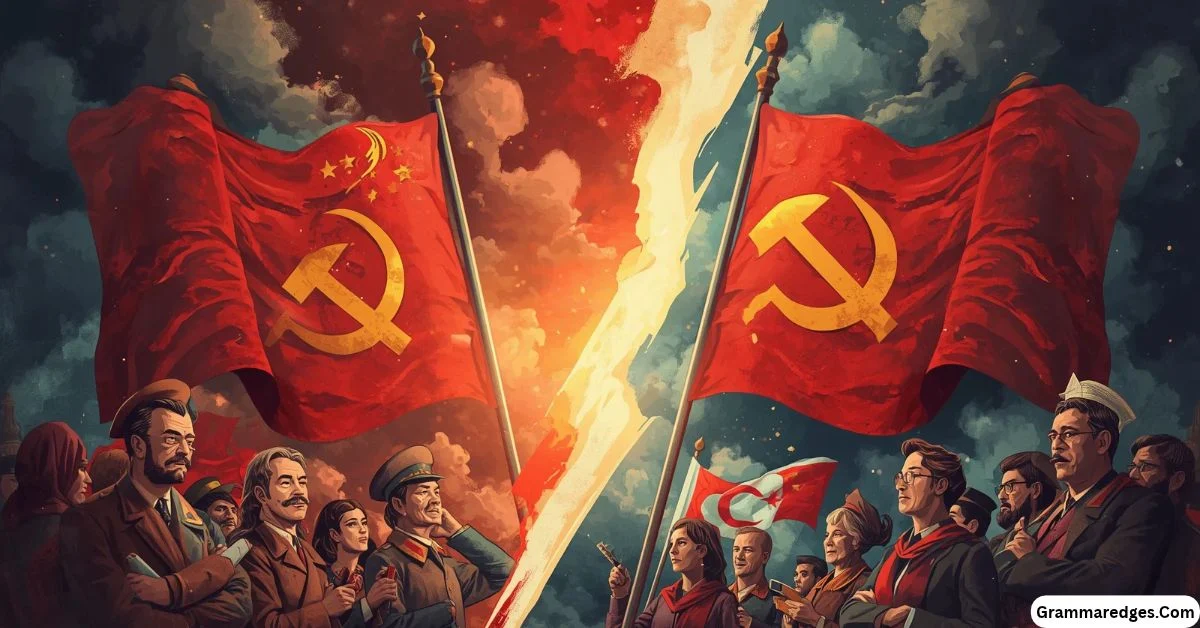
Communism and socialism are related but not identical. Socialism is a broad group of ideas that favors social or collective control of major productive resources. In Marxist theory, communism is a more specific end goal: a classless, stateless society based on common ownership. Real-world systems labeled socialist or communist have varied considerably.
Key Takeaways
- Socialism is a broad political and economic tradition with many different forms.
- Communism, in its classical Marxist form, aims for a classless and ultimately stateless society.
- Socialism can allow markets, private property, and different forms of ownership, depending on the model.
- Communism theoretically seeks common ownership and distribution according to need.
- Countries described as communist historically have generally operated as states claiming to pursue communism, rather than achieving the stateless communist society described in theory.
What Is Socialism?
Socialism is a broad political and economic tradition centered on the idea that important productive resources should be controlled socially rather than being dominated entirely by private owners.
The exact meaning varies. Some socialist theories favor government ownership of major industries. Others emphasize worker ownership, cooperatives, democratic control, or market socialism.
The Stanford Encyclopedia of Philosophy notes that socialism contains many different theories and traditions rather than one single model. A central theme in modern philosophical definitions is that workers should have effective control over the means of production rather than those resources being controlled by a separate capitalist class.
The means of production include things used to produce goods and services, such as factories, businesses, infrastructure, machinery, and natural resources.
How Socialism Views Ownership
Under some forms of socialism, major industries may be publicly owned. Under others, businesses may be owned and managed by workers or communities.
That means it is inaccurate to define every form of socialism simply as “the government owns everything.”
Some socialist models can include markets and private businesses. Others favor much greater public or collective ownership.
This flexibility is one reason the word socialism can refer to very different political and economic ideas.
Socialism Can Take Different Forms
Examples of concepts associated with socialism include:
- Democratic socialism
- Market socialism
- Worker cooperatives
- State socialism
- Revolutionary socialism
These approaches can disagree about markets, elections, government power, private property, and how quickly society should change.
So when someone says they support “socialism,” it is useful to ask what type of socialism they mean.
What Is Communism?
Communism is a political and economic tradition associated most strongly with the writings of Karl Marx and Friedrich Engels.
In its classical Marxist sense, communism describes a future society in which class divisions have disappeared and productive resources are held in common.
The idea developed from a broader critique of capitalism and class relations. Marx and Engels argued that economic systems were closely connected to social classes and the ownership of productive resources.
The Marxist Idea of Communism
One important reason for confusion is that Marx did not always use “socialism” and “communism” as sharply separated terms in the way modern explanations often do.
Later Marxist traditions developed a clearer distinction between socialism as a transitional or lower stage and communism as the higher stage of society.
In the theoretical communist society, there would be no capitalist class controlling productive resources. The long-term vision also involves the disappearance of class divisions and, ultimately, the state as a coercive institution.
Communism as a Classless and Stateless Society
This is an important distinction between communist theory and many historical governments described as communist.
A government can call itself communist while still having a powerful state, government officials, money, wages, and economic institutions.
That does not mean it has reached the theoretical communist end state.
In fact, a purely communist society as described in classical theory has never existed in practice on a national scale. Historical states such as the Soviet Union instead developed political and economic systems that their leaders presented as part of a transition toward communism.
Communism vs Socialism: Key Differences
The easiest way to understand communism vs socialism is to compare their goals, ownership structures, and views of the state.
| Feature | Socialism | Communism |
|---|---|---|
| Basic idea | Social or collective control of major productive resources | Common ownership in a classless society |
| Scope | Broad family of political and economic ideas | More specific ideological tradition |
| Private property | Depends on the model; some private property may exist | Classical theory seeks to eliminate private ownership of productive property |
| Markets | Some socialist models allow markets | Classical communist theory ultimately moves beyond markets |
| Government | Can retain a government or democratic state | The theoretical end state is stateless |
| Economic distribution | Often emphasizes social equality and contribution | The theoretical goal is distribution according to need |
| Class system | Seeks to reduce or overcome class domination, depending on the model | Seeks a classless society |
| Historical practice | Many different forms and mixed systems | States have claimed communist goals but have not achieved the theoretical end state |
Ownership and Private Property
One of the most misunderstood differences involves private property.
Socialism does not necessarily mean that individuals cannot own personal possessions. The more important question is who controls productive assets.
For example, owning your clothes, furniture, or personal belongings is different from owning a large factory and employing hundreds of people.
Classical communist theory goes further by seeking common ownership of productive resources rather than private capitalist ownership.
The Role of Government
Socialism does not automatically require the elimination of government.
Some socialist theories rely heavily on democratic institutions to manage public resources or provide social services. Others favor decentralized worker or community control.
Communist theory is different at its theoretical endpoint. The ideal communist society is stateless, because the class conflicts that supposedly require a coercive state would have disappeared.
This creates an important distinction:
Socialism can describe an economic or political system that operates through a state. Communism, in its classical theoretical form, ultimately envisions a society beyond the state.
Markets and Economic Planning
Socialism and communism can also differ in how they approach markets.
Some forms of socialism allow markets to determine prices and coordinate economic activity while changing who owns businesses.
Other socialist models favor extensive economic planning.
Classical communism aims at an economic system based on common ownership rather than capitalist markets and profit-driven production.
However, there is no single real-world “socialist economy” that perfectly represents every socialist theory.
Distribution of Wealth
Socialist ideas often emphasize reducing extreme economic inequality and ensuring that people have access to important goods and services.
Communist theory takes the idea further.
The famous Marxist principle associated with the higher stage of communist society is commonly summarized as:
“From each according to his ability, to each according to his needs.”
The basic idea is that people contribute according to their abilities and receive according to their needs rather than being organized primarily around wages and private profit.
Neither socialism nor communism should simply be described as demanding that everyone have exactly the same amount of money or possessions. Philosophical discussions of both traditions are more complicated than strict material equality.
Are Socialism and Communism the Same?
No.
They overlap historically and philosophically, which is why people often confuse them. Both developed partly as critiques of capitalism and economic inequality, and Marxist theory connects socialism and communism closely.
But the terms are not interchangeable in every context.
A useful shortcut is:
Socialism is a broad family of ideas about social ownership and control of the economy. Communism is a more specific tradition whose classical Marxist goal is a classless, stateless society based on common ownership.
The distinction becomes especially important when discussing political systems because different groups use the terms in different ways.
Democratic Socialism vs Communism
Democratic socialism is not the same as communism.
Democratic socialism generally emphasizes achieving socialist goals through democratic political institutions rather than assuming that revolutionary overthrow is necessary.
It can involve ideas such as worker control, public ownership, economic democracy, and greater social control over important industries.
Another related term is social democracy.
Social democracy is generally more comfortable with a capitalist market economy while supporting policies such as social insurance, labor protections, progressive taxation, and public services.
Therefore, these three terms should not automatically be treated as synonyms:
Socialism → broad family of ideas
Democratic socialism → a democratic approach to socialist transformation
Social democracy → generally a capitalist mixed economy with extensive social protections and redistribution
Socialism, Communism, and Capitalism
It is also useful to place the two concepts beside capitalism.
Capitalism generally relies on private ownership of productive assets and markets to organize much of economic activity.
Socialism challenges the concentration of productive ownership in private capitalist hands and proposes greater social or collective control.
Communism, in its classical form, goes further by envisioning a society without capitalist classes and ultimately without the state itself.
A simplified comparison looks like this:
| System | Main Ownership Idea | Role of Markets | Main Goal |
|---|---|---|---|
| Capitalism | Predominantly private ownership | Central role | Production through markets and private enterprise |
| Socialism | Social, public, cooperative, or collective ownership depending on model | May be allowed | Greater economic democracy and social control |
| Communism | Common ownership | Ultimately moves beyond capitalist markets | Classless and stateless society |
Real economies are often more complicated than these categories suggest. Countries can combine private businesses, government programs, public enterprises, regulations, and social insurance.
What About Communist Countries Today?
The phrase “communist country” usually refers to states whose ruling parties identify with communist or Marxist-Leninist traditions.
Examples historically include the Soviet Union, while countries such as China, Cuba, Vietnam, Laos, and North Korea have been associated with communist governments or ruling parties.
However, describing these countries simply as examples of “pure communism” is misleading.
Historical communist governments have generally maintained states, political institutions, wages, money, and other features that differ from the theoretical stateless communist society.
Likewise, countries sometimes casually described as “socialist,” such as Nordic countries, are better understood individually. Norway, Sweden, and Denmark maintain market-based economies alongside extensive welfare states and social programs rather than representing a pure socialist economic model.
Common Misconceptions About Socialism and Communism
“Socialism and communism are exactly the same.”
Not exactly. They share historical roots and overlap in some traditions, but socialism is broader and can include many different economic models.
“Socialism means the government owns everything.”
Not necessarily. Some socialist theories support public ownership, while others emphasize cooperatives, worker ownership, or other forms of collective control.
“Communism means everyone gets exactly the same thing.”
That is an oversimplification. Classical communist theory focuses on distribution according to need, rather than simply giving everyone identical amounts.
“Communist countries have achieved pure communism.”
They have not. Historical states identified with communism have retained governments and other institutions that differ from the theoretical communist end state.
Frequently Asked Questions
Is socialism the same as communism?
No. Socialism is a broad family of political and economic ideas, while communism is a more specific tradition. In classical Marxist theory, socialism is often presented as a stage or transition toward a fully communist society.
Is communism a form of socialism?
Communism is closely related to socialism and is often treated as a branch or development within the broader socialist tradition. However, terminology varies between historical movements and political theorists, so the two words should not always be treated as exact synonyms.
Can you own private property under socialism?
It depends on the socialist model. Some forms of socialism allow personal property and certain private businesses while seeking collective ownership or control of major productive resources. The treatment of private property is therefore not identical across all socialist theories.
Is democratic socialism the same as communism?
No. Democratic socialism generally emphasizes democratic political processes, while communist traditions have included revolutionary approaches. Democratic socialism also covers a range of views and should not automatically be equated with Marxist-Leninist communism.
Has pure communism ever existed?
No. The theoretical communist society described by classical Marxism—a classless and ultimately stateless society based on common ownership—has not been achieved at the national level. Historical governments that identified with communism maintained states and political institutions.
Conclusion
The difference between communism vs socialism becomes clearer once you stop treating both words as simple labels for government control.
Socialism is a broad tradition that supports greater social or collective control over productive resources. It includes different approaches, from worker cooperatives and market socialism to more centralized forms of public ownership.
Communism is more specific, especially in the Marxist tradition. Its ultimate vision is a classless, stateless society based on common ownership and distribution according to need.
The two ideas share historical roots and criticism of capitalist class structures, but they are not identical. Understanding that distinction also helps explain why terms such as democratic socialism, social democracy, and communism can mean very different things in American political discussions.