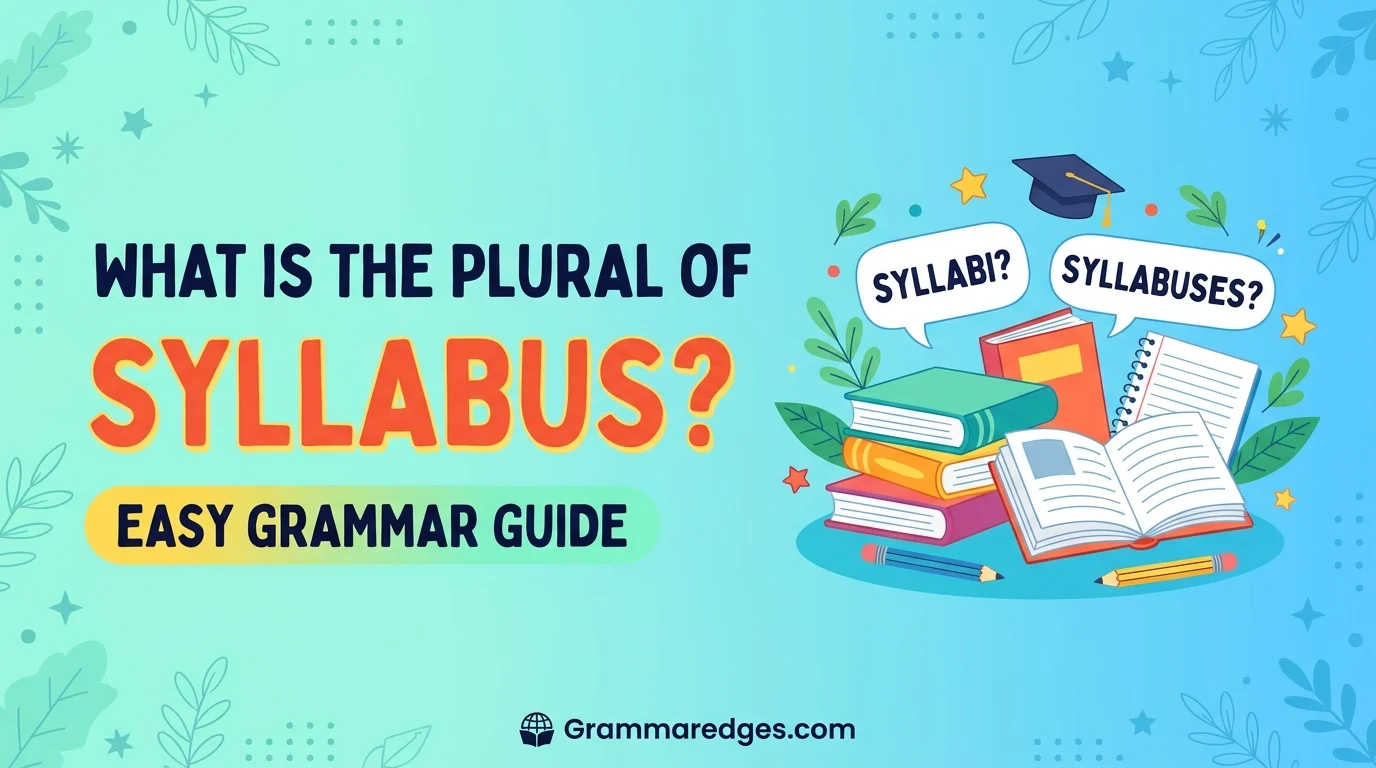
The plural of syllabus is a common grammar question, especially for students, teachers, and college professors. Should you write syllabi or syllabuses when talking about multiple courses?
The good news is that both forms are correct in English, but they follow different pluralization rules. Syllabi comes from a traditional Latin-style pattern, while syllabuses follows standard English grammar.
Understanding the difference can help you avoid spelling mistakes and write more confidently. In this guide, you’ll discover which form is preferred, how to use both in sentences, and which spelling works best in American English.
Key Takeaways
- Syllabi and syllabuses are both correct plural forms.
- Syllabus is the singular form of the word.
- Syllabi follows a traditional Latin-style plural pattern.
- Syllabuses uses the regular English plural rule.
- Both forms refer to multiple course outlines or academic plans.
What Is the Plural of Syllabus?
The plural of syllabus is syllabi or syllabuses. Both spellings are acceptable, so you can use either when referring to two or more course outlines.
A syllabus is a document that explains what students will study during a course. It usually includes course topics, learning goals, assignments, grading policies, reading materials, and important dates.
For example, a college student taking five different classes may receive five separate syllabi or syllabuses.
Here is a simple breakdown:
| Word | Grammatical Form | Example |
|---|---|---|
| Syllabus | Singular | I received one syllabus. |
| Syllabi | Plural | The professor shared three syllabi. |
| Syllabuses | Plural | The department updated its syllabuses. |
Both plural forms communicate the same basic meaning. The main difference is how they are formed.
If you are writing an academic paper, classroom announcement, or professional email, either spelling is acceptable. However, consistency is important. Choose one form and use it throughout your document.
Syllabi vs. Syllabuses: What’s the Difference?
The difference between syllabi and syllabuses is their plural formation, not their meaning.
Syllabi follows a traditional Latin-style pattern. In this pattern, some nouns ending in -us change to -i in their plural form.
Syllabuses follows the regular English plural rule. English speakers usually add -es to nouns ending in certain sounds, including words ending in -us.
Consider these differences:
| Syllabi | Syllabuses |
|---|---|
| Traditional plural form | Regular English plural form |
| Uses the -i ending | Uses the -es ending |
| Sounds more traditional or academic | Sounds straightforward and familiar |
| Correct in American English | Correct in American English |
| Used for multiple course outlines | Used for multiple course outlines |
Examples:
- The professors uploaded their syllabi before the semester started.
- The professors uploaded their syllabuses before the semester started.
Both sentences are grammatically correct. Neither changes the intended meaning.
According to Cambridge Dictionary, both forms are recognized as plurals of syllabus. definition in the Cambridge English Dictionary+1
Why Does Syllabus Have Two Plural Forms?
The word syllabus has an interesting history. Its plural forms reflect the influence of Latin on English vocabulary.
Many English words originally came from Latin or Greek. Some retained older plural patterns when they became part of English. One familiar example is alumnus, whose traditional plural is alumni.
Syllabi follows a similar traditional pattern:
- Syllabus → Syllabi
- Alumnus → Alumni
- Stimulus → Stimuli
- Nucleus → Nuclei
However, English does not require every Latin-derived word to follow its original plural pattern.
Over time, English speakers have also applied regular plural rules to many borrowed words. This explains the form syllabuses.
Both forms developed into accepted English usage. You do not need to know Latin grammar to use them correctly.
An important point is that syllabus itself is not a typical Latin noun with a straightforward historical plural. Its etymology is more complicated and involves an earlier Greek-related word. Therefore, treating syllabi as a familiar traditional English plural pattern is more useful than assuming every detail follows classical Latin grammar. Dictionary.com+1
Which Plural of Syllabus Is Correct in American English?
Both syllabi and syllabuses are correct in American English.
You may see syllabi frequently in colleges, universities, academic documents, and conversations among professors. It has a traditional academic tone.
Syllabuses is also acceptable. It follows a regular English spelling pattern and is easy for readers to understand.
The best choice depends on your audience and writing style.
| Writing Situation | Suggested Form |
|---|---|
| College assignments | Either form |
| University documents | Either form |
| Professional emails | Either form |
| Academic discussions | Either form |
| Everyday communication | Either form |
| Formal educational writing | Follow your institution’s preferred style |
Oxford Learner’s Dictionaries lists syllabuses as the more frequent plural and syllabi as less frequent. This is a useful reminder that the traditional-looking form is not automatically the preferred choice in every context. Oxford Learner’s Dictionaries
My recommendation: Use syllabuses when you want a simple, regular English plural. Use syllabi when it better matches your institution’s established language or your preferred academic style.
Most importantly, do not switch between the two forms without a reason in the same document.
Examples of Syllabi and Syllabuses in Sentences
Understanding grammar rules becomes easier when you see words in everyday situations.
Here are examples showing how to use both plural forms correctly.
Examples using syllabi:
- The students downloaded their syllabi before the first lecture.
- Our university provides online syllabi for every department.
- The professor reviewed all the syllabi during the faculty meeting.
- Several syllabi include detailed information about final exams.
- I compared the syllabi before choosing my college courses.
- The department collected the new syllabi from its instructors.
- Students should read their syllabi before attending class.
- The academic office keeps previous syllabi for reference.
Examples using syllabuses:
- The school updated its syllabuses for the new academic year.
- Teachers submitted their syllabuses to the principal.
- These syllabuses contain information about classroom assignments.
- The university reviewed several science syllabuses.
- Students received their course syllabuses through email.
- The department compared the syllabuses from different programs.
- Updated syllabuses are available on the school’s website.
- The instructors prepared new syllabuses for the fall semester.
Notice that both forms work in similar sentence structures. You can use either one when discussing multiple academic course documents.
Singular vs. Plural of Syllabus
Knowing when to use the singular and plural forms is important for correct sentence structure.
Use syllabus when discussing one course outline. Use syllabi or syllabuses when discussing two or more.
| Singular | Plural | Example |
|---|---|---|
| One syllabus | Two syllabi | I received two syllabi. |
| One syllabus | Three syllabuses | The teacher prepared three syllabuses. |
| A syllabus | Several syllabi | Several syllabi need updating. |
| This syllabus | These syllabuses | These syllabuses are available online. |
Pay attention to the verbs in your sentences, too.
Singular example:
– The syllabus explains the grading policy.
Plural examples:
- The syllabi explain the grading policies.
- The syllabuses explain the grading policies.
A singular subject normally takes a singular verb, while a plural subject takes a plural verb.
This simple rule helps prevent common subject-verb agreement mistakes.
Common Mistakes When Using Syllabus
Even though the plural forms are simple, writers sometimes make mistakes when using them.
Here are some problems to avoid.
1. Using syllabus for multiple documents
Incorrect: The professor uploaded three syllabus.
Correct: The professor uploaded three syllabi.
You can also write “three syllabuses.”
2. Treating syllabi as a singular noun
Incorrect: This syllabi explains the course requirements.
Correct: This syllabus explains the course requirements.
Syllabi is plural, while syllabus is singular.
3. Using the wrong verb
Incorrect: The syllabi explains the grading rules.
Correct: The syllabi explain the grading rules.
The plural subject requires the plural verb explain.
4. Mixing plural forms unnecessarily
If you begin a document using syllabi, try to maintain that form throughout. Although both forms are correct, consistent spelling makes your writing easier to follow.
5. Adding an unnecessary apostrophe
Incorrect: The professor shared the syllabi’s.
Correct: The professor shared the syllabi.
An apostrophe is not needed to make a noun plural. It is used for possession or contractions.
Frequently Asked Questions
1. What is the plural of syllabus?
The plural of syllabus is syllabi or syllabuses. Both forms are grammatically correct. Syllabi follows a traditional plural pattern, while syllabuses follows the regular English rule of adding -es.
2. Is syllabuses a real word?
Yes, syllabuses is a real and accepted English word. It is the regular plural of syllabus. You can use it in academic writing, school documents, emails, and everyday conversations.
3. Is syllabi grammatically correct?
Yes, syllabi is grammatically correct. It is a traditional plural form of syllabus and is commonly recognized in English dictionaries. It refers to two or more course outlines.
4. What is the singular form of syllabi?
The singular form of syllabi is syllabus. For example, “I received one syllabus from my professor.” When referring to multiple course documents, you can write “I received three syllabi.”
5. Which is better for formal writing?
Both forms are acceptable in formal writing. However, you should follow your organization’s preferred style guide. If no specific preference exists, choose one form and use it consistently throughout your document.
6. What is another word for syllabus?
Depending on the context, alternatives include course outline, course guide, course plan, and program of study. These expressions are not always exact replacements because a syllabus can contain specific information about assignments, grading, and course policies.
Conclusion
Understanding the plural of syllabus is simple once you know that both syllabi and syllabuses are correct. The two forms have the same meaning, but they follow different pluralization patterns.
Syllabi reflects a traditional Latin-style ending, while syllabuses follows standard English grammar. In American English, you can confidently use either form in academic writing, school documents, and everyday communication.
Remember to use syllabus for one course outline and either plural form for multiple outlines. If you are unsure which spelling to choose, follow your institution’s writing guidelines and remain consistent throughout your work.