
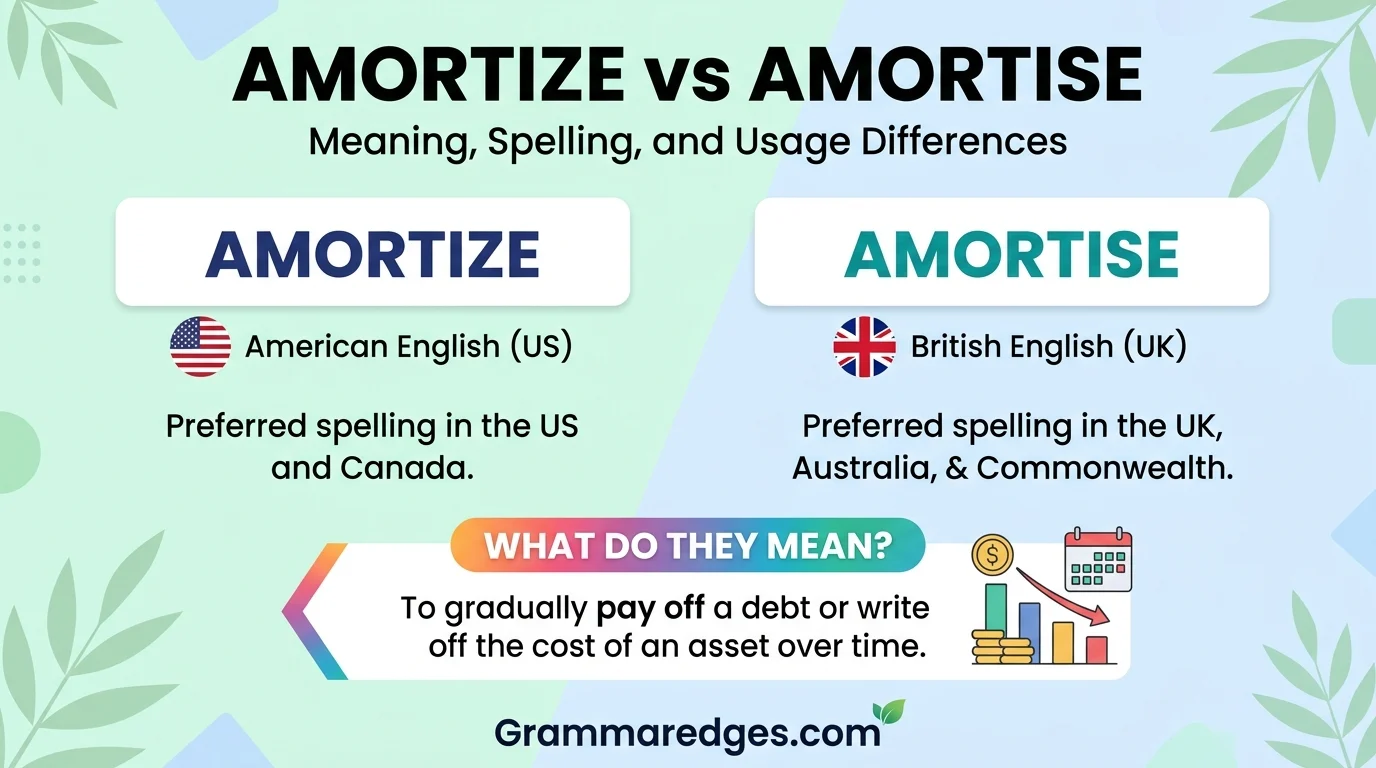
Have you ever wondered whether to write amortize or amortise in a financial report, business email, or everyday conversation? Both spellings are correct, but the right choice depends mainly on the variety of English you are using. Although the words look slightly different, they share the same meaning and pronunciation.
In American English, amortize is the standard spelling. In British English, amortise is commonly preferred. Both words describe the process of gradually paying off a debt over time or spreading the cost of an asset across its useful life.
Understanding this spelling difference is helpful for students, accountants, business owners, financial professionals, and writers who want to produce clear, professional content. Choosing the appropriate form can also make your writing more consistent for readers in different countries.
In this guide, we will explore the meaning, background, grammatical usage, regional differences, common misconceptions, and related terms. You will also learn how to use both spellings correctly in financial documents, online conversations, and professional communication.
1. Meaning and Definition of Amortize vs Amortise
The words amortize and amortise have the same meaning. The difference is simply a matter of spelling preference associated with different varieties of English.
What Does Amortize Mean?
Amortize is the standard American English spelling of a verb that describes gradually reducing a debt through scheduled payments or allocating the cost of an intangible asset over a period of time.
For example, when someone takes out a mortgage, each monthly payment may cover interest and part of the principal balance. Over the agreed repayment period, the outstanding loan balance gradually decreases.
Businesses also amortize certain intangible assets, such as patents, software licenses, and trademarks, over their estimated useful lives when the applicable accounting rules require it.
Examples:
- The company will amortize the software license over five years.
- We plan to amortize the loan over 20 years.
- The accountant explained how to amortize the acquisition cost.
What Does Amortise Mean?
Amortise is the usual British English spelling of the same verb. It describes the same financial and accounting processes as amortize.
Examples:
- The bank agreed to amortise the loan over 15 years.
- The business will amortise the cost of the patent.
- Our accountant recommended that we amortise the eligible expense over its useful life.
Quick Comparison
| Feature | Amortize | Amortise |
|---|---|---|
| Main spelling preference | American English | British English |
| Meaning | Gradually repay debt or allocate asset cost | Same |
| Pronunciation | Essentially identical | Essentially identical |
| Verb forms | Amortized, amortizing | Amortised, amortising |
| Common settings | US financial and business writing | UK financial and business writing |
The main rule is straightforward: use amortize for American audiences and amortise for British audiences. Both forms are understandable internationally.
2. Background and Origin of the Two Spellings
The spelling difference between amortize and amortise reflects a broader pattern in English. American and British English sometimes use different endings for words that have the same meaning and historical roots.
The verb amortize comes through French from a term associated with rendering something dead or extinguishing an obligation. Its historical meaning developed into the financial sense of gradually eliminating a debt or spreading a cost over time.
Over the years, the word became established in banking, accounting, economics, and business administration. Its spelling also followed the regional conventions used by different English-speaking communities.
Why Does American English Use “-ize”?
American English commonly uses the -ize ending in words such as:
- Organize
- Recognize
- Realize
- Modernize
- Amortize
The spelling is standard in American dictionaries and widely used in US business and financial publications.
Why Does British English Use “-ise”?
British English commonly favors -ise in words such as organise, recognise, and amortise. However, British English is not completely uniform. Some British dictionaries and publishers accept or use -ize spellings as well.
For example, certain British editorial styles prefer organise, while Oxford-based spelling conventions may use organize.
Therefore, it is not accurate to claim that every British writer must use -ise. The choice can depend on the dictionary, publisher, institution, or house style.
How the Difference Developed
The two forms became associated with different regional writing conventions as English developed across countries. American spelling was influenced by efforts to establish distinct and consistent spelling practices, while British usage retained several competing conventions.
Today, both spellings remain accepted. Neither one is inherently more correct, intelligent, or professional than the other.
The important consideration is consistency. If a financial report uses amortise, it should generally use related forms such as amortised and amortising throughout the document.
3. Usage in Different Contexts
Although the spelling changes between American and British English, the word’s meaning remains stable across professional and everyday contexts.
A. Banking and Loans
In banking, amortization usually refers to paying down a loan through scheduled installments over a specified period.
For example:
- American English: The borrower will amortize the mortgage over 30 years.
- British English: The borrower will amortise the mortgage over 30 years.
The loan agreement may specify the repayment schedule, interest rate, and installment amounts. In a typical fully amortizing loan, scheduled payments gradually reduce the principal until the balance reaches zero, assuming payments are made according to the agreement.
B. Accounting and Business
Businesses may amortize qualifying intangible assets over their useful lives.
For example:
- The US company will amortize the patent over its expected useful life.
- The UK company will amortise the patent over its expected useful life.
Accounting treatment depends on the applicable standards and the type of asset. Not every business expense or intangible asset is amortized in the same way.
C. Corporate Finance
Financial analysts use amortization schedules to understand how loan payments are divided between principal and interest.
They may also examine amortization expenses when assessing a company’s reported earnings and asset values.
D. Everyday Writing
In everyday language, people are more likely to encounter the word in discussions about mortgages, business costs, student loans, and financial planning than in casual conversation.
Examples:
- We need to amortize the equipment cost over several years.
- The business plans to amortise its eligible development costs.
E. Academic and Educational Writing
Students studying accounting, finance, or business administration may encounter both spellings in textbooks and online resources.
When writing assignments, students should follow the spelling conventions used by their educational institution or instructor.
Practical tip: Choose the regional spelling based on your intended audience, then use it consistently in every relevant word form.
4. Meaning in Chat, WhatsApp, Instagram, and TikTok
Unlike internet slang, amortize and amortise are established English financial terms. They do not normally have separate meanings on messaging apps or social media platforms.
However, people may use them in messages when discussing money, business, education, loans, or personal budgeting.
Amortize in Chat Messages
American English users might write:
- I need to amortize the car loan over five years.
- Can you explain how to amortize this expense?
- The monthly payment includes principal and interest.
These messages use the word in its standard financial sense.
Amortise in WhatsApp Messages
British English users may write:
- We should amortise the business loan over ten years.
- Can you send me the amortisation schedule?
- The accountant has amortised the software cost.
The spelling reflects British usage, not a different meaning.
Usage on Instagram and TikTok
On Instagram and TikTok, these terms may appear in educational videos about mortgages, budgeting, business accounting, or financial literacy.
For example, a creator might explain how a mortgage amortization schedule works or demonstrate how a business allocates the cost of an intangible asset.
The spelling will usually reflect the creator’s preferred regional English.
Is Amortize Internet Slang?
No. Neither amortize nor amortise is generally recognized as a texting abbreviation, meme expression, or dating slang term.
If someone uses either spelling in a message, the intended meaning is usually financial or accounting-related.
A reader who is unfamiliar with the word can ask for clarification rather than assuming that it has a hidden online meaning.
5. Meaning in Physics, Medical, and Aircraft Terminology
The words amortize and amortise primarily belong to financial and accounting vocabulary. However, related words can appear in technical fields, which sometimes causes confusion.
Physics and Engineering
In physics, damping describes the reduction of oscillations or vibrations over time. Engineers may discuss dampers, damping forces, and vibration control when studying mechanical systems.
The term amortize is not normally the standard technical word for reducing physical vibrations.
For example:
- Correct technical usage: The damper reduces vibrations in the mechanical system.
- Financial usage: The company will amortize the cost of the equipment.
Although both ideas involve a reduction or distribution over time, they describe different processes.
Medical Terminology
In medicine, amortize and amortise are not standard terms for diagnosing diseases, describing symptoms, or naming treatments.
Medical professionals generally use more specific terms to describe changes in the body, treatment schedules, or the distribution of a substance.
For example, a doctor might discuss the gradual release of a medication rather than describe it as amortizing.
If the word appears in a medical document, its meaning should be interpreted according to the surrounding context. It might refer to a financial cost associated with medical equipment or healthcare operations rather than a biological process.
Aircraft and Aviation
In aviation, technical terminology includes words such as damping, load, thrust, drag, and fatigue. These terms describe aircraft performance, structural behavior, and mechanical processes.
Amortize is not ordinarily used to describe the physical operation of an aircraft.
However, an airline or aircraft leasing company may amortize eligible costs associated with aircraft-related intangible assets or certain other assets under the relevant accounting rules. The treatment of an aircraft itself depends on the applicable accounting framework and circumstances.
The Key Distinction
| Field | Relevant term or use |
|---|---|
| Finance | Amortize a loan |
| Accounting | Amortise an eligible intangible asset |
| Physics | Damping and oscillation reduction |
| Medicine | Specific clinical terminology |
| Aviation | Technical terminology and financial accounting |
Do not assume that similar-sounding concepts are interchangeable. In technical writing, always use the term that accurately describes the process.
6. Common Misconceptions About Amortize and Amortise
Several misunderstandings surround these two spellings. Learning the facts will help you avoid mistakes in professional and academic writing.
Misconception 1: Amortize Is Correct and Amortise Is Wrong
Fact: Both spellings are accepted English forms. Amortize is standard in American English, while amortise is widely used in British English.
The correct choice depends on your audience and preferred style guide.
Misconception 2: The Words Have Different Meanings
Fact: They have the same meaning. The difference is orthographic, meaning that it concerns how the words are written rather than what they mean.
For example, amortizing a loan and amortising a loan describe the same general process.
Misconception 3: Amortization and Depreciation Are Identical
Fact: These terms are related but are not interchangeable in accounting.
Depreciation generally refers to allocating the depreciable cost of tangible property over its useful life. Amortization commonly refers to allocating the cost of intangible assets over a period, although terminology and accounting treatment can vary by context.
For example, a business might depreciate machinery and amortize a qualifying patent.
Misconception 4: Amortization Always Means Paying Interest
Fact: Amortization is not another word for interest.
In loan repayment, scheduled payments may include both principal and interest. The principal portion reduces the amount owed, while the interest portion is the cost of borrowing.
In accounting, amortization can refer to allocating an asset’s cost rather than repaying a loan.
Misconception 5: British Writers Must Always Use “-ise”
Fact: British spelling conventions vary. Many British publications prefer amortise, but some accept or use amortize.
Writers should follow the relevant publication’s style guide rather than assuming that every British English text follows one universal rule.
Misconception 6: The Spelling Difference Changes Pronunciation
Fact: Both words are generally pronounced the same way. The difference appears in writing, not in the fundamental pronunciation or meaning.
7. Similar Terms and Alternatives
Understanding related vocabulary makes it easier to select the most accurate word for a sentence.
Amortization vs. Amortisation
These are the noun forms associated with the two spelling conventions.
- Amortization: Common in American English.
- Amortisation: Common in British English.
Example: The bank provided an amortization schedule.
A British writer may instead use amortisation schedule.
Amortized vs. Amortised
These are the past-tense and past-participle forms.
- The company amortized the qualifying asset.
- The company amortised the qualifying asset.
Both sentences are grammatically correct.
Depreciate
Depreciate generally refers to the reduction in the value of an asset or the accounting allocation of the cost of a tangible asset over its useful life.
Example: The company depreciates its delivery vehicles over their estimated useful lives.
Repay
Repay means to return borrowed money.
Example: She plans to repay the loan within five years.
Unlike amortize, the word does not necessarily describe a structured repayment schedule or an accounting allocation.
Allocate
Allocate means to assign something to a particular purpose, person, account, or period.
Example: The accountant allocated the expense across the relevant reporting periods.
This term is broader than amortize and does not automatically imply a specific accounting method.
Write Off
Write off can refer to removing an amount or asset from the accounts under the applicable rules. It is not simply another word for amortization.
Example: The business wrote off an amount that was determined to be unrecoverable.
The exact treatment depends on the circumstances and applicable accounting requirements.
8. How to Respond When Someone Uses Amortize or Amortise
If you encounter either spelling in an email, conversation, assignment, or financial document, your response should depend on the context.
When Discussing a Loan
If someone writes, “We should amortize the loan over ten years,” you could reply:
- That repayment period sounds reasonable. Can you share the monthly payment estimate?
- Do you have an amortization schedule showing the principal and interest?
- Should we compare the total interest for different repayment periods?
These responses address the financial issue rather than the spelling.
When Reviewing a Document
If a colleague uses amortise in a British English document, there is usually no need to correct it.
If your organization follows American English, you can suggest using amortize consistently throughout the document.
For example:
“Could we use American English spelling throughout this report for consistency?”
This approach is professional and avoids suggesting that a valid regional spelling is inherently incorrect.
When You Do Not Understand the Term
You can ask:
- Could you explain what amortization means in this example?
- Are you referring to loan repayment or the accounting treatment of an asset?
- Could you share the relevant schedule or calculation?
These questions help clarify the meaning without making assumptions.
When Writing for an International Audience
Choose one spelling convention and apply it consistently. If the document is intended for a multinational audience, either form can work, provided the writing is clear and the style remains consistent.
The goal is to communicate accurately, not to debate regional spelling preferences.
9. Differences From Similar Words
The spelling difference between amortize and amortise is part of a larger group of regional English variations.
| American English | British English | Meaning |
|---|---|---|
| Amortize | Amortise | Gradually repay debt or allocate eligible asset cost |
| Organize | Organise | Arrange or coordinate |
| Recognize | Recognise | Identify or acknowledge |
| Realize | Realise | Understand or become aware |
| Analyze | Analyse | Examine something carefully |
| Paralyze | Paralyse | Cause loss of movement or function |
| Apologize | Apologise | Express regret |
These pairs generally share their meanings despite their different spellings.
However, English spelling differences are not always this simple. Some words have different meanings depending on context, and some terms vary in pronunciation or usage as well.
Amortize vs. Amortization
These words are related but serve different grammatical functions.
Amortize is a verb: “We amortize the eligible cost over five years.”
Amortization is a noun: “The amortization expense is recorded in the accounts.”
In British English, the corresponding forms are often amortise and amortisation.
Amortize vs. Repay
Amortize may describe a structured process of reducing debt over time. Repay simply means to pay borrowed money back.
A borrower can repay a loan in different ways, but a fully amortizing loan normally follows a schedule designed to reduce the balance to zero by the end of the agreed term, assuming the required payments are made.
Amortize vs. Capitalize
In accounting, capitalize generally means recording a qualifying cost as an asset rather than immediately recognizing the entire amount as an expense.
Amortize can then describe allocating the cost of a qualifying intangible asset over its useful life.
The two concepts can therefore be related stages in accounting, but they do not mean the same thing.
10. Relevance in Online Conversations and Dating Apps
The words amortize and amortise are not common dating-app slang, and they do not have an established romantic or flirtatious meaning.
Nevertheless, financial vocabulary can appear in conversations on platforms such as Tinder, Bumble, Instagram, and WhatsApp when people discuss careers, homeownership, budgeting, or future plans.
Financial Discussions in Online Dating
For example, someone might say:
“I am trying to understand how to amortize my mortgage.”
This is a straightforward financial statement. It does not carry an automatic romantic meaning.
Another person might write:
“I finally understand my loan amortisation schedule!”
The spelling may suggest a British English preference, but it does not reveal anything definite about the person’s personality, intentions, or relationship status.
Can It Be Used Humorously?
Yes. People can use technical vocabulary as part of a joke or playful conversation, provided the context makes the humor clear.
For example:
- “I need to amortize the cost of all these coffee dates.”
- “Our weekend plans need a better amortisation schedule!”
These are creative, informal uses rather than standard accounting statements. The intended meaning is playful: spreading a cost or organizing expenses over time.
How Should You Interpret It?
If someone uses either word on a dating app, consider the surrounding conversation before interpreting the message.
They may work in finance, be discussing a mortgage, or simply be making a joke. The word itself is not evidence of attraction, sarcasm, or hidden intent.
When the meaning is unclear, a friendly question is the best response.
Ultimately, online context can change the tone of a sentence, but it does not change the basic meaning of amortize or amortise.
Frequently Asked Questions
1. Is Amortize or Amortise Correct?
Both are correct. Amortize is the standard American English spelling, while amortise is commonly used in British English.
2. What Is the Difference Between Amortize and Amortise?
There is no difference in meaning. The words are alternative spellings of the same verb, and the choice generally depends on regional spelling conventions.
3. Is Amortisation British or American?
Amortisation is commonly used in British English. American English generally uses amortization.
4. How Do You Spell Amortized in British English?
The usual British English spelling is amortised. The American English form is amortized.
5. What Does It Mean to Amortize a Loan?
To amortize a loan means to repay it through scheduled payments that reduce the outstanding principal over time. Depending on the loan terms, each payment may include both principal and interest.
6. Is Amortization the Same as Depreciation?
No. Amortization commonly applies to qualifying intangible assets, while depreciation generally applies to tangible assets. The precise treatment depends on the relevant accounting standards.
Conclusion
The difference between amortize vs amortise is simple: both words have the same meaning, but their spelling varies by regional English convention.
Amortize is the standard choice in American English, while amortise is widely preferred in British English. Both are used in finance, banking, accounting, and business communication to describe gradually reducing debt or allocating eligible asset costs over time.
To write confidently, choose the spelling that matches your intended audience, dictionary, or organizational style guide. Remember that related forms follow the same general pattern: amortization and amortized in American English, compared with amortisation and amortised in British English.
Also, distinguish amortization from related concepts such as depreciation, repayment, and capitalization, because each has a specific meaning. By applying these rules consistently, you can make your financial writing clearer, more accurate, and more professional.