
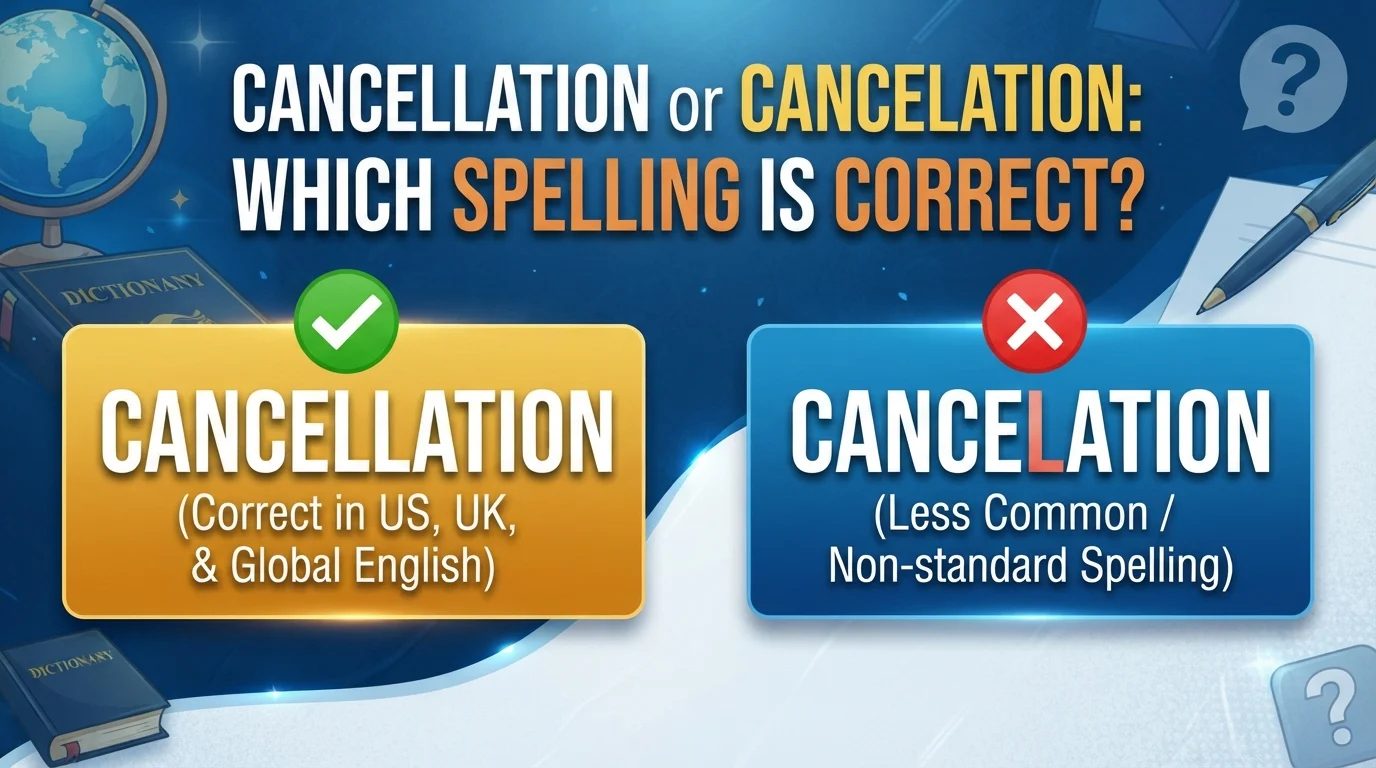
Are you unsure whether to write cancellation or cancelation? Both spellings are recognized, but one is much more common.
Cancellation is the standard and preferred spelling in American and British English, while cancelation is a less common alternative. Choosing the right form helps keep your writing clear and professional.
In this guide, Grammaredges explains the spelling difference, word meanings, and practical examples so you can confidently use the correct form in emails, articles, business documents, and everyday writing.
Key Takeaways
- Cancellation is the preferred spelling in American and British English.
- Cancelation is a recognized but uncommon spelling variant.
- Both forms have the same meaning.
- The verb forms canceled and canceling commonly use one L in American English.
- Use cancellation consistently in emails, business documents, and online content.
Cancellation vs. Cancelation: Which Is Correct?
If you are wondering whether to write cancellation or cancelation, the safest choice is cancellation, with two Ls.
Although American English often favors simplified spellings, this word is an exception to the pattern seen in words such as canceled and canceling. The double-L spelling is the established form in both American and British English. Cancelation is also recorded as an alternative, but it is rarely used.
Here is a simple way to remember the difference:
- Cancellation: Standard spelling and the best choice for most writing.
- Cancelation: An accepted but uncommon alternative.
For example, if you are writing an article for an American audience, use “The cancellation of the event surprised everyone.”
You do not need to change cancellation to cancelation just because you are following American spelling conventions.
Why Cancellation Is Preferred
The spelling cancellation is widely established in dictionaries, professional writing, and everyday communication. It is the form readers are most likely to expect.
You will commonly see it in:
- Cancellation policies
- Flight cancellation notices
- Appointment cancellation emails
- Subscription cancellation requests
- Order cancellation confirmations
- Event cancellation announcements
For website owners and content writers, using the standard form is a practical way to maintain clear, consistent language.
Is Cancelation Ever Correct?
Yes. Cancelation is recognized as a spelling variant, particularly in American English. However, recognition does not mean the two forms are equally common.
If you encounter cancelation in a document, you should not automatically assume it is a spelling mistake. Still, when you are writing new content, cancellation is the better choice because it is the established and more familiar form.
Cancellation vs. Cancelation: Key Differences
The two spellings differ by one letter, but their meanings remain the same.
| Feature | Cancellation | Cancelation |
|---|---|---|
| Spelling | Two Ls | One L in the ending |
| Meaning | Act of canceling something | Same meaning |
| American English | Standard and preferred | Recognized but uncommon |
| British English | Standard and preferred | Uncommon |
| Formal writing | Recommended | Usually best avoided |
| Best choice for SEO content | Yes | Generally no |
The key point is that this is not a difference between American and British English in the same way as color and colour. Both American and British writers generally use cancellation.
If your goal is clear, professional writing, there is little reason to choose the less common alternative.
What Does Cancellation Mean?
Cancellation is a noun that describes the act of stopping, withdrawing, or calling off something that was previously planned, arranged, or expected to happen.
The word can apply to many situations. A person might cancel a meeting, a company might cancel an order, or an airline might cancel a flight.
For example:
- The cancellation of the meeting gave everyone more time to prepare.
- I received a cancellation notice from the airline.
- The company approved my subscription cancellation.
- Heavy rain led to the cancellation of the outdoor concert.
In each sentence, cancellation refers to the act or event of something being called off.
The word can also appear in policies and official notices. A cancellation policy explains the conditions under which a reservation, service, or booking can be canceled. Depending on the agreement, it may include deadlines, fees, refunds, or other requirements.
Although the spelling question is simple, understanding the word’s use helps you choose it correctly in different contexts.
Cancellation or Cancelation in Example Sentences
Examples make the spelling difference easier to remember. In the following sentences, the recommended form is cancellation.
Everyday Examples
- The cancellation of our dinner plans disappointed everyone.
- I received a cancellation message this morning.
- The concert cancellation surprised the fans.
- A last-minute cancellation opened a spot for another customer.
- We discussed the cancellation of the weekend trip.
These sentences show how the noun works in ordinary communication. It can describe a canceled event, an announcement, or the act of changing a plan.
Business and Formal Writing Examples
- Email: Please confirm the cancellation of my appointment scheduled for Friday.
- Customer service: Your request for order cancellation has been received.
- Travel: Passengers will receive updates regarding any flight cancellation.
- Subscription: Your cancellation will take effect at the end of the current billing period.
- Business notice: The company announced the cancellation of its planned product launch.
In formal writing, cancellation is often used because it sounds clear and neutral. It works well in emails, policies, customer communications, and official documents.
Remember that the precise consequences of canceling an appointment, flight, or subscription depend on the applicable policy. The word itself does not automatically imply a refund or fee.
Cancellation, Canceling, and Canceled: What Is the Difference?
One common source of confusion is that the related forms of cancel do not all follow the same spelling pattern.
| Word | Part of speech | American English usage |
|---|---|---|
| Cancel | Verb | I need to cancel my appointment. |
| Cancellation | Noun | The cancellation was unexpected. |
| Canceling | Present participle | She is canceling her reservation. |
| Canceled | Past tense or past participle | They canceled the meeting. |
| Cancelation | Uncommon noun variant | The cancelation was announced. |
Notice that American English commonly uses one L in canceled and canceling, but two Ls in cancellation.
British English typically uses cancelled and cancelling, while retaining cancellation as the standard noun.
Canceled vs. Cancelled
Both canceled and cancelled are correct.
- American English generally prefers canceled.
- British English generally prefers cancelled.
Examples:
- American: The school canceled the trip.
- British: The school cancelled the trip.
Canceling vs. Cancelling
The same regional preference applies to the present participle.
- American: We are canceling the booking.
- British: We are cancelling the booking.
However, the noun cancellation is the standard choice in both varieties. This is why you should learn each word form individually instead of applying a one-L or two-L rule to every form of cancel.
Why Does Cancellation Have Two Ls?
English spelling has developed through several historical influences, including regional differences and attempts to simplify certain spellings.
In American English, words such as traveled, modeled, and canceled commonly use one L before their endings. British English generally retains the double L in travelled, modelled, and cancelled.
However, spelling patterns have exceptions. Cancellation retains two Ls in standard American English despite the single-L forms canceled and canceling.
This means you should not assume that every word derived from cancel will use the same number of Ls.
A useful memory tip is:
Cancel → Canceled → Canceling → Cancellation
Remember the double L in the noun cancellation. That single habit will help you avoid one of the most common spelling errors involving this word.
Common Spelling Mistakes to Avoid
Keep these practical tips in mind when writing.
1. Using cancelation in formal content
Although it is a recognized variant, cancelation is uncommon. Prefer cancellation in articles, reports, business emails, and professional documents.
2. Writing cancellation with one L
The standard spelling is cancellation, not cancelation, for most everyday and formal uses.
3. Applying the same spelling rule to every word form
American English uses canceled and canceling, but cancellation. Learn the individual forms.
4. Mixing American and British conventions unnecessarily
If you choose American English, use forms such as canceled and canceling consistently. If you follow British English, use cancelled and cancelling.
5. Confusing spelling with meaning
Cancellation and cancelation mean the same thing. The difference is spelling frequency and preference, not definition.
Frequently Asked Questions
Is it cancellation or cancelation?
Cancellation is the standard and preferred spelling. Cancelation is also recognized but is much less common. For everyday writing, schoolwork, professional communication, and website content, choose cancellation.
Is cancelation a real word?
Yes. Cancelation is recorded as an alternative spelling of cancellation. However, it is uncommon, so most writers should use cancellation to match standard usage and reader expectations.
Why is cancellation spelled with two Ls in American English?
English spelling includes exceptions to general patterns. Although American English commonly uses one L in canceled and canceling, the standard noun remains cancellation, with two Ls.
Is cancellation British or American English?
Cancellation is standard in both American and British English. Unlike many regional spelling pairs, this word does not normally change its spelling based on the country.
Is it canceled or cancelled?
Both are correct. Canceled is more common in American English, while cancelled is the standard British English form. The choice depends on your target audience and preferred style guide.
How do you spell cancellation in a sentence?
You can write, “The cancellation of the appointment was confirmed by email.” In this example, cancellation is a noun describing the act of calling off the appointment.
Conclusion
When choosing between cancellation or cancelation, remember that cancellation is the standard spelling in both American and British English. Although cancelation is a recognized alternative, it is much less common and is generally best avoided in professional writing.
Also, do not confuse the noun cancellation with the related forms canceled and canceling, which commonly use one L in American English.
If you are writing a blog post, sending a business email, or creating a cancellation policy, choosing the standard spelling will help keep your content clear, natural, and consistent.