Have you ever written a sentence and stopped to wonder whether the word should be break or brake? You are not alone. These two words sound almost identical, but they mean very different things, and mixing them up is one of the most common spelling mistakes in English.
The confusion shows up in driving tests, school essays, job applications, and everyday messages. You might read “hit the breaks” instead of “hit the brakes”, or “take a brake” instead of “take a break”, and both are wrong — even though they sound right when spoken aloud.
This guide explains the difference between break and brake, where the words came from, how British and American English treat them, and which spelling you should use in professional writing. By the end, you will know exactly when to use each word and avoid mistakes that can make your writing look careless.
Break or Brake – Quick Answer
The short answer is:
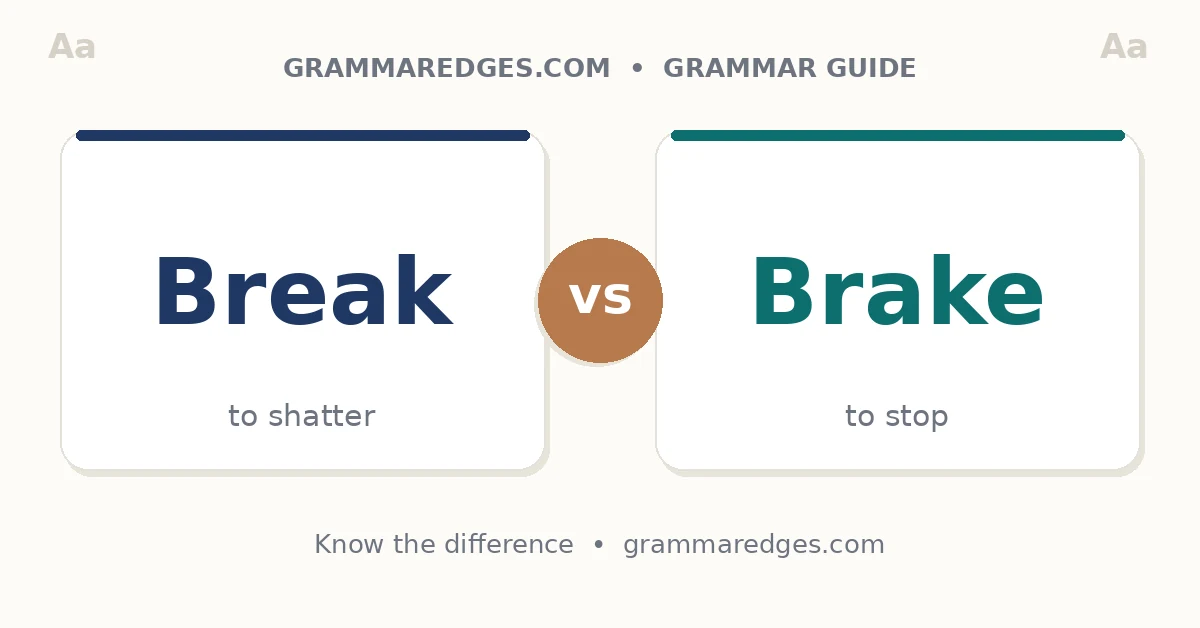
- Break is a verb or a noun. As a verb, it means to separate into pieces, to stop working, or to pause. As a noun, it means a pause or a rest.
- Brake is a noun or a verb. As a noun, it is the device that slows or stops a vehicle. As a verb, it means to slow down or stop using that device.
Examples:
- Please do not break the glass.
- I need a break after two hours of work.
- Press the brake to stop the car.
- She braked suddenly at the traffic light.
Correct Examples
✅ Be careful not to break the vase.
✅ Let’s take a short break.
✅ The car’s brakes need new pads.
✅ He braked in time to avoid the dog.
Incorrect Examples
❌ Be careful not to brake the vase.
❌ Let’s take a short brake.
❌ The car’s breaks need new pads.
❌ He breaked in time to avoid the dog.
A simple memory trick helps: break is about separating or pausing — and “break” contains the word “a”, as in “a pause”. Brake is about stopping a vehicle — and “brake” contains the letters “ak”, which appear in “brake” and in “car” words like “brake pedal”. Even simpler: if the sentence is about a car, a bike, or stopping a vehicle, the word is brake. Everything else is usually break.
The Origin of Break or Brake
Both words come from old Germanic roots, but from different ideas.
Break comes from the Old English word brecan, which means “to separate into pieces”. It has kept that meaning for more than a thousand years. It is related to the German word brechen, which also means “to break”.
Brake has a more surprising history. It comes from the Middle Dutch word brake, which was a device used to crush flax — a plant used to make linen. The device pressed and broke the plant fibres. Over time, the word moved from that crushing machine to any device that presses against something to slow it down, and finally to the brakes of a vehicle.
So the two words share a distant family connection — both involve pressing or separating — but English kept them as two different words with two different jobs.
| Word | Origin | Original Meaning |
|---|---|---|
| Break | Old English brecan | To separate into pieces |
| Brake | Middle Dutch brake | A crushing device for flax |
British English vs American English Spelling
For break or brake, British and American English follow the same rule. There is no spelling difference between the two varieties.
American English
Examples:
- The driver hit the brakes at the red light.
- Let’s take a break before the next session.
British English
Examples:
- The driver hit the brakes at the red light.
- Let’s take a break before the next session.
Both forms are accepted in the UK and the US. The confusion is not about American versus British spelling. It is about meaning: one word is about separating or pausing, and the other word is about stopping a vehicle.
Comparison Table
| Usage | American English | British English |
|---|---|---|
| Separate into pieces | Break | Break |
| A pause or rest | Break | Break |
| Vehicle stopping device | Brake | Brake |
| Slow down a vehicle | Brake | Brake |
Which Spelling Should You Use?
The best spelling depends on the meaning you want.
For US Audiences
Use:
- Break for separating, pausing, or resting
- Brake for stopping or slowing a vehicle
For UK Audiences
Use:
- Break for separating, pausing, or resting
- Brake for stopping or slowing a vehicle
For International Audiences
The safest option is to follow the same rule everywhere. Both words are spelled the same in all English-speaking countries, so a reader in the United States, the United Kingdom, Canada, Australia, or India will understand you if you use the correct meaning.
Quick Rule
Ask yourself: is the sentence about a car, a bike, or a vehicle stopping? Then use brake.
Is the sentence about separating, pausing, or resting? Then use break.
Example: ✅ We took a break from driving, then pressed the brake at the junction. Both words appear in one sentence, and each is correct in its own place.
Common Mistakes with Break or Brake
Many writers make the same errors.
Mistake 1: Writing Brake Instead of Break
❌ Let’s take a short brake.
✅ Let’s take a short break.
A pause from work is a break. A brake belongs on a car.
Mistake 2: Writing Break Instead of Brake
❌ Press the break to stop the car.
✅ Press the brake to stop the car.
The device that stops a car is the brake.
Mistake 3: Writing Breaks Instead of Brakes
❌ The car’s breaks are worn out.
✅ The car’s brakes are worn out.
When you talk about the parts of a car, the plural is brakes.
Mistake 4: Writing Breaked Instead of Braked
❌ He breaked suddenly at the corner.
✅ He braked suddenly at the corner.
The past tense of the verb brake is “braked”. The past tense of the verb break is “broke”, and its past participle is “broken”.
Break or Brake in Everyday Examples
Here are examples from everyday communication.
Emails
Correct:
“Let’s take a break at 11 and continue after lunch.”
Correct:
“The delivery van’s brakes were checked last week.”
News Articles
“The factory will break for the holidays on Friday.”
“The driver braked hard to avoid the cyclist.”
Social Media
“Time for a coffee break!”
“My bike brakes are making a weird noise.”
Resume Writing
Correct:
- Managed break schedules for a team of twenty
- Repaired and tested vehicle brakes as part of the role
Business Documents
“Staff are entitled to a fifteen-minute break every four hours.”
“All company vehicles must have their brakes inspected annually.”
Break vs Brake in Driving
Driving is where most brake mistakes happen, so it is worth learning the driving vocabulary properly.
As a noun, the brake is the pedal and the whole system that slows the vehicle:
Press the brake gently.
The hand brake was on.
The brakes failed on the hill.
As a verb, brake means to use that system:
She braked at the junction.
He is braking too late.
Common driving phrases include:
- brake pedal
- brake light
- hand brake
- emergency brake
- brake pads
Break, by contrast, almost never appears in driving sentences — except in one phrase: “take a break from driving”, which means to stop driving for a rest. In that phrase, the word is break, because it means a pause.
Break Meaning in Everyday Life
Break is one of the most flexible words in English. It has many meanings.
As a verb, it can mean:
- To separate into pieces: “She broke the plate.”
- To stop working: “My phone broke yesterday.”
- To pause: “Let’s break for lunch.”
- To interrupt: “Do not break the silence.”
- To tell news: “He broke the news gently.”
- To break a record: “She broke the world record.”
As a noun, it means a pause or a rest:
We took a short break between meetings.
The school break starts on Friday.
The past tense is “broke” and the past participle is “broken”:
- She broke the glass. (past)
- The glass is broken. (past participle)
Common phrases include:
- take a break
- break the news
- break a record
- break the rules
- break down (stop working)
- break up (end a relationship)
Brake Meaning in Vehicles
Brake is a specialist word with one main job: stopping a vehicle.
As a noun, it is the device:
The brake pedal is on the left of the accelerator.
The car’s brakes squeak when it rains.
As a verb, it means to slow down or stop:
The bus braked at the stop.
Please brake slowly on wet roads.
The past tense is “braked” and the present participle is “braking”:
- He braked suddenly.
- She is braking too hard.
A useful test: if you can replace the word with “stop the vehicle”, the word is brake. If you can replace it with “pause” or “separate”, the word is break.
Break or Brake – Google Trends & Usage Data
Search behaviour shows that many people are unsure about the correct spelling of this pair.
Generally:
- Break is the more common word in everyday use, because it has many meanings and appears in many phrases.
- Brake appears often in driving tests, car repairs, and road safety content.
- Both words are searched frequently by students, teachers, and learner drivers.
Popular Countries
The search term is frequently used in:
- United States
- United Kingdom
- Canada
- Australia
- India
Common Search Intent
Users often search:
- Break vs brake
- Break or brake difference
- How to remember break and brake
- Break meaning with examples
- Brake meaning with examples
Most language experts recommend the driving test: if the sentence is about a vehicle, the word is brake.
Break vs Brake Comparison Table
| Word | Part of Speech | Meaning | Example |
|---|---|---|---|
| Break | Verb | Separate into pieces | She broke the vase. |
| Break | Verb | Pause | Let’s break for lunch. |
| Break | Noun | A pause or rest | Take a short break. |
| Break | Verb | Stop working | My laptop broke. |
| Brake | Noun | Vehicle stopping device | Press the brake. |
| Brake | Verb | Slow down a vehicle | He braked at the light. |
| Brakes | Noun (plural) | The braking system | The brakes need new pads. |
Frequently Asked Questions
1. What is the difference between break and brake?
Break means to separate into pieces, to pause, or to stop working. Brake is the device that stops a vehicle, or the verb for using it.
2. Is it “take a break” or “take a brake”?
It is “take a break“. A pause from work or study is a break. A brake belongs on a car.
3. Is it “hit the brakes” or “hit the breaks”?
It is “hit the brakes“. The parts of a car that stop it are called brakes.
4. What is the past tense of brake?
The past tense of brake is “braked“. For example: “He braked suddenly at the corner.”
5. What is the past tense of break?
The past tense of break is “broke“, and the past participle is “broken“. For example: “She broke the glass.” / “The glass is broken.”
6. How do I remember the difference?
If the sentence is about a car, a bike, or stopping a vehicle, the word is brake. Everything else — pausing, separating, resting — is usually break.
7. Do American and British English spell these words differently?
No. Both varieties spell break and brake the same way, and the meaning rule is the same in both.
8. Can brake be a verb?
Yes. As a verb, brake means to slow down or stop a vehicle. For example: “She braked at the junction.”
9. What does “break the news” mean?
“Break the news” means to tell someone important news, often bad news, for the first time. For example: “He had to break the news that the trip was cancelled.”
10. Which word should I use in an exam?
If the sentence is about a vehicle stopping, use brake. If it is about separating, pausing, or resting, use break. Test with “stop the vehicle” and “pause” to check.
Conclusion
The answer to break or brake is simpler than it first appears. Break is the word for separating into pieces, pausing, or resting. Brake is the word for the device that stops a vehicle, and for the action of using it.
Remember the driving test: if the sentence is about a car, a bike, or a vehicle stopping, the word is brake. If it is about a pause, a rest, or something separating, the word is break.
For more help with words that sound alike, a good guide to the noun and verb forms in English is worth keeping nearby, because knowing whether a word is a thing or an action is the key to choosing the right spelling. With a little practice, you will never mix up break and brake again.