
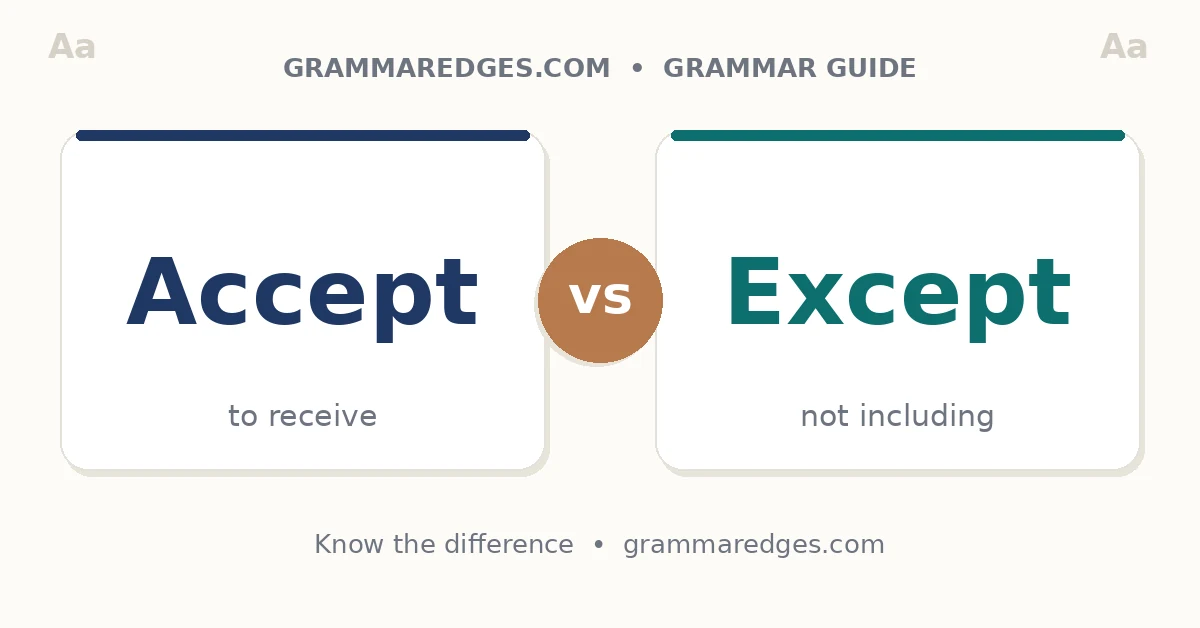
Have you ever written a sentence and stopped to wonder whether the word should be accept or except? You are not alone. These two words sound almost identical, but they mean almost opposite things, and confusing them can completely change the meaning of a sentence.
The mistake appears in school essays, job applications, business emails, and everyday messages. One wrong letter can turn “we accept everyone” into “we except everyone”, and those two sentences say very different things.
This guide explains the difference between accept and except, where the words came from, how British and American English treat them, and which spelling you should use in professional writing. By the end, you will know exactly when to use each word and avoid mistakes that can make your writing look careless.
Accept or Except – Quick Answer
The short answer is:
- Accept is a verb. It means to receive something, to agree to something, or to believe something is true.
- Except is usually a preposition. It means “not including” or “apart from”. It can also be a verb meaning to leave something out.
Examples:
- I accept your apology.
- She accepted the job offer.
- Everyone came to the party except Tom.
- The shop is open every day except Sunday.
Correct Examples
✅ Please accept my thanks for your help.
✅ All the students passed except two.
✅ He accepted the invitation with pleasure.
✅ I like all fruits except bananas.
Incorrect Examples
❌ Please except my thanks for your help.
❌ All the students passed accept two.
❌ He excepted the invitation with pleasure.
❌ I like all fruits accept bananas.
A simple memory trick helps: accept and agree both start with “ac”. If you agree to something or receive it willingly, the word is accept. Except and exclude both start with “ex”. If you are leaving something out, the word is except.
The Origin of Accept or Except
Both words come from Latin, and their roots explain the difference in meaning.
Accept comes from the Latin word accipere, which means “to take” or “to receive”. It is made of ad- (toward) and capere (to take). The word entered English through Old French in the 14th century, keeping the meaning of taking or receiving something that is offered.
Except comes from the Latin word excipere, which means “to take out”. It is made of ex- (out) and capere (to take). It also entered English in the 14th century, but with the opposite idea: taking something out of a group.
So the two words are almost twins — both are built on the Latin verb for “to take” — but one takes something in and the other takes something out. That is why they sound so similar and mean such different things.
| Word | Latin Root | Original Meaning |
|---|---|---|
| Accept | accipere | To take, to receive |
| Except | excipere | To take out |
British English vs American English Spelling
For accept or except, British and American English follow the same rule. There is no spelling difference between the two varieties.
American English
Examples:
- We accept credit cards at this store.
- Everyone attended the meeting except the manager.
British English
Examples:
- We accept credit cards at this shop.
- Everyone attended the meeting except the manager.
Both forms are accepted in the UK and the US. The confusion is not about American versus British spelling. It is about meaning: one word takes something in, and the other word leaves something out.
Comparison Table
| Usage | American English | British English |
|---|---|---|
| Receive an offer | Accept | Accept |
| Agree to terms | Accept | Accept |
| Not including | Except | Except |
| Leave someone out | Except | Except |
Which Spelling Should You Use?
The best spelling depends on the meaning you want.
For US Audiences
Use:
- Accept when someone receives, agrees, or believes
- Except when something is left out or not included
For UK Audiences
Use:
- Accept when someone receives, agrees, or believes
- Except when something is left out or not included
For International Audiences
The safest option is to follow the same rule everywhere. Both words are spelled the same in all English-speaking countries, so a reader in the United States, the United Kingdom, Canada, Australia, or India will understand you if you use the correct meaning.
Quick Rule
Ask yourself: does the sentence mean “take in” or “agree”? Then use accept.
Does the sentence mean “leave out” or “not including”? Then use except.
Example: ✅ I accept all the terms except the last one. Both words appear in one sentence, and each is correct in its own place.
Common Mistakes with Accept or Except
Many writers make the same errors.
Mistake 1: Writing Except Instead of Accept
❌ Please except my apology.
✅ Please accept my apology.
An apology is something you receive, so use accept.
Mistake 2: Writing Accept Instead of Except
❌ Everyone was invited accept John.
✅ Everyone was invited except John.
John is the person left out, so use except.
Mistake 3: Confusing Accepted and Excepted
❌ The offer was excepted by the company.
✅ The offer was accepted by the company.
When a company agrees to an offer, the offer is accepted. The word “excepted” means something was left out, which does not fit here.
Mistake 4: Using Accept for “Apart From”
❌ I eat everything accept meat.
✅ I eat everything except meat.
“Everything except meat” means meat is not included. The word for “not including” is always except.
Accept or Except in Everyday Examples
Here are examples from everyday communication.
Emails
Correct:
“Thank you for the offer. I am pleased to accept the position.”
Correct:
“The office will be closed on all public holidays except New Year’s Day.”
News Articles
“The council accepted the proposal after a long debate.”
“All schools in the district will open on Monday except those under repair.”
Social Media
“So happy to accept this award — thank you all!”
“Open every day except Mondays. See you soon!”
Resume Writing
Correct:
- Accepted a full-time role as Sales Manager
- Accepted into the graduate training programme
Business Documents
“The company will accept applications until the end of the month.”
“The discount applies to all items except those already on sale.”
Can Except Be a Verb?
Yes. Except is usually a preposition, but it can also be a verb, and that is one reason people get confused.
As a preposition, except means “not including”:
- Everyone came except Sarah.
- The store is open every day except Christmas Day.
As a verb, except means “to leave out” or “to exclude”. It is formal and less common in everyday speech:
- The rule applies to all students, but the teacher excepted the new arrivals.
- Present company excepted — everyone else was late.
In the verb form, the past tense is “excepted” and the present participle is “excepting”:
- The report covered all departments, excepting the finance team.
- He was excepted from the new rule.
Most of the time, though, you will use except as a preposition. When you need a verb meaning “to receive or agree”, the word is always accept.
Accept Meaning in Offers and Apologies
Accept is used in three main ways.
First, it means to receive something that is offered:
She accepted the gift with a smile.
Second, it means to agree to something:
He accepted the terms of the contract.
Third, it means to believe something is true or to admit it:
I accept that I made a mistake.
Common phrases include:
- accept an offer
- accept an apology
- accept responsibility
- accept the truth
- accept a challenge
Except Meaning in Exclusions
Except is used when something or someone is not included.
It often follows words like “all”, “everyone”, “everything”, “nothing”, and “nobody”:
Everyone passed except two students.
I like all vegetables except spinach.
It can also appear in the phrases “except for” and “except that”:
The house was perfect except for the small kitchen.
I would go with you, except that I have to work.
Common phrases include:
- all except one
- everyone except me
- except for
- except that
Accept or Except – Google Trends & Usage Data
Search behaviour shows that many people are unsure about the correct spelling of this pair.
Generally:
- Accept is the more common word in everyday use, because it appears in offers, apologies, and agreements.
- Except appears often in instructions, rules, and timetables, where something is left out.
- Both words are searched frequently by students, teachers, and job applicants.
Popular Countries
The search term is frequently used in:
- United States
- United Kingdom
- Canada
- Australia
- India
Common Search Intent
Users often search:
- Accept vs except
- Accept or except difference
- How to remember accept and except
- Accept meaning with examples
- Except meaning with examples
Most language experts recommend the “ac = agree” and “ex = exclude” trick to remember the difference.
Accept vs Except Comparison Table
| Word | Part of Speech | Meaning | Example |
|---|---|---|---|
| Accept | Verb | Receive something | I accept your gift. |
| Accept | Verb | Agree to something | She accepted the offer. |
| Accept | Verb | Believe something is true | I accept my mistake. |
| Except | Preposition | Not including | Everyone came except Tom. |
| Except | Verb | Leave out, exclude | The rule excepted new students. |
| Except | Conjunction | Apart from the fact that | I would come, except that I am busy. |
Frequently Asked Questions
1. What is the difference between accept and except?
Accept means to receive or agree to something. Except means “not including” or “apart from”.
2. Is it “accept my apology” or “except my apology”?
It is “accept my apology”. An apology is something you receive, so use accept.
3. Is it “everyone except me” or “everyone accept me”?
It is “everyone except me”. The word for “not including” is except.
4. Can except be a verb?
Yes, but it is formal and uncommon. As a verb, except means “to leave out”. For example: “The rule excepted new members.”
5. How do I remember the difference?
Accept and agree both start with “ac”. Except and exclude both start with “ex”. Agree means accept; exclude means except.
6. Is “accept” a noun?
No. Accept is a verb. The noun form is “acceptance”. For example: “Her acceptance of the award was warmly received.”
7. Do American and British English spell these words differently?
No. Both varieties spell accept and except the same way, and the meaning rule is the same in both.
8. What does “except for” mean?
“Except for” means “apart from” or “not including”. For example: “The trip was perfect except for the rain.”
9. Is “excepting” a word?
Yes. “Excepting” is the present participle of the verb except, and it is also used as a preposition meaning “not including”. For example: “All departments, excepting finance, met the target.”
10. Which word should I use in an exam?
Use accept when the sentence means receive or agree. Use except when the sentence means leave out or not including. Test the sentence with “agree” and “exclude” to check.
Conclusion
The answer to accept or except is simpler than it first appears. Accept is the verb for receiving, agreeing, or believing. Except is the word for leaving something out or not including it, usually as a preposition.
Remember the two memory tricks: accept and agree both start with “ac”, and except and exclude both start with “ex”. If your sentence means “take in”, use accept. If it means “leave out”, use except.
For more help with words that sound alike, a good dictionary is the best place to check the exact meaning before you write. With a little practice, you will never mix up accept and except again.