
Have you ever written a sentence and stopped to wonder whether the word should be advice or advise? You are not alone. These two words sound almost identical, but one is a noun and the other is a verb, and using the wrong one is one of the most common grammar mistakes in English.
The confusion shows up in emails, essays, job applications, and everyday messages. You might read “thank you for your advise” on a website or “please advice me” in a message, and both are wrong — even though they look almost right.
This guide explains the difference between advice and advise, where the words came from, how British and American English treat them, and which spelling you should use in professional writing. By the end, you will know exactly when to use each word and avoid mistakes that can make your writing look careless.
Advice or Advise – Quick Answer
The short answer is:
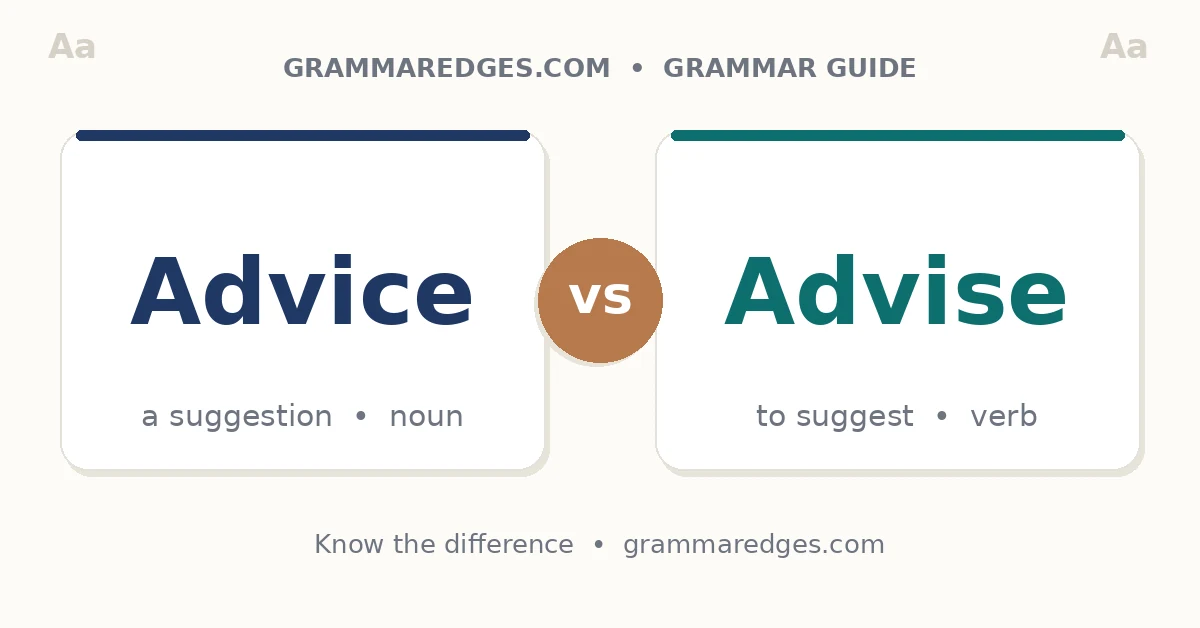
- Advice is a noun. It means guidance or a suggestion about what someone should do. It is pronounced with an “s” sound: ad-VICE.
- Advise is a verb. It means to give advice or to suggest what someone should do. It is pronounced with a “z” sound: ad-VIZE.
Examples:
- Thank you for your advice.
- Can you advise me on which course to take?
- She gave me some good advice.
- The lawyer advised her client to settle the case.
Correct Examples
✅ I need some advice about my career.
✅ Please advise me on the best option.
✅ His advice helped me a lot.
✅ The doctor advised him to rest.
Incorrect Examples
❌ I need some advise about my career.
❌ Please advice me on the best option.
❌ His advise helped me a lot.
❌ The doctor adviced him to rest.
A simple memory trick helps: advice ends in “ice”, like the noun “ice” — and a noun is a thing. Advise ends in “ise”, like the verb “rise” — and a verb is an action. If you can replace the word with “guidance”, use advice. If you can replace it with “suggest”, use advise.
The Origin of Advice or Advise
Both words come from the same Latin root, which is why they look so similar.
They come from the Latin phrase ad visum, which means “in the opinion of” or “according to what seems best”. The words entered English through Old French in the 13th century. Old French had avis for the noun and aviser for the verb, and English kept that split.
Advice kept the noun form with the “c” spelling, and advise kept the verb form with the “s” spelling. Over the centuries, the pronunciation also split: the noun kept the soft “s” sound, while the verb took the harder “z” sound.
This pattern appears in other English word pairs too:
| Noun (with “c”) | Verb (with “s”) |
|---|---|
| Advice | Advise |
| Practice (UK noun) | Practise (UK verb) |
| Licence (UK noun) | License (verb) |
| Device | Devise |
In American English, “practice” and “license” use the same spelling for the noun and the verb, but advice and advise stay different in both American and British English.
British English vs American English Spelling
For advice or advise, British and American English follow the same rule. There is no spelling difference between the two varieties.
American English
Examples:
- I took his advice and applied for the job.
- She advised me to save money every month.
British English
Examples:
- I took his advice and applied for the job.
- She advised me to save money every month.
Both forms are accepted in the UK and the US. The confusion is not about American versus British spelling. It is about grammar: one word is a noun and the other is a verb.
Comparison Table
| Usage | American English | British English |
|---|---|---|
| Guidance (noun) | Advice | Advice |
| Give guidance (verb) | Advise | Advise |
| Past tense of verb | Advised | Advised |
| Person giving guidance | Adviser / Advisor | Adviser / Advisor |
Which Spelling Should You Use?
The best spelling depends on the job the word does in your sentence.
For US Audiences
Use:
- Advice when the word is a thing — guidance or a suggestion
- Advise when the word is an action — giving guidance
For UK Audiences
Use:
- Advice when the word is a thing — guidance or a suggestion
- Advise when the word is an action — giving guidance
For International Audiences
The safest option is to follow the same rule everywhere. Both words are spelled the same in all English-speaking countries, so a reader in the United States, the United Kingdom, Canada, Australia, or India will understand you if you use the correct form.
Quick Rule
Try replacing the word with “guidance”. If the sentence still works, use advice.
Try replacing the word with “suggest”. If the sentence still works, use advise.
Example: ✅ Thank you for your advice (guidance). ✅ Please advise me (suggest to me).
Common Mistakes with Advice or Advise
Many writers make the same errors.
Mistake 1: Writing Advise as a Noun
❌ Thank you for your advise.
✅ Thank you for your advice.
“Your” comes before a noun, so the word must be advice.
Mistake 2: Writing Advice as a Verb
❌ Please advice me on this matter.
✅ Please advise me on this matter.
“Please” is followed by a verb here, so the word must be advise.
Mistake 3: Writing Adviced
❌ The teacher adviced us to study hard.
✅ The teacher advised us to study hard.
The past tense of advise is “advised”, not “adviced”. The spelling keeps the “s” and adds “d”.
Mistake 4: Using “An Advice”
❌ She gave me an advice.
✅ She gave me some advice / a piece of advice.
Advice is an uncountable noun. You cannot say “an advice” or “two advices”. Use “some advice”, “a piece of advice”, or “a bit of advice”.
Advice or Advise in Everyday Examples
Here are examples from everyday communication.
Emails
Correct:
“Thank you for your advice on the project — it really helped.”
Correct:
“Could you please advise me on the next steps?”
News Articles
“Experts advise people to check their smoke alarms every month.”
“The charity offers free advice to families in need.”
Social Media
“Best advice I ever got: start small, stay consistent.”
“Can anyone advise me on a good laptop for editing?”
Resume Writing
Correct:
- Advised senior managers on budget planning
- Provided advice on customer service improvements
Business Documents
“Our team will advise clients on the best investment options.”
“Legal advice is available to all employees.”
Is Advise a Noun?
No. Advise is only ever a verb. It means to give advice or to recommend something.
It appears in these forms:
- Advise (present): “I advise you to wait.”
- Advises (third person): “She advises her clients carefully.”
- Advised (past): “He advised me to apply early.”
- Advising (present participle): “She is advising the team this week.”
The person who gives advice is called an adviser or an advisor. Both spellings are accepted, although “adviser” is more common in British English and “advisor” is more common in American English, especially in job titles.
The financial adviser recommended a savings plan.
She works as a careers advisor at the university.
Advice Meaning in Everyday Life
Advice is an uncountable noun. It means guidance or a suggestion about what to do.
You can give advice, take advice, ask for advice, or follow advice:
I always take my grandmother’s advice seriously.
Can I ask for your advice on this?
Because it is uncountable, you cannot count it. You say:
- some advice
- a piece of advice
- a bit of advice
- good advice
- bad advice
You never say “an advice” or “advices”.
Common phrases include:
- good advice
- sound advice
- expert advice
- legal advice
- medical advice
- take my advice
- a piece of advice
Advise Meaning in Professional Writing
Advise is a formal verb used often in business, legal, and medical writing.
It is followed by a person (the object) and often by an infinitive or a “that” clause:
The lawyer advised her client to accept the offer.
The doctor advised that he should rest for a week.
We advise all customers to keep their receipts.
In business emails, “please advise” is a common formal phrase:
Please advise if this date works for you.
Note that this phrase is correct — “advise” is the verb, and the sentence is asking someone to give information or guidance.
Advice or Advise – Google Trends & Usage Data
Search behaviour shows that many people are unsure about the correct spelling of this pair.
Generally:
- Advice is searched more often, because people look for guidance on many topics.
- Advise appears often in formal writing, job descriptions, and legal texts.
- Both words are searched frequently by students, teachers, and job applicants.
Popular Countries
The search term is frequently used in:
- United States
- United Kingdom
- Canada
- Australia
- India
Common Search Intent
Users often search:
- Advice vs advise
- Advice or advise difference
- How to remember advice and advise
- Advice meaning with examples
- Is it advise or advice
Most language experts recommend the “ice = noun, ise = verb” trick to remember the difference.
Advice vs Advise Comparison Table
| Word | Part of Speech | Meaning | Example |
|---|---|---|---|
| Advice | Noun | Guidance, suggestion | Thank you for your advice. |
| Advice | Noun | Uncountable | I need some advice. |
| Advise | Verb | Give guidance | Please advise me. |
| Advised | Verb (past) | Gave guidance | He advised me to wait. |
| Adviser / Advisor | Noun | Person who gives advice | She is a financial adviser. |
Frequently Asked Questions
1. What is the difference between advice and advise?
Advice is a noun meaning guidance or a suggestion. Advise is a verb meaning to give guidance or to suggest.
2. Is it “thank you for your advice” or “thank you for your advise”?
It is “thank you for your advice“. “Your” comes before a noun, so use advice.
3. Is it “please advise” or “please advice”?
It is “please advise“. “Please” is followed by a verb here, so use advise.
4. Is “advices” a word?
No. Advice is uncountable, so it has no plural form. Use “some advice” or “pieces of advice” instead.
5. How do I remember the difference?
Advice ends in “ice”, like the noun “ice”. Advise ends in “ise”, like the verb “rise”. Noun = ice, verb = ise.
6. What is the past tense of advise?
The past tense is “advised“, not “adviced”. For example: “She advised me to apply early.”
7. Do American and British English spell these words differently?
No. Both varieties spell advice and advise the same way, and the noun-verb rule is the same in both.
8. Is it “adviser” or “advisor”?
Both are correct. “Adviser” is more common in British English, and “advisor” is more common in American English, especially in job titles.
9. Can advice be used as a verb?
No. Advice is only a noun. If you need a verb, use advise.
10. Which word should I use in an exam?
If the word is a thing (guidance), use advice. If the word is an action (giving guidance), use advise. Test with “guidance” and “suggest” to check.
Conclusion
The answer to advice or advise is simpler than it first appears. Advice is the noun — the guidance itself. Advise is the verb — the action of giving that guidance. The pronunciation helps too: advice sounds like “ad-VICE” and advise sounds like “ad-VIZE”.
Remember the two memory tricks: advice ends in “ice” like a noun, and advise ends in “ise” like a verb. Test your sentence with “guidance” and “suggest”, and the correct spelling will usually become clear at once.
If you want to get these pairs right every time, it helps to understand how a verb works in a sentence, because knowing whether a word is a thing or an action is the key to choosing the right spelling. With a little practice, you will never mix up advice and advise again.