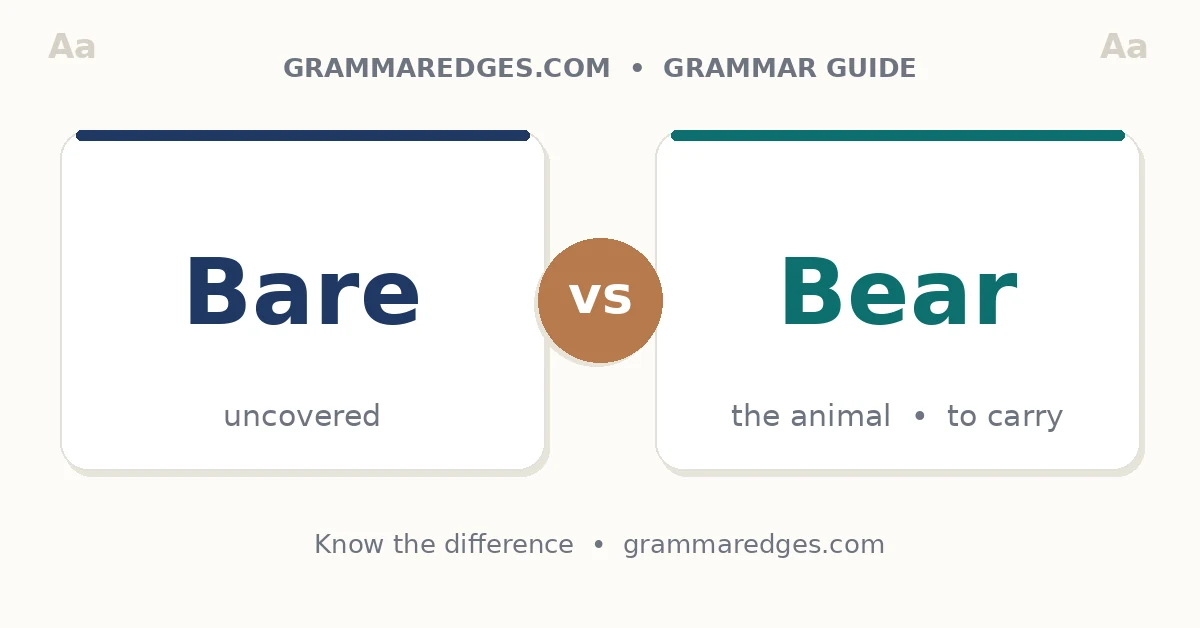
Have you ever written a sentence and stopped to wonder whether the word should be bare or bear? You are not alone. These two words are homophones — they sound exactly the same — but they mean very different things, and mixing them up is one of the most common spelling mistakes in English.
The confusion shows up in emails, essays, job applications, and everyday messages. You might read “bear with me” written as “bare with me”, or “the bare minimum” written as “the bear minimum”, and both are wrong — even though they sound right when spoken aloud.
This guide explains the difference between bare and bear, where the words came from, how British and American English treat them, and which spelling you should use in professional writing. By the end, you will know exactly when to use each word and avoid mistakes that can make your writing look careless.
Bare or Bear – Quick Answer
The short answer is:
- Bare is an adjective or a verb. As an adjective, it means uncovered, empty, or the minimum amount. As a verb, it means to uncover something.
- Bear is a noun or a verb. As a noun, it is a large wild animal. As a verb, it means to carry, to support, to endure, or to produce.
Examples:
- She walked across the room with bare feet.
- The room was bare except for a single chair.
- A brown bear crossed the road.
- I cannot bear this noise any longer.
- Please bear with me for a moment.
Correct Examples
✅ He stood on the bare floor.
✅ The bear slept through the winter.
✅ She could not bear to watch the sad film.
✅ The tree will bear fruit in summer.
Incorrect Examples
❌ He stood on the bear floor.
❌ The bare slept through the winter.
❌ She could not bare to watch the sad film.
❌ The tree will bare fruit in summer.
A simple memory trick helps: bare and “naked” both describe something uncovered — and “bare” is the shorter, simpler word for a simple idea. Bear is the animal, and it is also the verb for carrying a heavy load — and a bear is strong enough to carry heavy things.
The Origin of Bare or Bear
Both words come from Old English, but from different roots.
Bare comes from the Old English word bær, which means “naked” or “uncovered”. It has kept that meaning for more than a thousand years. The word is related to the German word bar, which also means “bare”.
Bear comes from the Old English word bera, which means the animal. The verb bear — to carry or endure — comes from a different Old English word, beran, which means “to carry”. Over time, the animal and the verb came to share the same spelling, even though they started as different words.
So the two words arrived at the same sound by different paths: one from the idea of being uncovered, and the other from an animal and the idea of carrying.
| Word | Old English Root | Original Meaning |
|---|---|---|
| Bare | bær | Naked, uncovered |
| Bear (animal) | bera | The animal |
| Bear (verb) | beran | To carry |
British English vs American English Spelling
For bare or bear, British and American English follow the same rule. There is no spelling difference between the two varieties.
American English
Examples:
- The walls were bare and white.
- The bear wandered into the campsite.
British English
Examples:
- The walls were bare and white.
- The bear wandered into the campsite.
Both forms are accepted in the UK and the US. The confusion is not about American versus British spelling. It is about meaning: one word means uncovered, and the other means an animal or the act of carrying and enduring.
Comparison Table
| Usage | American English | British English |
|---|---|---|
| Uncovered feet | Bare feet | Bare feet |
| Minimum amount | Bare minimum | Bare minimum |
| Wild animal | Bear | Bear |
| Endure something | Bear | Bear |
| Carry a load | Bear | Bear |
Which Spelling Should You Use?
The best spelling depends on the meaning you want.
For US Audiences
Use:
- Bare for uncovered, empty, or minimum
- Bear for the animal, or for carrying, supporting, and enduring
For UK Audiences
Use:
- Bare for uncovered, empty, or minimum
- Bear for the animal, or for carrying, supporting, and enduring
For International Audiences
The safest option is to follow the same rule everywhere. Both words are spelled the same in all English-speaking countries, so a reader in the United States, the United Kingdom, Canada, Australia, or India will understand you if you use the correct meaning.
Quick Rule
Ask yourself: does the sentence mean “uncovered” or “minimum”? Then use bare.
Does the sentence mean “animal”, “carry”, “support”, or “endure”? Then use bear.
Example: ✅ The bear walked across the bare ground. Both words appear in one sentence, and each is correct in its own place.
Common Mistakes with Bare or Bear
Many writers make the same errors.
Mistake 1: Writing Bare Instead of Bear With Me
❌ Please bare with me for a moment.
✅ Please bear with me for a moment.
“Bear with me” means “be patient with me” — you are asking someone to endure a short wait. The verb is bear.
Mistake 2: Writing Bear Instead of Bare Minimum
❌ We have the bear minimum of supplies.
✅ We have the bare minimum of supplies.
The “bare minimum” is the smallest possible amount. The word for “minimum” is bare.
Mistake 3: Writing Bare Instead of Bear in Mind
❌ Please bare in mind that the office closes early.
✅ Please bear in mind that the office closes early.
“Bear in mind” means “remember” — you are carrying an idea in your mind. The verb is bear.
Mistake 4: Writing Bear Instead of Bare Feet
❌ She walked in with bear feet.
✅ She walked in with bare feet.
Feet without shoes are uncovered, so the word is bare.
Bare or Bear in Everyday Examples
Here are examples from everyday communication.
Emails
Correct:
“Please bear with me while I check the details.”
Correct:
“The report covers the bare facts — no extra detail.”
News Articles
“A black bear was seen near the hiking trail this morning.”
“The house was sold with bare walls and no furniture.”
Social Media
“Bear with me — this video took forever to edit!”
“My fridge is looking pretty bare right now.”
Resume Writing
Correct:
- Bore responsibility for a team of twelve (past tense of bear)
- Managed projects and bore the final cost
Business Documents
“The company will bear the cost of the training programme.”
“The contract states the bare minimum of service we must provide.”
Bare vs Bear in Common Phrases
This pair appears in many fixed phrases, and each phrase uses only one of the two words.
Phrases with Bare
- Bare minimum — the smallest amount possible: “We need the bare minimum to start.”
- Bare feet — feet without shoes: “She walked on the beach with bare feet.”
- Bare bones — the most basic parts: “This is a bare bones plan.”
- Bare hands — hands without gloves or tools: “He caught the fish with his bare hands.”
- Lay bare — to reveal or expose: “The report laid bare the problems in the system.”
Phrases with Bear
- Bear with me — be patient with me: “Please bear with me for a moment.”
- Bear in mind — remember: “Bear in mind that prices may change.”
- Bear fruit — produce results: “Her hard work finally bore fruit.”
- Bear the cost — pay for something: “The company will bear the cost.”
- Bear a resemblance — look similar: “He bears a strong resemblance to his father.”
- Bear witness — give evidence: “She was asked to bear witness in court.”
Learning these phrases as fixed units is the fastest way to stop mixing the two words up.
Bare Meaning in Everyday Life
Bare describes something that is uncovered, empty, or at the minimum level.
As an adjective, it means:
- Uncovered: “bare feet”, “bare walls”
- Empty: “a bare room”, “a bare cupboard”
- Minimum: “the bare minimum”, “the bare essentials”
As a verb, bare means to uncover or reveal:
The dog bared its teeth.
She bared her arms to the sun.
Common phrases include:
- bare minimum
- bare feet
- bare bones
- bare hands
- lay bare
Bear Meaning as an Animal and a Verb
Bear as a noun is a large wild animal with thick fur. Common types include the brown bear, the black bear, and the polar bear.
A bear crossed the road in front of our car.
Bear as a verb has several meanings:
- To carry: “She bore the box upstairs.” (past tense: bore, past participle: borne)
- To support: “The bridge can bear heavy traffic.”
- To endure: “I cannot bear this heat.”
- To produce: “The tree bears fruit every summer.”
- To give birth to: “She bore three children.” (formal, old-fashioned)
Note the past tense forms. The past tense of bear is “bore”, and the past participle is “borne” for most meanings. For the meaning “give birth to”, the past participle is “born” when used with “be”: “She was born in 1990.”
Bare or Bear – Google Trends & Usage Data
Search behaviour shows that many people are unsure about the correct spelling of this pair.
Generally:
- Bear is the more common word in everyday use, because it appears in many phrases and in the animal sense.
- Bare appears often in phrases like “bare minimum” and “bare feet”.
- Both words are searched frequently by students, teachers, and job applicants.
Popular Countries
The search term is frequently used in:
- United States
- United Kingdom
- Canada
- Australia
- India
Common Search Intent
Users often search:
- Bare vs bear
- Bare or bear difference
- Bear with me or bare with me
- Bare minimum spelling
- Bear meaning with examples
Most language experts recommend learning the fixed phrases — “bear with me” and “bare minimum” — because those two phrases cause most of the mistakes.
Bare vs Bear Comparison Table
| Word | Part of Speech | Meaning | Example |
|---|---|---|---|
| Bare | Adjective | Uncovered | She walked with bare feet. |
| Bare | Adjective | Minimum | The bare minimum is enough. |
| Bare | Verb | Uncover, reveal | The dog bared its teeth. |
| Bear | Noun | Wild animal | A bear crossed the road. |
| Bear | Verb | Carry, support | The bridge can bear heavy loads. |
| Bear | Verb | Endure | I cannot bear the noise. |
| Bear | Verb | Produce | The tree bears fruit. |
Frequently Asked Questions
1. What is the difference between bare and bear?
Bare means uncovered, empty, or minimum. Bear is a wild animal, or a verb meaning to carry, support, endure, or produce.
2. Is it “bear with me” or “bare with me”?
It is “bear with me”. The phrase means “be patient with me”, and the verb is bear.
3. Is it “bare minimum” or “bear minimum”?
It is “bare minimum”. The phrase means the smallest possible amount, and the word is bare.
4. Is it “bear in mind” or “bare in mind”?
It is “bear in mind”. The phrase means “remember”, and the verb is bear.
5. How do I remember the difference?
Bare is the shorter word for a simple idea: uncovered. Bear is the animal, and a bear is strong enough to carry heavy loads — so bear is also the verb for carrying and enduring.
6. What is the past tense of bear?
The past tense of bear is “bore”. For example: “She bore the heavy bag upstairs.” The past participle is “borne”.
7. Do American and British English spell these words differently?
No. Both varieties spell bare and bear the same way, and the meaning rule is the same in both.
8. Can bare be a verb?
Yes. As a verb, bare means to uncover or reveal. For example: “The dog bared its teeth.”
9. What does “bear fruit” mean?
“Bear fruit” means to produce results. For example: “Her years of practice finally bore fruit.”
10. Which word should I use in an exam?
If the sentence means uncovered or minimum, use bare. If it means an animal, carry, support, or endure, use bear. Test with the phrases “bear with me” and “bare minimum” to check.
Conclusion
The answer to bare or bear is simpler than it first appears. Bare is the word for uncovered, empty, or minimum. Bear is the word for the animal, and for carrying, supporting, enduring, and producing.
Remember the two fixed phrases that cause most mistakes: “bear with me” and the “bare minimum”. If you learn those two phrases, you will get most sentences right. For the rest, test the meaning: uncovered means bare, and carrying or enduring means bear.
For more help with words that sound alike, a good guide to spelling rules is worth keeping nearby, because small spelling choices like this one are what make writing look professional. With a little practice, you will never mix up bare and bear again.