
Have you ever paused in the middle of a sentence and wondered whether to write principal or principle? You are not alone. These two words sound almost identical, but they mean very different things, and mixing them up is one of the most common spelling mistakes in English.
The confusion shows up everywhere — in school emails, business reports, exam essays, and everyday messages. You might read about a school principal, a loan principal, or a guiding principle, and each time the spelling matters. A small spelling slip can change the meaning of a whole sentence.
This guide explains the difference between principal and principle, where the words came from, how British and American English treat them, and which spelling you should use in professional writing. By the end, you will know exactly when to use each word and avoid mistakes that can make your writing look careless.
Principal or Principle – Quick Answer
The short answer is:
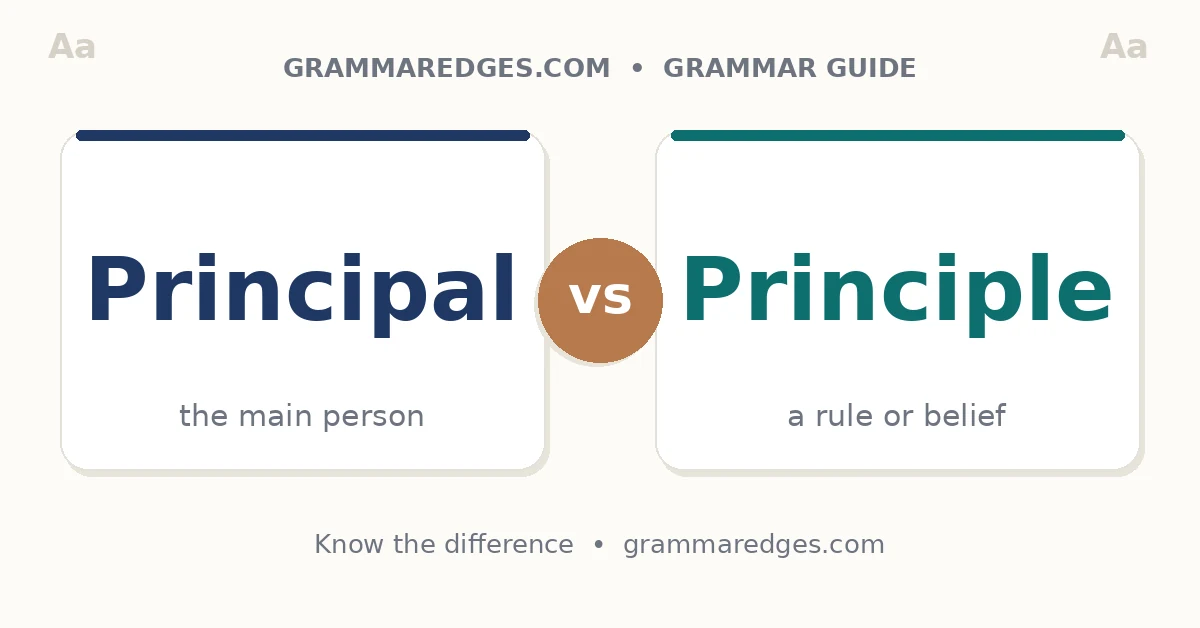
- Principal is a noun or an adjective. It means the main person, the main thing, or a sum of money. It can also mean the head of a school.
- Principle is only a noun. It means a rule, a belief, or a basic truth that guides behaviour.
Examples:
- The principal of the school welcomed the new students.
- She paid back the principal amount of the loan.
- Honesty is a principle she lives by.
- He refused to break his principles.
Correct Examples
✅ The school principal gave a speech at the assembly.
✅ My principal reason for leaving was the long commute.
✅ He follows the principle of treating everyone fairly.
✅ The principles of good design never change.
Incorrect Examples
❌ The school principle gave a speech at the assembly.
❌ My principle reason for leaving was the long commute.
❌ He follows the principal of treating everyone fairly.
A simple memory trick helps: the principal is your “pal” — the head of the school is a person, and a person can be your pal. A principle is a rule, and both words end in “le”, just like “rule”.
The Origin of Principal or Principle
Both words come from Latin, and that shared root is part of the reason they look so similar.
Principal comes from the Latin word principalis, which means “first” or “chief”. It is connected to princeps, the Latin word for a leader or chief. The word entered English through Old French in the 14th century, first meaning the main person in charge of something. Over time it also came to mean the main sum of money in a loan or investment, because that sum is the “chief” amount.
Principle comes from the Latin word principium, which means “a beginning” or “a foundation”. It entered English in the same period, but it kept a different meaning: the basic foundation on which an idea or a system is built. A principle is the starting point for a rule or a belief.
In short, both words began with the idea of “what comes first” — a first person, or a first rule. English simply kept them as two different words with two different jobs.
| Word | Latin Root | Original Meaning |
|---|---|---|
| Principal | principalis | First, chief |
| Principle | principium | Beginning, foundation |
British English vs American English Spelling
For principal or principle, British and American English follow the same rule. There is no spelling difference between the two varieties.
American English
Examples:
- The principal actor in the play received a standing ovation.
- He stood by his principles even when it cost him money.
British English
Examples:
- The principal actor in the play received a standing ovation.
- He stood by his principles even when it cost him money.
Both forms are accepted in the UK and the US. The confusion is not about American versus British spelling. It is about meaning: one word is a person or a main thing, and the other word is a rule.
Comparison Table
| Usage | American English | British English |
|---|---|---|
| Head of a school | Principal | Principal |
| Main reason | Principal reason | Principal reason |
| Loan amount | Principal | Principal |
| A rule or belief | Principle | Principle |
| Moral values | Principles | Principles |
Which Spelling Should You Use?
The best spelling depends on the meaning you want.
For US Audiences
Use:
- Principal for a person, a main thing, or money
- Principle for a rule or a belief
For UK Audiences
Use:
- Principal for a person, a main thing, or money
- Principle for a rule or a belief
For International Audiences
The safest option is to follow the same rule everywhere. Both words are spelled the same in all English-speaking countries, so a reader in the United States, the United Kingdom, Canada, Australia, or India will understand you if you use the correct meaning.
Quick Rule
Ask yourself: am I talking about a person, a main thing, or money? Then use principal.
Am I talking about a rule, a belief, or a basic truth? Then use principle.
Example: ✅ The principal announced a new school principle about homework. Both words appear in one sentence, and each is correct in its own place.
Common Mistakes with Principal or Principle
Many writers make the same errors.
Mistake 1: Writing Principle for the Head of a School
❌ The principle called the students to the hall.
✅ The principal called the students to the hall.
The head of a school is a person, so use principal.
Mistake 2: Writing Principal for a Rule
❌ Honesty is my guiding principal.
✅ Honesty is my guiding principle.
A rule or belief is always a principle.
Mistake 3: Mixing Up the Loan Amount
❌ She repaid the principle on her loan.
✅ She repaid the principal on her loan.
In finance, the original sum of money is called the principal.
Mistake 4: Using Principle as an Adjective
❌ It was a principle concern of the committee.
✅ It was a principal concern of the committee.
Only principal can work as an adjective meaning “main”. Principle is never an adjective.
Principal or Principle in Everyday Examples
Here are examples from everyday communication.
Emails
Correct:
“Please confirm the meeting with the principal before Friday.”
Correct:
“Our team works by the principle that every client deserves a reply within a day.”
News Articles
“The school principal announced a new timetable for the next term.”
“The company stated that transparency is a core principle of its work.”
Social Media
“Met the principal of my old school today — she still remembers every student!”
“One principle I never break: always say thank you.”
Resume Writing
Correct:
- Principal Consultant, Northbridge Advisory
- Principal Engineer, City Works Ltd.
Business Documents
“The principal amount of the loan will be repaid over five years.”
“The agreement is based on the principle of fair dealing.”
Is Principal a Noun or an Adjective?
Principal can be both a noun and an adjective.
As a noun, it means:
- The head of a school: “The principal signed the letter.”
- A main person in a deal: “She is the principal in this contract.”
- A sum of money: “The interest is charged on the principal.”
As an adjective, it means “main” or “most important”:
- She gave her principal reason for resigning.
- The principal cities of the region are listed in the report.
- His principal duty is to protect the students.
Principle, by contrast, is only ever a noun. It never describes another word, so it can never be used as an adjective. If you need an adjective, the word is always principal.
Principal Meaning in School and Finance
In a school, the principal is the person in charge. In the United States, the word is used for the head teacher of a school. In the United Kingdom, the same role is often called a headteacher, but principal is also used for the head of a college or an academy.
For example:
The principal welcomed parents at the start of the new term.
In finance, the principal is the original amount of money that was borrowed or invested, before interest is added. For example, if you borrow 10,000 dollars and pay interest on top, the 10,000 dollars is the principal.
He paid off the principal of his loan in three years.
Common finance phrases include:
- principal amount
- principal balance
- principal sum
- principal investment
Principle Meaning in Ethics and Science
A principle is a rule or belief that guides how people act or how something works.
In ethics, principles are moral rules: honesty, fairness, and respect are all principles people try to live by.
She would not lie, because honesty is a principle she holds dear.
In science, a principle is a basic law or truth that explains how something works. The principle of gravity, for example, describes how objects fall toward the earth.
The experiment was designed to test the principle of heat transfer.
Common phrases include:
- guiding principle
- basic principle
- moral principles
- first principles
- in principle
Note the phrase “in principle”: it means “in theory” or “as a general rule”. For example: “In principle, I agree with the plan, but I need to see the details.”
Principal or Principle – Google Trends & Usage Data
Search behaviour shows that many people are unsure about the correct spelling of this pair.
Generally:
- Principal is the more common word in everyday use, because it covers schools, jobs, and money.
- Principle appears often in discussions about rules, values, and science.
- Both words are searched frequently by students, teachers, and job applicants.
Popular Countries
The search term is frequently used in:
- United States
- United Kingdom
- Canada
- Australia
- India
Common Search Intent
Users often search:
- Principal vs principle
- Principal or principle difference
- How to remember principal and principle
- Principal meaning in school
- Principle meaning with examples
Most language experts recommend learning the “pal” trick for principal and remembering that a principle is always a rule.
Principal vs Principle Comparison Table
| Word | Part of Speech | Meaning | Example |
|---|---|---|---|
| Principal | Noun | Head of a school | The principal spoke to the parents. |
| Principal | Noun | Main person | She is the principal in the contract. |
| Principal | Noun | Sum of money | He repaid the principal. |
| Principal | Adjective | Main, most important | My principal concern is safety. |
| Principle | Noun | A rule or belief | Honesty is a principle. |
| Principle | Noun | A basic truth | The principle of gravity explains falling objects. |
Frequently Asked Questions
1. What is the difference between principal and principle?
Principal means the main person, the main thing, or a sum of money. Principle means a rule, a belief, or a basic truth.
2. Is it principal or principle of a school?
It is principal. The head of a school is a person, so the word ends in “pal”.
Example: “The principal announced the new term dates.”
3. Is it principal amount or principle amount?
It is principal amount. In finance, the original sum of money is called the principal.
4. Can principle be used as an adjective?
No. Principle is only a noun. If you need an adjective meaning “main”, use principal.
5. How do I remember the difference?
Remember that the principal is your “pal” — a person. A principle is a rule, and the words “principle” and “rule” both end in “le”.
6. Is “in principle” correct?
Yes. “In principle” means “in theory” or “as a general rule”. For example: “In principle, I agree, but I need more details.”
7. Do American and British English spell these words differently?
No. Both varieties spell principal and principle the same way, and the meaning rule is the same in both.
8. What does “principal” mean in a contract?
In a contract, the principal is the main person or party who gives instructions or who is represented by an agent.
9. Is “principle” ever spelled “principal”?
No. The two spellings are never interchangeable. Each word has its own meaning, and using the wrong one changes the sentence.
10. Which word should I use in an exam?
Use principal for a person, a main thing, or money. Use principle for a rule or a belief. If you are unsure, test the sentence: if “main” fits, use principal; if “rule” fits, use principle.
Conclusion
The answer to principal or principle is simpler than it first appears. Principal is the word for a person, a main thing, or a sum of money, and it can also work as an adjective meaning “main”. Principle is the word for a rule, a belief, or a basic truth, and it is only ever a noun.
Remember the two memory tricks: the principal is your “pal”, and a principle is a rule — both words end in “le”, just like “rule”. Test your sentence with “main” and “rule”, and the correct spelling will usually become clear at once.
If you want to improve your writing further, spend time reading about how grammar rules shape clear sentences, because small spelling choices like this one are what make writing look professional. With a little practice, you will never mix up principal and principle again.