
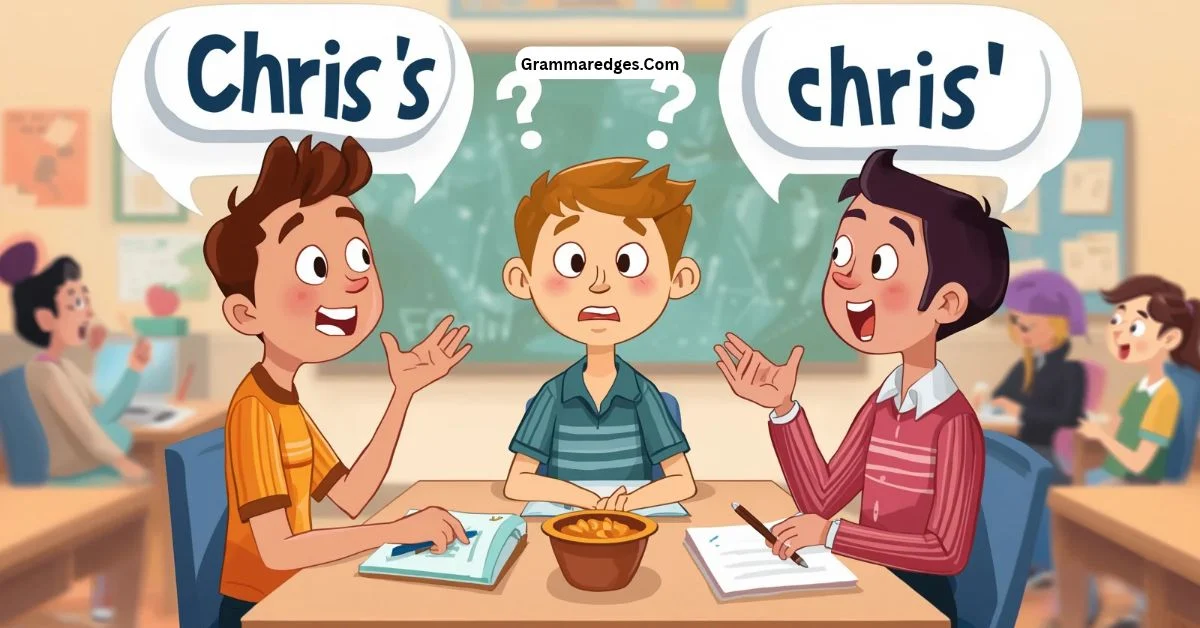
When writing someone’s name, even a simple apostrophe can cause confusion. “Chris’s” or “Chris’” is a common grammar question because both forms appear in books, websites, newspapers, and everyday writing. So, which one is correct?
The answer depends partly on the style guide, variety of English, and writing context you are using. In most modern English writing, “Chris’s” is the standard choice when Chris owns or is connected to something. For example, Chris’s car means the car belongs to Chris.
However, “Chris’” is also used, especially in some traditional style guides and formal publications. Both forms can be understood, but consistency matters.
In this guide, we will explain the difference between Chris’s and Chris’, their history, British and American preferences, common mistakes, and real-life examples. If you are writing an email, school assignment, article, social media post, or professional document, this guide will help you choose the right form.
Chris’s or Chris’ – Quick Answer
Chris’s is generally the preferred possessive form in modern English.
Examples:
- Chris’s phone is on the table.
- I borrowed Chris’s book.
- Chris’s car needs repair.
- We visited Chris’s house yesterday.
Chris’ is also acceptable in some style systems:
- Chris’ phone
- Chris’ book
- Chris’ car
- Chris’ house
Simple Rule
For a singular name ending in s, many modern style guides add ’s:
Chris → Chris’s
Some style guides allow or prefer only an apostrophe:
Chris → Chris’
So, Chris’s is usually the safest general choice, but always follow the style guide required by your school, employer, publisher, or organization.
The Origin of Chris’s or Chris’
The difference comes from the way English forms possessives.
In English, possession is commonly shown by adding an apostrophe and s:
- John → John’s
- Sarah → Sarah’s
- Emma → Emma’s
The question becomes more interesting when a singular name already ends in s.
For centuries, writers have used different conventions for names such as:
- James
- Charles
- Thomas
- Chris
- Lucas
One traditional approach was to add only an apostrophe:
James’ car
Another approach was to add ’s:
James’s car
Both patterns developed through English writing traditions and editorial styles.
Today, many major style systems accept James’s, Chris’s, and similar forms. Some publications and style guides still use the shorter James’ or Chris’.
The key point is that the apostrophe does not simply depend on how the word looks. Style conventions also influence the final form.
British English vs American English Spelling
There is no absolute British-versus-American rule that says British English must use Chris’ and American English must use Chris’s.
Instead, the choice often depends on the specific style guide being followed.
Modern American writing commonly uses Chris’s for a singular name ending in s. British writing also frequently uses Chris’s, although some British publishers and style traditions may use Chris’.
| Variety/Style | Common Form | Example |
|---|---|---|
| Modern American English | Chris’s | Chris’s car |
| Modern British English | Chris’s | Chris’s car |
| Some traditional styles | Chris’ | Chris’ car |
| Informal writing | Either, depending on preference | Chris’s/Chris’ car |
| Academic/professional writing | Follow required style guide | Chris’s or Chris’ |
Important Difference
The distinction is not simply American vs British.
For example:
- American English: Chris’s book
- British English: Chris’s book
- Style-dependent: Chris’ book
If your employer, university, publisher, or client has a specific style guide, follow it.
Which Spelling Should You Use?
If you are writing general English and do not have a required style guide, Chris’s is a clear and widely accepted choice.
For US English
Use:
Chris’s
Example:
Chris’s presentation was excellent.
For UK English
Chris’s is also widely used.
Example:
I met Chris’s brother yesterday.
However, if your publication follows a style guide that prefers Chris’, use that form consistently.
For Commonwealth English
Countries such as Canada, Australia, and New Zealand may follow different editorial preferences. Chris’s is understandable and widely used, but the publication’s house style should take priority.
For Global Online Writing
For websites and general online content, Chris’s is usually the simplest choice.
The most important rule is consistency. Do not write Chris’s in one paragraph and Chris’ in another without a reason.
Common Mistakes with Chris’s or Chris’
Several mistakes appear when people are unsure how possessive names work.
Mistake 1: Writing Chris Without an Apostrophe
Incorrect:
Chris car is outside.
Correct:
Chris’s car is outside.
The apostrophe shows possession.
Mistake 2: Adding an Apostrophe After the Wrong Part
Incorrect:
Chris’s’ car
Correct:
Chris’s car
Only one possessive construction is needed.
Mistake 3: Confusing Possession With a Contraction
Chris’s can sometimes be confusing because ’s can also mean is or has.
For example:
Chris’s working today.
Here, Chris’s means Chris is.
But:
Chris’s laptop is new.
Here, Chris’s shows possession.
Context tells you which meaning is intended.
Mistake 4: Changing the Name
Do not change Chris into an unusual spelling just to form the possessive.
Correct:
Chris’s jacket
Not:
Chriss jacket
Chris’s or Chris’ in Everyday Examples
The possessive form appears in many types of writing.
In Emails
I have attached Chris’s report for your review.
Chris’s meeting has been moved to Friday.
In News Writing
Chris’s statement was released on Monday.
A newspaper may instead use Chris’ if that is its established editorial style.
In Formal Writing
The committee reviewed Chris’s proposal before making its decision.
Chris’s research was included in the final report.
On Social Media
Chris’s new photo looks amazing!
Just saw Chris’s latest post.
Social media is less formal, but standard grammar still makes the meaning clearer.
In The Everyday Conversation
That’s Chris’s bike.
I think this is Chris’s seat.
In each example, the name refers to one person, and the following noun belongs to or is associated with that person.
Chris’s or Chris’ – Comparison Table
| Form | Use | Example | Notes |
|---|---|---|---|
| Chris’s | Singular possessive | Chris’s car | Widely used |
| Chris’ | Singular possessive | Chris’ car | Accepted by some styles |
| Chris | Name only | Chris arrived | Not possessive |
| Chriss | Incorrect name form | Chriss car | Usually incorrect |
| Chris’s’ | Incorrect double apostrophe | Chris’s’ car | Avoid |
Quick Comparison
Chris’s → modern, clear, widely accepted
Chris’ → accepted in some editorial styles
Chris → simply the person’s name
Chriss → not the normal spelling of the name
Chris’s or Chris’ – Google Trends & Usage Data
Search interest for “Chris’s or Chris’” reflects a broader question about possessive names ending in s. People often search this topic when they encounter different forms in books, websites, newspapers, or professional writing.
Usage can vary by country, publisher, academic institution, and style guide. A search-frequency graph alone does not establish that one grammatical form is universally correct.
In practical terms, the important pattern is:
- Chris’s is widely used in contemporary English.
- Chris’ remains common in publications that follow a style preferring the shorter possessive.
- Professional writers should follow their required style guide.
- General writers can use Chris’s consistently when no special house style applies.
Google Trends can show differences in search interest, but it should not be treated as a grammar authority. Editorial style guides and established English usage rules are more useful when deciding which form to write.
FAQs About Chris’s or Chris’
1. Is Chris’s grammatically correct?
Yes. Chris’s is a standard possessive form for the singular name Chris and is widely accepted in modern English.
2. Is Chris’ also correct?
Yes. Chris’ is accepted by some style guides and publications. The choice depends on the style being followed.
3. Should I write Chris’s or Chris’?
If you do not have a specific style requirement, Chris’s is generally a safe and clear choice.
4. Is Chris’s used in British English?
Yes. Chris’s is used in British English. British English does not universally require the shorter Chris’ form.
5. Is Chris’s used in American English?
Yes. Chris’s is widely used in American English for the singular possessive.
6. What is the possessive form of Chris?
The commonly used possessive form is Chris’s. Some editorial styles use Chris’.
7. Does Chris’s always show possession?
No. Depending on context, Chris’s can mean Chris is or Chris has.
For example:
Chris’s happy.
means:
Chris is happy.
But:
Chris’s phone is ringing.
shows possession.
Conclusion: Chris’s or Chris’?
The choice between Chris’s and Chris’ can look confusing, but the basic rule is simple. Chris’s is a widely accepted possessive form for the singular name Chris and is a practical choice for most modern English writing. Chris’ is also used and accepted by some style guides, publishers, and organizations.
The most important factor is consistency. If your school, employer, publisher, or client follows a particular style guide, use its preferred form. Otherwise, Chris’s is a clear choice for everyday, academic, professional, and online writing.
Remember that Chris is the name, while Chris’s or Chris’ can show possession. For example, Chris’s car means the car belongs to Chris. Choosing one form and using it consistently will make your writing clear and professional