
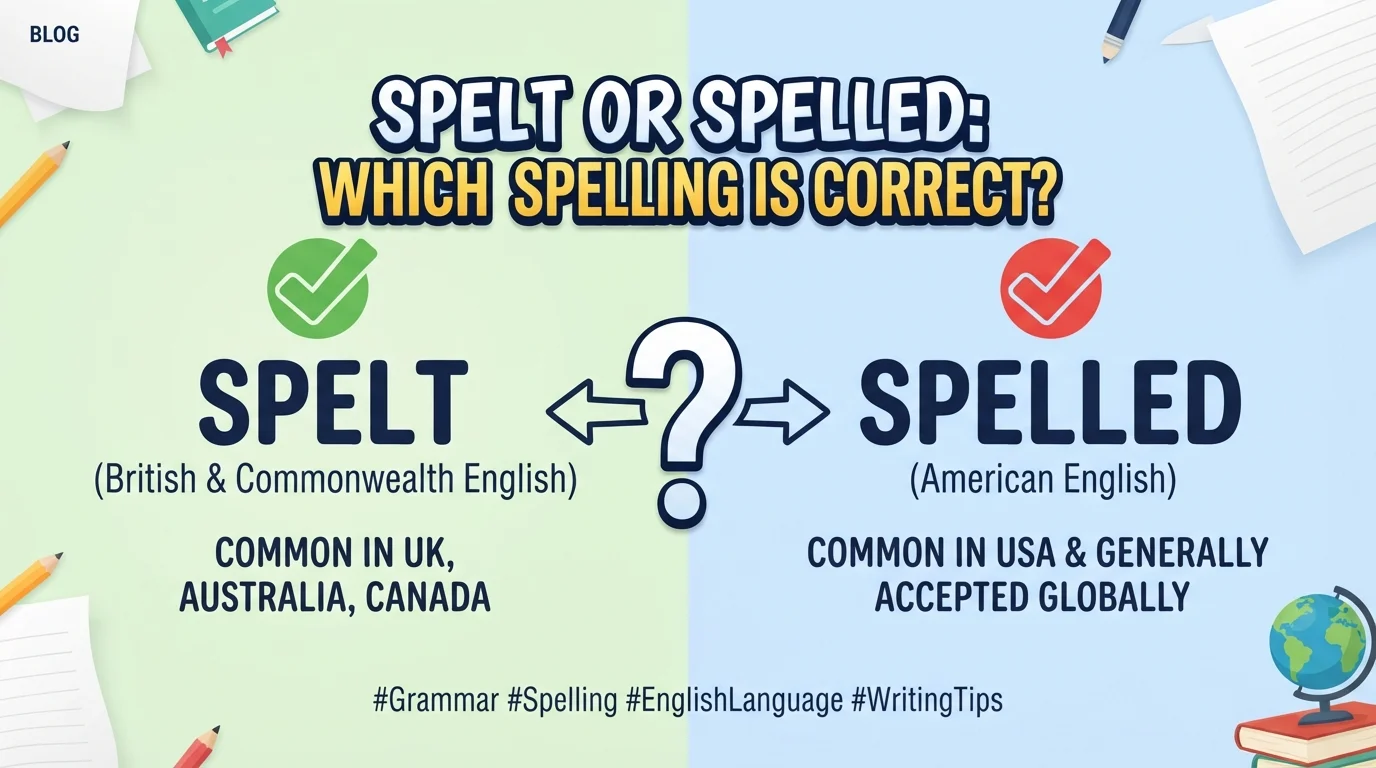
Have you ever wondered whether to write spelt or spelled? Both spellings are correct forms of the verb spell, but their popularity depends on the type of English you use. In American English, spelled is the standard and most common past tense and past participle. In British English, both spelled and spelt are accepted, although spelt is especially common in British and other varieties of English around the world.
Understanding the difference can help you write more clearly in school assignments, professional emails, social media posts, and everyday conversations. Many people search for this comparison because spelling rules can vary between American and British English. Others simply want to know which form sounds natural to native speakers.
In this guide, you will learn the meaning of both words, their grammatical roles, their regional differences, and how to use them correctly in different situations. You will also discover common mistakes, practical examples, and simple tips for choosing the right spelling.
1. Meaning and Definition of Spelt or Spelled
The words spelt and spelled are both forms of the verb spell, which means to name or write the letters of a word in the correct order.
For example, if someone asks you how to spell a word, you might answer, “The word is spelled C-A-T.”
Both forms can describe an action that happened in the past or an action completed before another event. The difference is mainly regional rather than grammatical.
What Does Spelled Mean?
Spelled is the regular past tense and past participle of spell. It is the preferred form in American English and is also widely used in British English.
Examples:
- She spelled my name correctly.
- I spelled the word incorrectly during the test.
- The teacher has spelled out the instructions clearly.
- Your surname is spelled with two Ls.
In each sentence, spelled describes an action involving the letters of a word or the communication of information.
What Does Spelt Mean?
Spelt is an alternative past tense and past participle of spell. It is particularly common in British English, although it also appears in other English-speaking regions.
Examples:
- She spelt my name correctly.
- I spelt the word incorrectly during the test.
- The teacher has spelt out the instructions clearly.
- Your surname is spelt with two Ls.
These sentences have the same meanings as their spelled versions.
Quick Comparison
| Feature | Spelled | Spelt |
|---|---|---|
| Grammatical role | Past tense and past participle | Past tense and past participle |
| American English | Preferred | Less common |
| British English | Correct | Correct and common |
| Meaning | Wrote or named letters correctly | Wrote or named letters correctly |
| Formal writing | Suitable | Suitable, depending on regional style |
Quick answer: Both spellings are correct. Choose spelled for standard American English and either form for British English, following your preferred style consistently.
2. Background and History
The difference between spelt and spelled comes from the way English verbs have developed over time. English has two broad patterns for forming the past tense: regular and irregular.
Regular verbs typically form their past tense by adding -ed. For example:
- Walk → walked
- Talk → talked
- Spell → spelled
Irregular verbs do not always follow this pattern. Their past forms may change in different ways, as seen in go → went and write → wrote.
The verb spell developed both a regular form, spelled, and an alternative form, spelt. These variations became established in different English-speaking communities.
Why Does American English Prefer Spelled?
American English generally favors spelled in everyday and formal writing. This preference follows the regular -ed pattern and is consistent with many other American verb forms.
For instance, an American student would usually write:
“The teacher spelled the difficult word on the board.”
This is the safest choice for schoolwork, business documents, and general publications intended for readers in the United States.
Why Is Spelt Common in British English?
British English retains a wider everyday use of the irregular form spelt. A British writer might naturally write:
“The teacher spelt the difficult word on the board.”
The sentence is grammatically correct and communicates exactly the same information.
However, British English also uses spelled. It would be incorrect to claim that the British form must always be spelt.
Is One Form Older or More Correct?
Neither form is inherently more correct than the other. Both belong to standard English usage.
The important distinction is that language conventions vary across regions and publications. A British newspaper, an American textbook, and an international company may follow different editorial preferences.
When writing for a specific audience, follow the spelling conventions of that audience. If you are preparing content for an American website, spelled is generally the better choice. For a British audience, either form is acceptable, provided you remain consistent.
3. Usage in Different Contexts
Choosing between spelt and spelled depends on your audience, writing purpose, and preferred English variety. Since both words have the same grammatical function, you can generally substitute one for the other without changing the meaning.
Academic Writing
Students should follow the spelling conventions required by their school, university, or examination board.
American English example:
“The student spelled every vocabulary word correctly.”
British English example:
“The student spelt every vocabulary word correctly.”
Both sentences are appropriate. The key is to avoid switching randomly between regional conventions in the same assignment.
Professional Emails
In professional communication, consistency and clarity matter more than choosing one form over the other.
American example:
“Your company name has been spelled incorrectly on the invoice.”
British example:
“Your company name has been spelt incorrectly on the invoice.”
If your company uses an American style guide, choose spelled. If it follows a British style guide, either form may be acceptable.
Books, Newspapers, and Websites
Editors often establish a house style that determines which spelling to use throughout a publication.
For example, a US publication may consistently use spelled, while a UK publication may prefer spelt. International websites should decide which English variety they serve and apply that choice consistently.
Everyday Conversation
Both words are understandable in ordinary conversation.
Examples:
- “How is your last name spelled?”
- “How is your last name spelt?”
- “I spelled it wrong.”
- “I spelt it wrong.”
The first version of each pair is more typical of American English, while the second is common in British usage.
Creative Writing
Authors can select either form to reflect their characters’ backgrounds, maintain a regional voice, or follow a publisher’s requirements.
A British character might naturally say, “I spelt your name wrong.” An American character would more commonly say, “I spelled your name wrong.”
Neither choice changes the essential meaning.
4. Meaning in Chat, WhatsApp, Instagram, and TikTok
In digital communication, spelt and spelled retain their ordinary grammatical meanings. They are not separate internet slang terms and do not carry a special meaning simply because someone uses them in a message.
Their use usually reflects the writer’s regional English, personal habits, or keyboard and autocorrect settings.
In Text Messages and WhatsApp
Someone might send:
“I think you spelled my name wrong.”
Or:
“You spelt my name wrong.”
Both messages mean that the other person wrote the name incorrectly.
The spelling does not automatically indicate the sender’s personality, mood, or level of education. It is simply a regional language preference.
On Instagram
Instagram users may discuss spelling mistakes in comments, captions, and direct messages.
Examples:
- “You spelled that word wrong 😂”
- “I just noticed I spelt your name incorrectly.”
- “Sorry, I spelled it wrong in the caption!”
Emojis can make the message sound playful, apologetic, or humorous, but the words themselves retain the same meaning.
On TikTok
A TikTok creator might use either form in a caption or comment.
For example:
“I finally learned how this word is spelled.”
A British creator might instead write:
“I finally learned how this word is spelt.”
Both are understandable. The platform does not impose a different spelling rule.
Does Spelt Mean Something Different Online?
No. There is no special WhatsApp, Instagram, or TikTok definition of spelt when it is used as the past tense of spell.
One important exception is that spelt can also refer to a type of ancient wheat. Context determines which meaning applies.
For example:
- “I spelt your name correctly.” Here, spelt is a verb.
- “This bread contains spelt.” Here, spelt is a noun referring to a grain.
When reading an online message, use the surrounding sentence to understand the intended meaning.
5. Meaning in Physics, Medical, and Aircraft Terminology
The words spelt and spelled are not standard technical terms in physics, medicine, or aviation. Their ordinary meanings remain the same when they appear in writing about these fields.
However, understanding the context helps prevent confusion with technical abbreviations and specialized vocabulary.
In Physics
Physics uses precise terminology to describe matter, energy, motion, forces, and other scientific concepts. Spelt and spelled may appear in explanations, laboratory reports, or educational materials when discussing how a scientific term is written.
Examples:
- “The researcher spelled the unit name incorrectly.”
- “The equation’s variable was spelt incorrectly in the report.”
Neither form describes a physical property, equation, force, or scientific process.
If you encounter spelt in a physics article, it is most likely the ordinary past tense of spell or, in a different context, a reference to the grain.
In Medical Terminology
Medical professionals use standardized names for diseases, medicines, anatomical structures, and procedures. Correct spelling is important because similar-looking medical terms can have different meanings.
Examples:
- “The patient’s surname was spelled incorrectly in the medical record.”
- “The diagnosis was spelt incorrectly in the original document.”
Both sentences describe a spelling error. Neither spelt nor spelled is itself a medical diagnosis or treatment.
In medical records, follow the organization’s documentation standards and correct errors through the approved process rather than altering official information informally.
In Aircraft and Aviation Terminology
Aviation depends on clear communication, accurate documentation, and standardized terminology. Flight plans, maintenance records, passenger details, and technical manuals must use the correct words and identifiers.
Examples:
- “The aircraft registration was spelled incorrectly on the form.”
- “The maintenance report contained a word that was spelt incorrectly.”
The words describe how text was written; they do not identify aircraft parts, flight maneuvers, or aviation procedures.
In radio communication, pilots and air traffic controllers may use the ICAO phonetic alphabet to communicate letters clearly. For example, the letter B is spoken as “Bravo” and D as “Delta.” This system helps distinguish letters over radio transmissions, especially when pronunciation is unclear.
Important distinction: In all three fields, spelt and spelled are ordinary English verb forms, not specialized technical terms.
6. Common Misconceptions
Several misunderstandings make this spelling choice more confusing than it needs to be.
Misconception 1: Spelt Is Incorrect
This is false. Spelt is a recognized past tense and past participle of spell. It is particularly common in British English.
Correct: “She spelt the word correctly.”
Misconception 2: Spelled Is Only American
This is also incorrect. Although spelled is the preferred form in American English, it is accepted in British English as well.
Correct: “She spelled the word correctly.”
Misconception 3: The Two Forms Have Different Meanings
When used as forms of the verb spell, the two words generally mean the same thing.
“I spelled the word incorrectly” and “I spelt the word incorrectly” both describe a spelling mistake.
However, spelt has an additional meaning as a noun referring to a grain. This separate meaning should not be confused with the verb.
Misconception 4: One Form Is More Professional
Neither form is automatically more professional. The best choice depends on the audience and the relevant style guide.
A British business report can use spelt, while an American business report would normally use spelled.
Misconception 5: You Can Mix Them Freely in Every Document
Although both forms are correct, switching between them without a reason can make writing inconsistent.
For example, using spelled in one paragraph and spelt in the next may distract readers if the document otherwise follows a single regional style.
The simple rule: Choose the spelling that suits your audience, then use it consistently.
7. Similar Terms and Alternatives
Understanding related words can help you communicate more accurately.
Spell
Spell is the base form of the verb. It can describe naming letters, writing a word correctly, or making something clear.
Examples:
- “Can you spell your surname?”
- “Please spell the word aloud.”
- “The report spells out the requirements.”
Spelling
Spelling refers to the way a word is written using letters. It can also describe the activity of learning or checking written words.
Examples:
- “Your spelling is improving.”
- “Check the spelling of the address.”
- “The application includes a spelling test.”
Misspelled
Misspelled is the American English form commonly used to describe a word written incorrectly.
Example: “The name was misspelled on the certificate.”
British English also commonly uses misspelt.
Example: “The name was misspelt on the certificate.”
These forms follow the same general regional pattern as spelled and spelt.
Spell Out
Spell out can mean to say or write each letter separately. It can also mean to explain something clearly and explicitly.
Examples:
- “Please spell out your email address.”
- “The manager spelled out the new rules.”
- “The manager spelt out the new rules.”
Other Related Words
| Word | Meaning | Example |
|---|---|---|
| Spell | Name or write letters in order | Please spell your name. |
| Spelling | The written form of a word | Check the spelling. |
| Spelled | Past tense or past participle | He spelled it correctly. |
| Spelt | Alternative past tense or past participle | He spelt it correctly. |
| Misspelled | Written incorrectly | The word was misspelled. |
| Misspelt | British alternative for misspelled | The word was misspelt. |
These words are related, but they are not interchangeable in every grammatical situation. Select the form that fits the sentence.
8. How to Respond When Someone Uses Spelt or Spelled
If someone uses either spelling in a message, you generally do not need to correct them. Both forms are valid, and the writer may simply be following their regional conventions.
However, if the context involves a genuine spelling mistake, you can respond politely and clearly.
If Someone Spells Your Name Incorrectly
You could say:
- “Just a quick correction: my name is spelled with one L.”
- “Thanks! My surname is spelt with an E.”
- “No worries. It’s spelled differently than you might expect.”
Choose the version that matches your preferred English variety and the tone of the conversation.
If Someone Asks Which Form Is Correct
A helpful answer is:
“Both are correct. Spelled is more common in American English, while spelt is especially common in British English.”
This explanation provides the essential distinction without suggesting that either form is wrong.
If Someone Corrects Your Spelling
You can acknowledge the correction without becoming defensive.
Examples:
- “Thanks for pointing that out!”
- “You’re right. I’ll correct it.”
- “Thanks! I was using the British spelling, but I understand your point.”
The last response is useful when someone assumes that spelt is incorrect simply because they are accustomed to American English.
If You Are Editing Someone Else’s Work
Follow the requested style guide rather than automatically replacing every instance of spelt with spelled.
For an American publication, standardize the text to spelled. For a British publication, retain the author’s preferred form if it fits the publication’s style.
The goal is to make the writing consistent, not to label a legitimate regional spelling as an error.
9. Differences From Similar Words
The main difference between spelt and spelled is regional preference, but other related forms can cause confusion.
Spelt vs. Spelled
These are alternative past tense and past participle forms of the verb spell.
- American English: “I spelled the word correctly.”
- British English: “I spelt the word correctly.”
Both sentences are correct.
Spelt vs. Spelled in the Present Perfect
Both forms can follow have, has, or had.
- “I have spelled the word correctly.”
- “I have spelt the word correctly.”
The choice still depends on regional preference and editorial style.
Spelled vs. Spelling
These words have different grammatical functions.
Spelled describes a completed action, while spelling can describe the process or the written form of a word.
- Correct: “She spelled the word.”
- Correct: “Her spelling is excellent.”
- Incorrect in standard usage: “She spelling the word yesterday.”
The last sentence needs a different verb structure, such as “She was spelling the word yesterday.”
Spelt as a Verb vs. Spelt as a Noun
The meaning changes according to context.
- Verb: “I spelt your name incorrectly.”
- Noun: “Spelt is an ancient type of wheat.”
The first describes writing letters in the wrong order. The second refers to a grain used in some foods.
A Simple Way to Remember
If you write primarily for American readers, use spelled,if you write for British readers, either spelt or spelled can work.
If you are unsure, check the style guide for your school, workplace, or publication. Consistency is more important than trying to prove that one valid form is universally correct.
10. Relevance in Online Conversations and Dating Apps
Spelling choices can appear in dating profiles, private messages, comments, and casual online conversations. However, spelt and spelled do not have special romantic or dating-related meanings.
A person who writes “I spelled your name wrong” is communicating the same thing as someone who writes “I spelt your name wrong.”
In Dating App Messages
Imagine someone writes:
“Sorry, I spelt your name incorrectly earlier!”
This is simply an apology for a spelling mistake. The choice of spelt may reflect British English or another variety that commonly uses the form.
A natural response could be:
“No problem! It happens 😊”
There is no need to interpret the spelling as flirting, sarcasm, or a hidden message.
In Dating Profiles
Someone might write:
“I love books, good conversation, and people who can spell.”
Here, spell refers to writing words correctly. The sentence has no connection to supernatural spells or any special dating-app convention.
If someone writes spelt in a profile, it may provide a small clue about their English preferences, but it is not enough to establish where they live or what their background is.
In Comments and Group Chats
People sometimes correct spelling errors in public comments. A correction may be helpful, playful, or unnecessarily critical depending on the tone.
For example:
- “It’s spelled with two Ls.”
- “In British English, spelt is fine too.”
- “Both forms are correct, so it depends on the variety of English.”
These responses focus on the language rather than attacking the person who made the mistake.
Does Spelling Affect Online Impressions?
Clear writing can make messages easier to understand, particularly in professional or formal settings. However, using spelt instead of spelled is not inherently a mistake.
When communicating online, consider the audience and the purpose of the message. For an American job application, spelled is the safer choice. In a casual conversation with a British friend, either form is natural.
Ultimately, successful communication depends on clarity, context, and respect—not on assuming that every regional spelling difference represents an error.
Conclusion
Choosing between spelt and spelled is simple once you understand their regional differences. Both words are correct past tense and past participle forms of the verb spell, and both describe the same action. The main distinction is that spelled is the standard preference in American English, while spelt is especially common in British English. British writers can also use spelled, so neither form should be treated as universally incorrect.
For school assignments, professional documents, websites, and online conversations, consider your intended audience and follow the appropriate style guide. If you write for American readers, spelled is usually the safest option. If you write for British readers, you can choose either form and remain consistent.
Remember that neither spelling has a special meaning in WhatsApp messages, social media posts, dating apps, physics, medicine, or aviation. Context determines how the word is being used. Once you recognize this simple difference, you can write confidently and avoid unnecessary corrections.