
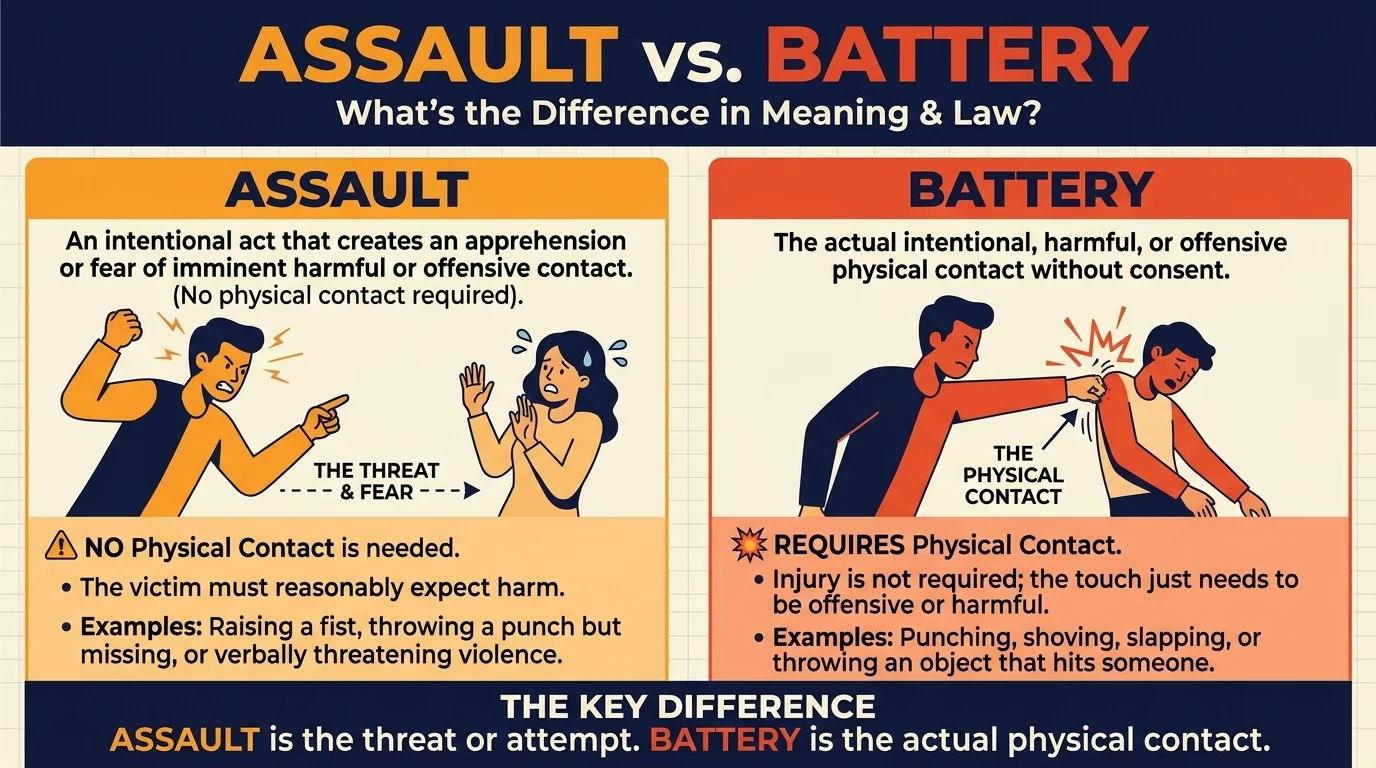
The terms assault vs battery are often used together, especially when discussing criminal law, personal safety, and physical violence. Although many people believe these words mean the same thing, they have different legal meanings.
Assault generally involves threatening or attempting to cause physical harm, while battery usually refers to intentional and unlawful physical contact with another person. Understanding the difference can help you interpret legal discussions, news reports, workplace policies, and everyday conversations more accurately.
People frequently search for these terms because they want to understand what happens when someone threatens another person, makes unwanted physical contact, or becomes involved in a physical confrontation.
The distinction is also important because legal definitions and penalties can vary depending on the jurisdiction. In this guide, we will explain their meanings, background, everyday usage, common misconceptions, and differences in simple English so you can understand when and how to use each term correctly.
1. Assault vs Battery: Meaning and Definition
Although assault and battery are closely related legal terms, they generally describe two different types of behavior. One involves creating an immediate fear of physical harm, while the other involves actual physical contact.
What Does Assault Mean?
Assault generally refers to an intentional act that causes another person to reasonably fear imminent harmful or offensive physical contact. In some jurisdictions, assault also includes an attempted physical attack.
For example:
- Someone raises a fist and threatens to punch another person.
- A person moves toward someone aggressively while threatening immediate violence.
- Someone attempts to hit another person but misses.
In these situations, the threatened or attempted harm may qualify as assault, depending on the applicable law.
An important point is that simply saying something unpleasant does not automatically constitute assault. The circumstances, intention, immediacy of the threat, and reasonable perception of danger can all matter.
What Does Battery Mean?
Battery generally means intentionally causing harmful or offensive physical contact with another person without legal justification or consent.
Examples include:
- Punching someone during an argument.
- Slapping another person without permission.
- Intentionally pushing someone.
- Throwing an object that makes unwanted physical contact with another person.
Physical injury is not always necessary for battery. In some jurisdictions, even unwanted physical contact can be sufficient.
Quick Comparison
| Assault | Battery |
|---|---|
| Often involves a threat or attempted attack | Generally involves physical contact |
| May create fear of immediate harm | Involves harmful or offensive touching |
| Physical contact is not always necessary | Physical contact is generally necessary |
| Can happen without an injury | An injury is not always required |
Simple explanation: Assault generally concerns the threat or attempt to cause harm, while battery concerns the actual unwanted physical contact.
However, these definitions are not universal. Some legal systems combine the offenses or define them differently.
2. Background and History of Assault and Battery
The legal concepts of assault and battery have developed over centuries. Their roots can be traced to English common law, which influenced the legal systems of several countries, including the United States.
Historically, societies needed rules to protect individuals from violence, threats, and unwanted physical interference. Without legal protections, people could face intimidation or physical attacks without an established way to seek justice.
English common law gradually developed separate concepts to address different forms of personal harm.
Historical Development of Assault
Assault became associated with conduct that created an immediate threat of unlawful physical contact. The purpose was to protect individuals before an actual physical attack occurred.
For example, someone threatening another person with an immediate physical attack could potentially face legal consequences even if no contact happened.
This concept helped recognize that threatening behavior could be serious even without visible injuries.
Historical Development of Battery
Battery developed as a legal concept addressing unlawful physical contact.
It provided protection against intentional physical interference, including actions that caused injury or involved offensive touching.
For instance, deliberately striking someone could be treated as battery even when the injury was relatively minor.
How the Terms Are Used Today
Modern legal systems have developed their own definitions of assault and battery.
In the United States, some states recognize assault and battery as separate offenses, while others use the term assault to cover conduct involving both threats and physical contact.
In England and Wales, common assault and battery are generally treated as separate but closely related offenses.
Other countries may use different terminology, including assault, physical assault, bodily harm, or unlawful violence.
Understanding this background explains why the two words are sometimes used differently in legal documents, news reports, and everyday conversations.
3. Usage in Different Contexts: Chat, Social Media, and Professional Fields
Assault and battery are primarily legal terms, but they also appear in everyday discussions, workplace communication, journalism, and online conversations.
Their meaning depends on the situation in which they are used.
In Everyday Conversations
People sometimes use assault and battery interchangeably when describing a physical confrontation.
For example:
- “He was charged with assault after threatening someone.”
- “The police investigated the incident as a possible battery.”
- “The argument eventually turned into a physical attack.”
Although these sentences are understandable, using the correct legal term makes communication more accurate.
In Professional Fields
These words have specific importance in several professional environments.
1. Legal profession
Lawyers use assault and battery when discussing criminal charges, civil claims, evidence, and personal injury disputes.
2. Healthcare
Medical professionals may document injuries resulting from suspected physical violence. They generally describe the actual medical findings rather than determine whether a legal offense occurred.
3. Journalism
News reporters use these terms when explaining criminal investigations, court proceedings, and incidents involving physical violence.
4. Workplace management
Human resource departments may investigate threats, physical confrontations, harassment, and violations of workplace safety policies.
On Social Media
On platforms such as Facebook, Instagram, and TikTok, users may discuss assault and battery when sharing news stories, personal experiences, or legal information.
For example:
- “What is the difference between assault and battery?”
- “He was arrested following an alleged assault.”
- “The video shows an incident involving possible physical violence.”
Online discussions can sometimes use these terms incorrectly. Therefore, readers should avoid assuming that a social media description represents an established legal finding.
4. Meaning in Chat, WhatsApp, Instagram, and TikTok
Unlike internet slang, assault and battery do not have special or hidden meanings on messaging and social media platforms.
Their ordinary legal meanings generally remain the same when people use them in digital conversations.
However, the context can influence how someone understands these words.
Assault Meaning in Chat
In online conversations, assault usually refers to threatening behavior, an attempted attack, or a reported incident involving violence.
Examples:
- “He threatened to hit me. Is that assault?”
- “I saw a news report about an assault case.”
- “That behavior sounds threatening.”
Sometimes people use the word casually to describe aggressive behavior, but a legal assault requires more than simply being rude or unpleasant.
Battery Meaning on WhatsApp
On WhatsApp, battery may appear in discussions about physical attacks, legal complaints, or news reports.
Examples:
- “The police are investigating a battery complaint.”
- “Can unwanted physical contact count as battery?”
- “I need to understand the difference before speaking to a lawyer.”
Battery does not refer to a phone battery or charging problem when used in this legal context.
Assault and Battery on Instagram
Instagram users may encounter these terms in educational posts, news updates, legal awareness content, and discussions about personal safety.
For example, a caption might explain that threatening someone and physically striking someone can involve different legal issues.
Assault and Battery on TikTok
TikTok creators may use these words in short educational videos explaining criminal law or discussing real-life incidents.
However, short videos may oversimplify legal definitions. A person’s description of an incident does not automatically establish that a crime occurred.
Remember: Neither assault nor battery is a recognized texting abbreviation or special social media code. Both retain their ordinary meanings unless someone is using them figuratively.
5. Meaning in Physics, Medical, and Aircraft Terminology
Assault and battery are not standard technical terms in physics or aircraft engineering. Their primary meanings are associated with law and personal safety.
However, the word battery has several independent meanings in technical and scientific fields.
Battery in Physics
In physics and electrical engineering, a battery is a device that stores chemical energy and converts it into electrical energy.
Examples include:
- Lithium-ion batteries.
- Alkaline batteries.
- Rechargeable batteries.
- Lead-acid batteries.
These devices provide electrical power to phones, vehicles, computers, and other equipment.
This meaning has no connection to the legal offense of battery.
Assault in Physics
Assault is not a recognized standard physics concept. However, the word may appear in discussions about physical impacts or violent interactions.
For example, someone might describe an aggressive collision as an assault on an object metaphorically, but this is not a formal scientific definition.
Medical Context
In medicine, assault may describe an incident involving suspected intentional violence.
Healthcare professionals may examine patients for injuries such as:
- Bruises.
- Cuts.
- Fractures.
- Swelling.
- Head injuries.
- Soft-tissue damage.
Battery may appear in legal or administrative documentation concerning unwanted physical contact.
However, medical professionals document clinical observations and patient statements rather than independently establish criminal liability.
Aircraft Terminology
Neither assault nor battery is a standard aircraft component or aviation engineering term.
The word battery, however, is commonly used in aviation to describe electrical power systems that support aircraft operations.
Aircraft batteries can help power essential electrical equipment, start engines or auxiliary power units, and provide backup electrical energy.
Therefore, context is important when interpreting the word battery. It can describe an electrical device or a legal offense, depending on the subject being discussed.
6. Common Misconceptions About Assault vs Battery
People frequently misunderstand these terms because they are often mentioned together in legal discussions and news reports.
Here are some common misconceptions.
Misconception 1: Assault and Battery Mean Exactly the Same Thing
This is not always correct. Traditionally, assault concerns an immediate threat or attempted attack, while battery involves actual harmful or offensive physical contact.
However, some jurisdictions combine these concepts under one offense.
Misconception 2: Assault Always Requires Physical Contact
Physical contact is not necessarily required for assault. A qualifying threat or attempted attack may be enough under the relevant legal definition.
Misconception 3: Battery Always Causes an Injury
Battery does not always require a visible injury. Unwanted physical contact may be sufficient under certain legal systems.
Misconception 4: Verbal Arguments Automatically Count as Assault
Not every argument, insult, or angry statement qualifies as assault.
The legal assessment may depend on whether the conduct created a reasonable fear of imminent harmful or offensive contact or satisfied another applicable legal definition.
Misconception 5: Battery Only Happens During Serious Fights
Battery is not limited to severe physical attacks. Depending on the jurisdiction, relatively minor intentional physical contact can also qualify.
Misconception 6: The Same Definitions Apply Everywhere
Legal definitions vary between countries and even between states within the United States.
For this reason, anyone dealing with an actual legal matter should check the law applicable to their location.
7. Similar Terms and Alternatives
Several legal and everyday words are closely related to assault and battery. However, they do not always have identical meanings.
| Term | Meaning |
|---|---|
| Physical assault | An attack or attempted attack involving physical violence |
| Threat | A statement or action expressing an intention to cause harm |
| Harassment | Unwanted conduct that may intimidate, distress, or disturb someone |
| Abuse | Harmful treatment that may be physical, emotional, or psychological |
| Battery | Unlawful harmful or offensive physical contact |
| Self-defense | Legally recognized protection against certain threats or attacks |
| Bodily harm | Physical injury or damage to the body |
| Aggravated assault | A more serious form of assault involving legally specified aggravating circumstances |
Assault vs Abuse
Assault generally describes a particular type of threatening or attacking conduct. Abuse is broader and can involve repeated physical, emotional, psychological, or other harmful behavior.
Assault vs Harassment
Harassment involves unwanted behavior that may cause distress or intimidation. Assault generally requires additional legal elements involving threatened or attempted physical harm.
Battery vs Physical Abuse
Battery usually concerns unlawful physical contact. Physical abuse can describe a broader pattern of harmful treatment.
Choosing the right term helps people explain incidents more clearly and avoid confusion in legal and professional communication.
8. How to Respond to Assault or Battery
Knowing how to respond to a threatening situation or unwanted physical contact is important for personal safety.
The appropriate response depends on the seriousness of the incident and whether anyone is in immediate danger.
If Someone Threatens You
If someone threatens to physically harm you:
- Stay calm and avoid escalating the confrontation.
- Create distance between yourself and the threatening person.
- Move toward a safe or public location.
- Contact emergency services if you believe an attack is imminent.
- Save relevant messages or evidence if it is safe to do so.
- Report serious threats to the appropriate authorities.
If Someone Physically Attacks You
If unwanted physical contact or an attack occurs:
- Move away from the person if possible.
- Seek medical attention if you are injured.
- Contact the police or appropriate authorities when necessary.
- Photograph visible injuries when safe and appropriate.
- Keep relevant messages, witness details, and other available evidence.
- Consider speaking with a qualified legal professional.
How to Respond in Online Conversations
If someone discusses an assault or battery incident on social media, respond carefully and respectfully.
For example:
- “I’m sorry this happened. Are you safe?”
- “You may want to contact the appropriate authorities.”
- “Consider getting legal advice before making decisions.”
- “Your safety should come first.”
Avoid making accusations or sharing private information without reliable evidence.
9. Differences From Similar Words
Understanding the differences between related legal terms makes it easier to use them correctly.
Assault vs Battery
Assault generally involves a qualifying threat or attempted attack, while battery involves intentional harmful or offensive physical contact.
Assault vs Aggravated Assault
Simple assault is generally a less serious offense. Aggravated assault involves additional circumstances that make the conduct more serious under the applicable law, such as certain weapons, serious injury, or protected victims.
Battery vs Domestic Violence
Battery describes certain unlawful physical contact. Domestic violence refers to abuse or violence occurring within particular family, household, or intimate relationships. The two concepts can overlap.
Battery vs Self-Defense
Battery may involve unlawful physical contact, while self-defense can provide a legal justification for using reasonable force in circumstances recognized by law.
Whether self-defense applies depends on the facts and relevant legal rules.
Assault vs Attempted Murder
Assault does not automatically mean attempted murder. Attempted murder generally requires proof of a specific intent to kill and other legal elements.
These distinctions matter because the terms can involve different charges, legal consequences, and standards of proof.
10. Relevance in Online Conversations and Dating Apps
Assault and battery are important topics in online conversations, particularly when people discuss relationships, boundaries, consent, and personal safety.
Dating apps allow individuals to communicate with strangers, which makes understanding respectful behavior and personal boundaries especially important.
Discussing Personal Boundaries
People may use these terms when explaining that unwanted physical contact or threatening behavior is unacceptable.
For example:
- “I believe personal boundaries should always be respected.”
- “Threatening physical violence is not acceptable.”
- “Consent matters in every relationship.”
Dating App Conversations
On dating platforms, users may discuss assault and battery when talking about safety, previous experiences, or relationship expectations.
A person might explain that they do not tolerate aggressive behavior or unwanted touching.
These conversations should be handled with respect and without pressuring anyone to share personal experiences.
Recognizing Warning Signs
Some behaviors that deserve attention include:
- Threatening physical harm.
- Ignoring clearly communicated boundaries.
- Using physical force during disagreements.
- Attempting to intimidate or control another person.
- Continuing unwanted physical contact after someone objects.
Not every uncomfortable interaction meets the legal definition of assault or battery. Nevertheless, people have the right to establish personal boundaries and seek help when they feel unsafe.
Why Understanding These Terms Matters Online
Accurate language helps users explain experiences, understand legal discussions, and avoid spreading misleading information.
It also encourages more responsible conversations about consent, violence, and personal safety.
Conclusion
Understanding assault vs battery is important because these terms describe different types of conduct under many legal systems. Assault generally involves creating a reasonable fear of imminent physical harm or attempting an attack, while battery usually involves intentional and unlawful harmful or offensive physical contact.
However, their exact definitions can vary depending on the country or state. Neither term should be used carelessly when discussing real incidents, legal cases, or personal experiences. Knowing the difference helps people communicate more accurately, recognize inappropriate behavior, and understand legal discussions.
If you encounter these words in news reports, professional documents, social media posts, or everyday conversations, remember that context matters. If you face an actual threat or physical attack, prioritize your safety and seek appropriate professional assistance.