
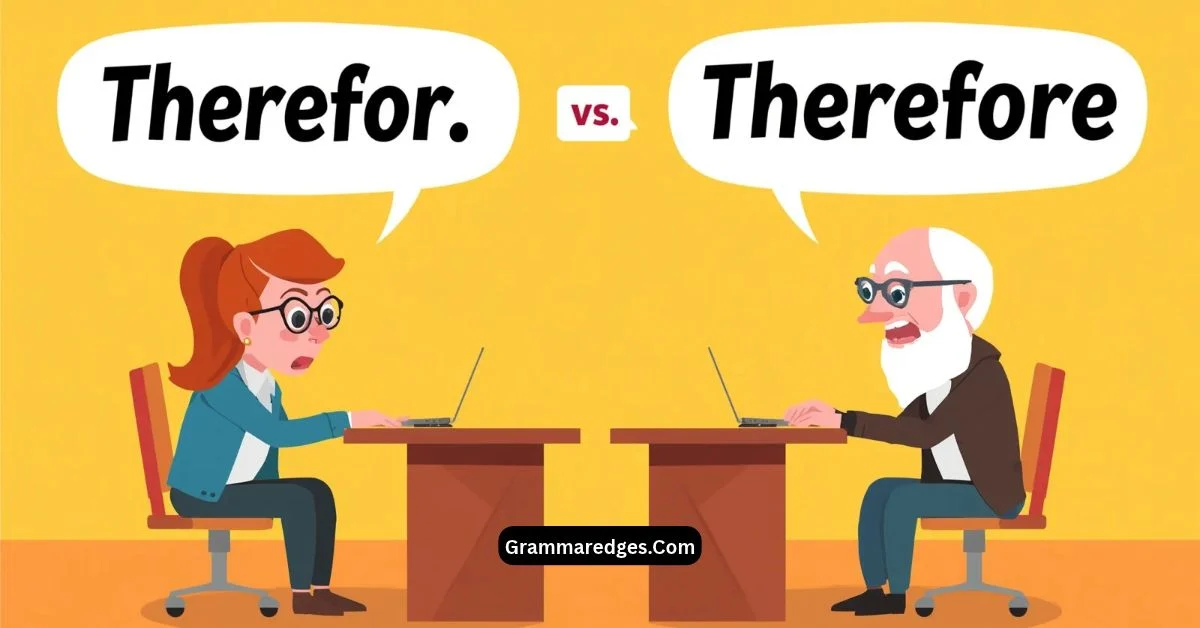
Choosing between “therefor” and “therefore” can be confusing because the two words look almost identical. Yet, they do not have the same meaning or use.
If you have ever stopped while writing an email, essay, report, or social media post and wondered whether therefor or therefore is correct, you are not alone. The extra e changes more than the spelling—it changes the word’s function.
The good news is simple: therefore is the word you will normally need. It means “for that reason,” “as a result,” or “consequently.” For example, “It was raining; therefore, we stayed home.”
Therefor is a much less common word. It is mainly found in legal and formal writing, where it means “for that” or “in return for that.”
This guide explains the difference between therefor or therefore, their history, common mistakes, British and American usage, and real-life examples. By the end, you will know exactly which spelling to choose.
Therefor or Therefore – Quick Answer
The correct word for most everyday writing is therefore.
Therefore means for that reason, because of that, or as a result.
The store was closed; therefore, we went home.
She studied hard. Therefore, she passed the exam.
Therefor is a different word. It means “for that” and is rarely used outside legal or very formal language.
The company received payment therefor.
In modern everyday English, you will almost always want therefore, not therefor.
Quick comparison
| Word | Meaning | Common use |
|---|---|---|
| Therefore | For that reason; as a result | Everyday and formal English |
| Therefor | For that; in return for that | Mainly legal/formal writing |
Easy memory trick
Think:
There + fore = therefore = for that reason
If you are saying “as a result,” use therefore.
The Origin of Therefor and Therefore
Both therefor and therefore come from older forms of English built around the word there.
The word therefore combines there with fore, an old word related to “before” or “in front.” Over time, therefore developed the meaning “for that reason” or “because of that.”
For example:
He was tired; therefore, he went to bed.
The word therefor has a different historical function. It combines there with for and originally meant something close to “for that.”
It still appears in some legal language:
Payment was made therefor.
This means payment was made for that thing or service.
The two words became easy to confuse because they look almost the same. The difference is only one letter, but the meanings are distinct.
Why does “therefor” look incomplete?
Modern readers may expect therefor to be a shortened version of therefore. It is not simply a spelling mistake, though.
Therefor is a real English word. It has its own meaning and grammatical use.
The problem is that it is uncommon in modern everyday English. That makes it easy to mistake for a typo.
British English vs American English Spelling
There is no major British-versus-American spelling difference between these two words.
Both British English and American English use:
- therefore for “as a result”
- therefor mainly in specialized legal or formal contexts
So you should not choose therefor simply because you are writing for a British audience or therefore because you are writing for an American audience.
Comparison table
| Feature | British English | American English |
|---|---|---|
| Correct common form | Therefore | Therefore |
| Meaning | For that reason | For that reason |
| Legal word | Therefor | Therefor |
| Common everyday use | Therefore | Therefore |
| Spelling difference | None | None |
Examples
British English:
The train was delayed; therefore, I arrived late.
American English:
The train was delayed; therefore, I arrived late.
The spelling stays the same.
The important difference is meaning, not regional spelling.
Which Spelling Should You Use?
For almost all general writing, choose therefore.
If you write everyday English
Use therefore when you mean:
- as a result
- consequently
- for that reason
- because of that
Example:
The weather was bad; therefore, the game was canceled.
If you write academic papers
Therefore is common in academic writing because it helps show a logical result.
The sample size was small; therefore, the results should be interpreted carefully.
If you write business emails
Use therefore when explaining a conclusion or action.
The deadline has changed. Therefore, we need to update the schedule.
If you write legal documents
You may encounter therefor, but do not replace therefore with it.
Therefor is appropriate only when its specific meaning fits the sentence.
For global English
If your readers come from different countries, therefore is the safest choice when you mean “as a result.”
It is widely understood and commonly used.
Common Mistakes with Therefor or Therefore
The most common mistake is using therefor when you mean therefore.
Mistake 1: Using “therefor” to mean “as a result”
❌ The road was closed; therefor, we took another route.
✅ The road was closed; therefore, we took another route.
The second sentence is correct because the writer means “as a result.”
Mistake 2: Thinking “therefor” is a shorter spelling
❌ Therefor is simply a shortened form of therefore.
✅ Therefor is a separate word with a different meaning.
Mistake 3: Adding an extra word
Sometimes writers use phrases such as:
The project was late, and therefore because of this, the team apologized.
This is unnecessarily complicated.
Better:
The project was late; therefore, the team apologized.
Mistake 4: Using “therefore” when “therefor” is required
This is less common, but it can happen in legal writing.
If a sentence means “for that,” then therefor may be correct.
The buyer paid the agreed amount therefor.
Here, therefor does not mean “as a result.”
Therefor or Therefore – Side-by-Side Comparison
| Variation | Correct? | Meaning | Example |
|---|---|---|---|
| Therefore | ✅ | As a result | It rained; therefore, we stayed inside. |
| Therefor | ✅ | For that | Payment was made therefor. |
| There fore | ❌ | Not standard | Avoid this form. |
| Therefore in place of therefor | ❌ | Wrong meaning in legal context | Check the intended meaning. |
| Therefor in place of therefore | ❌ | Wrong meaning in normal writing | Use therefore. |
The key is to remember that both spellings can be correct, but they are not interchangeable.
Therefor or Therefore in Everyday Examples
1. In emails
Correct:
The meeting has been moved to Friday. Therefore, please update your calendar.
Incorrect:
The meeting has been moved to Friday. Therefor, please update your calendar.
When you mean “as a result,” use therefore.
2. In news writing
Heavy rain caused flooding. Therefore, several roads were closed.
News writers often use therefore to connect a cause with its result.
3. On social media
I forgot my umbrella, therefore I got soaked! ☔
A more natural casual version might be:
I forgot my umbrella, so I got soaked! ☔
This shows an important point: therefore is correct, but so may sound more natural in casual conversation.
4. In academic writing
The evidence was limited; therefore, further research is needed.
This is a common formal use.
5. In business writing
Sales increased this quarter; therefore, the company will expand the project.
6. In legal writing
The parties agreed to the terms and received consideration therefor.
Here, therefor has its specialized meaning of “for that.”
Therefor or Therefore – Google Trends & Usage Data
Searches for “therefor or therefore” usually come from people who recognize that the two spellings look similar but are unsure which one fits their sentence.
The broader usage pattern is clear: therefore is vastly more common in general English, while therefor remains uncommon and is strongly associated with legal or specialized language.
This difference matters for writers.
If you are writing:
- blog posts
- emails
- school assignments
- essays
- reports
- news articles
- social media posts
- general business content
you will normally need therefore.
If you are reading a contract, court document, deed, or other legal text, you may encounter therefor.
Search interest can also vary by country because English learners and writers in different regions often search spelling questions differently. However, the basic rule does not change between British and American English.
Usage context
| Context | More likely word |
|---|---|
| Everyday conversation | Therefore |
| School writing | Therefore |
| Academic writing | Therefore |
| Business emails | Therefore |
| News | Therefore |
| Social media | Therefore |
| Legal documents | Therefor may appear |
| General websites | Therefore |
So, if you are looking for the word to use in normal English, therefore is overwhelmingly the safer choice.
FAQs About Therefor or Therefore
1. Is “therefor” a correct word?
Yes. Therefor is a real English word, but it is uncommon. It generally means “for that” and is most often seen in legal or formal writing.
2. Is “therefore” always correct?
No. Therefore is correct when you mean “as a result” or “for that reason.” It should not automatically replace therefor in specialized legal language.
3. What is the difference between therefor and therefore?
Therefore means “as a result” or “for that reason.” Therefor means “for that.”
4. Should I use therefore in an essay?
Yes. Therefore is perfectly suitable for essays, academic writing, and formal English when you are showing a result or conclusion.
The evidence was strong; therefore, the conclusion was supported.
5. Is there a British spelling of therefore?
No. British and American English both spell the word therefore.
6. Is therefor a typo?
Not always. Therefor is a legitimate word. However, if someone writes it when they mean “as a result,” it is a spelling or word-choice error.
7. What is an easy way to remember therefore?
Remember this:
Therefore = for that reason = as a result.
If you can replace the word with “as a result,” choose therefore.
Conclusion: Therefor or Therefore?
The difference between therefor and therefore is small in spelling but important in meaning. Therefore is the word you will need in most situations. It means “as a result,” “for that reason,” or “consequently.”
For example:
The store was closed; therefore, we went home.
Therefor is also a correct English word, but it has a much narrower use. It generally means “for that” and is most often found in legal or highly formal writing.
There is no special British or American spelling rule that changes these words. Both varieties of English use therefore in normal writing.
So, when writing an email, essay, article, report, or social media post, remember the simple rule: if you mean “as a result,” use therefore. Save therefor for situations where its specific meaning “for that” is intended.
Conclusion:
Still wondering about therefor or therefore? The answer is simple: use therefore when you mean “as a result” or “for that reason.” For example, “It was raining; therefore, we stayed home.” Therefor is a real word, but it is rare and mainly appears in legal or formal writing, where it means “for that.”
Remembering this small difference can prevent common writing mistakes and make your English clearer.
Whether you are writing an email, essay, blog, or professional document, therefore is usually the right choice. Choose the word that matches your meaning, and your writing will sound more natural and confident.