
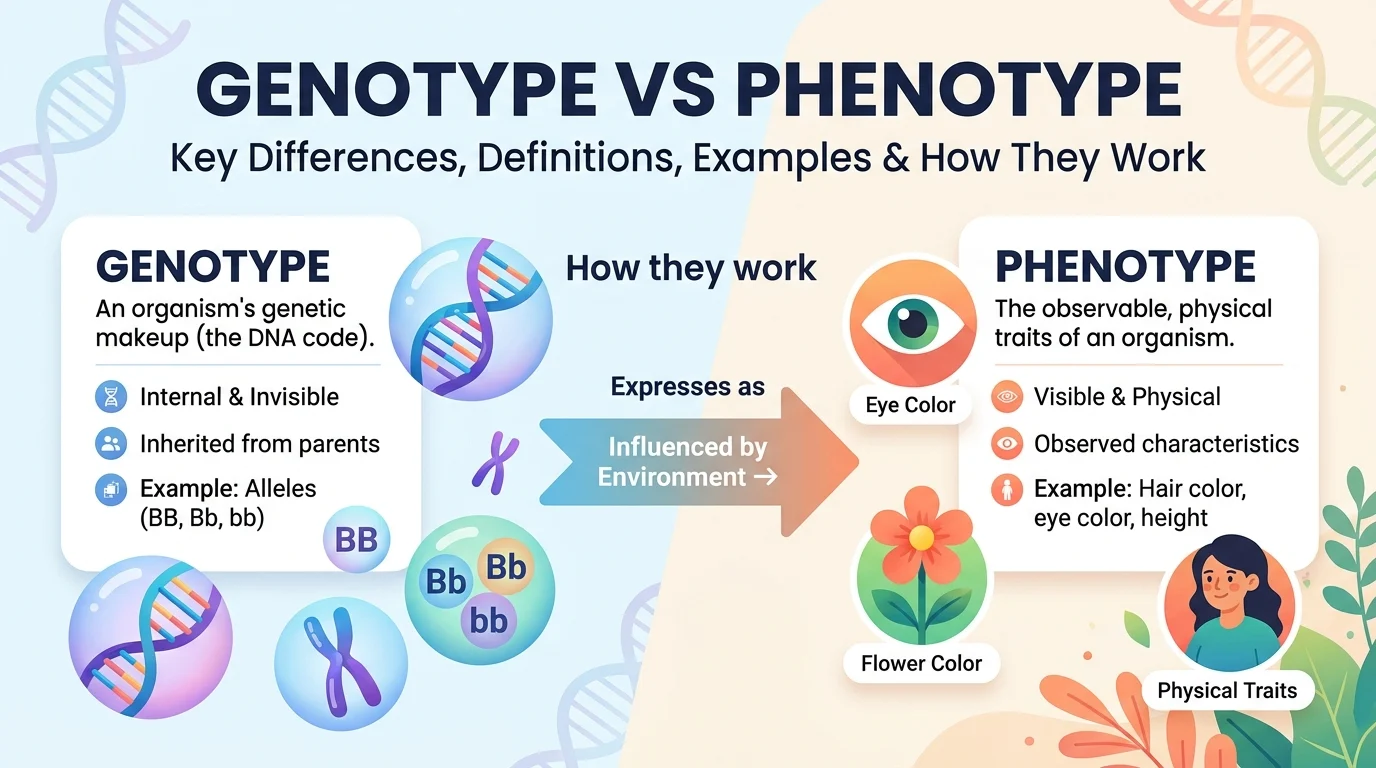
Genotype vs phenotype is an important topic in genetics that helps explain how inherited information influences the characteristics of living organisms. Although these two terms are closely related, they describe different aspects of biology. A genotype refers to the genetic information an organism inherits from its parents, while a phenotype describes the observable characteristics that develop from that genetic information and environmental influences.
People often search for the difference between genotype and phenotype because these concepts appear in biology classes, medical research, genetic testing, and scientific discussions. Understanding them makes it easier to explain why family members can share certain traits but still look different. It also helps explain how characteristics such as eye color, blood type, height, and hair texture develop.
In this article, we will explore their definitions, backgrounds, practical applications, common misconceptions, and key differences using simple explanations and relatable examples.
1. Meaning and Definition of Genotype vs Phenotype
Genotype and phenotype are two fundamental concepts in genetics. They help scientists understand the relationship between an organism’s inherited DNA and its physical or measurable characteristics.
What Is Genotype?
A genotype refers to the genetic makeup of an organism. It describes the specific versions of genes, known as alleles, that an individual carries.
An organism receives genetic information from its biological parents. These inherited instructions influence how its body develops and functions.
For example, a person may inherit genetic variations associated with brown eyes or blue eyes. The particular combination of inherited alleles contributes to their genetic makeup.
Genotypes are commonly represented using letters in basic genetics lessons:
- BB: Two dominant alleles.
- Bb: One dominant and one recessive allele.
- bb: Two recessive alleles.
These examples represent a simplified model of inheritance involving one gene and two alleles.
What Is Phenotype?
A phenotype refers to the observable or measurable characteristics of an organism. These characteristics develop through interactions between genetic information and environmental conditions.
Examples include:
- Eye color
- Hair texture
- Height
- Skin pigmentation
- Blood type
- Certain inherited conditions
- Plant height and flower color
Not every phenotype is directly visible. Some characteristics, such as blood type or enzyme activity, require laboratory testing to identify.
The Main Difference
The simplest way to understand the distinction is:
- Genotype = The genetic instructions an organism carries.
- Phenotype = The characteristics those instructions help produce.
For example, a plant may carry genes associated with tall growth. However, limited sunlight, poor soil, or insufficient water can affect how tall it actually becomes.
Therefore, genotype provides inherited biological information, while phenotype represents the resulting characteristics.
2. Background and History of Genotype and Phenotype
The concepts of genotype and phenotype developed as scientists began exploring how characteristics pass from one generation to another.
Before modern genetics, people noticed that children often shared physical features with their parents. However, the biological mechanisms behind inheritance were not fully understood.
Early Genetic Research
One of the most important contributors to genetics was Gregor Mendel. During the nineteenth century, he conducted experiments with pea plants to understand how inherited characteristics behave across generations.
His experiments examined traits such as:
- Plant height
- Seed color
- Seed shape
- Flower color
- Pod appearance
Mendel discovered predictable inheritance patterns and developed principles that later became central to classical genetics.
Development of Genetic Terminology
In 1909, Danish scientist Wilhelm Johannsen introduced the terms genotype and phenotype.
He used these terms to distinguish between an organism’s inherited genetic constitution and its observable characteristics.
This distinction became especially important because scientists realized that inherited information does not always produce identical visible results.
Modern Understanding
Scientific developments in DNA research, molecular biology, and genomics expanded our understanding of these concepts.
Today, researchers study how genes interact with one another and how environmental conditions influence biological development.
Modern genetics also examines:
- DNA mutations
- Gene expression
- Inherited diseases
- Genetic variation
- Environmental influences
- Complex inherited characteristics
The historical development of these terms established an important foundation for understanding how organisms inherit, express, and develop their characteristics.
3. Usage in Different Contexts: Education, Science, and Professional Fields
Genotype and phenotype are widely used in different areas of science and education. Although their meanings remain consistent, their applications can vary depending on the subject.
In Biology Classes
Students learn these terms when studying inheritance, DNA, chromosomes, and genetic variation.
Teachers often use simple letter combinations to demonstrate how alleles influence inherited traits.
For example, a classroom exercise might show how two parents carrying a particular allele can pass different combinations to their children.
In Medical Research
Medical researchers use genetic information to investigate inherited conditions and understand why certain individuals have different health risks.
Genotype information can help researchers identify genetic variations associated with specific diseases.
Phenotype information helps them understand how those variations appear in an individual.
In Agriculture
Farmers and agricultural scientists use genetic principles to develop crops with desirable characteristics.
For example, researchers may select plants with genetic variations associated with:
- Higher productivity
- Disease resistance
- Drought tolerance
- Improved fruit quality
- Better growth characteristics
However, the final characteristics also depend on growing conditions.
In Animal Breeding
Animal breeders may examine inherited characteristics when selecting animals for specific purposes.
They might study genetic information related to coat color, body size, milk production, or disease resistance.
In Scientific Research
Scientists compare genotypes and phenotypes to investigate how genes influence biological processes.
This research can help explain why individuals with similar genetic backgrounds sometimes develop different characteristics.
In all these fields, understanding both concepts provides a more complete picture of inheritance and biological development.
4. Meaning in Chat, WhatsApp, Instagram, and TikTok
Unlike popular internet slang, genotype and phenotype are established scientific terms. They do not have separate official meanings on WhatsApp, Instagram, TikTok, or other social platforms.
However, people sometimes use these words in educational posts, jokes, memes, and casual conversations.
Genotype in Online Conversations
When someone mentions genotype in a message, they are generally referring to inherited genetic information.
For example:
- “Your genotype determines some of your inherited traits.”
- “We studied genotype in biology today.”
- “Do you know your blood genotype?”
In some countries, particularly in conversations about sickle cell inheritance, people may use genotype to refer specifically to blood-related genetic status.
Phenotype on Social Media
Phenotype may appear in posts discussing physical appearance, genetics, and inherited characteristics.
Examples include:
- “Your phenotype reflects your genetic background and environment.”
- “Height is an example of a measurable phenotype.”
- “Two people can have similar genotypes but different phenotypes.”
WhatsApp and Dating Conversations
People may discuss genotype when talking about genetic compatibility, especially before marriage or family planning.
For example:
“Have you checked your genotype?”
This question may refer to screening for inherited blood disorders, particularly sickle cell disease.
On Instagram and TikTok, these terms may also appear in educational videos explaining genetics through simple examples.
Important: Neither term has a special romantic, emotional, or hidden meaning in ordinary online communication. Their interpretation depends on the surrounding conversation.
5. Meaning in Physics, Medical, and Aircraft Terminology
Genotype and phenotype belong primarily to genetics and biology. They are not standard technical terms in physics or aviation. However, understanding where they apply helps prevent confusion.
Genotype and Phenotype in Physics
Physics studies matter, energy, motion, forces, and natural phenomena.
Genotype and phenotype are not standard physics concepts because they describe genetic information and biological characteristics.
However, genetics and physics sometimes overlap in interdisciplinary research.
For example, biophysics uses physical principles to study biological systems, including DNA structure, molecular interactions, and cellular processes.
In such research, genetic information may be examined alongside physical measurements.
Genotype and Phenotype in Medicine
These concepts have important medical applications.
Genotype in medicine:
Doctors and genetic specialists may examine a patient’s genetic information to identify inherited variations.
Examples include:
- Sickle cell-related genetic variations
- Certain inherited metabolic conditions
- Genetic variations associated with disease risk
- Some inherited blood disorders
Phenotype in medicine:
Medical professionals examine a patient’s observable or measurable characteristics.
These may include symptoms, physical findings, laboratory results, and other clinical features.
For example, a person may carry a genetic variation associated with a particular condition without showing the expected symptoms.
Genotype and Phenotype in Aircraft Terminology
In aviation, genotype and phenotype are not standard terms used to describe aircraft systems, flight operations, or aircraft classifications.
Aircraft terminology generally includes concepts such as:
- Aerodynamics
- Aircraft configuration
- Engine performance
- Flight characteristics
- Structural design
- Navigation systems
Although biological genetics has no direct role in ordinary aircraft terminology, researchers may use genetic concepts when studying living organisms in aviation-related environmental research.
The important distinction is that genotype and phenotype are biological concepts rather than standard physics or aircraft vocabulary.
6. Common Misconceptions About Genotype vs Phenotype
People sometimes misunderstand these terms because both relate to inherited characteristics. However, several important differences should be clear.
Misconception 1: Genotype and Phenotype Mean the Same Thing
This is incorrect.
Genotype refers to genetic information, while phenotype refers to observable or measurable characteristics.
They are connected but not interchangeable.
Misconception 2: Every Phenotype Is Completely Determined by Genes
Genes play an important role in many characteristics, but environmental factors can also influence development.
For example, nutrition, physical activity, and health conditions can affect a person’s height and body composition.
Misconception 3: Similar Genotypes Always Produce Identical Phenotypes
Not necessarily.
Even individuals with identical or very similar genetic information may develop different characteristics because of environmental influences, gene regulation, and developmental differences.
Identical twins provide a useful example.
Misconception 4: Phenotype Only Means Physical Appearance
Phenotype includes much more than visible features.
It can also include physiological, biochemical, and behavioral characteristics that can be measured or observed.
Misconception 5: A Genetic Test Explains Everything About a Person
Genetic testing provides useful information, but it does not predict every aspect of an individual’s future health or development.
Many characteristics are influenced by multiple genes and environmental conditions.
Understanding these misconceptions helps people interpret genetic information more accurately.
7. Similar Terms and Alternatives
Several scientific terms are closely related to genotype and phenotype. Learning their meanings makes genetics easier to understand.
| Term | Meaning |
|---|---|
| Gene | A section of DNA that contributes to biological functions or characteristics. |
| Allele | An alternative version of a gene. |
| DNA | The molecule that stores genetic information. |
| Genome | The complete set of an organism’s genetic material. |
| Heredity | The transmission of characteristics from parents to offspring. |
| Genetic variation | Differences in DNA sequences among individuals. |
| Trait | A particular characteristic of an organism. |
| Gene expression | The process through which information in a gene is used by a cell. |
Genotype vs Gene
A gene is a specific DNA sequence, whereas genotype describes the genetic makeup of an organism or the alleles it carries at particular genetic locations.
Genotype vs Genome
A genome refers to an organism’s complete genetic material. Genotype usually describes its genetic constitution, often in relation to particular genes or traits.
Phenotype vs Trait
A trait is a particular characteristic, while phenotype describes the collection or pattern of observable and measurable characteristics.
Phenotype vs Appearance
Appearance is part of phenotype, but phenotype is broader. It includes characteristics that cannot necessarily be identified just by looking at someone.
These related terms are useful when studying inheritance, genetic testing, and biological variation.
8. How to Respond When Someone Mentions Genotype or Phenotype
Your response should depend on the context in which someone uses these scientific terms.
If someone mentions genotype or phenotype in a classroom, professional discussion, or online conversation, you can respond with a simple explanation or ask a relevant question.
If Someone Asks About Genotype
You could say:
- “Genotype refers to the genetic information inherited from your parents.”
- “It describes the alleles an individual carries.”
- “Are you talking about a particular inherited condition?”
If Someone Asks About Phenotype
Possible responses include:
- “Phenotype describes observable or measurable characteristics.”
- “It includes traits influenced by genes and the environment.”
- “Physical appearance is one example of phenotype.”
If Someone Uses Both Terms Together
A helpful response could be:
“Genotype is the genetic makeup, while phenotype is how genetic information is expressed through observable or measurable characteristics.”
In Medical Conversations
If someone asks about genotype testing, avoid making assumptions about their health or genetic status.
Instead, you can suggest discussing the results with a qualified healthcare professional or genetic counselor.
This is especially important when interpreting inherited blood conditions because the results can have implications for family planning.
A clear, respectful explanation is usually the best response in both casual and professional conversations.
9. Differences Between Genotype and Phenotype
The easiest way to understand these concepts is to compare their main features.
| Comparison | Genotype | Phenotype |
|---|---|---|
| Definition | Genetic makeup | Observable characteristics |
| Main focus | Inherited DNA information | Expressed characteristics |
| Determined by | Genetic inheritance | Genes and environmental influences |
| Identification | Genetic analysis | Observation and measurement |
| Examples | BB, Bb, or bb | Height, eye color, or blood type |
| Environmental influence | DNA sequence is generally inherited, though mutations can occur | Often influenced by environmental conditions |
| Scientific importance | Explains inherited genetic variation | Shows how characteristics develop and appear |
Example: Plant Height
Imagine two plants carrying genetic variations associated with tall growth.
Both may have similar genotypes, but one grows in nutrient-rich soil while the other grows in poor conditions.
The first plant may become taller because it receives better growing conditions.
Their genetic information may be similar, but their resulting phenotypes can differ.
Example: Human Characteristics
Two individuals may inherit similar genetic variations associated with a particular characteristic.
However, differences in nutrition, development, and environmental exposure may influence how that characteristic appears.
This demonstrates why genotype and phenotype must be studied together.
10. Relevance in Online Conversations and Dating Apps
Although genotype and phenotype are scientific terms, they can become relevant in personal conversations, especially when people discuss health, family history, physical appearance, or marriage.
Genotype in Dating Conversations
In some communities, particularly where inherited blood disorders are a concern, people may discuss genotype before entering a serious relationship.
For example, two individuals may want to understand their sickle cell-related genetic status before making long-term family-planning decisions.
Common genotype labels in this context include:
- AA
- AS
- SS
- AC
- SC
These labels represent particular hemoglobin genotypes. They should not be confused with the simplified BB, Bb, and bb examples used in introductory Mendelian genetics.
People should obtain appropriate medical testing and professional guidance rather than relying on assumptions or informal conversations.
Phenotype in Dating Conversations
Phenotype may appear when people discuss inherited physical features, such as:
- Eye color
- Hair texture
- Height
- Facial characteristics
- Skin pigmentation
Someone might say that a child has inherited a parent’s physical features. This is an everyday way of discussing phenotype.
Why These Terms Matter
Understanding the difference helps people avoid confusing physical appearance with genetic information.
Someone’s appearance cannot reliably reveal their complete genotype. Similarly, two people who look alike do not necessarily have identical genetic information.
In dating and marriage discussions, genetic information should be treated respectfully and privately.
These concepts are useful because they encourage informed conversations about heredity, health, and family planning without making unfair judgments about another person.
Conclusion
Understanding genotype vs phenotype makes it easier to see how inherited genetic information influences the characteristics of living organisms.
Genotype describes the genetic makeup an individual carries, while phenotype refers to the observable and measurable characteristics that develop through interactions between genes and environmental conditions. Although these concepts are closely connected, they are not interchangeable.
From biology classrooms and medical research to agriculture and genetic counseling, both play an important role in explaining inheritance and biological variation. Remember that genotype provides the genetic instructions, while phenotype shows how those instructions are expressed.
Learning this distinction helps students, researchers, and everyday readers understand genetics more clearly and recognize why individuals can share inherited characteristics without always looking or developing exactly alike.