
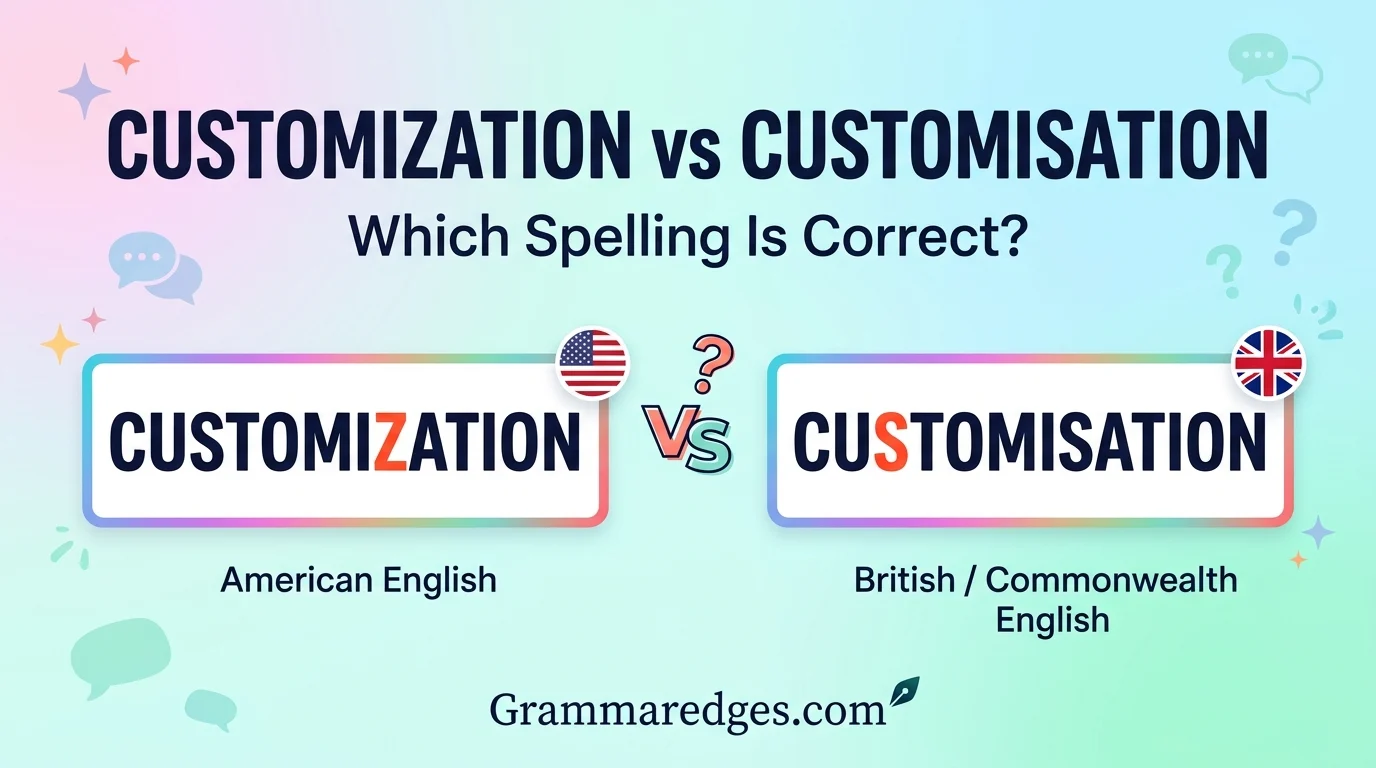
Have you ever wondered whether to write customization or customisation? Both spellings are correct, but the difference depends mainly on the variety of English you use. American English typically uses “customization,” while British English generally prefers “customisation.” Although the two words look different, they share the same meaning: the process of changing or adapting something to suit a person’s needs, preferences, or requirements.
People often search for this spelling comparison when writing blog posts, business emails, academic assignments, website content, or professional documents. Choosing the appropriate version helps maintain consistency and makes your writing feel natural to your intended audience.
In this guide from Grammaredges, we will explore the meaning, origin, regional differences, and practical uses of both spellings. You will also learn how these words appear in technology, social media, business communication, and everyday conversations. By the end, you will know which spelling to choose and how to use it confidently in different situations.
1. Grammar, Meaning, and Definition
The words “customization” and “customisation” are nouns derived from the verb “customize” or “customise.” Both describe the act of modifying something to meet individual preferences, specific needs, or particular requirements.
The main difference is spelling rather than meaning. American English uses -ization, whereas British English commonly uses -isation.
What Does Customization Mean?
Customization refers to making changes to a product, service, application, or experience so that it better suits a particular person or purpose.
Examples include:
- Personalizing the appearance of a smartphone.
- Changing the settings of a computer application.
- Adjusting a website’s layout to match a company’s brand.
- Choosing personalized features for a new car.
- Modifying a service to meet a customer’s needs.
Example sentence: The software allows extensive customization of its dashboard.
This spelling is standard in American English and is widely used by American businesses, software companies, and technology publications.
What Does Customisation Mean?
Customisation has exactly the same meaning as customization. It is the preferred spelling in British English and is commonly used in the United Kingdom and many other English-speaking regions that follow British spelling conventions.
Examples include:
- Customisation of online shopping experiences.
- Customisation of business software.
- Customisation of clothing and accessories.
- Customisation of customer service packages.
- Customisation of educational materials.
Example sentence: The company offers several customisation options for its products.
This version is appropriate for British English writing and publications that follow British spelling conventions.
Quick Comparison
| Feature | Customization | Customisation |
|---|---|---|
| Meaning | Personalizing or modifying something | Personalizing or modifying something |
| English variety | American English | British English |
| Common ending | -ization | -isation |
| Grammar | Noun | Noun |
| Example | Software customization | Software customisation |
Grammar tip: Both words are nouns. Their corresponding verbs are “customize” and “customise,” while the adjective “customizable” is commonly spelled “customisable” in British English.
2. Background and Origin
The spelling difference between customization and customisation reflects the historical development of American and British English. Over time, the two varieties developed different preferences for certain word endings, punctuation conventions, and spellings.
Both words ultimately relate to “custom,” which refers to an established practice, tradition, or individual preference. The verb forms “customize” and “customise” developed from the idea of adapting something to particular requirements.
Why Does American English Use Z?
American English commonly uses “-ize” in words such as customize, organize, recognize, and personalize. This convention is well established in American dictionaries and editorial style guides.
As a result, American writers generally use “customization” when describing personalization in products, services, or technology.
For example:
- The application supports advanced customization.
- Product customization improves the shopping experience.
- Users can customize their account settings.
Why Does British English Often Use S?
British English traditionally uses “-ise” in many words, including customise, organise, recognise, and personalise. Consequently, “customisation” is a familiar spelling in British publications and business documents.
For example:
- The application supports advanced customisation.
- Product customisation improves the shopping experience.
- Users can customise their account settings.
However, British English does not universally require the S spelling. Some British dictionaries and publishers accept or prefer “-ize” spellings, particularly in words with Greek-derived “-ize” endings. Therefore, “customization” can also be correct in British English, depending on the chosen style guide.
How the Spellings Became Different
The differences between American and British spelling developed through centuries of language change, dictionary standardization, publishing practices, and regional preferences.
American spelling conventions became more distinct through the influence of American lexicographers and educational publishing. British spelling conventions retained other traditional forms and developed their own editorial preferences.
Neither spelling is inherently more correct or more professional. The best choice depends on your audience, location, and preferred style guide.
3. Usage in Different Contexts
Both spellings are used in many industries, including technology, marketing, education, retail, manufacturing, and professional services. Their meanings remain the same across these fields, although the preferred spelling changes according to regional English conventions.
In Everyday Communication
People use these terms when discussing changes made to suit personal preferences.
Examples:
- I love the customization options on my phone.
- The customisation feature makes the product more useful.
- This application offers plenty of customization choices.
- The website provides extensive customisation options.
The appropriate version depends on whether the writer follows American or British spelling.
In Business and Professional Writing
Businesses frequently use these words when describing tailored products, personalized services, or configurable solutions.
Examples:
- Our platform provides flexible customization options for business users.
- The company offers website customisation for small businesses.
- Customer customization is available for selected products.
- Customisation services can be arranged before delivery.
American companies generally favor “customization,” while British companies commonly use “customisation.” International companies should follow their established editorial guidelines.
In Marketing and E-Commerce
Online stores often describe customization features that let customers select colors, materials, sizes, designs, or other product details.
For example:
- Product customization helps shoppers create personalized gifts.
- Customisation options allow customers to choose their preferred design.
- The store offers customization for selected accessories.
In Technology and Software
Customization is especially common in software, websites, mobile applications, and digital platforms. Users can modify themes, menus, notifications, layouts, and account settings.
Example: “The software supports customization of dashboards and user permissions.”
A British publication may write the same sentence using “customisation.”
In Academic Writing
Students and researchers should choose the spelling that matches their institution’s preferred English variety. Consistency matters more than choosing one version over the other.
For example, a paper written in American English should generally use “customization,” while a paper following a British university’s style guide may use “customisation.”
4. Meaning in Chat, WhatsApp, Instagram, and TikTok
In digital communication, customization and customisation refer to changing the appearance, settings, or features of an application, profile, device, or online experience.
The meaning does not change when the words appear on social media. The difference remains a regional spelling preference.
Customization in Chat
In messaging conversations, people may use the term when discussing personalized settings, themes, notifications, or chat backgrounds.
Examples:
- “I like the customization options in this app.”
- “Can you help me with chat customization?”
- “The new update gives us more ways to customize our messages.”
On WhatsApp
Customization can refer to changing chat wallpapers, notification preferences, themes where supported, and other available settings.
Examples:
- “WhatsApp customization makes my chats feel more personal.”
- “I changed my chat wallpaper through the available settings.”
- “I wish this app offered more customization options.”
WhatsApp features vary by device and app version, so not every personalization option is available to every user.
On Instagram
Customization can involve editing profile details, choosing profile themes or visual styles where available, organizing content, and adjusting account settings.
Examples:
- “My Instagram customization matches my personal brand.”
- “I spent time customizing my profile.”
- “Profile customisation helps creators maintain a consistent look.”
On TikTok
Customization may refer to personalizing profile details, editing videos, choosing available effects, adjusting preferences, and selecting content settings.
Examples:
- “TikTok customization makes my videos feel unique.”
- “I customized my profile to match my content.”
- “The editing tools offer several customization options.”
Which Spelling Should You Use Online?
Choose “customization” if you are writing primarily for American readers. Choose “customisation” if your audience expects British English.
In casual chats, either version will usually be understood. However, when writing website content, captions for a business account, or professional social media posts, maintaining consistent spelling gives your communication a more polished appearance.
5. Meaning in Physics, Medical, and Aircraft Terminology
Neither customization nor customisation has a special, universally recognized technical meaning in physics, medicine, or aviation. In these fields, both words retain their general meaning of adapting something to specific needs. The actual technical meaning depends on the object being modified.
Customization in Physics
In physics, customization may describe adapting an experimental setup, simulation, instrument, or measurement system for a particular investigation.
Examples include:
- Customization of a laboratory apparatus for an experiment.
- Customization of simulation parameters to model a specific physical system.
- Customization of measurement equipment for specialized research.
For instance, a researcher might customize an experimental apparatus to measure a particular range of temperatures.
The word itself is not a specific physical law, mathematical quantity, or scientific unit.
Customization in Medicine
In medical settings, customization can describe adapting care, treatment planning, medical equipment, or digital health systems to an individual’s requirements.
Examples include:
- Customization of a rehabilitation program.
- Customization of a medical device to suit a patient’s needs.
- Customization of treatment planning based on individual clinical circumstances.
The term should not be confused with a particular medical procedure or diagnosis. Medical decisions require appropriate clinical assessment and professional judgment.
Customization in Aircraft and Aviation
In aviation, customization may refer to modifying an aircraft’s interior, seating arrangement, control interfaces, entertainment systems, or other approved features.
Examples include:
- Customization of aircraft cabin interiors.
- Customization of passenger seating configurations.
- Customization of flight-training simulator interfaces.
- Customization of aircraft maintenance software.
Aircraft modifications must comply with applicable safety requirements, certification rules, and manufacturer specifications.
Does the Spelling Change the Technical Meaning?
No. “Customization” and “customisation” communicate the same general concept in these fields. American-oriented technical documents often use the Z spelling, while British-oriented documents may use the S spelling.
When writing technical material, follow the organization’s terminology standards and avoid implying that the word describes a specific technical process unless the context establishes that meaning.
6. Common Misconceptions
Several misconceptions surround these two spellings. Understanding the facts can help you avoid unnecessary corrections and communicate more clearly.
Misconception 1: Customisation Is Incorrect
Fact: Customisation is a valid spelling in British English and other writing traditions that use the “-ise” form.
It is not a spelling mistake simply because an American dictionary or website prefers “customization.”
Misconception 2: Customization Is Always American Only
Fact: Customization is the standard American form, but it is also accepted by some British dictionaries and publishers.
The distinction is a useful regional guideline rather than an absolute rule that applies to every publication.
Misconception 3: The Two Words Have Different Meanings
Fact: Both words mean adapting or modifying something to meet specific requirements.
For example, “website customization” and “website customisation” describe the same activity.
Misconception 4: One Spelling Is More Professional
Fact: Neither spelling is automatically more professional. Correct usage depends on the audience and the style guide being followed.
A consistent article using British English is just as professional as a consistent article using American English.
Misconception 5: Customization and Personalization Are Always Identical
Fact: The terms overlap, but they can carry slightly different meanings.
Customization often emphasizes changes selected or configured by the user. Personalization can also refer to adapting an experience to an individual’s preferences, behavior, or needs, sometimes automatically.
For example, changing a website’s theme is customization, while a website recommending products based on previous activity may be described as personalization.
Misconception 6: Search Engines Require Only One Spelling
Fact: Both spellings can communicate the same search intent. Writers should focus on serving their audience, using clear language, and maintaining consistent regional spelling rather than repeating both versions unnaturally.
7. Similar Terms and Alternatives
Several words are related to customization and customisation. Although they share similar meanings, they are not always interchangeable.
| Word | Meaning | Example |
|---|---|---|
| Personalization | Adapting something to an individual’s preferences | The website offers personalized recommendations. |
| Modification | Changing or altering something | The device requires a minor modification. |
| Adaptation | Adjusting something for a different purpose or situation | The team made an adaptation for mobile users. |
| Configuration | Arranging settings or components | The application supports advanced configuration. |
| Tailoring | Adjusting something to specific requirements | The company offers tailored services. |
| Individualization | Treating or designing something for individual needs | The program supports individualization of learning activities. |
| Optimization | Improving something for a particular goal | The developer focused on website optimization. |
Customization vs. Personalization
Customization commonly involves choices made directly by the user. Personalization may involve user-selected preferences or automatic adjustments based on information about the individual.
Example:
- Customization: A user selects a dark theme.
- Personalization: A platform recommends content based on the user’s interests.
These distinctions depend on context, and the terms sometimes overlap.
Customization vs. Modification

Modification is a broader term for changing something. Customization usually implies that the changes are made to meet a particular user’s preferences or requirements.
For example, repairing a broken component is a modification, but adapting a product’s features for a specific customer is customization.
Customization vs. Configuration
Configuration usually refers to arranging settings or components within an existing system. Customization may involve a wider range of changes, including alterations to appearance, features, or functionality.
For example, adjusting notification settings is configuration, while adding a specialized feature to an application may be customization.
8. How to Respond When Someone Uses Either Word
If someone uses customization or customisation in a conversation, you usually do not need to correct them. Both spellings are understandable, and the intended meaning is generally clear.
Your response should depend on the context of the conversation.
When Someone Discusses Software
You could respond:
- “Which customization options does the software offer?”
- “Can you show me how to customise the settings?”
- “That feature sounds useful. Is it available in the latest version?”
When Someone Discusses Products
You could say:
- “What customization options are available?”
- “Can I customise the product before ordering?”
- “Does the price include these changes?”
When Someone Asks Which Spelling Is Correct
A clear response would be:
“Both spellings are correct. Customization is commonly used in American English, while customisation is generally preferred in British English. They have the same meaning.”
When Editing Professional Content
If you are reviewing a document, first identify its intended audience or style guide. Then make spelling consistent throughout the text.
For example, if a company’s website uses American English, retain “customization,” “personalization,” and “organization” where appropriate. If it follows a British style that uses S spellings, use “customisation,” “personalisation,” and “organisation.”
The goal is not to correct every regional variation. It is to ensure that the chosen spelling fits the document’s established language conventions.
9. Differences From Similar Words
Understanding the difference between customization and related words makes it easier to select the most accurate term.
Customize vs. Customization
“Customize” is a verb, while “customization” is a noun.
- Verb: You can customize your account settings.
- Noun: Account customization is available.
In British English, these become “customise” and “customisation” when following the S-spelling convention.
Customizable vs. Customized
“Customizable” describes something that can be customized. “Customized” describes something that has already been changed to meet particular requirements.
Examples:
- This is a customizable website template.
- The customer received a customized product.
The common British equivalents are “customisable” and “customised.”
Customization vs. Custom-Made
Customization describes the process of adapting or changing something. Custom-made generally describes an item created specifically for a customer or purpose.
For example, adjusting the color of an existing product is customization. Creating a new suit based on an individual’s measurements is an example of custom-made production.
Customization vs. Personalization
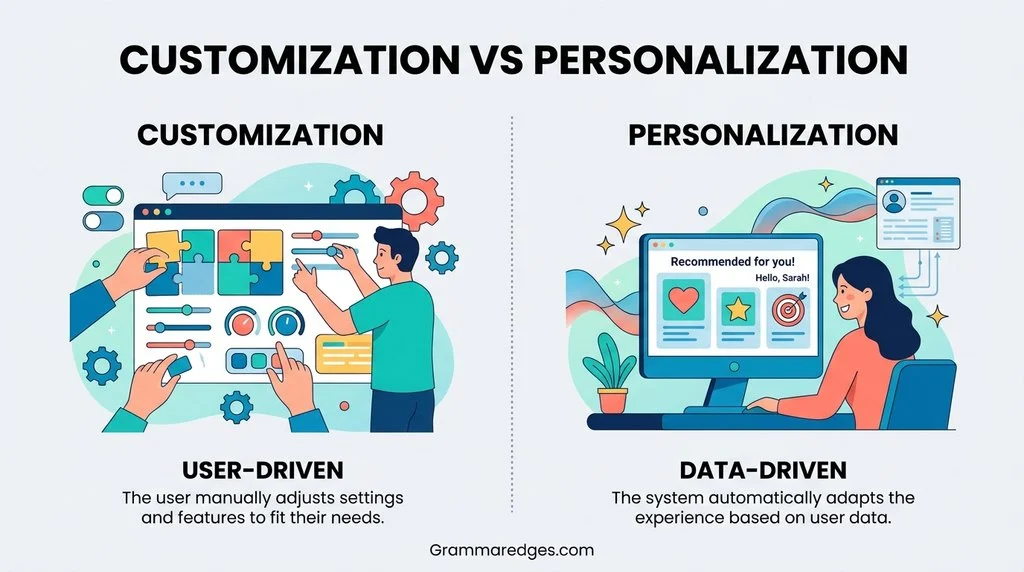
Customization generally highlights user-controlled changes, while personalization focuses on making an experience suitable for an individual. However, both terms may be used for the same feature, depending on the industry.
How to Choose the Right Word
Ask yourself three questions:
- Am I describing an action or a thing? Use “customize” for the action and “customization” for the process or concept.
- Am I following American or British spelling conventions? Choose the corresponding spelling.
- Does the word describe user-selected changes, automatic adaptation, or a broader alteration? Consider “customization,” “personalization,” or “modification” accordingly.
These simple checks help you write more accurately without making the wording unnecessarily complicated.
10. Relevance in Online Conversations and Dating Apps
Customization is increasingly relevant to digital experiences because users often want applications to reflect their personal preferences. Dating platforms, social networks, shopping websites, and communication tools may offer settings that let users adjust their experience.
Customization on Dating Apps
On dating apps, customization can refer to selecting profile details, setting preferences, choosing photographs, adjusting privacy settings, and controlling certain discovery features.
For example:
- “I like the customization options on this dating app.”
- “I customized my profile to reflect my interests.”
- “The app lets users adjust their discovery preferences.”
These examples describe app features rather than a special meaning of the word in dating.
Does Customization Have a Romantic Meaning?
No. The words customization and customisation do not have an established romantic or flirtatious meaning by themselves.
If someone says, “I customized my profile,” they are usually describing changes to their profile. The surrounding conversation may reveal additional intent, but the word alone does not indicate attraction or romantic interest.
Why Spelling Matters Online
Although users generally understand both forms, businesses and content creators may want to match the spelling their audiences expect.
For example, an American dating platform might use “profile customization,” while a British platform might use “profile customisation.”
Writers targeting international readers can choose one primary English variety and apply it consistently. They do not need to alternate between spellings in every paragraph.
For SEO content, it is sensible to include the main spelling naturally and explain the alternative once when it helps readers. Avoid excessive repetition of both forms because it can make the article harder to read.
Conclusion
Customization vs customisation is primarily a spelling difference, not a difference in meaning. Both words describe the process of adapting something to meet specific needs, preferences, or requirements. Customization is the standard spelling in American English, while customisation is commonly preferred in British English and other English varieties that follow the S-spelling convention.
Neither version is automatically more correct or professional in every situation. The best choice depends on your intended audience, publication requirements, and preferred style guide. Whether you are writing a business email, creating website content, discussing software, or editing a social media post, consistency is the key to clear communication.
At Grammaredges, understanding these small spelling differences can help you make more confident writing choices. Choose the version that suits your readers, use it consistently, and remember that both forms communicate the same essential idea.