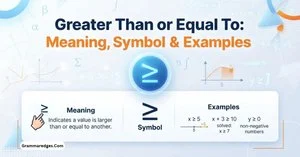
The greater than or equal to sign is ≥. It means that one value is either greater than another value or exactly equal to it. For example, 10 ≥ 10 is true, and 15 ≥ 10 is also true. In plain language, it often means “at least.”
Key Takeaways
- ≥ means greater than or equal to.
- The bottom line means the two values can also be equal.
- x ≥ 10 means x can be 10 or any value greater than 10.
- > excludes equality, while ≥ includes it.
- In many programming languages and Excel formulas, the equivalent text operator is >=.
What Does the Greater Than or Equal to Sign Mean?
The greater than or equal to sign (≥) is a mathematical comparison symbol. It tells you that the value on the left side is larger than or exactly the same as the value on the right side.
For example:
- 8 ≥ 5 → True
- 8 ≥ 8 → True
- 4 ≥ 8 → False
The symbol combines two ideas:
- > = greater than
- = = equal to
When these ideas are combined, ≥ means the first value can be greater than or equal to the second value.
The equality line is important. Without it, the symbol becomes simply >, which means the left value must be strictly greater.
A Simple Variable Example
Consider:
x ≥ 10
This means x can be 10 or any number greater than 10.
Possible values include:
- 10
- 11
- 15
- 25
- 100
But 9, 5, and 0 do not satisfy the inequality.
The easiest phrase to remember is:
x ≥ 10 = x is at least 10.
Greater Than or Equal to Sign Examples
The symbol becomes easier to understand when you see it in different situations.
| Expression | Meaning | Result |
|---|---|---|
| 12 ≥ 8 | 12 is greater than or equal to 8 | True |
| 7 ≥ 7 | 7 equals 7 | True |
| 3 ≥ 9 | 3 is not greater than or equal to 9 | False |
| x ≥ 20 | x is 20 or higher | Depends on x |
| Age ≥ 18 | Age is 18 or older | Depends on age |
Notice that equality counts.
For example:
25 ≥ 25
is true because the two values are equal.
That is the key difference between ≥ and the ordinary greater-than sign.
Greater Than vs. Greater Than or Equal To
The symbols > and ≥ look similar, but they do not have exactly the same meaning.
| Symbol | Meaning | Is equality allowed? | Example |
|---|---|---|---|
| > | Greater than | No | 8 > 5 |
| ≥ | Greater than or equal to | Yes | 8 ≥ 5 |
| < | Less than | No | 5 < 8 |
| ≤ | Less than or equal to | Yes | 5 ≤ 8 |
Compare these two statements:
x > 10
This means x must be more than 10. The value 10 is not included.
x ≥ 10
This means x can be 10 or more. The value 10 is included.
So if a rule says “at least 10,” use ≥, not >.
How to Use ≥ in Inequalities
An inequality compares values that may not be equal. The greater than or equal to sign is especially useful when a condition has a minimum value or lower boundary.
For example:
x ≥ 50
means that x must be 50 or higher.
This includes:
- 50
- 51
- 75
- 100
- 1,000
It does not include 49 or anything below 50.
Mathematics resources commonly associate ≥ with phrases such as “at least,” “no less than,” and “minimum.”
“At Least” Means ≥
One of the most useful language clues is at least.
For example:
You need at least 60 points.
This becomes:
score ≥ 60
The number 60 is included.
Likewise:
The minimum age is 18.
can be represented as:
age ≥ 18
The same idea appears in everyday rules, eligibility requirements, measurements, prices, and performance targets.
Greater Than or Equal To on a Number Line
A number line makes the difference between > and ≥ easy to see.
For:
x ≥ 5
the number 5 is included. On a standard number-line graph, this is shown with a closed or filled circle at 5, with the solution extending toward larger numbers.
For:
x > 5
5 is excluded, so an open circle is used instead.
Therefore:
x ≥ 5 → [5, ∞)
The square bracket indicates that 5 is included.
Solving Inequalities With ≥
You can solve many inequalities in much the same way as equations. However, there is one important rule to remember.
If you multiply or divide both sides by a negative number, reverse the inequality sign.
For example:
-2x ≥ 8
Divide both sides by -2:
x ≤ -4
The symbol changes from ≥ to ≤ because the operation involved division by a negative number. This is a fundamental rule when solving inequalities.
Another example:
x + 4 ≥ 9
Subtract 4 from both sides:
x ≥ 5
So the solution is 5 or any number greater than 5.
How to Type the Greater Than or Equal To Sign
If you need the actual symbol, here it is:
≥
You can simply copy and paste it.
The Unicode character for ≥ is U+2265, and its decimal value is 8805.
Windows
On Windows, the available method depends on the application and keyboard.
In Microsoft Word, one reliable Unicode method is:
- Type 2265.
- Press Alt + X.
- Word converts it to ≥.
You can also use the Windows symbol picker or Character Map. Some Windows keyboard configurations support the traditional numeric keypad Alt-code method as well.
Mac
On a Mac using a U.S. English keyboard layout, a commonly documented shortcut is:
Option + .
You can also open the Mac Character Viewer with Control + Command + Space, search for “greater-than or equal to,” and insert the symbol.
Microsoft Word
Word offers several ways to insert mathematical symbols.
One convenient method is:
2265 + Alt + X → ≥
Inside Word’s equation editor, you can also use mathematical input such as:
\geq
and convert it to the mathematical symbol.
Google Docs
In Google Docs, you can use:
Insert → Special characters
Then search for greater than or equal to.
For mathematical equations, Google’s equation tools can also be used to enter mathematical notation.
HTML
For a webpage, you can represent the character using its HTML entity:
≥You can also use the Unicode character directly:
≥The Unicode code point is:
U+2265Greater Than or Equal To in Programming and Excel
The mathematical symbol ≥ and the programming operator >= represent the same comparison concept, but they are used differently.
In many programming languages, you should use:
>=rather than inserting the single Unicode character ≥ into a comparison expression. For example:
age >= 18means the age is 18 or greater.
Common programming languages such as Python, JavaScript, Java, C, and C++ use >= for this comparison.
Greater Than or Equal To in Excel
Excel also uses >= as its greater-than-or-equal comparison operator.
For example:
=A1>=50checks whether the value in cell A1 is greater than or equal to 50.
Microsoft’s documentation lists >= as the Excel comparison operator for “greater than or equal to.”
You might also see it inside a formula such as:
=IF(A1>=50,"Pass","Fail")Here, Excel checks whether A1 contains 50 or more.
Common Mistakes With the ≥ Symbol
1. Using > When You Mean ≥
If you mean 10 or more, write:
x ≥ 10
Do not write:
x > 10
because that excludes 10.
2. Forgetting That Equality Is Included
Some learners assume ≥ means only “greater than.”
It does not.
7 ≥ 7 is true.
The equal line underneath the symbol tells you that equality is allowed.
3. Confusing ≥ With ≤
These symbols point in opposite directions:
- ≥ = greater than or equal to
- ≤ = less than or equal to
For example:
10 ≥ 5 is true.
5 ≤ 10 is also true.
Both statements describe the same relationship from opposite sides.
4. Confusing ≥ With >=
In mathematical writing, ≥ is the single-symbol form.
In many programming languages and spreadsheet formulas, >= is the keyboard-friendly operator.
They express the same basic comparison, but you should use the format required by the software or language.
5. Reversing the Numbers
Compare:
15 ≥ 10 → True
with:
10 ≥ 15 → False
Always read the comparison from left to right.
Frequently Asked Questions
What is the greater than or equal to sign?
The greater than or equal to sign is ≥. It means that the value on the left is either greater than the value on the right or exactly equal to it. For example, 9 ≥ 9 is true because the values are equal, while 12 ≥ 9 is true because 12 is greater.
What does ≥ mean in math?
≥ means “greater than or equal to.” It allows two possibilities: the value on the left can be greater, or both values can be equal. For example, x ≥ 5 means x can be 5 or any value greater than 5.
Is “at least” the same as greater than or equal to?
Yes. In mathematical inequalities, “at least 20” means 20 or more, which can be written as x ≥ 20. The important point is that the minimum value itself is included.
What is the difference between > and ≥?
> means strictly greater than, so equality is not allowed. ≥ means greater than or equal to, so equality is allowed. Therefore, 5 > 5 is false, while 5 ≥ 5 is true.
Is >= the same as ≥?
In many programming languages, >= is the text-based operator that means the same comparison as ≥. For example, x >= 10 means x is greater than or equal to 10. Excel also uses >= as its comparison operator.
What is the Unicode for ≥?
The Unicode code point for the standard greater-than-or-equal-to character is U+2265. Its decimal value is 8805. You can also copy the character directly: ≥.
How do I type ≥ in Word?
In Microsoft Word, type 2265 and then press Alt + X. Word converts the Unicode code into ≥. You can also insert it through Word’s Symbol or equation tools.
Conclusion
The greater than or equal to sign (≥) is a simple but important mathematical symbol. It tells you that one value is larger than or exactly equal to another value. The easiest way to remember it is “greater than, with equality included.”
For example, x ≥ 10 means x can be 10 or any number above 10. This makes the symbol especially useful for minimums, limits, requirements, and thresholds.
In programming and Excel, the same idea is usually written as >=. If you need the symbol for a document, equation, or webpage, you can copy ≥ directly or use its Unicode code, U+2265.